






















TL;DR:
- eSIM provides a flexible, instant, and cheaper alternative to traditional roaming for World Cup travelers.
- Choosing the right eSIM plan involves balancing data, voice, coverage, and support, especially in crowded venues.
- Pre-activating your eSIM before departure ensures seamless connectivity and cost savings during the tournament.
The 2026 FIFA World Cup is arriving across 16 host cities in the United States, Canada, and Mexico, and with it comes a connectivity challenge that millions of international fans are not prepared for. Traditional roaming fees in the USA can hit $10 or more per day, and that adds up fast over a multi-week tournament. A $50 million investment in eSIM solutions for World Cup travelers signals that the industry knows roaming is broken, and that smarter options are now available. This guide breaks down exactly what those options are, what they cost, and how to set them up before you land.
Table of Contents
- Why eSIM matters for World Cup travelers
- Understanding your eSIM options: Data-only vs all-in-one plans
- Real cost advantages: Forget roaming, choose smarter travel data
- How to set up and get the most from your eSIM at the World Cup
- The truth about eSIM travel during the World Cup: What most guides miss
- Best eSIM picks for the World Cup in the USA
- Frequently asked questions
Key Takeaways
| Point | Details |
|---|---|
| eSIM trumps roaming | Switching to eSIM saves you from expensive roaming charges during the World Cup. |
| Pick the right plan | Consider data, voice, and regional coverage to match your travel and usage needs. |
| Fast, easy setup | Most eSIMs activate in minutes, letting you connect instantly upon arrival. |
| Watch for coverage gaps | Choose flexible, multi-carrier eSIMs for uninterrupted service at crowded venues. |
| Pre-order for peace of mind | Buying your eSIM in advance ensures availability and the best rates for World Cup travel. |
Why eSIM matters for World Cup travelers
An eSIM, or embedded SIM, is a digital SIM card built directly into your phone. Unlike a physical SIM card, it does not require a trip to a carrier store or a plastic card swap. You download a mobile data profile remotely, activate it, and you are connected. For travelers arriving in the USA for the World Cup, that distinction matters a great deal.
The US prepaid SIM market is not built for short-term international visitors. Most prepaid plans require a local address, a US credit card, or a trip to a carrier store during business hours. These are real barriers for someone who lands in New York at midnight before a match the next morning. As the eSIM facts for travelers resource outlines, eSIM removes those barriers entirely.
“US prepaid plans are not optimized for short-term international visitors, making eSIM the practical default for World Cup fans arriving from abroad.”
Key reasons eSIM is the right choice for 2026 World Cup travel:
- No physical SIM needed. Activate your plan from your home country before you board.
- Instant setup. Most eSIM plans activate within minutes via QR code or app.
- Keep your home number. Your original SIM stays active for calls and texts from family.
- Multiple plans on one device. Switch between your home plan and your travel eSIM without swapping anything.
- No contracts. Pay for the duration of your trip and stop when you leave.
The eSIM terms explained guide covers the technical vocabulary in plain language if you want to go deeper. The core point is that eSIM is now the fastest, most flexible way to get data in a foreign country, and the eSIM vs local SIM comparison shows that for trips under 30 days, eSIM wins on convenience almost every time.
UX Connect’s $50 million eSIM initiative in partnership with FIFA and major telecoms is specifically targeting World Cup travelers with cost-effective data and voice plans. That level of investment reflects how significant the demand is and how much the industry has recognized the gap in affordable short-term connectivity for international fans.
Pro Tip: Set up your eSIM before you leave home. Most providers let you install the profile days in advance and simply activate it when you land. This means you have data the moment your plane touches down, without standing in a line or hunting for airport Wi-Fi.

Understanding your eSIM options: Data-only vs all-in-one plans
With the basics of eSIM covered, it is important to choose the right plan for your specific World Cup travel style. Not all eSIM plans are the same, and picking the wrong type can cost you more or leave you without voice access when you need it.
The two main categories are data-only eSIMs and all-in-one eSIMs. Here is how they compare:
| Feature | Data-only (e.g., Nomad, Holafly) | All-in-one (e.g., Visible) |
|---|---|---|
| Mobile data | Yes | Yes |
| Voice calls | No | Yes |
| SMS texting | No | Yes |
| Price per GB | Lower | Higher |
| Best for | Data-heavy users with VoIP apps | Travelers needing full phone service |
| Multi-country | Often available | Limited |
| Speed throttling | Varies by provider | After 2GB/day on Visible |
Data-only plans from providers like Nomad and Holafly are typically cheaper per gigabyte, which makes them attractive for travelers who use WhatsApp, FaceTime, or Google Voice for calls. However, they do not include traditional voice or SMS, which can be a problem if you need to call a hotel, a taxi, or an emergency number using your regular dial pad.
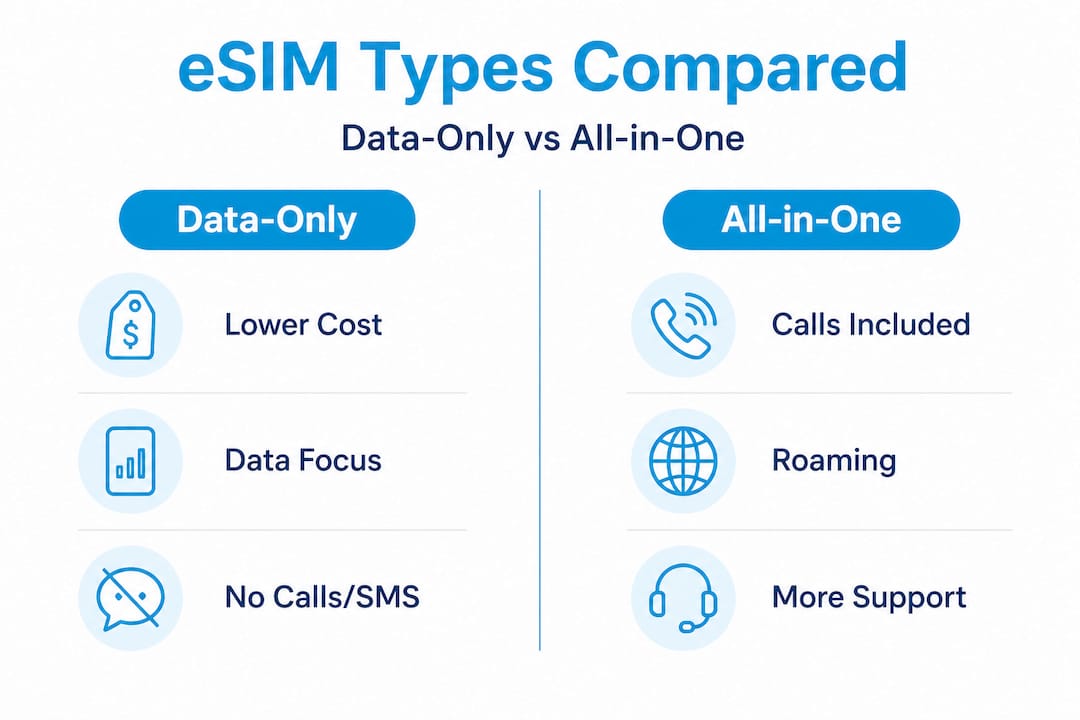
All-in-one plans like Visible’s Travel Pass offer calls, texts, and data in a single package. The tradeoff is that unlimited plans throttle after 2GB/day, meaning your speeds drop significantly after heavy use. For a World Cup fan streaming match highlights, using GPS navigation, and posting on social media, that 2GB ceiling can feel tight.
A few additional factors worth noting when you save money with eSIMs:
- Holafly uses stable multi-carrier networks, which means better coverage in crowded stadiums, but it costs more per day.
- Airalo offers flexible global options and a wide range of countries, but speeds can vary depending on which local network it connects to.
- Nomad prices around $1 per GB for metered data, which is excellent value if you monitor your usage carefully.
The best eSIM types for travel resource breaks down these categories in more detail, including regional plans that cover multiple countries at once.
Real cost advantages: Forget roaming, choose smarter travel data
A close look at the cost factors reveals even more compelling advantages for the eSIM-savvy traveler. Traditional roaming charges from European, Asian, or South American carriers in the USA regularly run between $8 and $15 per day for a basic data package. Over a 30-day World Cup trip, that is $240 to $450 in roaming fees alone, before you factor in voice calls.
Here is how eSIM pricing stacks up against those numbers:
| Plan type | Provider | Duration | Total cost | Cost per day |
|---|---|---|---|---|
| Unlimited (throttled after 2GB/day) | Visible | 30 days | $35 | $1.17 |
| Metered 50GB | Nomad | 30 days | ~$50 | $1.67 |
| Unlimited data-only | Holafly | 30 days | ~$65 | $2.17 |
| Traditional roaming | Home carrier | 30 days | $240 to $450 | $8 to $15 |
The Visible 30-day $35 pre-order is one of the most competitive benchmarks in this space. At roughly $1.17 per day for unlimited high-speed data (up to 2GB at full speed daily), it undercuts roaming by a factor of 7 to 10. Nomad’s 50GB plan works out to approximately $1 per GB, which suits travelers who know their usage patterns and want to avoid paying for data they will not use.
Multi-country eSIM plans add another layer of value. If your World Cup itinerary includes matches in Canada or Mexico, a North America regional eSIM covers all three countries under one plan. Buying separate local SIMs for each country would cost significantly more and require multiple activations.
Steps to maximize your eSIM plan and avoid overspending:
- Estimate your daily data use. Navigation, streaming, and social media together average 1.5 to 3GB per day for most travelers.
- Pre-order before departure. Prices are often lower when you book in advance, and your plan is ready the moment you land.
- Use Wi-Fi at your hotel. Save your mobile data for when you are out at matches or traveling between cities.
- Turn off automatic app updates. Background downloads can drain gigabytes without you noticing.
- Monitor usage in your phone settings. Both iOS and Android show real-time data consumption per app.
Pro Tip: Pre-ordering your eSIM often locks in a promotional rate that disappears closer to the event. Several providers offer early-bird discounts for major sporting events. The travel eSIM savings guide covers timing strategies in detail.
Understanding how eSIM plans work helps you avoid the most common mistake: choosing a plan based only on price without checking the fine print on speed throttling, data caps, and network coverage in specific cities.
How to set up and get the most from your eSIM at the World Cup
You have seen the practical and financial upsides. Now make sure your eSIM experience is smooth from takeoff to touchdown. Setup is straightforward, but there are specific steps that most travelers skip, and those gaps cause problems at the worst possible moments.
Before departure:
- Confirm your phone is eSIM compatible. Check the top eSIM devices list, which covers the latest iPhone, Samsung Galaxy, and Google Pixel models, along with many mid-range Android phones.
- Make sure your device is unlocked. Carrier-locked phones will not accept a foreign eSIM profile.
- Purchase and install your eSIM profile. Most providers send a QR code by email. Scan it in your phone’s SIM settings.
- Set the eSIM as your data line but keep your home SIM active for calls and texts.
- Test the connection at home before you leave.
On arrival in the USA:
- Toggle your eSIM data line on in settings.
- Disable data roaming on your home SIM to prevent accidental charges.
- Confirm you are connected to a supported local network (AT&T, T-Mobile, or Verizon depending on your provider).
During your trip:
- Check your data balance every few days, especially before match days when usage spikes.
- If speeds drop significantly, toggle airplane mode on and off to force a network reconnect.
- Use the provider’s app or support chat for quick troubleshooting. Most major eSIM providers offer 24/7 support.
Data-only eSIMs allow faster setup online before arrival, and certain plans allow QR code activation for seamless airport connectivity without needing to find a store or kiosk. The eSIM activation steps guide walks through each screen in detail for both iOS and Android.
One thing most travelers overlook: airport eSIM kiosks and carrier stores at US airports often charge premium prices compared to online pre-orders. Buying your plan in advance from a reputable provider is almost always cheaper and faster. The eSIM global guide covers country-specific activation rules that apply in the USA.
The truth about eSIM travel during the World Cup: What most guides miss
Most articles on this topic focus on price comparisons and stop there. That is useful, but it misses the more important variable: reliability under pressure. During a World Cup match at a 70,000-seat stadium, every fan around you is on their phone at the same time. Networks get congested. Single-carrier eSIMs that rely on one local network can drop to unusable speeds or lose signal entirely in those conditions.
Multi-carrier solutions like Holafly cost more per day, but they switch automatically between available networks when one gets congested. That flexibility is genuinely valuable when you are trying to send a photo, check your ride-share app, or contact your travel group after a match. The cheapest plan is not always the smartest plan.
There is also the support factor. Budget eSIM providers sometimes offer limited customer service, which is fine when everything works. When something goes wrong at 11pm before a match day, you want a provider with responsive support and clear troubleshooting options. Spending an extra $10 to $15 on a plan from a well-established provider can save hours of frustration.
Choosing eSIM over local SIM is already the right call for most World Cup visitors. But within the eSIM category, the choice between budget and mid-tier plans deserves more thought than most guides give it. Flexible data allowances, multi-carrier coverage, and solid support are worth paying for during a high-stakes, high-crowd event like the World Cup.
Best eSIM picks for the World Cup in the USA
Ready to choose a plan? EsimGlobe offers a curated selection of eSIM options specifically designed for travelers heading to the USA and across North America.
For fans staying entirely within the United States, the USA travel eSIM options page lists current plans with pricing, data allowances, and coverage details across all 16 host cities. For travelers whose itinerary spans the USA, Canada, and Mexico, the North America eSIM packages page covers regional plans that keep you connected across borders without switching providers. Plans are available in USD, EUR, and GBP, with instant QR code delivery and multilingual support. Pre-order early for the best available rates before the tournament begins.
Frequently asked questions
Can I use my eSIM in multiple US cities during the World Cup?
Yes, most eSIM plans cover all major US cities, making it easy to stay connected as you travel between matches. Multi-carrier plans like Holafly provide especially stable coverage across different regions.
How do I activate my eSIM after arriving in the USA?
eSIMs can typically be activated via QR code or app download. Certain plans allow QR code activation before arrival, so you have data the moment you land without any additional steps at the airport.
Is an eSIM cheaper than buying a local SIM card or using roaming?
For most World Cup visitors, eSIM plans are far less expensive than roaming. The Visible 30-day plan at $35 works out to about $1.17 per day, compared to $8 to $15 per day for typical international roaming in the USA.
Which devices are compatible with eSIM in 2026?
Most current smartphones support eSIM, including the latest iPhone, Samsung Galaxy, and Google Pixel models. Check your device settings under SIM or Mobile Data to confirm eSIM support before purchasing a plan.
Can my eSIM cover Canada or Mexico if I travel beyond the USA during the tournament?
Several multi-country eSIMs cover North America, allowing seamless connectivity in the USA, Canada, and Mexico under a single plan, which is significantly more cost-effective than buying separate plans for each country.