






















Most travelers assume avoiding roaming charges means hunting down a local SIM card at every airport. That assumption costs time, money, and often results in a dead phone at baggage claim. eSIMs for global travelers provide data-only prepaid plans via digital SIM profiles, activated remotely to avoid physical SIM swaps and high roaming fees. This guide covers the core terms, plan types, pricing benchmarks, activation pitfalls, and practical strategies every international traveler needs before purchasing an eSIM plan.
Table of Contents
- What are eSIMs and how do they work for international travel?
- Types of eSIM plans: country, regional, and global
- Pricing benchmarks and cost-saving strategies
- eSIM activation terms, limitations, and traveler pitfalls
- The traveler’s reality: what most guides miss about eSIM terms
- Explore the best eSIM options for your next global journey
- Frequently asked questions
Key Takeaways
| Point | Details |
|---|---|
| Digital flexibility | eSIMs allow you to activate multiple mobile data plans instantly without swapping SIM cards. |
| Coverage options | Choose between country-specific, regional, or global eSIMs depending on your travel route and needs. |
| Cost savings | eSIMs offer prepaid data plans that eliminate roaming charges and provide transparent pricing. |
| Device and terms | Ensure your device is unlocked, check refund policies, and understand usage limits before buying. |
| Avoid common pitfalls | Check compatibility, activate close to travel dates, and select plans with coverage for all your destinations. |
What are eSIMs and how do they work for international travel?
An eSIM is a digital SIM profile embedded directly into your device. No physical card. No tray-popping tool. No waiting in a carrier store line after a 10-hour flight. The profile is downloaded remotely, either by scanning a QR code or through a provider app, and your device connects to a local network within minutes.
For international travelers, this changes everything about how you manage mobile connectivity. You can purchase a plan before you leave home, activate it the moment you land, and switch between profiles without touching your phone’s hardware. Data-only prepaid plans are the standard format, though some providers now offer voice and SMS add-ons depending on the destination.
Here is what makes eSIMs practical for frequent travelers:
- Remote activation: Download and install your plan from anywhere with Wi-Fi
- Multiple profiles: Store several eSIM profiles on one device and switch between them
- No SIM damage risk: No physical card to lose, bend, or drop in a taxi
- Instant plan changes: Switch plans mid-trip if your data needs change
- Cost control: Pay only for what you need, with no surprise roaming bills
Compatibility is the first thing to verify. Not every device supports eSIM, and not every eSIM-compatible device works with every provider. The Apple eSIM guide lists supported iPhone models and activation steps, but Android compatibility varies widely by manufacturer and region. You can browse global eSIM options across 130-plus areas to check plan availability for your specific destination.
One frequently overlooked issue is regional device restrictions. For example, China eSIM compatibility requires specific carrier partnerships that not all providers support, so checking before purchase saves frustration.
Pro Tip: Always confirm your device is both unlocked and eSIM-compatible before buying any plan. A locked device will reject foreign eSIM profiles entirely.
Types of eSIM plans: country, regional, and global
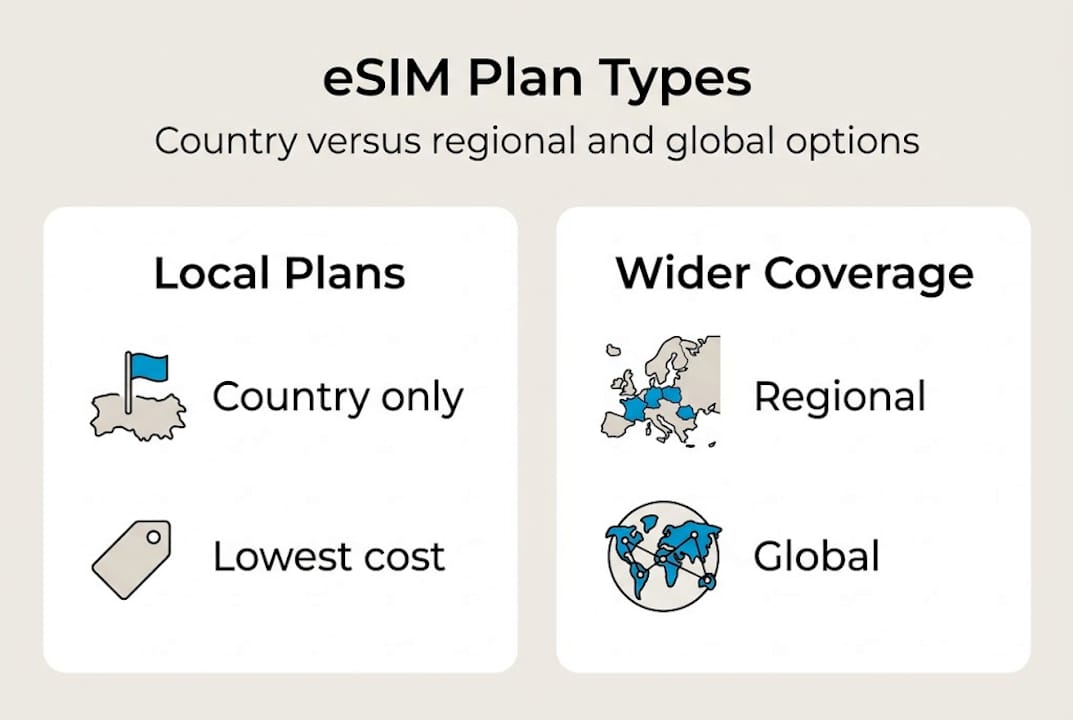
Not all eSIM plans are built the same. The three main categories are country-specific, regional, and global, and each serves a different type of traveler.
Country-specific plans cover a single nation. They tend to offer the best local speeds and lowest per-GB cost for travelers visiting one destination. If you are spending two weeks in Japan and going nowhere else, a country plan is the right call.

Regional plans cover a defined group of countries, typically organized by geography. A Europe plan, for example, might include 35 to 42 countries depending on the provider. Plans are country-specific, regional, or global, with validity ending at data exhaustion or expiry windows ranging from 7 to 90 days. Regional plans are the sweet spot for multi-country trips.
Global plans cover 113 to 200-plus countries and are designed for travelers who move across multiple regions. Coverage is broad, but per-GB costs are usually higher than regional options.
Here is a side-by-side comparison to help you decide:
| Plan type | Coverage | Typical validity | Cost range | Best for |
|---|---|---|---|---|
| Country | 1 nation | 7 to 30 days | Lowest per GB | Single-destination trips |
| Regional | 35 to 43 countries | 15 to 30 days | Mid-range | Multi-country regional travel |
| Global | 113 to 200+ countries | 30 to 90 days | Highest per GB | Frequent multi-region travelers |
For travelers crossing borders frequently in Europe, an Europe regional eSIM covering 43 countries offers strong value. For broader coverage, a global coverage eSIM handles most destinations in one plan. You can also review European travel eSIMs for current provider comparisons.
Pro Tip: If your trip involves crossing two or more borders, a regional plan almost always beats buying separate country plans. The per-GB rate is slightly higher, but you avoid the hassle of managing multiple activations.
Pricing benchmarks and cost-saving strategies
eSIM pricing has become more competitive in 2026, but the range is still wide enough that choosing the wrong plan can double your connectivity costs.
Fixed data plans typically start at $3.50 to $5 per GB. Unlimited plans run $27 to $60 per month, but most include a daily high-speed cap before throttling speeds down significantly. Knowing this cap matters if you stream video or use navigation apps heavily.
Here is a sample pricing table for popular destinations:
| Destination | Plan type | Data | Approximate cost |
|---|---|---|---|
| Europe (43 countries) | Regional | 10 GB / 30 days | $18 to $25 |
| Southeast Asia | Regional | 5 GB / 15 days | $12 to $18 |
| United States | Country | 10 GB / 30 days | $15 to $22 |
| Global (120+ areas) | Global | 10 GB / 30 days | $25 to $40 |
| Japan | Country | 5 GB / 15 days | $10 to $14 |
To get the most value from your plan, follow these strategies:
- Match data to usage: Light users (maps, messaging) need 1 to 3 GB per week. Heavy users (streaming, video calls) need 5 GB or more.
- Buy regional over country for multi-stop trips: The marginal cost difference is smaller than buying two separate plans.
- Activate just before departure: Most plans start counting validity from activation, not purchase.
- Avoid topping up at airport kiosks: Kiosk rates are typically 30 to 50 percent higher than purchasing online in advance.
- Check global plan price examples: Comparing plans before purchase takes under five minutes and can save $15 or more per trip.
You can also review Europe pricing trends for current regional benchmarks.
Pro Tip: Activate your eSIM the day before travel, not weeks in advance. Validity periods begin at activation, and early activation wastes paid days.
eSIM activation terms, limitations, and traveler pitfalls
The fine print on eSIM plans matters more than most travelers realize. Understanding key terms before purchase prevents expensive surprises.
eSIM plans are prepaid and non-refundable after activation. The EU provides a 14-day withdrawal window for unactivated plans, but once you scan that QR code, the plan is considered used. Faults or technical failures may qualify for refunds, but standard dissatisfaction does not.
Here are the most common traveler mistakes to avoid:
- Buying before checking device compatibility: A plan purchased for a carrier-locked phone is money lost
- Activating too early: Validity starts at activation, not at travel date
- Skipping APN settings: Some destinations require manual APN configuration for data to work
- Assuming global means everywhere: Some remote regions and sanctioned countries are excluded from global plans
- Ignoring tethering restrictions: Most plans prohibit using your eSIM as a hotspot for other devices
“Service may be suspended for misuse or abuse, including tethering and machine-to-machine applications. Plans are provided as-is, with no guarantee of uninterrupted service in all regions.” Revolut Legal: eSIMs 1Global
Device locking is the single biggest technical barrier. Carrier-locked devices block foreign eSIMs, and iPhone 14 and later US models, while eSIM-only, can access 400-plus carriers when unlocked. Check China-specific eSIM terms before traveling to mainland China, as network restrictions apply. For a full breakdown of locking issues, review device locking pitfalls.
Pro Tip: Before leaving home, test your eSIM on Wi-Fi and verify APN settings are correct. Troubleshooting abroad without local data access is significantly harder.
The traveler’s reality: what most guides miss about eSIM terms
Most eSIM guides focus on the upside. Instant activation. No SIM swaps. Cost savings. All of that is accurate. What gets less attention is the gap between advertised flexibility and real-world performance.
Carrier-locked devices block foreign eSIMs, and activation requires Wi-Fi along with correct APN settings. Rural handover failures are more common than providers acknowledge. A plan that works perfectly in a city center may drop to unusable speeds in a rural area or near a border crossing.
The smarter approach is to treat your eSIM as your primary connection and keep a physical SIM as a backup for critical moments. Read the terms for your specific plan, not just the marketing page. Check eSIM plan selection lessons to compare coverage maps before committing.
Activation timing is another underappreciated factor. Activating three weeks before departure wastes paid validity. Activating at the airport without Wi-Fi access is a common failure point. The right window is one to two days before departure, on a stable Wi-Fi connection, with APN settings confirmed.
Pro Tip: Research device and country compatibility for your specific device model and destination, not just the general plan description. Compatibility varies more than most providers clearly communicate.
Explore the best eSIM options for your next global journey
Armed with practical knowledge, it’s time to find the right eSIM for your destination.
EsimGlobe offers a straightforward way to compare and purchase eSIM plans across global, regional, and country-specific options. Whether you need a global eSIM for travel covering 120-plus areas or targeted Europe eSIM deals for a regional trip, the platform lets you filter by destination, data size, and validity period. Currency options in USD, EUR, and GBP make pricing transparent regardless of where you are purchasing from. See all eSIM plans to find the option that fits your next trip’s specific destinations and data needs.
Frequently asked questions
Can I use an eSIM plan if my phone is locked to a carrier?
Carrier-locked devices block foreign eSIMs in most cases, though some models may accept a secondary eSIM profile as a roaming partner depending on the carrier agreement.
Do eSIM plans offer refunds if unused or faulty?
Plans are non-refundable post-activation, but unactivated plans and verified technical faults may qualify for refunds; EU consumers have a 14-day withdrawal right before activation.
Can I tether or use my eSIM for machine-to-machine applications?
Most providers prohibit tethering and M2M use, and accounts found in violation can be suspended without refund.
How do I activate an eSIM for international travel?
Install via QR code or app on an unlocked, eSIM-compatible device using a Wi-Fi connection; activation is typically instant once the profile downloads.
Can I use the same eSIM plan in multiple countries during my trip?
Regional and global plans cover multiple countries, while country-specific plans are restricted to their designated nation only.
Recommended
- Buy Global (130+ areas) eSIM for travel - Global139 1GB 7Days – Esimglobe
- Buy Global (120+ areas) eSIM for travel - Global (120+ areas) 1GB 7Days – Esimglobe
- Buy Caribbean 20+ eSIM for travel - Caribbean (20+ areas) 1GB 7Days – Esimglobe
- Buy Europe (40+ areas) eSIM for travel - Europe 1GB 7Days – Esimglobe