






















TL;DR:
- eSIMs offer quick pre-travel setup and eliminate the need for physical SIM swaps.
- For trips up to four weeks and multiple countries, eSIMs are generally more convenient and cost-effective.
- Local SIMs are more economical for longer stays in a single country but require in-person purchase and registration.
Grabbing a local SIM at the airport has long been the default move for budget-conscious travelers. But that habit is quietly becoming outdated. eSIM technology, now built into most phones released since 2018, lets you activate a data plan before you even board your flight. The gap between eSIM and local SIM costs has narrowed significantly, and for many trip profiles, the convenience math tips decisively toward eSIM. This guide compares both options across cost, coverage, compatibility, and real-world use cases so you can make the right call for your next trip.
Table of Contents
- How eSIMs and local SIM cards work: The basics explained
- Cost breakdown: eSIM vs local SIM for travelers
- Coverage and compatibility: Where each option works best
- Which is best for you? Use cases and decision framework
- Our take: The real-world eSIM vs local SIM decision
- Stay connected anywhere: Choose your best eSIM
- Frequently asked questions
Key Takeaways
| Point | Details |
|---|---|
| Convenience advantage | eSIMs can be activated instantly before travel, eliminating airport lines and local registration hassles. |
| Cost varies by trip | eSIMs are often best for short and multi-country trips, while local SIMs remain cheaper for long single-country stays. |
| Full compatibility matters | eSIMs require a recent phone, but local SIMs work with any unlocked device. |
| Best for flexibility | Combining eSIM and local SIM can let you balance cost, convenience, and local functionality. |
How eSIMs and local SIM cards work: The basics explained
Understanding the difference starts with how each option is acquired and installed.
A local SIM card is a small physical chip you insert into your phone’s SIM tray. You buy it from a carrier store, airport kiosk, or convenience shop after arriving in a country. Most destinations require passport registration at the point of sale. You swap out your home SIM, configure the APN (Access Point Name, the network setting that connects your phone to mobile data), and you’re online. Simple enough, but it takes time and requires you to be physically present.
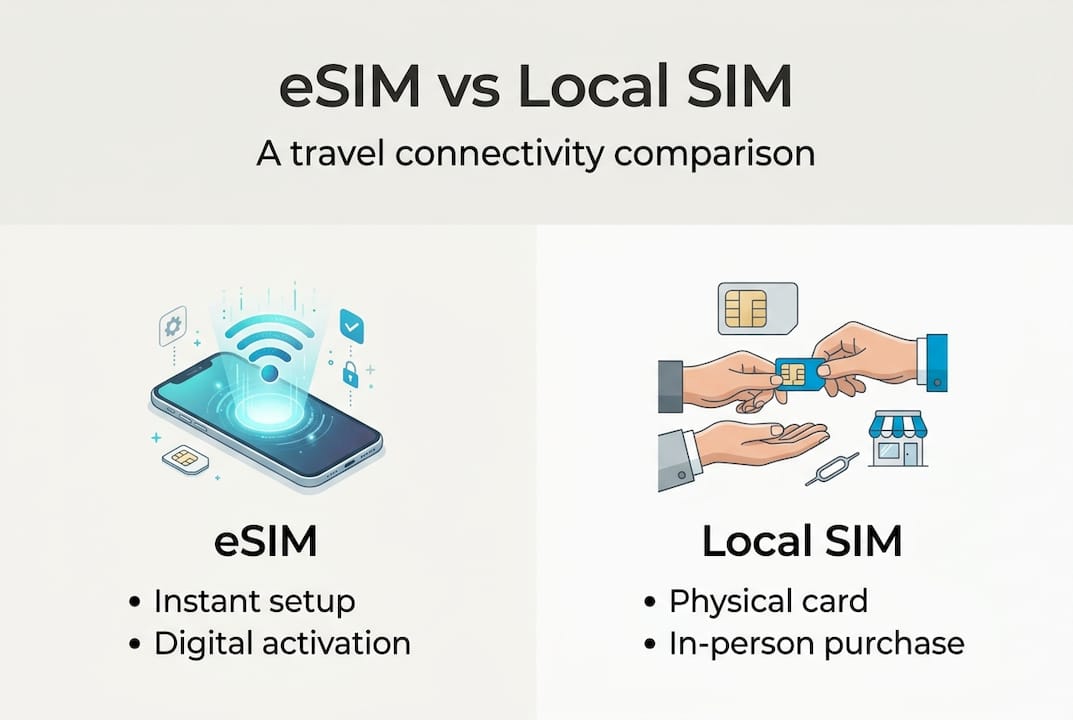
An eSIM (embedded SIM) is a digital SIM profile stored directly on your phone’s hardware. There is no physical card. You purchase a plan online, receive a QR code or app link, and scan it to install the profile. eSIMs activate digitally via QR code or app pre-travel, allowing instant connectivity on arrival without a physical swap, while local SIMs require in-person purchase, passport registration, and SIM tray access post-arrival. You can install an eSIM days before departure and have data the moment your plane lands.
Key differences at a glance:
- Acquisition: eSIM purchased online anytime; local SIM purchased in-country at a store or kiosk
- Installation: eSIM via QR code or app; local SIM requires physical swap and tray access
- Pre-travel setup: eSIM fully configurable before departure; local SIM requires arrival first
- Device requirement: eSIM needs a compatible phone (2018 or later); local SIM works on any unlocked phone
- Multiple profiles: eSIM supports several stored profiles; local SIM is one card at a time
For short trips or multi-country itineraries, the ability to set everything up from your couch before you fly is a significant practical edge. You can read more about eSIM terms explained if the terminology is new to you.
One more setup worth knowing: dual SIM. Many modern phones support both a physical SIM slot and an eSIM simultaneously. This lets you keep your home number active for calls and texts while running a travel eSIM for data. Check the global eSIM activation guide for step-by-step setup instructions.
Pro Tip: Before your trip, confirm your phone is carrier-unlocked. A locked phone will not accept a foreign local SIM or, in some cases, a third-party eSIM profile.
Cost breakdown: eSIM vs local SIM for travelers
Once you know how the technology works, it’s time to compare the most important numbers: how much you’ll actually spend depending on your destination and habits.

Raw per-GB pricing varies widely by region. eSIMs typically cost $1.50 to $6 per GB, averaging around $5.50/GB, while local SIMs are often cheaper at $0.50 to $3/GB in markets like Southeast Asia. Thailand, for example, offers local SIM deals around $10 to $15 for 15GB. But raw GB cost is only part of the picture.
| Factor | eSIM | Local SIM |
|---|---|---|
| Avg. cost per GB | $1.50 to $6 | $0.50 to $3 |
| Setup time | Minutes (pre-travel) | 30 to 90 min (in-country) |
| Multi-country coverage | Regional plans available | New SIM per country |
| Roaming vs. eSIM savings | Saves 35%+ vs. roaming | N/A (local rates apply) |
| Hidden costs | None | Transport, time, possible overpaying |
For a 10-day Europe trip, eSIM costs run $15 to $40 versus $20 to $50 for a local SIM, and eSIM saves roughly 35% compared to standard carrier roaming charges that can reach $100 to $600 or more. For multi-country trips, eSIM regional plans are clearly superior. For a single-country stay of a month or longer, local SIMs win on per-GB cost.
Hidden costs matter more than most travelers realize. Finding a carrier store can mean a taxi ride, a language barrier, a queue, and 30 to 90 minutes of your travel day. If your time is worth $25 to $50 per hour, that erases the per-GB savings of a local SIM on shorter trips. eSIM eliminates all of that friction.
For destination-specific pricing, check best eSIM deals by country to compare current rates before you book.
Coverage and compatibility: Where each option works best
Beyond cost, another key decision factor is whether your device and destination will fully support your choice.
Device compatibility is the first filter. eSIM requires a compatible phone from 2018 or later; local SIM works on any unlocked phone. Devices with confirmed eSIM support include the iPhone XS and newer, Samsung Galaxy S20 and newer, Google Pixel 3 and newer, and most recent models from Motorola, OnePlus, and Huawei. If you’re using an older or budget Android device, local SIM is your only option.
For compatible eSIM devices, a full list with model-specific notes is available to check before you purchase.
Coverage by region also differs. Local SIMs connect to the dominant national carrier in that country, often giving you the strongest possible local signal. eSIM providers partner with local networks through roaming agreements, which means coverage is usually comparable but occasionally slightly weaker in rural or remote areas.
Comparison by use case:
| Scenario | eSIM | Local SIM |
|---|---|---|
| Multi-country Europe trip | Excellent (regional plans) | Requires multiple SIMs |
| Rural Southeast Asia | Good (network dependent) | Often stronger locally |
| Business travel, 1 week | Ideal (fast setup) | Workable but slower |
| Long stay, 1+ month | Higher per-GB cost | More cost-effective |
| Local calls and SMS | VoIP only (WhatsApp, etc.) | Full local number |
Calls and SMS are a real distinction. eSIMs are data-only; for voice calls, you use VoIP apps like WhatsApp or Google Voice. Local SIMs provide a local phone number, which is essential in some countries for ride-hailing apps, two-factor authentication, and local banking. If your destination requires a local number for key services, a local SIM or the hybrid approach is necessary.
Dual SIM setups solve this neatly. Your home SIM handles your number; your eSIM handles data. Most flagship phones from 2020 onward support this configuration.
Pro Tip: Always verify which network bands your eSIM provider uses in your destination country. Band mismatch is rare but can result in slower speeds or limited coverage in specific regions.
Which is best for you? Use cases and decision framework
With features, coverage, and costs in mind, let’s make the decision real by applying these facts to common travel situations.
“For short trips, multi-country itineraries, and digital nomads: eSIM wins on convenience. For long single-country stays: local SIM is more cost-effective. The hybrid approach is best for many travelers.” eSIM, SIM card, WiFi travel guide
Here is a numbered framework to guide your decision:
- Check device compatibility first. If your phone does not support eSIM, the decision is made for you. Use a local SIM.
- Define your trip length. Under 4 weeks: eSIM is likely the better overall value. Over 4 weeks in one country: local SIM saves money.
- Count your destinations. One country: either works. Two or more countries: eSIM regional plans are almost always the smarter pick.
- Assess your call needs. Need a local number for banking or ride-hailing? Plan for a local SIM or a hybrid setup.
- Calculate your time budget. If finding a carrier store costs you 90 minutes of a 7-day trip, that is 1% of your entire trip spent on logistics.
- Decide on hybrid or single option. Dual SIM devices let you run both simultaneously, which removes the either/or pressure entirely.
For a 1-week Europe trip, eSIM is the clear choice. Regional plans cover multiple countries, setup takes minutes, and the cost difference versus a local SIM is minimal. For a 2-month stay in Thailand, a local SIM at $10 to $15 for 15GB beats eSIM per-GB rates by a meaningful margin. For a digital nomad moving between 5 countries in 3 months, a global or regional eSIM plan removes the monthly SIM-hunting ritual entirely.
For step-by-step setup, the eSIM activation steps guide walks you through the full process. For broader plan options, global eSIM solutions covers 120+ countries.
Our take: The real-world eSIM vs local SIM decision
Focusing only on raw per-GB cost is the most common mistake travelers make when choosing between eSIM and local SIM. The cheapest GB rate means nothing if you spend 90 minutes of your first travel day tracking down a carrier store, navigating a language barrier, and waiting in line.
Cost-effectiveness depends on trip length and destinations: eSIM is unbeatable for 1 to 4 week multi-hop trips; local SIM wins for a month or longer in one location like Thailand. But once you factor in time cost, the balance tips toward eSIM for most modern travel patterns.
Hardware trends are also shifting the equation. Dual SIM phones are now standard across most mid-range and flagship devices. That means the hybrid approach, keeping your home SIM for your number and adding an eSIM for data, is accessible to most travelers without any extra hardware.
For first-time eSIM users: check eSIM flexibility insights to understand your options, verify your device supports eSIM, and install your profile before you fly. Arriving with data already active is a material improvement to any trip start.
Stay connected anywhere: Choose your best eSIM
Ready to put your research into action and skip SIM card stress on your next trip?
EsimGlobe offers instant-activation eSIM plans covering 120+ countries, with options ranging from country-specific plans to regional and global packages. Whether you need a US travel eSIM for a domestic trip or a global eSIM plan for a multi-country itinerary, setup takes minutes via QR code or app. Plans are available in USD, EUR, and GBP, with no physical SIM required. Digital nomads and short-trip travelers can compare options by destination, data volume, and duration to find the right fit without overpaying.
Frequently asked questions
Do I need a new phone to use an eSIM?
You need a device from 2018 or later with eSIM support; local SIMs work on any unlocked phone regardless of age or model.
Can I use both my home SIM and an eSIM at the same time?
Yes, most modern phones support dual-SIM operation, letting your home SIM handle calls and texts while your eSIM manages data.
Is it safer to buy a SIM at the airport or online before my trip?
Buying an eSIM online before departure is more reliable; eSIMs activate digitally via QR code pre-travel, so you have data the moment you land.
Which is cheaper for a month in one country: eSIM or local SIM?
For stays of a month or longer in a single country, local SIM is cheaper per GB in most markets.
Can I use an eSIM for local calls and banking?
eSIMs are primarily data-only; if a local number is required for ride-hailing or banking, a local SIM or hybrid setup is the better option.