






















TL;DR:
- eSIMs are digital profiles loaded onto compatible devices, eliminating the need for physical SIM swaps.
- Setting up an eSIM involves purchasing online, downloading a profile over Wi-Fi, and activating it before travel.
- They are ideal for multi-country trips, but travelers should verify coverage, device unlocking, and regional restrictions.
Roaming fees have a reputation for turning a straightforward trip into a billing nightmare. You land in a new country, your phone latches onto a foreign carrier, and suddenly each megabyte costs more than your coffee. eSIM data plans (digital SIM profiles loaded directly onto your device) offer a practical alternative that many travelers have not yet tapped into. This guide breaks down exactly what eSIM data plans are, how they work step by step, how they compare to local SIM cards, and what hidden pitfalls to watch out for so you can stay connected abroad without overpaying.
Table of Contents
- What are eSIM data plans?
- How eSIM data plans work for global travelers
- Comparing eSIM vs. local SIM: Which should you choose?
- Hidden pitfalls and practical tips for eSIM data plans
- A traveler’s perspective: What most guides miss about eSIM data plans
- Get started with eSIM data plans for your next trip
- Frequently asked questions
Key Takeaways
| Point | Details |
|---|---|
| eSIM eliminates roaming fees | With eSIM, you activate local or regional plans and pay local rates while traveling abroad. |
| Easy activation process | eSIM profiles are downloaded and activated easily on compatible devices using Wi-Fi. |
| Know the pitfalls | Be aware of device compatibility, coverage, throttling, and region-specific restrictions to avoid surprises. |
| eSIM vs local SIM | eSIMs provide flexibility, but local SIMs may offer better rural coverage depending on location. |
| Wide plan options | Global and regional eSIM data plans are available to suit every travel itinerary. |
What are eSIM data plans?
An eSIM, short for embedded SIM, is a small chip already built into your phone or tablet. Instead of inserting a plastic card, you download a digital SIM profile over the internet. That profile connects your device to a carrier network, just like a physical SIM would, but without any hardware swap.
eSIM data plans are digital SIM profiles downloaded to compatible devices, letting you activate local or regional data plans without physical cards. For travelers, this means connecting to partner networks at local rates rather than paying your home carrier’s roaming markup.
Here is a quick look at how eSIM data plans differ from traditional physical SIMs:
- Physical SIM: A removable card you insert into your device. You buy it in a store, at an airport kiosk, or from a carrier. Swapping carriers means physically swapping cards.
- eSIM profile: A digital file downloaded remotely. No store visit required. You can hold multiple profiles on one device and switch between them in settings.
- Activation: Physical SIMs activate on insertion. eSIM profiles activate when you turn the plan on, often through a QR code scan or a direct app download.
- Flexibility: eSIMs let you keep your home number active on one profile while running a local data plan on another simultaneously.
Compatible devices include recent iPhone models (iPhone XS and later), Google Pixel phones, many Samsung Galaxy models, and a growing list of Android flagships. Laptops and smartwatches are also increasingly eSIM-enabled.
For travelers, eSIMs solve a real problem: you no longer need to find a carrier shop the moment you land, fumble with a SIM ejector tool, or risk losing your home SIM in transit.
Beyond convenience, the core benefit is cost. Roaming fees from home carriers can run several dollars per megabyte in some regions. An eSIM data plan purchased before departure typically delivers local or regional rates, cutting data costs dramatically. Make sure to review essential eSIM facts before your next trip so you know exactly what to expect from your plan.
How eSIM data plans work for global travelers
Setting up an eSIM data plan involves a few clear steps. Understanding each one prevents the most common first-timer mistakes.
Step-by-step setup process:
- Confirm device compatibility. Not every phone supports eSIM. Check your model’s spec sheet or dial *#06# to see if an EID (eSIM identifier) number appears. Also confirm your device is unlocked. Carrier-locked phones may not accept third-party eSIM profiles.
- Purchase your plan before you travel. Most eSIM providers let you buy online, which keeps your options open without time pressure at the airport.
- Download the eSIM profile over Wi-Fi. This is critical. You need an active internet connection, either at home, at a hotel, or at a café, to scan the QR code or download the profile through an app. Mobile data from your home carrier will not work for this step if you are already abroad.
- Install and enable the profile. Go to your device’s cellular or mobile data settings, select the new eSIM profile, and set it as your active data line.
- Activate on first use. The plan’s validity period starts when you first use data, not when you purchase it. This gives you flexibility to buy in advance.
According to device-level notes, iPhone 14 US models are eSIM-only with no physical SIM tray at all, making eSIM the only option for those users. Plans start on first use, not purchase, and activation always requires Wi-Fi.
Pro Tip: Download and install your eSIM profile at home before departure. Airport Wi-Fi is often slow or requires a login page that can interrupt the download process.
For everyday use, eSIMs handle multiple profile scenarios well. Digital nomads often keep a regional plan active for a month-long stay, then switch to a different regional plan for the next destination, all from the settings menu. Refer to EsimGlobe’s eSIM activation guide for device-specific instructions, and check the list of top eSIM devices to confirm your hardware qualifies.

Comparing eSIM vs. local SIM: Which should you choose?
Both options beat roaming, but they serve different travel styles. Here is a direct comparison.
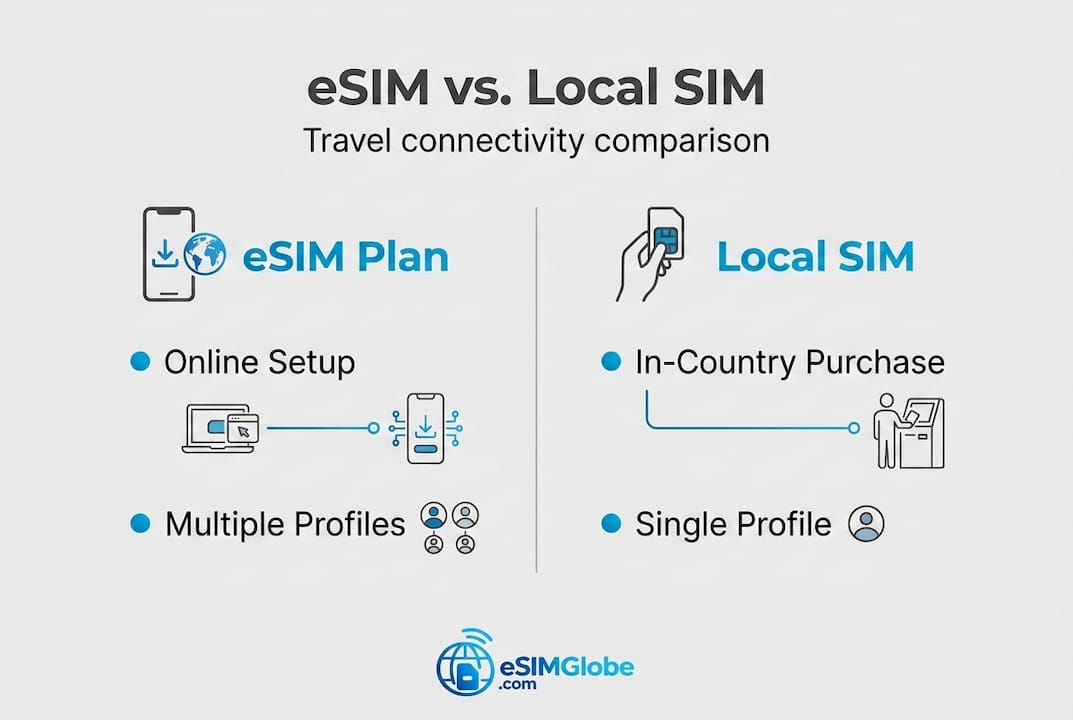
| Factor | eSIM data plan | Local SIM card |
|---|---|---|
| Setup location | Online, before you travel | In-country carrier shop or kiosk |
| Device change required | No | Physical swap needed |
| Activation speed | Minutes (via QR code) | 15-60 minutes in-store |
| Pricing | Competitive regional rates | Often cheapest local rates |
| Coverage | Partner network dependent | Direct carrier coverage |
| Multiple destinations | One plan can cover regions | New SIM per country |
| Home number access | Yes (dual profile) | Home number goes offline |
eSIM data plans can remove roaming fees and provide local rates through downloadable profiles, but they may face coverage and throttling limitations depending on the region and carrier partnerships.
When an eSIM makes more sense:
- You are visiting multiple countries in one trip.
- You need to keep your home phone number reachable.
- You want to set everything up before departure.
- Your destination lacks easily accessible carrier shops.
When a local SIM might be better:
- You are staying in one country for weeks or months.
- Local SIM pricing is significantly lower than eSIM options.
- Your device is not eSIM-compatible.
One important edge case: in the UAE, VoIP services like WhatsApp calls and Skype are restricted by regulation. This affects both local SIMs and eSIMs equally, but some travelers assume an eSIM bypasses these rules. It does not. Review the eSIM vs local SIM breakdown for a deeper analysis, and also check best SIM cards abroad if you want a side-by-side cost comparison for specific destinations.
Hidden pitfalls and practical tips for eSIM data plans
eSIM data plans work well for most travelers, but several edge cases can derail the experience if you are not prepared.
| Pitfall | Details |
|---|---|
| Device lock | Carrier-locked phones reject third-party eSIM profiles |
| Wi-Fi required | Profile download needs internet; unavailable mid-flight |
| Start date confusion | Plans begin on first data use, not purchase date |
| No rollover | Unused data expires at plan end; no carry-forward |
| Throttling | Speed drops sharply after hitting your data cap |
| Rural coverage | Partner networks may not reach remote areas |
| VoIP blocks | UAE and a few other countries restrict voice-over-IP apps |
All of these edge cases apply regardless of which eSIM provider you use. The device lock and Wi-Fi dependency are the two that catch travelers most off guard.
Key actions to avoid problems:
- Check your phone’s unlock status before purchasing any plan.
- Download the eSIM profile at home or a reliable Wi-Fi location.
- Match plan size to your actual data habits. Streaming video eats gigabytes fast.
- Check whether your destination has known VoIP restrictions.
- Note the plan’s expiry date, not just the data cap.
Pro Tip: Buy slightly more data than you think you need. Throttled speeds after hitting your limit can make even basic tasks like loading maps nearly unusable.
Coverage in rural areas is a real concern. eSIM plans route through partner carrier agreements, and those partners do not always cover mountainous or remote zones the way a dominant local carrier would. If your trip involves off-the-beaten-path destinations, cross-check coverage maps before purchase. Learn more about eSIM terms explained to understand contract language around throttling and limits. The global eSIM connectivity guide also lists known regional restrictions worth reviewing.
A traveler’s perspective: What most guides miss about eSIM data plans
Most eSIM guides cover the setup steps well. They rarely address the mental model shift required to use eSIMs confidently.
Travelers treat an eSIM plan like a product they buy and forget. It is better treated as a tool with specific operating conditions. A hammer works everywhere; an eSIM plan works within a network partnership map that you need to verify for your specific route. The difference between a great experience and a frustrating one often comes down to ten minutes of pre-trip research.
Regulatory quirks also get glossed over. The UAE VoIP situation is the famous example, but it is not the only one. Some countries throttle eSIM traffic more aggressively than local SIM traffic due to how partner agreements are structured. This is not disclosed prominently on most provider pages.
The smartest approach: treat your eSIM plan as one layer of a travel connectivity stack. Pair it with offline maps downloaded before departure and a VoIP-independent messaging app for backup. Review the global eSIM guide to understand regional coverage realities before committing to a plan. The travelers who get the most value from eSIMs are those who verify first, then purchase.
Get started with eSIM data plans for your next trip
EsimGlobe provides a straightforward path to eSIM connectivity across hundreds of destinations. Whether you need coverage for a single country or a multi-region itinerary, the platform offers plans sized and priced for different travel styles.
For US-bound travel or trips originating in the States, browse United States eSIM plans for local data rates without carrier lock-in. For longer journeys across multiple regions, Global eSIM plans cover over 130 areas under a single profile. Not sure where to start? Browse all eSIM plans on the EsimGlobe platform to filter by destination, data size, and validity period. Setup guides and activation support are available for every plan.
Frequently asked questions
Do all smartphones support eSIM data plans?
No. Only eSIM-compatible devices like iPhone 14 and newer (US models are eSIM-only) and select Android handsets support eSIM data plans. Check your device’s spec sheet to confirm.
When does an eSIM data plan start, at purchase or activation?
Plans start on first use, not at the time of purchase. This means you can buy a plan in advance without losing validity days before your trip begins.
Are there any coverage limitations with eSIMs abroad?
Yes. Poor rural coverage is common because eSIMs route through partner carrier agreements that may not reach remote areas. Some countries, including the UAE, also restrict VoIP services regardless of SIM type.
Can unused data from eSIM plans be rolled over?
No rollover is the standard policy. Unused data expires at the end of the plan’s validity period, so choosing the right plan size before you travel matters.
How can I avoid data throttling with eSIM plans?
Purchase a plan that covers your expected data use, and track consumption through your device’s data monitor. Throttling post-limit is standard across most providers once you exceed your plan’s data cap.