






















TL;DR:
- eSIM technology allows quick, multi-profile activation without physical SIM cards, ideal for travelers.
- Coverage and speed vary regionally, with Europe leading in reliable, fast eSIM networks.
- eSIMs offer flexibility and cost savings compared to traditional roaming but require device compatibility and backup plans.
Swapping SIM cards at every border or paying $15 a day in carrier roaming fees is a frustration most international travelers know well. eSIM technology has changed that equation, but the options, coverage gaps, and activation steps still confuse a lot of people. This guide covers how eSIM works globally, where it performs best, how it stacks up against traditional SIM cards and roaming plans, and what practical steps you can take to stay connected anywhere. Whether you are a digital nomad working across time zones or a leisure traveler hopping between countries, the information here will help you make smarter connectivity decisions.
Table of Contents
- What is eSIM and how does it work globally?
- Coverage and speed: Regional differences you should know
- eSIM vs physical SIM and roaming: Which is best for you?
- Practical tips for choosing and using a worldwide eSIM
- Why the right eSIM strategy saves more than money
- Ready to try eSIM for your next adventure?
- Frequently asked questions
Key Takeaways
| Point | Details |
|---|---|
| Wide global coverage | eSIMs now support connections in over 150 countries, especially strong in Europe. |
| Flexibility and convenience | Switching eSIM profiles lets you skip SIM swaps and avoid surprise roaming fees. |
| Know your network limits | Expect top speeds in cities, but prepare for slower data in rural or remote regions. |
| Pro tip: Always check compatibility | Verify your device and destination are eSIM-ready before traveling to avoid surprises. |
What is eSIM and how does it work globally?
An eSIM, short for embedded SIM, is a small chip built directly into your device. Unlike a physical SIM card you slide in and out, an eSIM stores multiple carrier profiles digitally. You download a profile, activate it, and your phone connects to a local network, no plastic card required.
The activation process is straightforward. You purchase a plan, receive a QR code or an activation link, scan it using your phone’s camera, and the profile installs over Wi-Fi. Most modern devices let you store several eSIM profiles and switch between them in settings. That means you can keep your home number active on a physical SIM while running a travel data plan on the eSIM simultaneously.
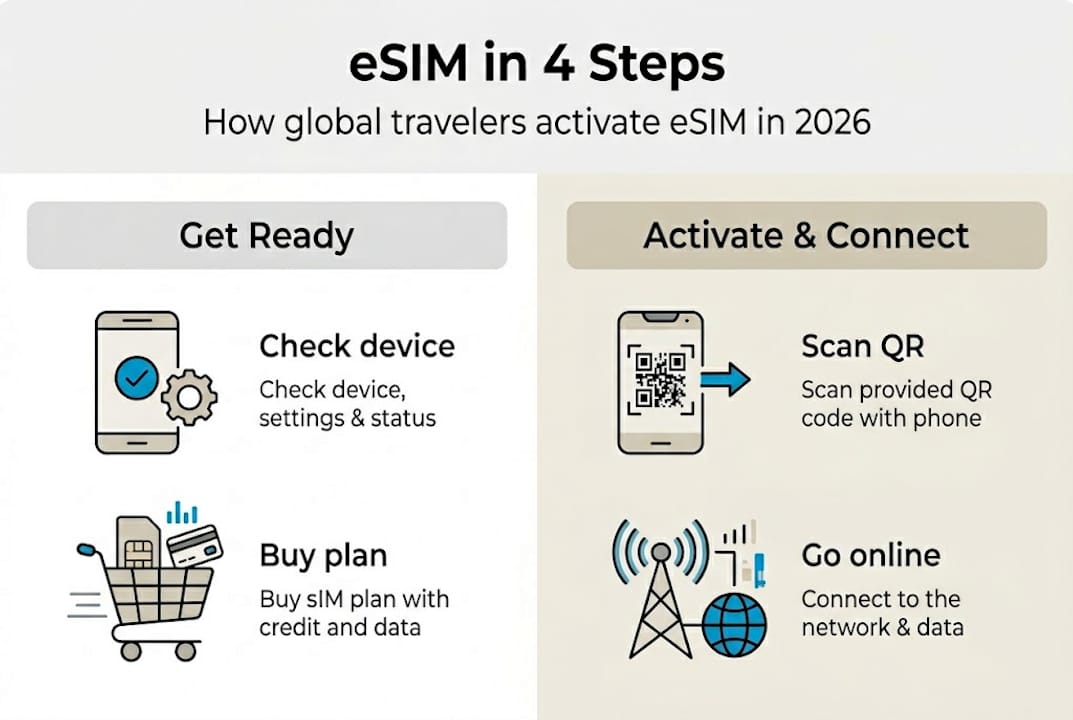
Device support has grown significantly. Recent iPhone models (XS and later), Samsung Galaxy S and Z series, Google Pixel phones, and many other Android flagships support eSIM. Before you travel, confirm your specific model supports eSIM and that it is not carrier-locked.
For global reach, global eSIM plans typically cover between 100 and 150 countries, with 150 to 200+ countries covered across the broader eSIM market. Europe is the strongest region, with regional plans covering 30 to 42 countries. Asia coverage is variable by country. Africa and Oceania can be patchy, especially outside major cities.
eSIM makes the most sense for travelers visiting multiple countries on one trip, digital nomads who change locations frequently, and anyone who wants to avoid the hassle of finding a local SIM vendor upon arrival.
- Confirm your phone model supports eSIM before departure
- Check that your device is unlocked from your home carrier
- Download the QR code or activation link before boarding your flight
- Store multiple eSIM profiles for different regions if needed
- Verify the plan covers the specific countries on your itinerary
Pro Tip: Always check device compatibility and the list of supported carriers for your destination before you leave home. A plan that works in Western Europe may not include all Balkan countries.
Coverage and speed: Regional differences you should know
Once you understand how eSIM functions, it is important to know how coverage and speed vary depending on your destination. Not all regions perform equally, and setting realistic expectations will prevent frustration mid-trip.
Europe leads in eSIM infrastructure. Europe eSIM coverage is the most consistent globally, with 4G LTE nearly universal in urban and suburban areas, and 5G expanding rapidly in cities like Amsterdam, Berlin, and Stockholm. Asia is a mixed picture: Japan, South Korea, Singapore, and Thailand offer strong urban coverage, while rural Southeast Asia and parts of South Asia can drop to 3G or lose signal entirely.

The Americas perform well in major metros. The United States and Canada have solid 4G and growing 5G networks. Latin America varies widely, with Brazil and Mexico offering decent urban coverage but weaker rural performance. Caribbean eSIM plans work well on main islands but can be unreliable on smaller ones. Africa and Oceania present the most challenges outside city centers.
For speed, urban benchmarks reach 50 to 300Mbps on 5G-capable networks. Tests in Italy recorded speeds near 300Mbps, while Portugal has seen peak readings above 800Mbps. The UK averages around 171Mbps. Rural and transit zones drop considerably lower.
| Region | Typical coverage | Average urban speed | Rural reliability |
|---|---|---|---|
| Europe | Excellent | 100 to 300Mbps | Good |
| Asia (major cities) | Good | 50 to 200Mbps | Variable |
| Americas | Good to moderate | 50 to 150Mbps | Moderate |
| Africa | Moderate (urban only) | 20 to 80Mbps | Weak |
| Oceania | Moderate | 30 to 100Mbps | Weak (rural) |
| Caribbean | Moderate | 20 to 60Mbps | Limited |
“Global plans cover 100 to 150 countries but come at a higher cost per gigabyte compared to regional or local plans.”
Expect performance drops in these situations:
- Underground transit stations and tunnels
- Ferry crossings between islands
- Mountain villages and remote hiking areas
- Flights (unless the airline offers onboard Wi-Fi)
- Dense event venues with network congestion
eSIM vs physical SIM and roaming: Which is best for you?
Now that you know how well eSIM works in different regions, comparing it with traditional options helps you make the right call for your specific trip.
eSIM wins on flexibility and speed of setup. Physical SIMs require you to find a vendor, sometimes navigate a foreign-language store, and physically swap cards. Carrier roaming is the easiest option but often the most expensive, though some carriers include free international roaming in their plans.
| Feature | eSIM | Physical SIM | Carrier roaming |
|---|---|---|---|
| Setup effort | Low (QR code) | Medium (find vendor) | None |
| Cost | Low to moderate | Low (local rates) | High (unless included) |
| Flexibility | High (switch profiles) | Low (one card) | None |
| Local number | No | Yes | Yes |
| Multi-country use | Yes | Usually no | Yes |
| Compatibility | Modern devices only | Universal | Universal |
The pros and cons of eSIM travel show that eSIM is convenient and cost-saving but not always the right tool. Activation friction, device compatibility limits, and rural gaps are real drawbacks.
When each option works best:
- eSIM: Multi-country trips, digital nomads, travelers who want instant setup and no physical card management
- Physical SIM: Long stays in one country where a local number matters, or older devices without eSIM support
- Carrier roaming: Short trips of one to three days where your home plan already includes free international data
- Best Europe eSIM: Travelers covering multiple European countries who want one plan across borders
Pro Tip: Before purchasing any eSIM plan, check your home carrier’s international roaming policy. Some plans include free data in 50 or more countries, which may cover a short trip at no extra cost.
Practical tips for choosing and using a worldwide eSIM
You have seen how eSIM compares to other options. Now, practical steps for picking and using eSIM services across the globe will make the process straightforward.
Start with device compatibility. iPhones from the XS model onward, Samsung Galaxy S20 and later, and Google Pixel 3 and later all support eSIM. Check your device settings under “Mobile Data” or “SIM Card” to confirm. If you see an option to add a data plan or eSIM, your device is ready.
Choosing between global, regional, and local plans depends on your itinerary. A Germany travel eSIM or country-specific plan gives you the best value and speed if you are staying in one country. A regional plan suits multi-country trips in Europe or Asia. A global plan works when you are crossing multiple regions but costs more per gigabyte.
For Thailand trips specifically, a dedicated Thailand eSIM plan gives you local network access without the hassle of finding a SIM vendor at the airport.
Activation tips for a smooth experience:
- Connect to stable Wi-Fi before scanning the QR code
- Download the QR code and save it as a screenshot before you travel
- Install the eSIM profile before you board, not at the destination airport
- Disable your home carrier’s data roaming after the eSIM is active to avoid surprise charges
- Test the connection briefly before relying on it for navigation or work calls
Managing multiple profiles is easy once you are familiar with your phone’s SIM settings. Label each profile by country or region so you can switch quickly. If data stops working, toggle the eSIM off and back on, or switch to a different network band in settings.
Pro Tip: Save a backup of your eSIM QR code in cloud storage and email it to yourself. If you need to reinstall the profile, you will have instant access without contacting support.
For general explore eSIM options across all destinations, EsimGlobe covers over 130 regions with plans in multiple currencies.
Why the right eSIM strategy saves more than money
The financial savings from avoiding roaming charges are obvious. What gets overlooked is the operational value eSIM provides in real travel situations.
Arriving at a border crossing at midnight with no local connectivity is a genuine security risk. With an eSIM already installed and ready to activate, you have maps, translation tools, and emergency contacts available within seconds. That is not a minor convenience.
That said, even in 2026, over-reliance on any single connectivity solution is a mistake. Coverage gaps exist. Activation can fail if your device has a software glitch or the carrier’s system is down. Remote regions in Africa, Oceania, and parts of Asia still have dead zones that no eSIM plan can fix.
The hard-won lesson from frequent travelers is this: treat eSIM as your primary data tool, but always carry a backup plan. Offline maps downloaded before departure, a secondary physical SIM for critical destinations, or a portable Wi-Fi hotspot are all valid fallbacks. Connectivity at EsimGlobe covers the primary layer well. The backup layer is your responsibility.
Savvy travelers do not just pick the cheapest plan. They match the plan type to the trip length, region, and their specific data needs.
Ready to try eSIM for your next adventure?
EsimGlobe offers eSIM plans for travelers covering single countries, regions, and global itineraries, all purchasable in USD, EUR, or GBP with instant digital delivery.
For travel to the United States, the USA travel eSIM provides reliable nationwide coverage. Heading to Southeast Asia? The Singapore eSIM is a strong starting point for the region. For trips spanning multiple continents, the global coverage eSIM covers over 120 areas in one plan. EsimGlobe’s platform supports multiple languages and currencies, making it a practical one-stop option for digital nomads and international travelers who want connectivity sorted before they leave home.
Frequently asked questions
Is eSIM available in every country?
No. eSIM is available in over 150 countries, but coverage can be limited or patchy in rural areas of Africa and Oceania. Urban areas in most regions are well-covered.
Can I use my phone’s number with an eSIM while traveling?
Yes. Your original number stays active on your physical SIM while the eSIM handles data. Most modern smartphones support dual profiles running at the same time.
How fast is mobile data with global eSIMs?
In cities, 5G speeds reach 50 to 300Mbps or higher depending on the network. Rural and remote areas deliver noticeably slower speeds and can drop to 3G in some regions.
Are eSIMs better than buying local SIM cards?
eSIMs offer faster setup and more flexibility across countries, but local SIMs can be cheaper for long single-country stays where a local phone number is also needed.