






















TL;DR:
- eSIM technology offers cheaper, flexible, and quick digital plans compared to traditional roaming and physical SIMs.
- Choosing between regional and single-country eSIM plans depends on travel itinerary and data needs.
- Proper preparation, device compatibility checks, and tracking usage maximize savings and prevent connectivity issues.
Most travelers assume their carrier’s international roaming plan is the simplest and cheapest way to stay connected abroad. That assumption costs real money. eSIM technology, which stands for embedded SIM, lets you activate a digital mobile plan without inserting a physical card. You can purchase and switch plans from anywhere in the world, often at a fraction of standard roaming rates. This guide breaks down exactly how eSIM cuts costs, when it makes the most sense, and what traps to avoid so you get the best value on every trip.
Table of Contents
- Why traditional roaming and physical SIMs cost more
- How eSIM works and cuts costs abroad
- Comparing eSIM plans: regional vs single-country options
- Advanced tips and common pitfalls for maximizing eSIM savings
- The real lesson: track your travel habits for maximum savings
- Ready to save with eSIM? Explore your options today
- Frequently asked questions
Key Takeaways
| Point | Details |
|---|---|
| Roaming costs add up | Traditional roaming is rarely cost-effective for frequent travelers. |
| eSIM simplifies savings | With eSIMs, you can avoid roaming fees and get better deals instantly online. |
| Pick the right plan | Choose between regional and single-country eSIMs based on your travel itinerary for maximum savings. |
| Avoid hidden pitfalls | Check device compatibility, coverage, and buy from trusted providers to get the best value. |
| Match tech to your habits | Track your own travel and tech spending to tailor the best money-saving approach. |
Why traditional roaming and physical SIMs cost more
International roaming charges from major carriers remain steep in most destinations. A single day of roaming in Europe or Southeast Asia can run $10 to $15 with a US carrier, and that often comes with throttled speeds after a small data threshold. For a two-week trip, that adds up to $140 to $210, just for basic connectivity.
Physical local SIMs are the traditional workaround. You land, find a kiosk, and buy a SIM from a local carrier. Pricing is usually competitive, but the process has real friction. Language barriers make it difficult to confirm plan details. Queues at airport counters are long, especially after a red-eye flight. Travelers have also reported being overcharged or sold plans with hidden limitations at popular tourist airports. Beyond that, swapping physical SIMs means managing tiny cards that are easy to lose, and you must remove your home SIM entirely, cutting off your primary number.
Here is a quick comparison of what each option typically costs for a standard one-week trip:
| Connectivity method | Typical 7-day cost | Setup time | Local number included |
|---|---|---|---|
| Carrier roaming (US) | $70 to $140 | Instant | Yes |
| Airport physical SIM | $15 to $40 | 20 to 60 minutes | Yes |
| Pre-purchased local SIM | $8 to $25 | 10 to 30 minutes | Yes |
| eSIM (regional plan) | $10 to $25 | 5 to 10 minutes | Data only |
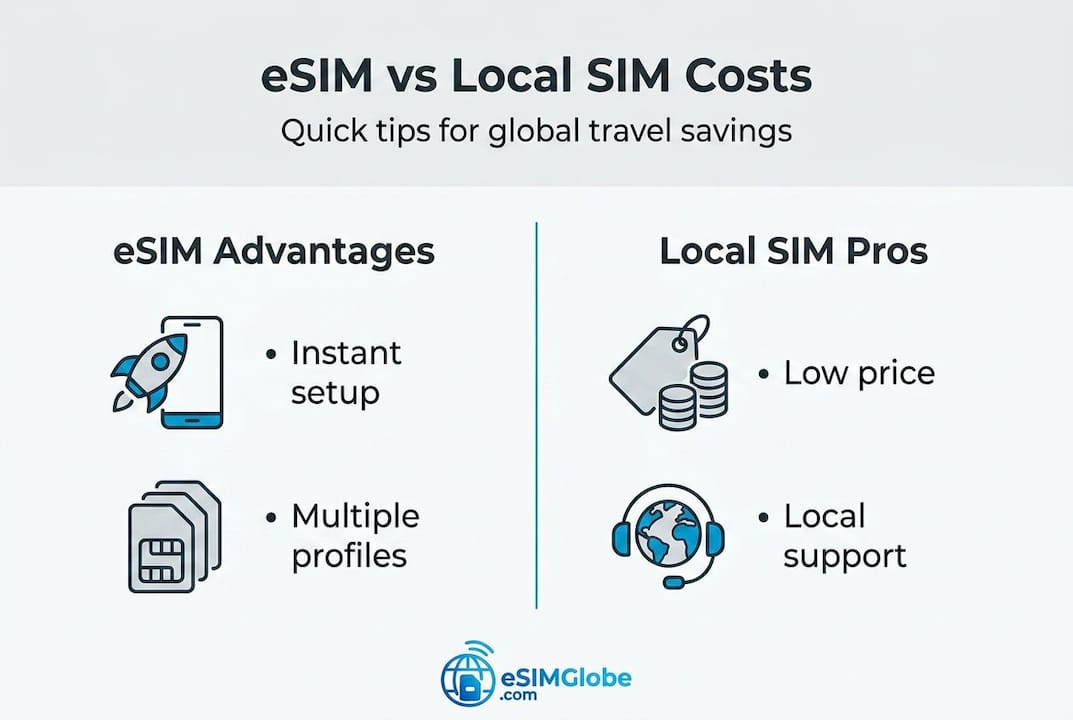
The table shows that eSIM pricing is competitive with pre-purchased local SIMs and significantly cheaper than carrier roaming. Still, traditional methods have situations where they perform well. According to the pros and cons of eSIM, there are clear edge cases where eSIM is less optimal:
- Carrier-locked phones: Some devices are locked to a home carrier and cannot activate an eSIM from another provider.
- Very short trips (1 to 2 days): If your carrier offers a flat-rate $12 daily roaming pass, the convenience may outweigh savings.
- Remote or rural areas: eSIM providers rely on local partner networks, which may not reach all rural zones.
- Need for a local phone number: Most travel eSIMs are data-only and will not give you a local SMS or calling number.
- Long stays in a single country: Buying a full local physical SIM directly from a carrier may be cheaper for a month or longer.
Reviewing an eSIM vs local SIM guide helps clarify which approach fits your specific travel profile. Understanding the essential eSIM facts before you travel removes guesswork from the decision.
With traditional options clarified, let’s look into how eSIM technology steps in.
How eSIM works and cuts costs abroad
An eSIM is a chip soldered directly into your phone’s motherboard. Unlike a removable physical SIM card, it stores multiple carrier profiles digitally. You download a plan, scan a QR code or use an app, and your device connects to the local network. No hardware swaps, no counters, no waiting.
The cost savings come from a few specific mechanisms. First, eSIM providers purchase data wholesale from local carrier networks and resell it at rates that are still far below what your home carrier charges for roaming. Second, because eSIM plans are sold online, there is no retail overhead. Third, regional plans let one purchase cover multiple countries, eliminating the need to buy separate SIMs at each border crossing.
Here is how eSIM cuts costs in practice:
- No roaming activation fees: Standard roaming often includes per-day activation charges on top of data costs.
- Transparent plan pricing: You see exactly what you are paying before activating, with no surprise charges at the end of the month.
- Regional data sharing: A single Europe eSIM plan works across 30 or more countries under one flat rate.
- Buy before departure: Purchasing online before leaving home eliminates the need for airport kiosks, which consistently charge more.
- Flexible plan sizes: You choose exactly how much data you need, 1 GB, 5 GB, or 20 GB, avoiding paying for data you will not use.
That said, eSIM pricing is not always the cheapest option compared to local physical SIMs in every country. In places like Thailand, India, or Vietnam, local SIM prices are so low that even budget eSIM plans cost slightly more per gigabyte. The savings are clearest when you factor in the time saved and the convenience of not managing physical cards. Understanding eSIM terms like ICCID, APN, and QR provisioning helps you set up faster and troubleshoot confidently.
Pro Tip: Purchase your eSIM at least 24 hours before departure so you have time to install and test it on your home network. This eliminates any setup stress at the airport.
The global eSIM guide for 2026 covers country-specific availability in detail, which is especially useful if you are traveling to less common destinations.
Now that you know how much traditional options cost, here’s how eSIM solutions can change your travel experience.
Comparing eSIM plans: regional vs single-country options
Having explored eSIM’s core advantages, let’s get concrete about your options for different travel scenarios.
The biggest decision when buying a travel eSIM is choosing between a regional plan and a single-country plan. Each has a distinct value profile depending on how you travel.
Regional plans cover a broad geographic zone, such as Europe, Southeast Asia, or Latin America. One purchase covers connectivity across dozens of countries. Regional plans covering multiple countries such as 30-plus European nations can cost as little as $12 to $15 for 5 GB, making them highly cost-effective for multi-stop trips. If you are spending a week in France, then moving to Spain and Portugal, a regional plan eliminates the need for three separate purchases.

Single-country plans are optimized for one destination. They often offer more data for the same price because coverage is narrower. If you are spending 10 days in Japan, a Japan-specific eSIM will likely give you better value per gigabyte than an Asia regional plan.
| Plan type | Best for | Typical cost for 5 GB | Coverage |
|---|---|---|---|
| Regional (Europe) | 2 to 5 countries in one trip | $12 to $18 | 30 to 40 countries |
| Regional (Asia) | Island-hopping or multi-city | $15 to $22 | 10 to 20 countries |
| Single-country (Japan) | One destination, 7 to 14 days | $8 to $14 | Japan only |
| Single-country (US) | Extended stay, high data needs | $10 to $20 | US only |
To choose the right plan, follow these steps:
- List every country you will visit on the trip. If it is more than two, lean toward a regional plan.
- Estimate your data usage. Streaming maps, videos, and working remotely will require 1 to 2 GB per day. Light browsing uses 200 to 500 MB.
- Check if a regional plan covers all your destinations. Some countries fall outside standard regional zones.
- Compare per-gigabyte cost between regional and single-country options for your destinations.
- Confirm coverage quality by reviewing the provider’s partner network list for each country on your itinerary.
Reviewing options to save money with eSIMs across different destinations helps you benchmark prices before committing. For travelers who want to understand the different types of plans available, the best eSIM types guide offers clear comparisons.
Advanced tips and common pitfalls for maximizing eSIM savings
Before you buy your next eSIM, consider these extra tips to reach peak savings and avoid disappointment.
Getting the best value from an eSIM requires more than just purchasing a plan. There are several practical steps that separate travelers who save significantly from those who end up overpaying or facing connectivity problems mid-trip.
Device compatibility is the first check. Not all phones support eSIM. Most flagship phones released after 2019 are compatible, including the iPhone XS and later, Samsung Galaxy S20 and later, and Google Pixel 3 and later. However, phones purchased in certain markets or locked to specific carriers may block eSIM activation. Checking top eSIM devices confirms whether your phone model supports the technology before you spend a dollar.
Coverage verification is equally important. eSIM providers do not operate their own towers. They partner with local carriers in each country. If their partner carrier has weak rural coverage, your eSIM will face the same limitations. Always review the coverage map for your specific travel route, not just the major cities.
Here are the most common pitfalls and how to avoid them:
- Buying at the airport: Airport kiosks and resellers apply a significant markup. The same plan purchased online typically costs 30 to 50 percent less.
- Skipping the activation test: Install and activate your eSIM before you land. If something goes wrong, you have Wi-Fi and time to fix it at home.
- Ignoring data caps and throttling: Some budget plans throttle speeds after a small threshold. Read the fine print on speed limits.
- Assuming all plans include calling: Most travel eSIMs are data-only. If you need to make local calls, you need a different solution or a VoIP app.
- Forgetting to turn off roaming on your primary SIM: If your home SIM is still active in your device, your phone may connect to roaming networks and rack up charges even while the eSIM is set as primary.
“Edge cases where eSIM is less optimal include carrier-locked phones, very short trips of one to two days where a flat-rate $12 roaming pass may be more convenient, remote or rural areas with poor partner coverage, situations requiring a local number or SMS, and long stays in one country where a local physical SIM is cheaper.”
The eSIM activation guide walks through setup for all major device types and covers troubleshooting for the most common issues. Following it step by step ensures your plan is live and tested before departure.
Pro Tip: Keep a screenshot of your eSIM QR code saved offline. If you need to reinstall the profile abroad and lack reliable Wi-Fi, the QR code is your backup.
The real lesson: track your travel habits for maximum savings
Now, let’s take a broader view on what really matters for cost-effective travel connectivity.
Most connectivity guides make a binary argument: eSIM is better than roaming. That framing misses the point. The travelers who save the most over time are not the ones who pick eSIM on principle. They are the ones who track their actual connectivity costs across multiple trips and make decisions based on real data.
A digital nomad visiting three to five countries per month is a completely different user than a business traveler who flies to one city for a two-day meeting four times a year. For the nomad, a regional eSIM plan almost always wins. For the business traveler, a $12 daily roaming pass may be the rational choice. Neither is wrong. Both are optimizing for their actual travel pattern.
The practical approach: save your telecom receipts and data usage records for three to four trips. Compare what you paid under each method (roaming, physical SIM, eSIM) against the data you actually consumed. Patterns emerge quickly. Many travelers discover they overpay consistently in one category while getting good value in another. For destination-specific cost comparisons, reviewing an affordable eSIM guide for Thailand illustrates how much pricing varies by region and helps calibrate expectations for Southeast Asia specifically.
The bottom line: eSIM is a powerful and genuinely cost-effective tool for most international travelers. But maximum savings come from matching the tool to your travel reality, not from any single blanket recommendation.
Ready to save with eSIM? Explore your options today
EsimGlobe provides eSIM plans for hundreds of destinations worldwide, covering both single-country and regional options across multiple currencies and languages.
Whether you are planning a trip to the US or searching for an eSIM for the Maldives, EsimGlobe offers instant digital activation with no shipping wait. Browse the full catalog at EsimGlobe to compare plans, confirm coverage, and activate before your flight. An eSIM for the United States is available for inbound travelers as well. Purchasing online through EsimGlobe ensures you pay market rates, not airport markups, and your plan is ready from the moment you land.
Frequently asked questions
Is eSIM always cheaper than buying a local SIM abroad?
No, local physical SIMs can sometimes be cheaper, especially for long stays or in countries where eSIM pricing is not competitive with local carrier rates.
Can I use eSIM in rural or remote areas?
Coverage may be limited in rural or remote regions depending on provider partnerships; always check coverage maps before purchasing because poor partner coverage in rural zones is a known limitation.
Are regional eSIM plans more cost-effective for multi-country trips?
Yes, regional plans covering multiple countries such as 30-plus European nations for $12 to $15 per 5 GB are typically cheaper than buying separate SIMs for each country.
How do I avoid overpaying for eSIMs?
Buy online from reputable sources, avoid airport kiosks, and compare prices and coverage in advance because airport and kiosk pricing consistently runs higher than online retail rates.