






















TL;DR:
- eSIM provides instant, remote activation and multiple profiles for flexible travel connectivity.
- It is more cost-effective and convenient than local SIMs or roaming for most travelers.
- Carefully select plans based on trip duration and data needs to maximize savings.
Roaming charges in Thailand catch most travelers off guard. A few days of casual browsing, maps, and messaging can generate a bill that rivals the cost of the flight itself. The good news is that eSIM technology has changed the equation entirely. Instead of hunting for a SIM card shop at Suvarnabhumi Airport or accepting your carrier’s inflated international rates, you can activate a local Thai data plan before your plane even lands. This guide covers how eSIM works, how it compares to alternatives, and how to get the most value from it during your trip.
Table of Contents
- What is eSIM and why it matters for Thailand travelers
- Comparing eSIM vs. local SIM card and roaming: What’s best?
- How to set up eSIM for Thailand: Step-by-step guide
- Tips for maximizing your eSIM value in Thailand
- Why most travelers underestimate eSIM advantages in Thailand
- Explore the best eSIM plans for your next Thailand trip
- Frequently asked questions
Key Takeaways
| Point | Details |
|---|---|
| Save on roaming fees | Choosing eSIM for Thailand can cut your mobile data costs by up to 60%. |
| Instant connectivity | Purchase and activate your Thailand eSIM remotely to start using data as soon as you land. |
| Flexible regional plans | Travelers can select eSIM bundles covering multiple countries for hassle-free connectivity throughout Asia. |
| Easy setup process | Setting up an eSIM for Thailand involves a simple, three-step activation on compatible devices. |
| Unlimited data options | Heavy data users can choose unlimited eSIM plans for Thailand to stay connected worry-free. |
What is eSIM and why it matters for Thailand travelers
An eSIM, or embedded SIM, is a digital SIM card built directly into your smartphone. Unlike a physical SIM card that you slide in and out of a tray, an eSIM stores carrier profiles electronically. You switch between plans through your phone’s settings menu rather than through a hardware swap.
For travelers heading to Thailand, this distinction is significant. eSIM allows travelers to store multiple profiles and activate local data plans remotely, which means you can purchase and install a Thai data plan from home, days before departure.
Here is why eSIM fits the Thailand travel context so well:
- No physical SIM required. You keep your home SIM active for calls and texts while the eSIM handles data.
- Instant activation. No queuing at airport counters or convenience stores.
- Cost control. You choose a fixed plan upfront, so there are no surprise charges.
- Multiple profiles. Traveling from Thailand to Malaysia or Singapore? You can add a regional profile without removing anything.
- Security. No risk of losing a tiny plastic card in your bag or at the beach.
Thailand’s mobile networks, including AIS, DTAC, and True Move H, are well-developed and support 4G LTE across major cities and tourist regions. eSIM plans tap directly into these networks, giving you reliable coverage in Bangkok, Chiang Mai, Phuket, and beyond.
Device compatibility has expanded rapidly. Most flagship smartphones released after 2020 support eSIM, including Apple iPhone XS and later, Google Pixel 3 and later, and Samsung Galaxy S20 and later. If you are unsure whether your phone qualifies, check your device settings under “Mobile Data” or “SIM Card” for an eSIM option.
Browsing Thailand eSIM options before you travel gives you a clear picture of available plans, pricing tiers, and data allowances. The variety is broad enough to suit a weekend trip or a month-long stay.
Comparing eSIM vs. local SIM card and roaming: What’s best?
Three connectivity options exist for travelers in Thailand: international roaming through your home carrier, buying a local physical SIM card, and using an eSIM. Each has trade-offs worth understanding.
| Feature | eSIM | Local SIM | International roaming |
|---|---|---|---|
| Activation time | Instant, remote | 15 to 30 min in-store | Automatic |
| Cost for 5GB | $5 to $15 | $5 to $12 | $30 to $80+ |
| Physical swap needed | No | Yes | No |
| Keeps home number active | Yes | No | Yes |
| Works before landing | Yes | No | Yes |
| Multi-country support | Yes (regional plans) | No | Yes (extra cost) |
eSIMs offer instant activation and no physical swapping, while local SIMs require store visits. That convenience gap matters when you land at midnight or have a tight connection.
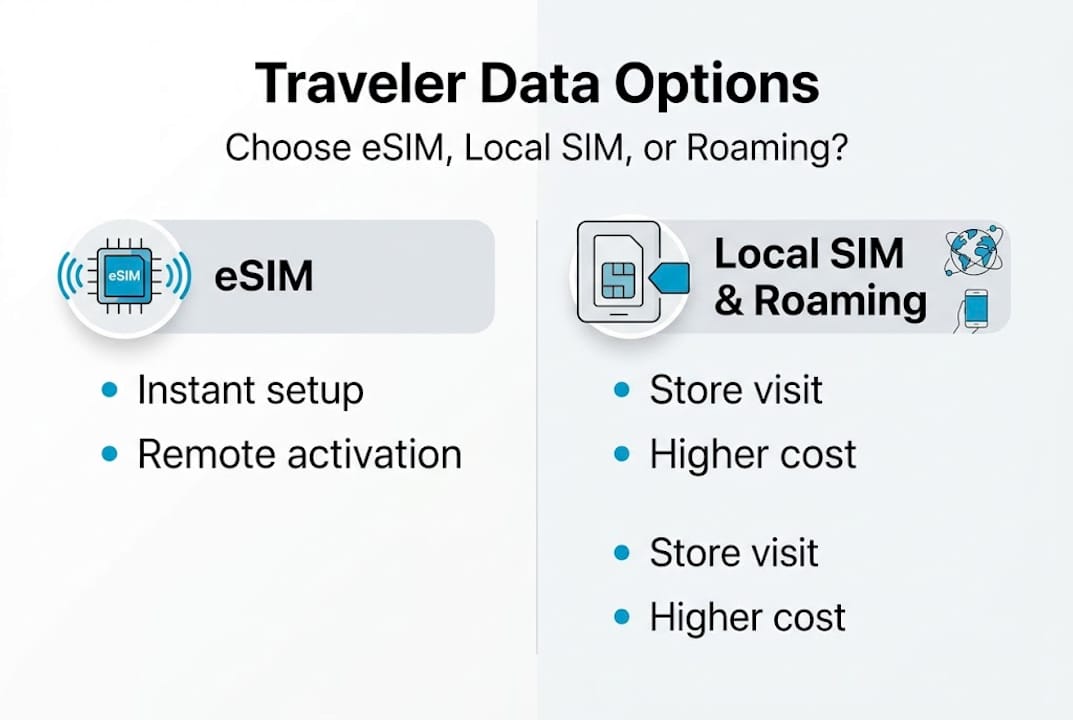
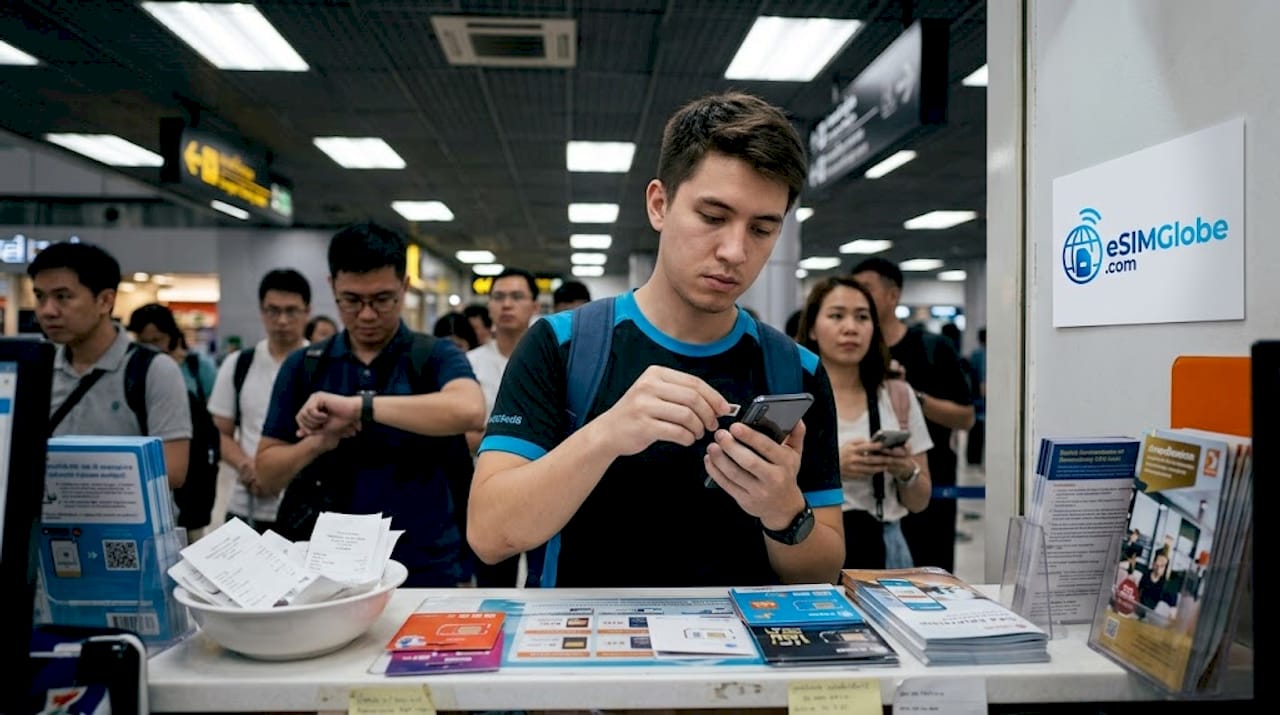
Local SIM cards are cheap and widely available at 7-Eleven stores and airport counters. The catch is that you must remove your home SIM to use one, which means missing calls and texts on your primary number. For business travelers or anyone expecting important contacts, this is a real inconvenience.
International roaming is the most expensive option by a wide margin. Carriers typically charge per megabyte or offer daily roaming passes that still cost several times what an eSIM plan runs for the same data volume.
For travelers visiting multiple countries, multi-country eSIM options covering Thailand, Malaysia, and Singapore in a single profile eliminate the need to manage separate plans for each destination.
If you are a heavy data user, an unlimited eSIM Thailand plan removes the anxiety of tracking gigabytes entirely.
Pro Tip: If your phone supports dual SIM plus eSIM, you can keep your home SIM for voice and use the eSIM for data simultaneously. Check your device specs before purchasing to confirm this capability.
- eSIM is best for travelers who want convenience, cost savings, and flexibility.
- Local SIM is acceptable for budget travelers on single-destination trips who do not need their home number.
- Roaming is only practical for very short trips where data usage is minimal.
How to set up eSIM for Thailand: Step-by-step guide
Setting up an eSIM for Thailand is straightforward. The process takes less than ten minutes from purchase to active connection.
Activating eSIM is typically a three-step process: purchase, scan QR, and confirm profile. Here is the full sequence:
- Confirm device compatibility. Go to your phone’s settings and look for a “Add eSIM” or “Add Mobile Plan” option. If it exists, your device supports eSIM.
- Unlock your device. Your phone must be carrier-unlocked to install a third-party eSIM. Contact your home carrier if you are unsure of your lock status.
- Choose and purchase a plan. Visit EsimGlobe and get eSIM Thailand by selecting the data volume and duration that fits your trip.
- Receive your QR code. After purchase, EsimGlobe delivers a QR code to your email within minutes.
- Scan the QR code. Go to Settings, then Mobile Data or Cellular, then Add eSIM. Point your camera at the QR code.
- Label and activate the profile. Name the plan (for example, “Thailand Data”) and set it as your default data line.
- Enable data roaming on the eSIM line. This is a common step that travelers miss. Without it, the eSIM will not connect to local Thai networks.
Pro Tip: Always unlock your device before traveling. Carrier locks prevent eSIM installation entirely, and unlocking can take several business days if requested last minute.
For travelers planning to visit neighboring countries, regional eSIM plans let you add coverage for multiple destinations under one profile, saving you from repeating this process for each country.
Common troubleshooting points:
- QR code not scanning. Ensure your screen brightness is high and the code is not expired.
- No network after activation. Toggle airplane mode on and off to force a network search.
- Plan not showing data. Double-check that data roaming is enabled on the eSIM line specifically.
Tips for maximizing your eSIM value in Thailand
With your eSIM active, a few practical habits will stretch your data budget and prevent common frustrations.
Travelers can save up to 60% on data costs using a Thailand eSIM compared to roaming, but that saving only holds if you manage your plan well.
Match plan size to your actual usage. Most travelers overestimate how much data they need. A 5GB plan covers a week of maps, messaging, and occasional video calls. Heavy streamers or remote workers should consider unlimited data plans to avoid running out mid-trip.
| Trip length | Recommended data | Typical use case |
|---|---|---|
| 1 to 3 days | 1 to 2GB | Light browsing, maps |
| 4 to 7 days | 3 to 5GB | Social media, calls |
| 8 to 14 days | 7 to 10GB | Regular streaming |
| 15+ days | Unlimited | Remote work, heavy use |
- Use Wi-Fi for heavy downloads. Hotels and cafes in Thailand offer reliable Wi-Fi. Save your eSIM data for when you are out exploring.
- Disable background app refresh. Apps updating in the background consume data silently. Turn this off in your settings.
- Monitor usage weekly. Check your data balance in your phone’s settings to avoid surprises near the end of your plan.
- Plan for regional travel. If your itinerary extends beyond Thailand, review saving on eSIM Thailand options and consider whether a regional plan covers your full route.
- Check CBD travel rules. If you carry any wellness products, review CBD travel guidance for Thailand’s specific regulations before arrival.
Avoid the common mistake of purchasing a plan that starts immediately if you are buying days before your trip. Some plans activate on first use, while others start counting from purchase date. Read the plan terms carefully.
Why most travelers underestimate eSIM advantages in Thailand
Most travel guides focus on whether eSIM works. The more interesting question is why so many travelers still avoid it despite clear advantages.
Many travelers still default to physical SIMs, missing the value and convenience of eSIM. The reasons are mostly habit and unfamiliarity, not rational cost analysis.
Frequent visitors to Thailand report that the airport SIM card queue alone can take 20 to 40 minutes during peak arrival times. That is time you could spend in a taxi heading to your hotel. Digital nomads who have switched to eSIM consistently cite the ability to have connectivity the moment they land as the single biggest quality-of-life improvement in their travel routine.
The contrarian view worth considering: a local SIM is not always cheaper when you factor in the time cost, the risk of losing the card, and the loss of your home number. eSIM wins on total value in most scenarios, not just on data price per gigabyte. Review expert eSIM tips Thailand for a deeper breakdown of real-world comparisons from frequent travelers.
Explore the best eSIM plans for your next Thailand trip
EsimGlobe offers a straightforward selection of eSIM plans built for travelers visiting Thailand and the broader Asia region. Whether you need a short-term data boost or extended regional coverage, the options are organized by destination and duration.
For Thailand-specific travel, browse Thailand eSIM deals covering a range of data volumes and validity periods. Travelers extending their trip across Asia can explore Asia eSIM unlimited plans covering 20 areas under one profile. For those with broader itineraries, global eSIM plans provide access across 130 areas worldwide. All plans are activated digitally, with QR codes delivered by email immediately after purchase.
Frequently asked questions
Can I use eSIM on all smartphones in Thailand?
Most modern smartphones support eSIM, but compatibility varies by device and region, so check your specific model with your provider before purchasing.
How much does a Thailand eSIM cost compared to roaming?
Thailand eSIMs frequently cost significantly less than international roaming plans. Travelers save up to 60% on data costs compared to standard roaming rates for the same volume.
Is it better to buy eSIM before arriving in Thailand or once there?
Buying before arrival is the better choice. eSIM activates profiles remotely, so you have working data the moment you land without needing to find a store.
Can I use a single eSIM for multiple Asian countries during my trip?
Yes. Regional plans are available for travelers covering Thailand, Malaysia, Singapore, and other Asian countries within a single eSIM profile.
Are unlimited data eSIM options available for Thailand?
Yes. Unlimited Day Pass plans are available for Thailand eSIM users who need consistent, unrestricted data access throughout their stay.