






















TL;DR:
- eSIM technology allows digital profiles to be downloaded and activated instantly over the air.
- It offers flexible plans categorized as local, regional, or global, reducing costs and increasing convenience.
- Travelers benefit from quick setup, multiple profiles, enhanced security, but must verify device compatibility and plan terms.
Switching SIM cards at every border used to be one of the most tedious parts of international travel. You would land, hunt down a carrier kiosk, navigate a foreign language menu, and hope the plan you bought actually covered your next destination. eSIM technology cuts through all of that. Instead of a plastic card, your phone downloads a digital profile directly over the air, and you can activate a new plan before your flight even lands. This article breaks down what eSIM is, how it reshapes your mobile plan options, and what to watch out for before you buy.
Table of Contents
- What is eSIM and how does it work?
- How eSIM is changing mobile plan options
- Why travelers and nomads are switching: Benefits and real-world impact
- Potential drawbacks and what to watch out for
- The real impact: Why eSIM is more than just a new SIM card
- Find the perfect eSIM plan for your next journey
- Frequently asked questions
Key Takeaways
| Point | Details |
|---|---|
| Flexible global options | eSIM lets you pick local, regional, or global plans tailored to your travel style. |
| Instant connectivity | Activate new data plans remotely without the hassle of finding physical SIM cards abroad. |
| Cost savings | eSIM helps you avoid expensive roaming charges and often offers more competitive rates. |
| Know the limits | Many ‘unlimited’ eSIM plans throttle speed after 20-40GB, so always check the fine print. |
| Device compatibility required | Not all devices support eSIM, so verifying your phone’s compatibility is essential. |
What is eSIM and how does it work?
An eSIM, or embedded SIM, is a small chip soldered directly into your device during manufacturing. Unlike a standard SIM card that you insert and remove, the eSIM chip never leaves your phone. What changes instead is the software profile loaded onto it. Carriers send these profiles digitally, and your device stores them. You activate a plan, and within minutes you have a working connection, no card required.
The practical difference is significant. With a physical SIM, one device means one active profile at a time. With eSIM, your device can store multiple profiles and you choose which one is active. A traveler moving from Japan to Germany to Brazil can load a local plan for each country in advance and flip between them in the settings menu. There is no physical action involved at all.
Key technical facts worth knowing:
- eSIM profiles are downloaded via a QR code or directly through an app.
- Activation typically takes two to five minutes.
- Most modern flagship smartphones, tablets, and smartwatches now support eSIM.
- eSIM plans are typically data-only and leverage VoIP apps for voice calls.
- Some carriers allow eSIM and physical SIM to run simultaneously on dual-SIM devices.
For a deeper look at the basics, these key eSIM facts cover compatibility, activation steps, and what travelers most commonly misunderstand about the technology.
Pro Tip: Many current flagship phones support dual SIM, meaning one physical SIM slot plus one eSIM. This lets you keep your home number active for banking verification texts while running a local data plan on the eSIM. You get two numbers, two connections, one device.
The shift away from physical SIM cards also has practical security benefits. Lost luggage, stolen bags, or a dropped phone at the airport no longer means losing your SIM card. Your plan is tied to your device’s eSIM chip, and reactivating after a device replacement is handled through the carrier’s app or website.
How eSIM is changing mobile plan options
With a basic understanding of eSIM in place, the next step is understanding how this technology reshapes the actual plans available to travelers. Traditional SIM cards locked you to a single carrier’s network and a single country. eSIM opens access to a much wider menu of plan structures.
Plans are categorized as local, regional, and global. Local plans are the cheapest option for extended stays in one country. Regional plans cover several countries under one subscription, making them ideal for multi-stop itineraries. Global plans work almost everywhere but come at a higher price point. Understanding which category fits your trip is the first decision any traveler should make.
| Plan type | Best for | Coverage | Typical cost |
|---|---|---|---|
| Local | Single country, longer stays | One country | Lowest |
| Regional | Multi-country itineraries | Defined region (e.g., Europe, Southeast Asia) | Moderate |
| Global | Frequent, unpredictable travel | Most countries worldwide | Highest |
For travelers who want to understand the categories in detail before committing, a review of the best eSIM plan types covers each option with specific use cases. If you want to get into the mechanics of data allowances and renewal policies, the guide on how eSIM data plans work is worth reading before your first purchase.
Most eSIM plans are data-only by design. This means your calling and texting happen through apps like WhatsApp, Telegram, FaceTime, or Google Meet rather than through a traditional phone number. For most travelers in 2026, this is not a limitation at all. It is simply how communication works now.
The shift from carrier-locked SIMs to flexible eSIM activation also changes the pricing dynamic. Because eSIM providers can source data wholesale from multiple local networks in each country, they can often undercut the roaming rates your home carrier charges. A traveler paying $15 per day for international roaming through a traditional carrier can frequently replace that with a regional eSIM plan for a fraction of the cost over the same period.
The most relevant plans for each traveler type:
- Short trip, single country: Local eSIM plan, purchased before departure.
- Two to three week European tour: Regional plan covering the EU or the Schengen Area.
- Digital nomad with no fixed itinerary: Global plan or a strategy of buying local plans per country.
- Frequent business traveler: Global plan for convenience, with local upgrades in high-use destinations.
Why travelers and nomads are switching: Benefits and real-world impact
The concrete advantages of eSIM are clearest when you look at real traveler scenarios. Consider three common situations.

A digital nomad working across Southeast Asia for three months. Under the old model, they would buy a new SIM in Thailand, another in Vietnam, and another in Indonesia. Each purchase means time spent at a carrier shop, navigating language barriers, and potentially losing contacts stored on the old SIM. With eSIM, they load a regional plan before leaving home, or buy local eSIM plans from each country online and activate them on schedule.
A business traveler making short trips to four countries in two weeks. Roaming fees from a home carrier can add up to hundreds of dollars on a trip like that. eSIM plans help avoid roaming charges, offer seamless switching between profiles, and eliminate the hassle of sourcing physical SIMs in unfamiliar airports.
A spontaneous traveler who books a last-minute flight on a Friday night. In the past, they would worry about connectivity on arrival. With eSIM, they buy and activate a plan from the departure lounge. The profile downloads in minutes, and they land connected.
The numbered list of core benefits that drive adoption:
- No physical card needed. No lost SIMs, no airport kiosk queues.
- Instant activation. Plans are live within minutes of purchase.
- Multiple profiles stored. Switch between plans in settings without touching hardware.
- Lower costs. Local and regional eSIM plans typically undercut traditional roaming fees.
- Flexibility. Buy only what you need, for the duration you need it.
- Security. Your plan is not tied to a removable card that can be lost or stolen.
For travelers who want to see the numbers, the breakdown of eSIM savings for travelers compares eSIM costs against standard roaming on common routes. The travel eSIM cost tips guide goes further, with strategies for keeping data costs minimal on longer trips.
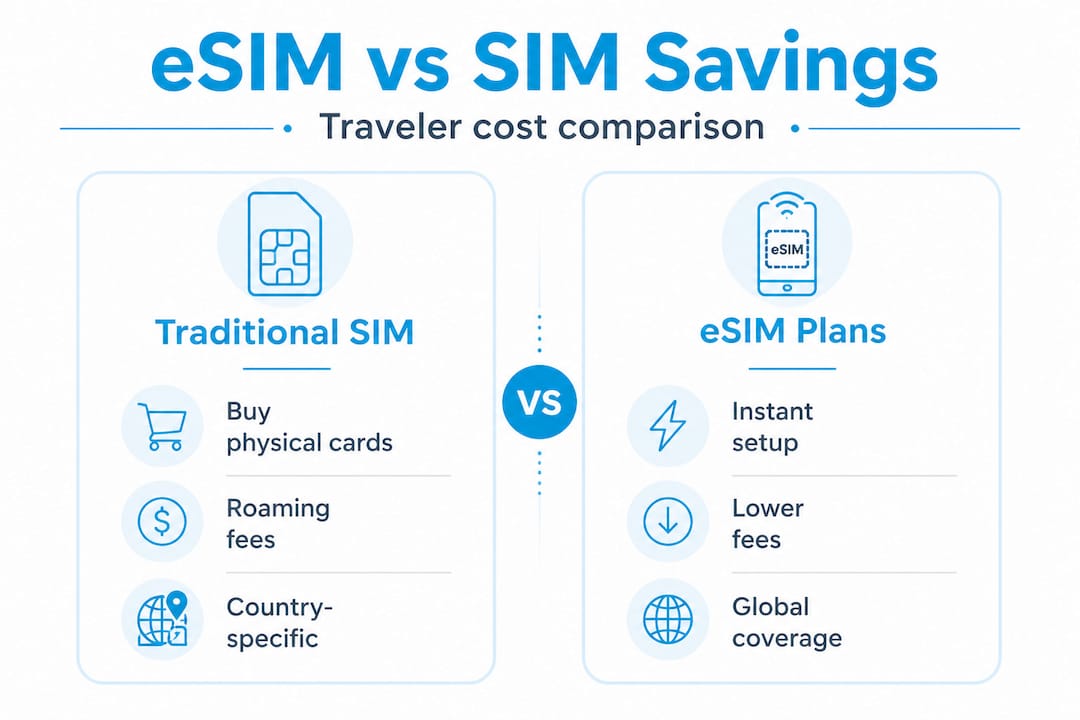
Pro Tip: Always read the fair-use and throttling terms before buying any plan labeled “unlimited.” Many providers cap full-speed data at 20 to 40GB per billing cycle. After that threshold, speeds drop significantly, sometimes to levels that make streaming or video calls impractical. Knowing this in advance lets you size your plan correctly or budget for a top-up.
| Scenario | Traditional SIM cost (estimate) | eSIM cost (estimate) | Savings |
|---|---|---|---|
| 7-day Europe trip | $90 to $140 roaming | $15 to $30 regional eSIM | 60 to 80% |
| 30-day Southeast Asia stay | $120 to $200 multiple SIMs | $25 to $50 local eSIM plans | 50 to 70% |
| 14-day multi-continent business trip | $200 to $350 roaming | $40 to $80 global eSIM | 55 to 75% |
Potential drawbacks and what to watch out for
No technology shift is perfect, and eSIM has real limitations that travelers need to factor in before assuming it is the right choice for every situation.
Device compatibility remains the most common barrier. Not every phone supports eSIM, and among those that do, not all are unlocked to accept third-party eSIM profiles. Budget smartphones, older models, and some carrier-locked devices may not work with eSIM plans at all. The solution is simple: verify your device’s eSIM compatibility before purchasing any plan.
Key limitations to review before switching:
- Data-only by default. No traditional voice or SMS service unless you use VoIP apps.
- Coverage gaps in remote areas. eSIM plans rely on local partner networks. In rural or very remote regions, coverage may be weaker than a local physical SIM from the dominant carrier.
- Fair-use throttling. “Unlimited” eSIM plans often throttle after 20 to 40GB of data usage, which catches heavy users off guard.
- Plan switching requires attention. If you have multiple eSIM profiles loaded and forget to switch, your device may default to a more expensive plan or lose connectivity entirely.
- Carrier lock issues. Some phones are locked to a specific carrier’s eSIM system and will not accept profiles from other providers.
Before committing to any provider, review understanding eSIM terms to get familiar with the language used in plan descriptions, particularly around fair-use limits, validity periods, and network access types. The eSIM vs local SIM guide is also useful if you are weighing whether eSIM or a locally purchased physical SIM makes more sense for a specific destination.
Key questions to ask before purchasing any eSIM plan:
- Is my device model confirmed compatible?
- What networks does the plan access in each country?
- What is the fair-use data threshold before throttling begins?
- Does the plan expire at a fixed date or after the data is consumed?
- Is top-up available if I run out of data mid-trip?
The transparency around these terms varies significantly between providers. Spending ten minutes reading the plan details before purchase prevents a lot of frustration mid-trip.
The real impact: Why eSIM is more than just a new SIM card
There is a case to be made that eSIM represents something more significant than a technical upgrade to mobile connectivity. The deeper shift is in how travelers plan and manage their connection to the world while abroad.
Before eSIM, staying connected internationally required advance planning, physical logistics, and a degree of acceptance that you would be offline during transitions. Travelers built this friction into their expectations. The global eSIM guide for 2026 points to a world where that friction is almost entirely removed. You can be connected before your plane lands, in a country you decided to visit 48 hours ago, with a plan that costs less than a single roaming day under your old carrier.
That immediacy changes behavior. Travelers are more willing to divert, extend trips, and make spontaneous decisions when connectivity is not a logistical puzzle. Digital nomads can accept contracts in new locations without first researching SIM availability. Business travelers can confirm deals in the back of a cab minutes after landing.
The honest counterpoint: eSIM places more responsibility on the user. With a traditional carrier roaming plan, the complexity was hidden. You paid the bill, sometimes with shock, but the connection worked without effort. eSIM requires you to compare plans, check device compatibility, understand throttling terms, and manage profile switching. It is not difficult, but it is not invisible either.
Longer term, eSIM is likely to reshape how carriers compete for international travelers. When switching costs are near zero and a traveler can change their data provider in minutes from anywhere in the world, price and network quality become the only real differentiators. That competitive pressure should push costs lower over time and push coverage quality higher.
The practical advice: use the flexibility eSIM offers, but stay informed. Check plan terms before each trip, review coverage maps for destinations off the beaten path, and keep a backup option in mind for destinations where coverage might be unreliable.
Find the perfect eSIM plan for your next journey
EsimGlobe makes it straightforward to compare and activate eSIM plans for destinations worldwide. Whether you need a single-country plan for a two-week stay or a regional plan covering an entire continent, the platform lists options in USD, EUR, and GBP with filters for coverage region, data volume, and validity period.
Travelers heading to island destinations can explore options like the Maldives eSIM page for destination-specific plans with confirmed local network access. For broader itineraries, the EsimGlobe homepage provides the full country and region selector. Activation is handled by QR code or app, plans go live in minutes, and support is available for troubleshooting. No physical card. No airport kiosk. No roaming bill at the end of the trip.
Frequently asked questions
What is the difference between local, regional, and global eSIM plans?
Local plans are cheapest for long stays in one country, regional plans cover several countries and offer good value for multi-stop trips, and global plans work almost everywhere but carry a higher price.
Can I use an eSIM for phone calls and texts?
Most eSIMs are data-only and require VoIP apps for calls, so use WhatsApp, Skype, or FaceTime rather than expecting a standard phone number.
What happens if I use more than 20 to 40GB on an “unlimited” eSIM plan?
“Unlimited” eSIM plans often throttle data speed after 20 to 40GB, so review the fair-use policy for your plan before purchasing and budget for a top-up if you are a heavy user.
Are all phones compatible with eSIM?
Not every phone supports eSIM; check your specific device model on the manufacturer’s website or your carrier’s compatibility list before purchasing any plan.
How do I switch between multiple eSIM plans when traveling?
Most compatible devices let you store several eSIM profiles simultaneously and switch the active profile through the settings menu in seconds, with no hardware change required.