






















TL;DR:
- Several eSIM providers, including Airalo, Holafly, Nomad, and Esimglobe, offer alternatives to Ubigi with features like unlimited data, local phone numbers, and better customer support. Speed, coverage, and support quality vary across providers, making destination and usage needs essential for choice. Esimglobe stands out for its flexible plans, comprehensive coverage, and responsive support, making it a reliable option for frequent travelers and digital nomads.
An alternative to Ubigi is any global or regional eSIM provider that delivers mobile data connectivity abroad, often with features Ubigi lacks: unlimited data options, included local phone numbers, or stronger customer support. Providers like Airalo, Holafly, and Nomad each fill a different gap in Ubigi’s lineup, and platforms like Esimglobe go further by combining flexible plan structures with responsive multilingual support. This guide compares the top ubigi replacement services across pricing, coverage, and usability so you can pick the right fit for your travel style, whether you are a weekend tripper, a digital nomad, or a road-warrior executive.
What are the best alternatives to Ubigi for global eSIM?
The eSIM market offers several strong ubigi competitor options, and the right choice depends on what Ubigi is missing for your specific use case. Four providers consistently appear at the top of independent comparisons: Airalo, Holafly, Nomad, and Esimglobe.
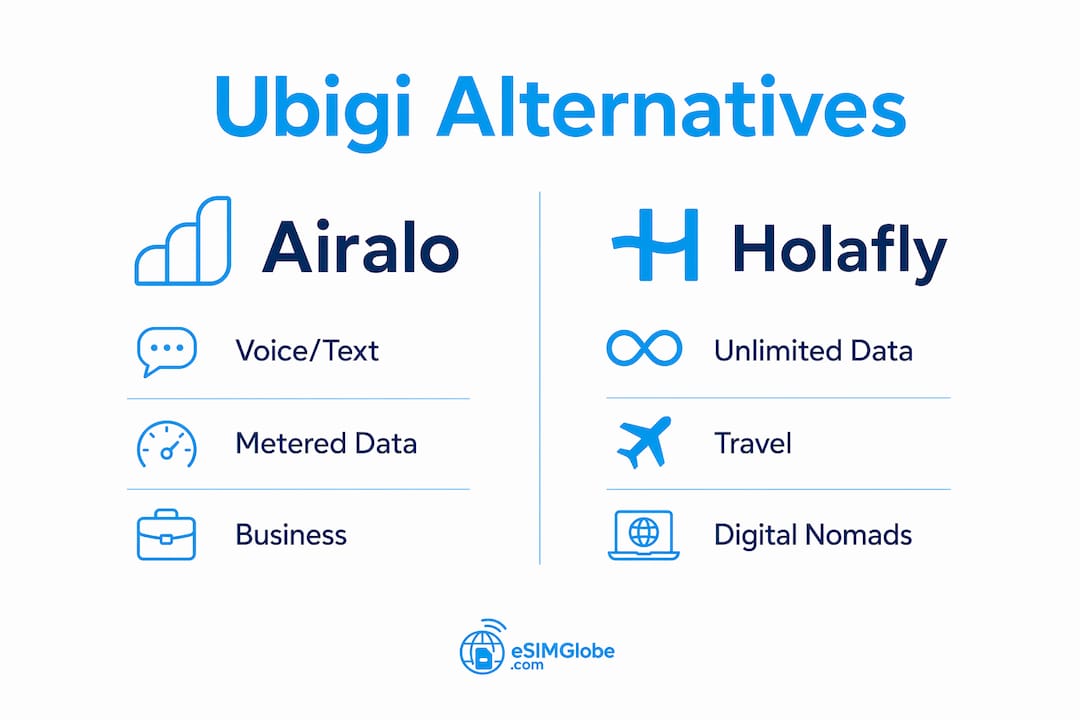
Airalo is the largest eSIM marketplace by country coverage. Its key advantage over Ubigi is the inclusion of voice and text options in select markets. Airalo offers local phone numbers in key markets, a feature Ubigi’s primarily data-only model does not broadly support. That distinction matters most to business professionals who need a reachable local number while abroad.

Holafly targets high-data users. Unlimited data plans ranging from 1 to 90 days are Holafly’s core product, and Ubigi does not match that breadth. Travelers who stream video, join video calls, or work from cafés find Holafly’s flat-rate model less stressful than tracking gigabytes on a metered plan.
Nomad sits between the two, offering regional bundles at competitive prices. Its app is functional but has received mixed reviews for ease of use compared to more polished platforms.
Esimglobe covers all three use cases. The platform offers flexible global eSIM plans with country-specific, regional, and global options, supports multiple currencies including USD, EUR, and GBP, and provides responsive customer support that competitors including Ubigi have struggled to match consistently.
Comparison table: top Ubigi alternatives at a glance
| Provider | Data type | Voice/text | Best for |
|---|---|---|---|
| Airalo | Metered and some unlimited | Yes, select markets | Business users needing a local number |
| Holafly | Unlimited | No | High-data travelers and streamers |
| Nomad | Metered regional bundles | No | Budget-conscious regional travelers |
| Esimglobe | Metered and flexible | Plan-dependent | Travelers, nomads, and professionals |
Pro Tip: If you travel to China frequently, Airalo’s 50GB China plan prices out at $0.98 per GB, which is more competitive than Ubigi’s maximum 25GB China offering. Always check destination-specific pricing before committing to any provider.
How do these Ubigi alternatives perform on speed, coverage, and support?
Network speed is where Ubigi genuinely competes well. Independent speed tests show Ubigi leads in South Korea, the United States, and Vietnam, while Airalo leads in France and the UAE. No single provider wins everywhere. That means your destination list, not brand loyalty, should drive your decision.
Coverage reliability is a separate question from raw speed. A provider can post fast numbers in a capital city and still drop to 3G in secondary cities or rural areas. Esimglobe’s network partnerships prioritize local carrier agreements that maintain consistent speeds across both urban and rural zones, which matters for digital nomads who do not always work from major cities.
Customer support is the area where Ubigi draws the most criticism in independent reviews. Holafly is noted for responsive multilingual support, including Spanish-language service, which Ubigi’s support structure does not match. For travelers who run into activation issues at midnight in a foreign airport, response time is not a minor detail.
Esimglobe addresses support quality directly. The platform is recognized for responsive service for digital nomads and business travelers, with support channels that do not leave you waiting through a 48-hour ticket queue when your data stops working mid-trip.
Data performance summary by provider
| Provider | Speed strength | Coverage depth | Support quality |
|---|---|---|---|
| Ubigi | Strong in 8 of 10 markets tested | Good in major markets | Below average in reviews |
| Airalo | Leads in France, UAE | Very broad country list | Adequate, ticket-based |
| Holafly | Moderate | Good in popular destinations | Strong, multilingual |
| Esimglobe | Consistent across regions | Global with local carrier ties | Responsive, multi-channel |
Pro Tip: Before your trip, run a quick search for your destination plus “eSIM speed test 2026.” Independent bloggers and tech publications regularly publish country-specific results that are more current than any single provider’s marketing claims.
How to choose the right Ubigi alternative for your needs
Picking the best ubigi alternative starts with an honest look at how you actually use mobile data. Most travelers overestimate how much data they need for short trips and underestimate it for longer stays.
-
Assess your trip length and data volume. A weekend city break rarely needs more than 3–5 GB. A month-long remote work stint can burn through 30 GB or more, especially with video calls. Match your plan size to your realistic usage, not your optimistic estimate.
-
Decide whether you need a phone number. Voice and text options are critical for business travelers who receive calls on a local number. Ubigi’s data-only model works for leisure travelers but falls short for professionals. Airalo covers this gap in select markets; Esimglobe’s plan catalog includes options worth checking for your specific destination.
-
Choose between unlimited and metered plans. Unlimited data plans are increasingly practical for heavy users. Metered plans cost less for light users. If you stream music, use GPS navigation constantly, or join daily video calls, unlimited is worth the premium. If you mainly check email and use maps occasionally, a 5–10 GB metered plan saves money.
-
Check device compatibility before purchasing. Not every phone supports every eSIM provider’s network bands. The iPhone 14 and later, Samsung Galaxy S23 and later, and Google Pixel 7 and later all support dual eSIM. Older devices may support only one eSIM profile at a time. Esimglobe’s device compatibility guide lists supported models clearly.
-
Factor in plan flexibility. Some providers lock you into fixed durations. Others let you pause, extend, or top up. For long-term travelers and digital nomads, flexibility in plan duration is often worth paying a small premium over the cheapest fixed option.
Step-by-step process to buy and activate an alternative eSIM
Switching from Ubigi to an alternative eSIM provider takes less than 10 minutes when you follow the right steps. The process is the same whether you choose Esimglobe, Airalo, or Holafly.
-
Confirm your device is unlocked and eSIM compatible. An unlocked device accepts any carrier’s eSIM. A carrier-locked phone will reject the new profile. Check your phone’s settings under “Mobile Data” or “SIM & Network” to confirm eSIM support. The eSIM vs local SIM guide from Esimglobe explains the technical difference clearly.
-
Connect to Wi-Fi before purchasing. You need an active internet connection to download the eSIM profile. Do this before you land at your destination, not after, since you will not have data yet when you arrive.
-
Select your destination and plan. On Esimglobe, use the country selector to find plans for your destination. Compare data sizes, durations, and prices. For multi-country trips, check regional or global plans, which often cost less than buying separate country plans.
-
Complete the purchase and save your QR code. After payment, you receive a QR code by email. Save it to your phone’s photo library or take a screenshot. You will scan this code to install the eSIM profile.
-
Install the eSIM profile. Go to Settings, then “Add eSIM” or “Add Mobile Plan,” and scan the QR code. The profile installs in under a minute. Set the new eSIM as your data line and keep your home SIM active for calls if needed.
-
Monitor your data usage. Most providers offer an app or web dashboard to track remaining data. Esimglobe emphasizes simple data monitoring so you never hit a surprise overage. Check your balance daily on long trips.
Pro Tip: Install and activate your eSIM at home before departure. If anything goes wrong, you have Wi-Fi, time, and customer support available. Activating at the airport under time pressure is where most eSIM mistakes happen.
Common activation errors include scanning an expired QR code (each code works only once), trying to install on a carrier-locked device, or selecting the wrong country plan. If the profile fails to install, contact the provider’s support immediately. Esimglobe’s support team resolves most activation issues within the same session.
Key Takeaways
The best alternative to Ubigi depends on whether you need unlimited data, a local phone number, or stronger customer support, and Esimglobe covers all three gaps better than Ubigi or its main competitors.
| Point | Details |
|---|---|
| Ubigi’s speed advantage is real but limited | Ubigi leads speed tests in 8 of 10 markets but loses in France and the UAE. |
| Unlimited data requires a Ubigi alternative | Holafly and Esimglobe offer unlimited plans that Ubigi does not broadly provide. |
| Business users need voice and text support | Airalo and Esimglobe include phone number options that Ubigi’s data-only model lacks. |
| Activation success depends on preparation | Install your eSIM at home on Wi-Fi before departure to avoid airport activation failures. |
| Esimglobe leads on support and flexibility | Esimglobe provides responsive multi-channel support and flexible plan durations competitors lack. |
Why I think Ubigi’s reputation is overrated for most travelers
Ubigi wins speed benchmarks in a handful of markets, and that single metric has driven a lot of its positive press. But speed is only one variable in a connectivity decision, and for most travelers it is not the deciding one.
I have tested multiple eSIM providers across Europe, Southeast Asia, and Latin America. The moments that actually derail a trip are not slow speeds. They are activation failures at 11 PM, support tickets that go unanswered for two days, and data plans that run out with no easy top-up option. Ubigi’s support structure consistently draws criticism in independent reviews, and its data-only model leaves business travelers without a workable voice solution.
Holafly solves the unlimited data problem but does not include voice. Airalo adds voice in select markets but its pricing for high-data destinations like China is inconsistent. Esimglobe is the provider I recommend to digital nomads and business travelers because it addresses all three gaps: flexible plan types, included voice options where available, and support that actually responds.
The travel trends shaping 2026 point toward longer trips, more remote work abroad, and higher data consumption per traveler. A provider that wins a speed test in Seoul but fails you in customer support in Lisbon is not a good long-term choice. Esimglobe’s global coverage and service consistency make it the stronger pick for anyone planning more than a single short trip.
— Daniele
Esimglobe: the reliable eSIM alternative for global travelers
Esimglobe offers country-specific, regional, and global eSIM plans designed for travelers, digital nomads, and business professionals who need reliable mobile data without roaming charges. The platform supports USD, EUR, and GBP, covers destinations across every major region, and provides customer support that responds when you need it most.
Whether you are replacing Ubigi for a single trip or building a long-term connectivity setup for remote work, Esimglobe’s plan catalog gives you options that match your actual usage. Explore global eSIM plans on Esimglobe and find the right fit for your next destination before you leave home.
FAQ
What is the best alternative to Ubigi for unlimited data?
Holafly offers the broadest range of unlimited data plans, covering durations from 1 to 90 days. Esimglobe also provides flexible unlimited and high-volume options suited to long-term travelers.
Is Airalo a good Ubigi replacement for business travelers?
Airalo is a strong option for business users because it includes local phone numbers and voice/text in select markets, which Ubigi’s data-only model does not offer. Esimglobe provides similar voice-capable plans with broader destination support.
Does Ubigi have faster speeds than its competitors?
Ubigi leads speed tests in markets like South Korea, the United States, and Vietnam, but Airalo outperforms it in France and the UAE. Speed results vary by country, so check destination-specific benchmarks before choosing.
How do I switch from Ubigi to an alternative eSIM provider?
Purchase a new eSIM plan from your chosen provider, scan the QR code in your phone’s eSIM settings, and set the new profile as your active data line. The full process takes under 10 minutes on an unlocked, eSIM-capable device.
Which Ubigi alternative has the best customer support?
Holafly is recognized for responsive multilingual support, and Esimglobe provides multi-channel support that consistently outperforms Ubigi’s ticket-based system in independent user reviews.