






















TL;DR:
- eSIM technology enables instant global activation and multiple profiles for remote workers, reducing reliance on physical SIM cards. It offers cost savings, flexible regional plans, and reliable speeds in urban areas but faces coverage limitations in rural locations due to existing carrier infrastructure. Strategic planning, device compatibility checks, and proactive subscription management are essential for maximizing eSIM benefits during international travel.
Paying $15 per day for international roaming is a fast way to watch your budget disappear before the first client call lands. Traditional SIM cards are the obvious workaround, but hunting down a local carrier shop in a new country every few weeks burns time you could spend working. eSIMs excel for nomads with instant global activation and multi-profile storage, saving hundreds of dollars per year compared to roaming charges. This guide breaks down exactly how eSIMs work, which providers deliver the best value in 2026, what real-world performance looks like outside city centers, and the specific strategies that keep remote workers connected without overspending.
Table of Contents
- What is an eSIM and why does it matter for digital nomads?
- Top eSIM providers for digital nomads: Comparing cost, coverage, and reviews
- Everyday realities: Speed, coverage, and the eSIM experience on the road
- Smart eSIM strategies: Maximizing connectivity, savings, and seamless travel
- What most digital nomads get wrong about eSIMs—and how to really win
- Get started: Your next step to global eSIM freedom
- Frequently asked questions
Key Takeaways
| Point | Details |
|---|---|
| eSIMs unlock flexibility | eSIM solutions let you activate data profiles instantly with no need to swap SIM cards wherever you work. |
| Compare providers smartly | Top eSIM brands differ on price, coverage, speed, and customer reviews—side-by-side comparisons help you choose. |
| Urban speeds meet work needs | Reliable eSIM download rates (35-100+ Mbps) support remote work, but rural performance can vary. |
| Plan for seamless travel | Preload multiple eSIM profiles and have Wi-Fi backup to stay connected across borders and avoid downtime. |
What is an eSIM and why does it matter for digital nomads?
Understanding what is an eSIM starts with one key difference from a standard SIM card. A physical SIM is a small removable chip you insert into a tray. An eSIM is a chip soldered directly onto your phone’s motherboard. Instead of swapping plastic cards, you download a digital profile from a carrier over Wi-Fi. The profile activates a data plan, and you are online within minutes.
For digital nomads, this shift matters for very practical reasons. No more standing in a carrier store trying to explain a prepaid plan through a language barrier. No more SIM card slots getting damaged from constant swapping. No more discovering that the SIM card you bought in Berlin simply does not work in Prague.
Key advantages of eSIM technology for remote workers include:
- Instant activation from anywhere with a Wi-Fi connection, including airports and hotels before you even clear customs
- Multiple profiles stored simultaneously, meaning you can hold a regional eSIM alongside a local plan and switch between them in your phone settings
- Remote plan management, allowing you to top up, change plans, or purchase a new country bundle without visiting any store
- No physical damage risk, since there is no card to lose, bend, or have seized at a border crossing
- Simultaneous dual connectivity on supported devices, keeping your home number active for calls while the travel eSIM handles data
Device compatibility is the first thing to verify before purchasing any eSIM plan. Most flagship smartphones released after 2020 support eSIM, including iPhone XS and later models, Google Pixel 3 and newer, and Samsung Galaxy S20 and above. Many Windows and Mac laptops also support eSIM for cellular data. To check compatibility, go to your phone settings and look for an option labeled “Add cellular plan” or “Add eSIM.” If that option is present, your device is ready. Carrier-locked phones can cause issues, so confirm your handset is unlocked before departure.
Getting familiar with understanding eSIM terms like QR code activation, ICCID numbers, and APN settings will save troubleshooting time when setting up profiles in unfamiliar locations.
Pro Tip: Download your eSIM profile before leaving your home country while on a reliable Wi-Fi connection. Activating a new plan at an airport on spotty public Wi-Fi is a recipe for delays.
Top eSIM providers for digital nomads: Comparing cost, coverage, and reviews
The best eSIM for global travel comes down to three factors: country coverage, price per gigabyte, and verified user experience. The eSIM market in 2026 has matured enough that several providers now compete specifically for the digital nomad segment, each with a different positioning.

Popular providers for digital nomads include Saily, Airalo, Holafly, Nomad, and Maya Mobile. Each targets different user needs.
Provider comparison table
| Provider | Countries | Price per 10 GB (30 days) | Unlimited data | Trustpilot score | Reviews |
|---|---|---|---|---|---|
| Saily | 150+ | ~$20 to $25 | No | 4.7 | 22,000+ |
| Airalo | 200+ | Varies by region | No | 4.3 | 20,000+ |
| Holafly | 160+ | ~$64.90/month | Yes | 4.6 | 84,000+ |
| Nomad | 100+ | ~$59 | No | 4.3 | 31,000+ |
| Maya Mobile | 130+ | Varies | Selective | 4.1 | 8,000+ |
Saily stands out as the most cost-efficient option for moderate data users. Backed by NordVPN’s infrastructure team, it covers 150+ countries and prices a 10 GB plan in Thailand at approximately $22.99 for 30 days. For context, a local Thai SIM with the same data allowance typically runs $8 to $12, so the premium is modest given the convenience of not needing to locate a carrier shop on arrival.
Holafly targets heavy data users who need unlimited plans and want predictable monthly costs. At approximately $64.90 per month for unlimited data in 160+ countries, it makes sense for nomads who run video calls, upload large files, or stream reference content throughout the workday. The Trustpilot score of 4.6 across 84,000 reviews is one of the largest verified review pools in the eSIM industry.
Nomad is positioned for users who want reliable mid-tier performance with solid coverage in Asia and Europe. The price point of $59 for 10 GB over 30 days is higher than Saily, which makes it harder to justify for budget-focused nomads unless Nomad’s specific coverage in your destination countries is stronger.
Annual cost comparison for a nomad using 10 GB per month:
- Saily: $240 to $300 per year
- Nomad: approximately $708 per year
- Holafly unlimited: approximately $779 per year
- International roaming (carrier average): $1,800 to $3,600 per year
The savings over roaming are substantial regardless of which eSIM provider you choose. The real decision is matching your data habits and travel circuit to the right plan structure.
Key essential eSIM facts that affect purchasing decisions include whether a provider uses data throttling after a soft cap, whether they support 5G or only 4G LTE, and whether regional bundles exist for multi-country routes like Southeast Asia or the Schengen zone.
Pro Tip: Look for providers that offer free trials or low-cost short-term plans for a new destination before committing to a 30-day bundle. Testing actual speeds in your specific city before a long-term purchase avoids expensive surprises.
Statistic callout: Annual eSIM costs for a digital nomad using 10 GB per month average $240 to $300 with budget providers, compared to $1,800 or more in standard international roaming fees.
Everyday realities: Speed, coverage, and the eSIM experience on the road
Specs on a provider’s website rarely match what you experience when your Zoom call drops mid-presentation in a rural co-working space. Understanding the gap between advertised performance and actual usage conditions is critical for anyone depending on connectivity for income.
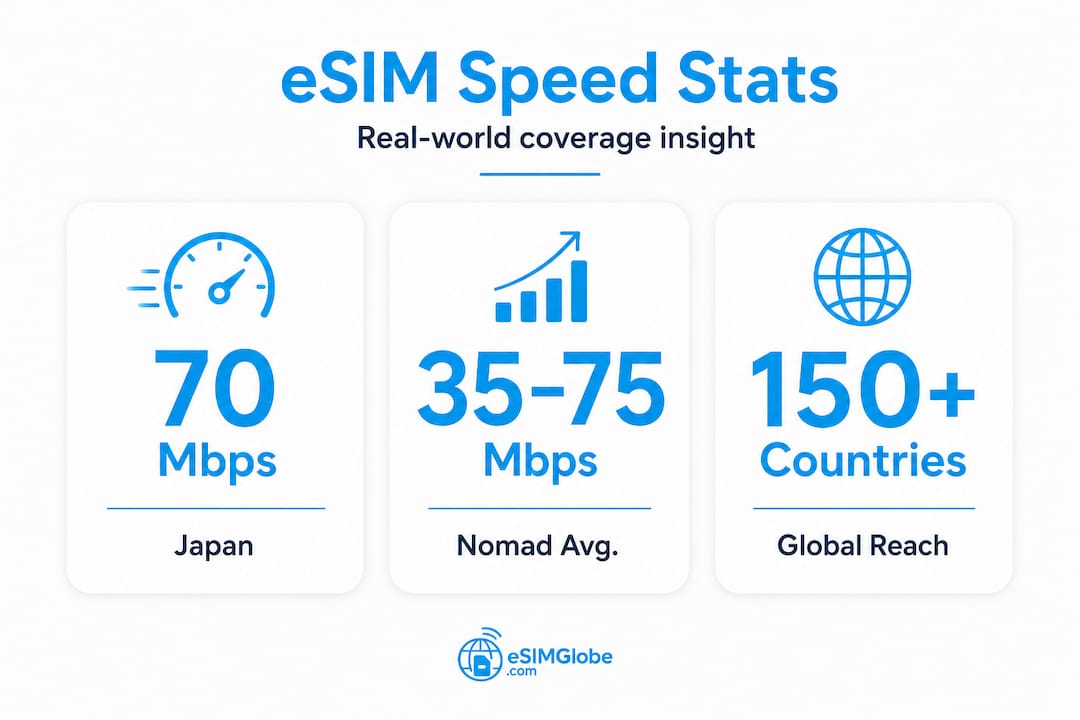
Real-world speed tests show Nomad eSIM averaging 35 to 75 Mbps download, with Japan consistently hitting 70 Mbps. Saily tests range from 50 to 95 Mbps in urban environments. Both figures are more than sufficient for standard remote work requirements.
What these speeds mean for common work tasks
| Task | Minimum speed needed | eSIM urban speed | Status |
|---|---|---|---|
| Zoom HD video call | 3.8 Mbps | 35 to 95 Mbps | Reliable |
| Google Meet with screenshare | 3.2 Mbps | 35 to 95 Mbps | Reliable |
| Uploading 500 MB files | 5 to 10 Mbps | 35 to 95 Mbps | Fast |
| 4K streaming | 25 Mbps | 35 to 95 Mbps | Manageable |
| Basic VoIP calls | 0.1 Mbps | 35 to 95 Mbps | No issues |
The picture changes outside major cities. Rural and remote coverage is inconsistent for eSIMs, with speeds dropping well below Zoom-viable thresholds in areas where the underlying partner network operates on legacy 3G infrastructure. eSIM providers do not own physical towers. They lease access from local carriers through roaming agreements. If that local carrier has poor coverage in a region, your eSIM inherits those limitations.
“In urban areas, 35 to 100+ Mbps is sufficient for Zoom, maps, and hotspot use, but inconsistent rural speeds and higher cost than local SIMs in some cases, such as Turkey, mean troubleshooting is harder remotely compared to physical SIM shops.” — Nomad eSIM Review
Common troubleshooting scenarios and solutions:
- Profile not activating after scanning QR code. Restart the device after scanning. If it still fails, delete the profile and re-scan on a different Wi-Fi network. Public airport Wi-Fi sometimes blocks eSIM activation servers.
- Data connected but no internet. Manually set the APN (Access Point Name) in your network settings. Your provider’s support page will list the correct APN for each country.
- Roaming not enabled. eSIM data plans require data roaming to be switched on in your device settings, even when the eSIM is your primary data source.
- Slow speeds despite good signal bars. Signal strength and network congestion are different things. Run an Ookla speed test and compare against the provider’s published benchmarks for that country. If speeds are far below average, contact support to check for network issues.
- Plan expired mid-month. Most eSIM plans run on calendar days, not usage days. A 30-day plan purchased on the 5th of the month expires on the 4th of the following month regardless of how much data you used.
Knowing the best eSIM travel practices for each destination type reduces the chance of a critical connectivity failure during working hours. For extended stays in a single country beyond 60 days, a local SIM remains the more cost-effective and reliable choice in most markets. The eSIM vs local SIM decision depends heavily on how long you plan to stay and whether your destination has a competitive local carrier market.
Smart eSIM strategies: Maximizing connectivity, savings, and seamless travel
Knowing which provider to choose is only part of staying productive on the road. The specific steps you take before, during, and between destinations determine whether your connectivity is reliable or a constant source of friction.
Expert guidance for digital nomads emphasizes prioritizing providers with 5G access, regional multi-country plans for frequent circuits like Europe’s 39-country Schengen zone, real-time usage tracking apps, and plans without daily data caps that would throttle a heavy work session.
Step-by-step eSIM strategy for digital nomads:
-
Audit your monthly data usage before choosing a plan. Check your current phone’s data settings to see your average monthly consumption. Most remote workers use 8 to 15 GB per month for video calls, file transfers, and general browsing. Unlimited plans only make financial sense above approximately 12 GB per month.
-
Purchase your destination eSIM profile before departure. Many providers allow you to buy and install a profile days in advance while delaying activation. Set the activation to trigger on arrival or upon first network use. This means you are online the moment you land.
-
Run an Ookla speed test within the first hour of arrival. Do this before your first scheduled call or work block. If speeds are below 10 Mbps, switch to a different network band in your phone settings (toggle between 5G and LTE) or contact support to troubleshoot.
-
Enable real-time data usage tracking in your provider’s app. Most major eSIM providers offer dedicated apps that show live data consumption. Set a usage alert at 80% of your plan to avoid surprise overages.
-
Preload regional bundle profiles for upcoming countries. If you are moving from Spain to Portugal to France within a month, load all three country profiles or one European regional plan before you start the journey. Switching between active profiles in your settings takes under 30 seconds once they are installed.
-
Keep a backup plan ready. Download a low-cost backup eSIM profile for each destination, or identify the nearest co-working space with guaranteed Wi-Fi. Coffee shops and hotels vary too much in connection quality to rely on as a primary work location.
-
Monitor for hidden caps in “unlimited” plans. Read the fair usage policy for any unlimited plan. Most throttle speeds to 1 to 3 Mbps after 10 to 20 GB of high-speed usage in a single day. For a Zoom call, 3 Mbps is borderline. For a large file upload, it will time out.
-
Use offline tools for mission-critical work. Keep local copies of your key documents, project files, and communication threads. Apps like Google Docs, Notion, and Slack all offer offline modes. If connectivity drops during a commute or in a rural area, you can keep working and sync when back online.
Pro Tip: Check eSIM travel tips for destination-specific advice before each trip. Coverage quality varies significantly by country and even by city within the same country. Reading recent reviews from the past 30 to 60 days gives a more accurate picture than a provider’s general marketing claims.
A particularly effective cost-saving approach is using regional eSIM plans rather than individual country plans. A single Europe-wide plan covering 39 countries typically costs 20 to 35% less than purchasing separate country plans for each stop. For nomads running a standard circuit through Western Europe or Southeast Asia, this approach reduces both cost and administrative overhead.
What most digital nomads get wrong about eSIMs—and how to really win
Most conversations about eSIMs for digital nomads focus on how much cheaper they are than roaming. That framing is accurate but incomplete, and it leads to a set of predictable mistakes that cost nomads both money and productivity.
The first mistake is ignoring country-specific compatibility and coverage gaps. eSIM plans excel for nomads with instant activation and multi-profile storage, but coverage maps should be cross-referenced against recent community reviews, not just the provider’s official documentation. In practice, a provider showing “coverage” in a country may be leasing access from a rural carrier with 3G infrastructure. The official coverage map still shows a green checkmark.
The second and more damaging assumption is that “unlimited” means unlimited. Fair usage policies are standard across every major eSIM provider. After a threshold of high-speed data, usually 10 to 20 GB depending on the plan, speeds drop to 1 to 3 Mbps. For reference, a standard HD Zoom call needs around 3.8 Mbps. Hitting the throttle threshold during a client presentation is a professional liability.
The third gap is over-relying on eSIMs for high-stakes professional moments. Inconsistent rural speeds and technical troubleshooting challenges make eSIMs a less predictable single point of failure for job interviews, live webinars, or contract negotiations in a country you have just arrived in. The nature of eSIM troubleshooting is that it happens through apps and support tickets, not by walking into a store. For genuinely mission-critical calls, a hotel ethernet connection or a verified co-working space with dedicated fiber is worth booking.
The fourth, and most underrated, opportunity is the hybrid eSIM-local SIM approach. How eSIM is transforming mobile plans is a gradual process, and local SIM cards still win on price in many markets. In Turkey, for example, a local SIM delivers better speeds and costs significantly less than most international eSIM providers. Running a local SIM for data in a country where you stay three weeks or more, while keeping an eSIM active for your home number and inter-country transitions, is a practical strategy that most nomads overlook entirely.
The pattern in all four mistakes is the same: treating eSIM as a universal solution rather than a powerful tool with specific optimal use cases. The nomads who spend less and stay more consistently connected are the ones who match the tool to the situation rather than defaulting to a single approach for every destination.
Get started: Your next step to global eSIM freedom
Reliable mobile connectivity for remote work is not a luxury at this point. It is a baseline operational requirement.
Explore EsimGlobe to find eSIM plans covering 200+ countries and regions, with options in USD, EUR, and GBP and interfaces in multiple languages. EsimGlobe is built specifically for travelers and digital nomads who need straightforward access to verified digital eSIM profiles without navigating complex carrier portals. Whether you are looking for a single-country plan before a two-week stay or a multi-region bundle for a full nomad circuit, the eSIM worldwide guide provides updated coverage information and plan comparisons for 2026. Check available plans, confirm device compatibility, and have your eSIM profile installed and ready before your next departure.
Frequently asked questions
Is eSIM really cheaper than local SIM cards for digital nomads?
eSIMs offer significant savings over roaming but can be costlier than local SIMs in specific regions such as Turkey. Always compare per-destination rates before committing to a plan.
How do I know if my device supports eSIM?
Go to your phone’s cellular settings and look for an “Add eSIM” or “Add cellular plan” option. You can also check your device’s official spec sheet on the manufacturer’s website.
Can I use multiple eSIMs when traveling?
Yes. Many phones allow you to store and switch between multiple active profiles, and multi-profile storage is one of the core advantages of eSIM technology for international travelers.
What features make an eSIM provider best for remote work?
Prioritize providers with 5G access, regional multi-country plans, transparent speed benchmarks, no daily data caps, and real-time usage tracking apps to manage consumption during heavy work sessions.
How fast are eSIM data speeds compared to regular SIM cards?
Urban eSIM speeds range from 35 to 100+ Mbps depending on provider and destination, which matches or exceeds most local SIM options in the same network environment.