






















TL;DR:
- eSIM technology allows travelers to activate local or regional data plans digitally, eliminating the need for physical SIM cards and reducing roaming costs. It offers quick activation via QR codes or apps, supports multiple profiles, and provides flexible plan options suited for individual destinations or multi-country trips. By switching carriers through software, travelers can stay connected more affordably and conveniently abroad, transforming international travel connectivity.
Arriving in a new country and scrambling to find a local SIM card vendor, only to discover the shop is closed or the language barrier makes the process nearly impossible, is a familiar frustration for frequent travelers. Roaming charges from home carriers can turn a two-week trip into a financial surprise, with data bills sometimes reaching hundreds of dollars. eSIM technology changes this equation entirely. By allowing travelers to activate a local or regional data plan digitally, without touching a physical card, eSIMs offer a faster, more flexible, and often more affordable path to staying connected abroad.
Table of Contents
- Understanding eSIM: The basics explained
- How eSIM streamlines travel connectivity
- eSIM vs. traditional SIM: Side-by-side for travelers
- Practical eSIM setup: What travelers need to know
- Why most travelers underuse eSIMs—and what they’re missing
- Travel smarter: Start your eSIM journey today
- Frequently asked questions
Key Takeaways
| Point | Details |
|---|---|
| What eSIM means | An eSIM is an embedded digital SIM that lets you add carrier plans without a physical card. |
| Travel convenience | Activate local or global data plans on your device instantly, avoiding SIM swaps and airport kiosks. |
| Cost savings | eSIM lets you bypass high roaming fees by accessing regional or local plans wherever you land. |
| Setup essentials | Check device compatibility, scan a QR code or use an app, and manage your plan in device settings. |
| Why most miss out | Many travelers underuse eSIMs because they overestimate setup difficulty and undervalue flexibility. |
Understanding eSIM: The basics explained
An eSIM, short for embedded SIM, is a small chip soldered directly into a device’s circuit board. Unlike a traditional SIM card that you physically insert and remove, the eSIM is permanently fixed inside the phone, tablet, or smartwatch. What makes it functional across different carriers is not hardware but software: a digital profile that tells the device which network to connect to and how to authenticate.
The term “embedded” refers to this permanent physical placement. The chip itself is called an eUICC, which stands for embedded Universal Integrated Circuit Card. The eUICC can store multiple operator profiles at once, meaning a single device can hold plans from different carriers without needing multiple physical cards.
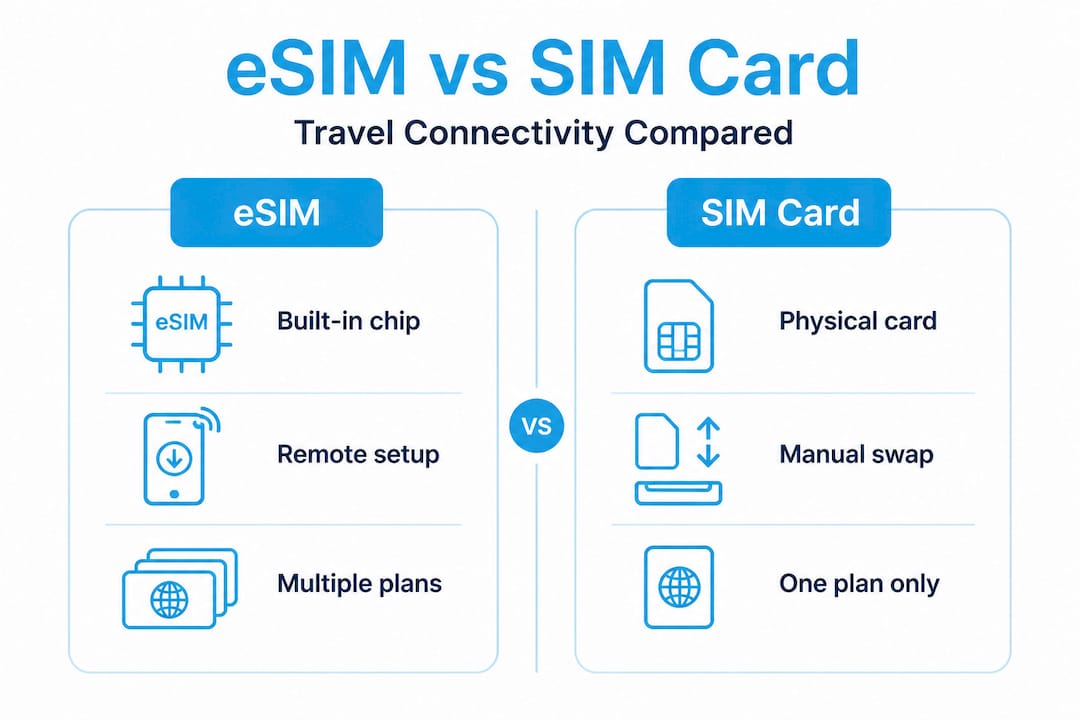
How profile provisioning works
The process that makes eSIMs useful for travelers is called remote provisioning. When you purchase an eSIM plan, the provider sends a digital profile to your device over the internet. According to the GSMA SGP.22 specification, eSIMs work by remotely provisioning an operator profile into the embedded SIM, which then lets the phone authenticate to the mobile network. This process is managed through a standardized architecture that also handles security functions and profile storage segregation, keeping each carrier’s data separate and protected.
This remote management capability is what separates eSIM from every previous generation of SIM technology. With a physical SIM, changing carriers means physically obtaining a new card. With an eSIM, switching is a software operation.
Key features of eSIM technology:
- Profiles are downloaded and installed over a data or Wi-Fi connection
- Multiple profiles can be stored on a single eUICC chip
- Users can switch between active profiles through device settings
- Profiles can be deleted and replaced without any physical action
- The chip meets international security standards defined by the GSMA
For more context on the fundamentals, the essential eSIM facts resource covers what every traveler should understand before their first eSIM activation.
eSIM adoption by the numbers
The global eSIM market has expanded rapidly. Industry analysts project that billions of eSIM-enabled devices will be in active use by the mid-2020s, driven by smartphone manufacturers including Apple, Samsung, and Google all standardizing eSIM support across flagship and mid-range models. This growth reflects both consumer demand for flexibility and carrier investment in the infrastructure needed to support remote provisioning at scale.
The key takeaway for travelers: you can now switch carriers and activate data plans without ever holding a physical SIM card in your hand. That single fact changes how international connectivity works.
How eSIM streamlines travel connectivity
After understanding eSIM technology at its core, let’s see how it transforms real-life travel experiences.
The most immediate benefit for travelers is time. Under the old model, arriving in a foreign country meant finding a carrier store or airport kiosk, waiting in line, presenting a passport, paying in local currency, and hoping the staff could configure the SIM correctly. With eSIM, that entire process is replaced by a QR code scan or a few taps in an app, often completed before the flight even departs.

Cost savings are measurable
Carrier roaming fees remain one of the most unpredictable travel expenses. A single day of international roaming on a standard home carrier plan can cost more than an entire week of local eSIM data. For international travelers and digital nomads, eSIMs are often used to get local or regional data plans without waiting for a physical SIM on arrival, directly reducing the need for costly carrier roaming. The savings compound quickly on longer trips or multi-country itineraries.
Plan flexibility by destination
eSIM providers typically offer three types of plans for travelers:
| Plan type | Best for | Coverage scope |
|---|---|---|
| Local eSIM | Single-country trips | One country only |
| Regional eSIM | Multi-country trips in one region | Europe, Asia, Americas, etc. |
| Global eSIM | Frequent travelers, digital nomads | Worldwide or near-worldwide |
Choosing the right plan type depends on your itinerary. A two-week trip through five European countries calls for a regional plan. A one-month stay in Japan works well with a local plan. A digital nomad moving between continents every few weeks benefits most from a global plan.
Understanding how eSIM data plans work in detail helps travelers match their usage patterns to the right plan structure before departure.
Step-by-step: How travelers typically manage eSIM connectivity
- Check device compatibility using the manufacturer’s eSIM support page before purchasing any plan
- Research eSIM providers that cover your destination country or region
- Purchase the appropriate plan online, at least 24 hours before departure
- Receive the QR code or activation code by email or within the provider’s app
- Scan the QR code in device settings under “Add eSIM” or “Add Mobile Plan”
- Label the new plan (for example, “Japan Trip” or “Europe Data”) to avoid confusion
- Set the eSIM as the default data line in device settings upon arrival
- Monitor data usage through the provider’s app or device settings
- Top up or switch to a new plan if your itinerary changes mid-trip
Pro Tip: Always activate your eSIM while still connected to Wi-Fi at home or at the airport. Some plans require an initial internet connection to complete the provisioning process, and doing this before you land ensures you have data the moment you step off the plane.
For practical guidance on staying connected affordably, the eSIM travel tips resource covers real-world scenarios from budget travelers and frequent flyers alike.
eSIM vs. traditional SIM: Side-by-side for travelers
To make a truly informed choice, it’s important to see how eSIMs stack up against physical SIM cards across the criteria that matter most to travelers.
Comparison table: eSIM vs. physical SIM for travelers
| Criteria | eSIM | Physical SIM |
|---|---|---|
| Activation method | Digital, via QR code or app | In-person at carrier store or kiosk |
| Setup time | Minutes, before or after landing | 30 minutes to several hours |
| Switching carriers | Software operation, instant | Requires new physical card |
| Number of plans | Multiple stored simultaneously | One at a time per slot |
| Risk of loss or damage | None (chip is embedded) | Card can be lost, damaged, or stolen |
| Availability | Requires compatible device | Works on virtually any phone |
| Local pricing access | Yes, through eSIM providers | Yes, but requires local purchase |
| Coverage options | Local, regional, or global plans | Typically local or national only |
“eSIMs can be activated digitally, letting you connect instantly and skip the hassle of buying a SIM card abroad.” CNET
Travel scenarios where eSIM wins clearly:
- Multi-country European or Southeast Asian itineraries where buying a new SIM at each border is impractical
- Remote work arrangements requiring reliable data across changing locations each week
- Short layovers in transit cities where there’s no time to visit a carrier shop
- Travelers who carry devices without a spare SIM slot
- Business travelers who need to maintain a home number while using local data
When a physical SIM still makes sense:
Physical SIMs are not obsolete. In some countries, local carriers offer extremely competitive prepaid plans that are only available in-store and not accessible through eSIM providers. Travelers visiting a single destination for an extended period, particularly in markets where eSIM infrastructure is still developing, may find a physical SIM offers better value or broader network access. Older devices that predate eSIM support also require physical cards by default.
The eSIM vs local SIM guide breaks down specific country scenarios to help travelers decide which approach fits their situation. For a broader look at connectivity options, the best SIM cards abroad resource covers both eSIM and physical SIM options by region for 2026.
The core advantage eSIM holds is the elimination of the SIM swap process entirely. No physical card means no risk of losing it, no fumbling with a SIM ejector tool in a foreign airport, and no dependence on a local store being open when you land.
Practical eSIM setup: What travelers need to know
Now that you know the pros and cons, here’s how you can get started with eSIM in practice.
Step 1: Confirm your device supports eSIM
Not every phone supports eSIM, and support varies by model and region. Apple iPhones from the XS onward generally support eSIM, though some models sold in China use dual physical SIM slots instead. Samsung Galaxy S series phones from 2019 onward typically include eSIM support. Google Pixel phones from the Pixel 3 onward are eSIM compatible. The safest approach is to check the manufacturer’s official specifications page for your exact model and country of purchase.
Within your device settings, look for “Mobile Data,” “SIM & Network,” or “Connections” depending on your operating system. If an “Add eSIM” or “Add Mobile Plan” option appears, your device supports it.
Step 2: Choose a provider and plan
Selecting a reputable eSIM provider matters for both reliability and support. Look for providers that clearly list the networks they partner with in your destination country, publish data speed information, and offer customer support in your language. Plan pricing varies significantly: regional plans covering all of Europe for 10GB can range from $15 to $40 depending on the provider and validity period.
Step 3: Activate your eSIM
eSIM management is software-centric: you typically install and activate via QR code or an app, then manage which line handles data and calls in the phone’s settings. Device compatibility is a key part of making this work smoothly. The activation steps generally follow this sequence:
- Open device settings and navigate to the mobile or cellular section
- Select “Add eSIM” or “Add Mobile Plan”
- Choose to scan a QR code (point camera at the code from your provider’s email)
- Alternatively, enter an activation code manually if QR scanning fails
- Wait for the profile to download, typically 30 to 90 seconds on a stable connection
- Name the new plan to distinguish it from your home SIM
- Set the new eSIM as your default data line
- Confirm calls and SMS routing if your device asks
Step 4: Troubleshoot if needed
Activation failures are usually caused by one of three issues: a weak internet connection during download, an incorrect activation code entry, or a device that is still carrier-locked. If activation fails, restart the device and try again on a stronger Wi-Fi connection. If the problem persists, contact the eSIM provider’s support team with your order details.
Pro Tip: Before traveling, note how to switch your default data line back to your home SIM in device settings. If you need to receive a verification code via SMS from your bank or home service, your home SIM needs to be active for calls and texts, while the eSIM handles data.
For a broader look at preparation, eSIM travel practices covers pre-departure checklists and in-trip management strategies. If any technical terms in this guide are unclear, understanding eSIM terms provides plain-language definitions for the most commonly misunderstood concepts.
Device compatibility summary by brand:
- Apple: iPhone XS, XR, and all later models (except some China-market variants)
- Samsung: Galaxy S20 series and later, Galaxy Z Fold and Flip series
- Google: Pixel 3 and all later models
- Other brands: Motorola Razr series, select Huawei models, and various newer mid-range Android devices
Always verify before purchasing a plan. Buying an eSIM for an incompatible device results in a plan you cannot use.
Why most travelers underuse eSIMs—and what they’re missing
Having explained the step-by-step setup, let’s explore why so many travelers still overlook eSIM advantages.
The most common reason is a misconception about complexity. Many travelers assume that because eSIM is newer technology, it must be harder to use than a physical SIM. The opposite is true. Scanning a QR code and waiting 60 seconds for a profile to download is objectively simpler than finding a carrier store in a foreign city, navigating a language barrier, and waiting for a staff member to configure a card manually.
A second misconception is that eSIM devices are rare or expensive. As of 2026, eSIM support is standard across virtually every flagship smartphone released in the past three years. The majority of travelers already own a compatible device without knowing it.
The deeper issue is that many travelers treat connectivity as an afterthought, something to sort out after landing rather than before departure. This reactive approach leads directly to airport kiosk purchases at inflated prices or defaulting to home carrier roaming because it feels like the path of least resistance. The real cost of that choice shows up on the next credit card statement.
What eSIM actually enables, beyond the convenience argument, is active management of connectivity costs. A traveler who understands their options can select a 7-day regional plan for a short trip, top up mid-trip if needed, and switch to a different provider in the next country without any physical logistics. That level of control was not possible before eSIM.
For digital nomads specifically, the ability to save money with eSIM is not just a convenience feature. It is a meaningful operational advantage. A nomad spending $200 per month on roaming charges instead of $30 to $50 on regional eSIM plans is leaving real money behind, month after month.
The travelers who benefit most from eSIM are not necessarily the most tech-savvy. They are simply the ones who took 15 minutes before a trip to understand their options. The setup is straightforward enough that first-time users rarely need to repeat it twice before it becomes routine.
Travel smarter: Start your eSIM journey today
If you’re ready to avoid SIM hassles and access reliable data wherever your itinerary takes you, EsimGlobe provides a straightforward starting point.
EsimGlobe offers eSIM plans covering destinations across every major travel region, with options in USD, EUR, and GBP to match your preferred currency. The platform’s country and region selector makes it simple to find a compatible plan for your next destination, whether that’s a single country or a multi-region itinerary. Plans can be purchased and activated before departure, so you arrive connected rather than searching for a SIM vendor. Explore available plans at esimglobe.com and find the option that fits your travel dates, data needs, and budget. Setup resources are available for first-time users alongside plan details.
Frequently asked questions
How do I know if my phone supports eSIM?
Check your phone manufacturer’s website or look in your device settings for an “Add eSIM” option. Most flagship models released from 2020 onward support eSIM, though availability varies by region and carrier lock status.
Can I use both eSIM and physical SIM at the same time?
Yes, most eSIM-enabled phones support dual SIM functionality, allowing both a physical SIM and an eSIM to be active simultaneously. This is useful for keeping your home number active while using a local data plan abroad.
Is eSIM more secure than a traditional SIM card?
The GSMA SGP.22 specification defines security functions and profile storage segregation within the eUICC, meaning eSIM profiles are stored securely and cannot be physically removed or stolen like a traditional SIM card.
Will switching to eSIM save me money on roaming charges?
Yes, in most cases significantly. Local or regional eSIM plans typically cost far less than standard carrier roaming rates, particularly for data-intensive travel involving streaming, video calls, or navigation.
Can I keep my regular number when using an eSIM abroad?
Yes. With dual SIM support, your home number remains active on your physical SIM for calls and texts, while the eSIM handles local data. You do not need to give up your existing number to use an eSIM while traveling.