






















TL;DR:
- Instant eSIM delivery enables rapid, digital provisioning of mobile profiles to compatible devices within minutes, eliminating physical SIMs and shipping delays. The process involves secure server communication, QR code scanning, and profile download, offering travelers and users immediate carrier flexibility and cost savings. Unlike traditional SIMs, instant eSIMs support multiple profiles, reduce environmental impact, and streamline international connectivity without store visits or wait times.
Instant eSIM delivery is the process of digitally provisioning a mobile network profile to your device within minutes via secure remote activation, eliminating the need for physical SIM cards or postal delivery. The industry term for this technology is remote SIM provisioning (RSP), and it operates through a secure server infrastructure called SM-DP+ (Subscription Manager Data Preparation Plus). When you buy an eSIM online, the provider generates an encrypted profile and delivers it to you as a QR code or activation link, often within seconds of purchase. Platforms like Esimglobe have built their entire service model around this instant delivery capability, making it the standard for travelers and digital nomads who need mobile connectivity without delays.
What is instant eSIM delivery and how does it work technically?
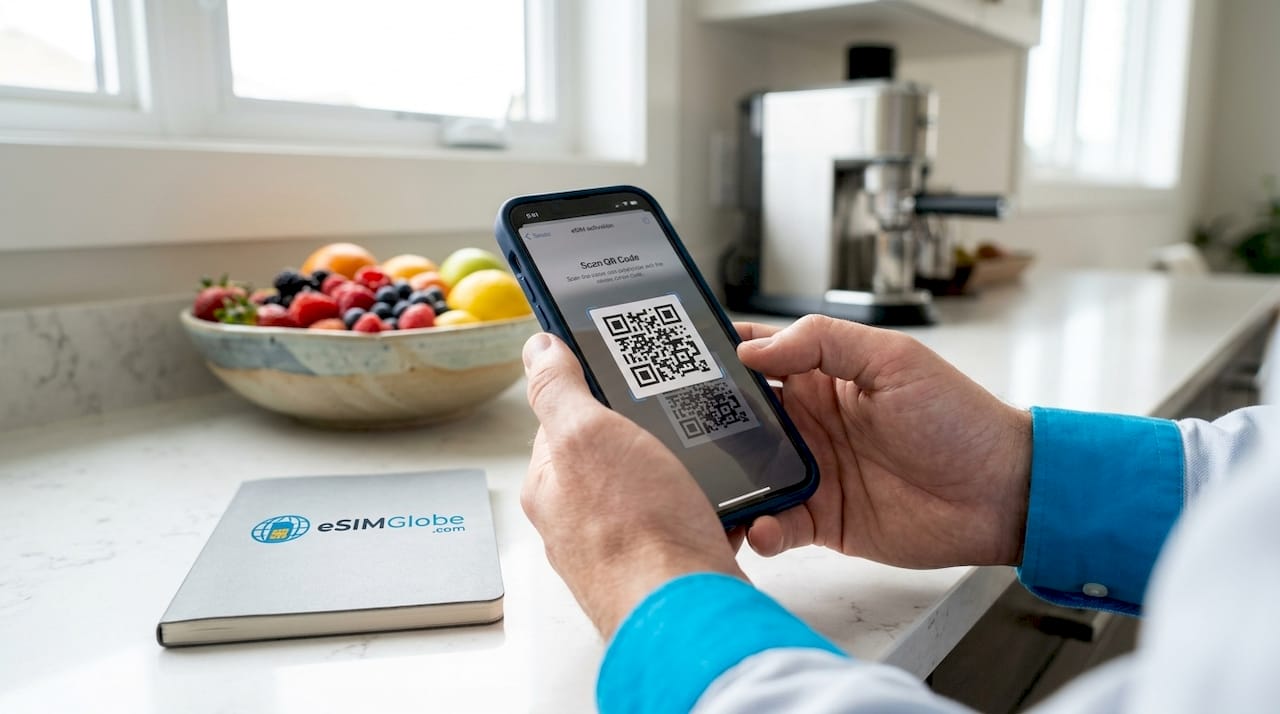
Remote SIM provisioning works through a specific sequence of events that begins the moment you complete a purchase and ends with your device connected to a live network. The SM-DP+ server acts as a secure warehouse and provisioning engine, generating, encrypting, storing, and delivering mobile subscription profiles over HTTPS/TLS protocols with device validation via unique identifiers like EID. This server is the backbone of every instant eSIM delivery transaction, and understanding its role removes most of the confusion people have about how the process actually functions.
A critical misconception to address upfront: the QR code is not the eSIM itself. It is an access key that instructs your device where and how to retrieve the encrypted eSIM profile securely. The profile is then downloaded, decrypted, and installed into your device’s embedded SIM chip, known as the eUICC (embedded Universal Integrated Circuit Card), enabling network authentication and connection.
Here is the step-by-step activation flow on a compatible device:
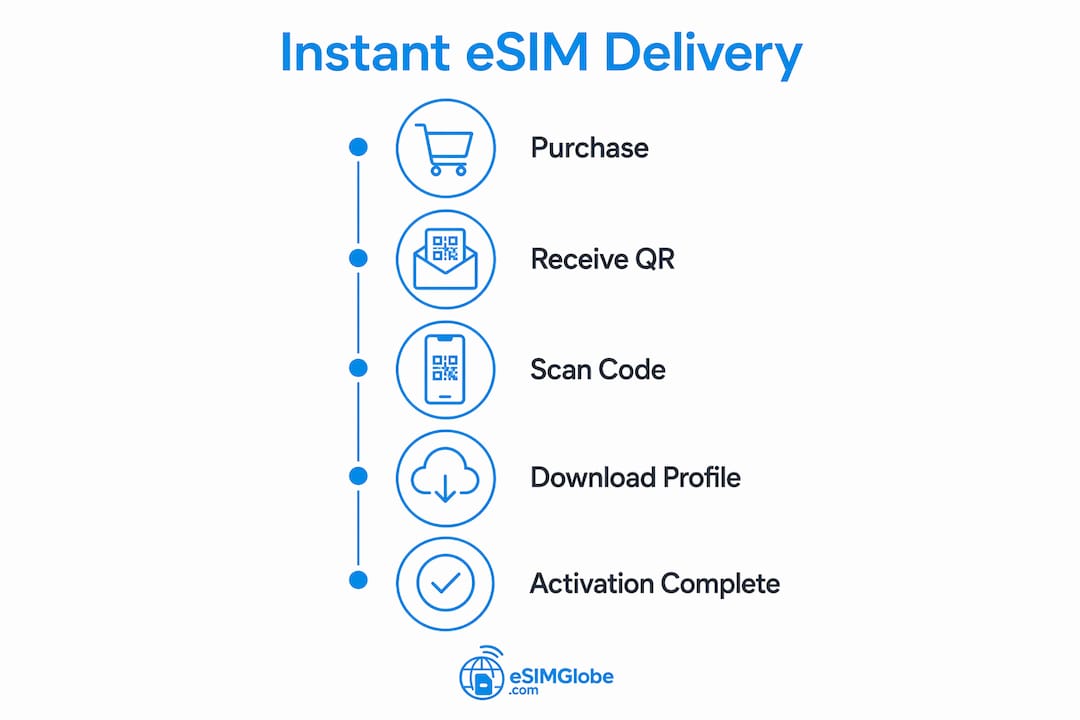
- Purchase and profile generation. You buy an eSIM plan online. An API call triggers automated profile creation and sends you an email or app notification with a QR code within seconds.
- QR code scanning. You open your device’s cellular settings and scan the QR code. The code contains the SM-DP+ server address and your unique activation credentials.
- Server contact and authentication. Your device contacts the SM-DP+ server over a secure connection. The server validates your device’s EID and confirms the profile is ready for download.
- Profile download and installation. The encrypted eSIM profile transfers to your device’s eUICC chip. This step typically completes in under a minute on a stable Wi-Fi or cellular connection.
- Network activation. Your device registers with the carrier network using the installed profile. Apple iPhone eSIM setup typically completes this entire flow within 30 seconds to a few minutes after scanning the QR code.
Pro Tip: Scan your QR code before you travel, not at the airport. You need an internet connection to download the profile, and airport Wi-Fi is unreliable. Activate at home on your own Wi-Fi and the eSIM will be ready the moment you land.
The instant delivery element focuses on the digital transmission of activation credentials, not on eliminating the activation process entirely. Users still complete a brief on-device setup, but the total time from purchase to connected status is measured in minutes rather than days.
What are the benefits of instant eSIM delivery for users?
The advantages of instant eSIM delivery over traditional SIM distribution are concrete and measurable. Immediate activation, carrier flexibility, multi-profile support, and encrypted digital provisioning each address a specific pain point that physical SIM cards cannot solve.
Here is a breakdown of the primary benefits:
- Zero wait time. There is no manufacturing lead time, no shipping window, and no store visit required. You receive your activation credentials within seconds of purchase and can be connected within minutes.
- No physical hardware. Devices with eUICC chips do not need a SIM tray or a physical card. This matters for travelers who have lost or damaged SIM cards in transit, and for devices like the Apple Watch Ultra or newer iPad models that have no SIM slot at all.
- Multiple profiles on one device. Most modern smartphones support storing several eSIM profiles simultaneously. A business traveler can maintain a home carrier profile and a local data profile for each country visited, switching between them in device settings without swapping cards.
- Carrier flexibility. Switching plans or providers requires no physical exchange. You delete one profile and download another, entirely within your phone’s settings menu.
- Encrypted security. Every profile delivered through the SM-DP+ infrastructure is encrypted end-to-end. There is no physical card to clone, steal, or lose.
- Roaming cost reduction. Travelers can add local eSIM plans instantly upon arrival, bypassing international roaming charges entirely. This is the single most financially significant benefit for frequent international travelers.
The user experience of instant eSIM provisioning can feel zero-touch because automated backend API calls trigger profile generation and instant delivery via email or app notifications. From the user’s perspective, the process feels closer to downloading an app than setting up a phone plan.
How does instant eSIM delivery compare with traditional SIM delivery?
Physical SIM card distribution requires manufacturing, quality testing, packaging, stocking at retail or postal facilities, shipping to the customer, and physical insertion into the device. Each step adds time, cost, and potential failure points. Instant eSIM delivery eliminates every one of those steps.
| Factor | Physical SIM | Instant eSIM delivery |
|---|---|---|
| Delivery time | 1 to 7 business days | Seconds to minutes |
| User effort | Store visit or mail wait, physical insertion | QR code scan or activation link tap |
| Environmental impact | Plastic card, packaging, shipping emissions | Zero physical waste |
| Carrier switching | New card required | Profile swap in device settings |
| Scalability for providers | Limited by logistics capacity | API-driven, scales instantly |
| Device compatibility | Universal | Requires eUICC-compatible device |
Instant eSIM technology disrupts traditional SIM supply chains by enabling service providers to offer rapid, API-driven digital onboarding that reduces costs and improves user experience. Carriers can generate and deliver eSIM profiles instantly upon order with minimal manual intervention, which directly supports customer retention and faster market expansion.
The operational savings for carriers and MVNOs are significant. Removing manufacturing, stocking, and shipping processes lowers operational expenses and allows providers to scale without proportional increases in logistics overhead. Those savings can translate to more competitive pricing for end users.
Two limitations are worth stating clearly. First, instant eSIM delivery requires a device with an embedded eUICC chip. Older smartphones, budget Android devices, and many feature phones do not qualify. Second, activation requires a network or Wi-Fi connection to download the profile. Without internet access, the profile cannot be retrieved, so planning ahead matters.
Pro Tip: Before purchasing any eSIM plan, confirm your device model supports eSIM by checking the manufacturer’s specifications page. Apple lists every eSIM-compatible iPhone model on its support site, and Samsung maintains a similar compatibility list for Galaxy devices.
How can travelers benefit from instant eSIM delivery internationally?
International travelers represent the clearest use case for instant eSIM delivery. The ability to purchase and activate a local data plan before boarding a flight, or within minutes of landing, removes one of the most frustrating parts of international travel: finding a working SIM card in an unfamiliar country.
Here is how travelers get the most value from instant eSIM delivery services:
- Pre-trip activation. Purchase a destination eSIM plan from a provider like Esimglobe before you leave home. The QR code arrives by email immediately. Scan it on your home Wi-Fi, and the profile is stored on your device ready to activate the moment you cross the border.
- Avoiding airport SIM kiosks. Airport SIM vendors typically charge premium prices and require time-consuming setup. Instant eSIM delivery bypasses this entirely.
- Multi-country plans. Many eSIM providers offer regional plans covering Europe, Southeast Asia, or the Americas under a single profile. Travelers moving between countries do not need to purchase a new plan at each border.
- Hotel and concierge integration. Hotels and resorts increasingly integrate instant eSIM activation within their digital concierge offerings, allowing guests to connect without leaving their room.
- Safari and remote travel. For travelers heading to destinations like East Africa, where connectivity options are limited, services like Queen Safaris provide traveler information that pairs well with pre-activated eSIM plans covering regional networks.
- Business travel efficiency. Corporate travelers managing multiple country visits in a single trip can maintain separate eSIM profiles for each destination, switching between them in device settings without contacting IT support or visiting a carrier store.
For a practical walkthrough of the activation process before your next trip, Esimglobe’s guide on eSIM activation for international travel covers device-specific steps and timing recommendations that apply to most major smartphone models.
Key takeaways
Instant eSIM delivery is the fastest and most cost-effective method for obtaining mobile connectivity, requiring only a compatible device, an internet connection, and a QR code delivered within seconds of purchase.
| Point | Details |
|---|---|
| Definition of instant eSIM delivery | Digital provisioning of a mobile profile via SM-DP+ server, delivered as a QR code within seconds of purchase. |
| Activation time | Most devices complete the full activation flow in under five minutes after scanning the QR code. |
| Key advantage over physical SIM | Zero shipping time, no physical hardware, and carrier switching without store visits. |
| Primary travel benefit | Travelers can activate local data plans before departure, avoiding roaming charges and airport SIM kiosks. |
| Device requirement | Only eUICC-compatible devices support instant eSIM delivery; confirm compatibility before purchasing a plan. |
Why instant eSIM delivery is the shift mobile users have been waiting for
I have tracked mobile connectivity solutions for years, and the shift from physical SIM logistics to digital provisioning is one of the clearest examples of a technology change that benefits every party in the chain simultaneously. Carriers cut costs. Users gain time. The environment loses a few million plastic cards per year. That alignment of incentives is rare.
What strikes me most is how the user experience has outpaced user awareness. Most travelers still queue at airport SIM kiosks or pay roaming rates that are three to five times higher than a locally purchased plan, simply because they do not know that a better option exists and takes less than five minutes to set up. The technology is not the barrier. Education is.
The next phase of this shift is already visible. Zero-touch activation, where eSIM profiles are pushed directly to devices without any QR code scanning, is already deployed in some enterprise and IoT contexts. Consumer adoption will follow. App-integrated eSIM management, where you browse, purchase, and activate a plan entirely within a single interface, is becoming the norm rather than the exception.
My honest assessment: providers that still rely on physical SIM distribution as their primary model are operating on borrowed time. The operational cost disadvantage compounds every year as API-driven provisioning scales and physical logistics do not. For users, the practical advice is simple. Check whether your device supports eSIM, find a provider with genuine global coverage and instant delivery, and stop paying for the inefficiency of a plastic card.
If you want to understand the broader market context behind this shift, the eSIM market growth analysis from Esimglobe covers adoption trends and what they mean for travelers specifically.
— daniele
Get instant eSIM delivery with Esimglobe
Esimglobe delivers eSIM profiles instantly after purchase, covering destinations across Europe, Asia, the Americas, Africa, and the Middle East. Every plan includes a QR code sent directly to your email within seconds, with activation instructions that work across iPhone, Samsung Galaxy, Google Pixel, and other eUICC-compatible devices.
Esimglobe supports multiple currencies including USD, EUR, and GBP, and provides multilingual interfaces for travelers from any region. The platform’s global coverage and straightforward activation process make it a reliable choice compared to providers with limited regional plans or slower delivery systems. Browse available plans by destination and buy an eSIM online to get connected before your next trip, without a SIM card, a store visit, or a wait.
FAQ
What is instant eSIM delivery?
Instant eSIM delivery is the digital provisioning of a mobile network profile to your device via a QR code or activation link, delivered within seconds of purchase and activated in minutes through the SM-DP+ server infrastructure.
How does eSIM activation work after I receive the QR code?
Scanning the QR code instructs your device to contact the SM-DP+ server, which downloads and installs the encrypted eSIM profile into your device’s eUICC chip, completing network registration typically within a few minutes.
Do I need Wi-Fi to activate an instant eSIM?
Yes. Activation requires a Wi-Fi or cellular data connection to download the eSIM profile from the SM-DP+ server. Activating on a home or hotel Wi-Fi connection before traveling is the most reliable approach.
Can I use instant eSIM delivery on any smartphone?
Only devices with an embedded eUICC chip support eSIM activation. Compatible models include iPhone XS and later, Samsung Galaxy S20 and later, and Google Pixel 3 and later, among others.
How is instant eSIM delivery different from a physical SIM card?
Physical SIM cards require manufacturing, shipping, and physical insertion into a device tray, a process that takes one to seven days. Instant eSIM delivery is entirely digital, completing the same function in minutes with no hardware required.