






















TL;DR:
- The eSIM market is rapidly growing, reaching up to 22 billion dollars by 2031.
- Travelers benefit from lower costs, instant activation, and multi-country coverage with eSIM.
- Device compatibility and carrier support remain challenges, but adoption continues to expand worldwide.
The global eSIM market was valued between $5.51B and $11.98B in 2024 to 2025, and it shows no signs of slowing down. For international travelers and digital nomads, this is not just a technology headline. It signals a fundamental shift in how mobile connectivity is purchased, activated, and managed across borders. Physical SIM cards, once the only option for staying connected abroad, are losing ground fast. This article covers market size, the forces driving adoption, how eSIM technology actually works, its current limitations, and what all of this means for your next trip.
Table of Contents
- How big is the eSIM market? Key facts and figures
- What is driving eSIM adoption for travelers?
- How does eSIM work? Technology and real-world usage
- Challenges and limits: What travelers should know before switching
- Our perspective: The real story behind eSIM market growth
- Explore your eSIM travel options
- Frequently asked questions
Key Takeaways
| Point | Details |
|---|---|
| Market growth is surging | eSIM usage is projected to triple by 2030, creating more options for cost-conscious travelers. |
| Travelers drive demand | International travelers and digital nomads are leading eSIM adoption for seamless connectivity. |
| Asia-Pacific leads adoption | This region is at the forefront due to outbound travel and fast 5G rollouts. |
| Not all devices support eSIM | Currently, only about 25-40% of smartphones are eSIM-compatible. |
| Growth brings challenges | Travelers still face interoperability, carrier, and regulatory barriers despite rapid expansion. |
How big is the eSIM market? Key facts and figures
The numbers behind eSIM growth are striking, and understanding them helps travelers see why this technology is becoming a standard rather than a specialty option.
| Segment | 2023 to 2025 Value | Projected Value | CAGR |
|---|---|---|---|
| Global eSIM market | $5.51B to $11.98B | $17B to $22B by 2030 to 2031 | 13% to 18.7% |
| Travel eSIM market | $325M to $1.76B | $734M to $7.62B by 2030 to 2034 | 12% to 17% |
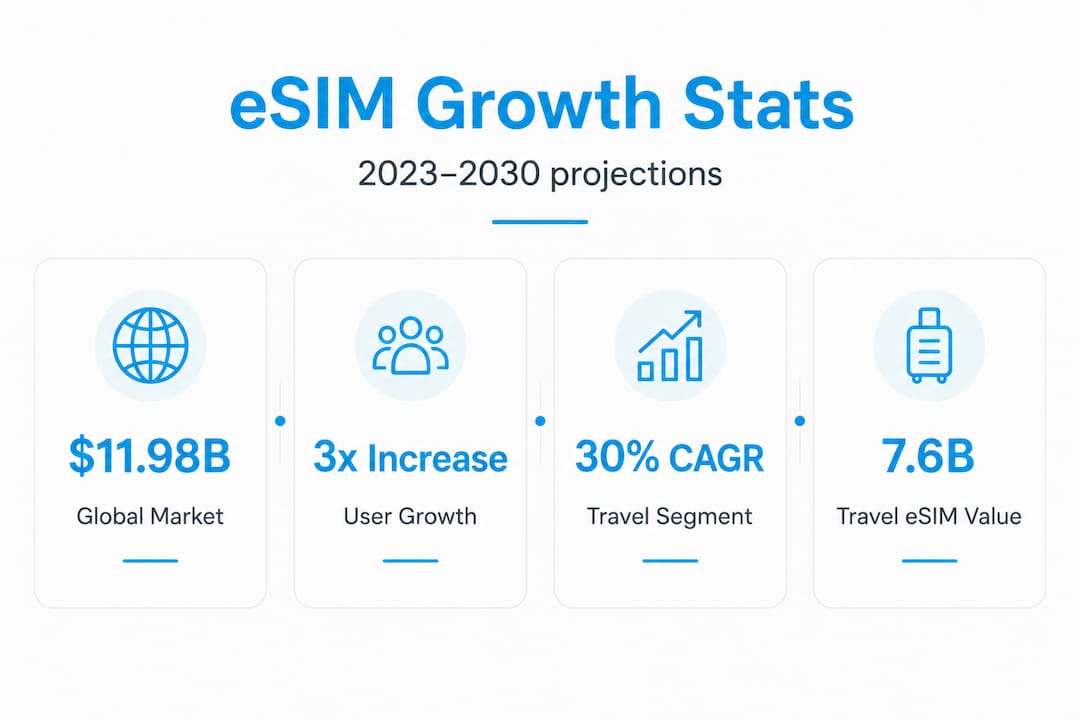
The travel eSIM market alone is projected to reach between $734M and $7.62B by 2030 to 2034, with compound annual growth rates (CAGRs) between 12% and 17%. A CAGR is the year-over-year growth rate needed to reach a projected value, and a 17% CAGR means the market is roughly doubling every four to five years.
For travelers, this scale of growth has three direct consequences. First, more providers entering the market means more competitive pricing, which translates to lower costs for data plans abroad. Second, mainstream adoption means devices and networks are increasingly built to support eSIM from the start, reducing setup friction. Third, a larger market means more geographic coverage, so travelers heading to less common destinations will find workable eSIM options where none existed before.
Before choosing a plan, reviewing essential eSIM facts helps travelers understand what to look for. For a broader overview of cost-saving strategies, the travel eSIM guide covers how to avoid roaming charges across multiple regions.
Key takeaways from the market data:
- eSIM is no longer a niche product. It is a mainstream connectivity tool.
- Pricing pressure from new market entrants benefits travelers directly.
- Coverage gaps are closing rapidly, especially in Asia-Pacific and Europe.
- The travel segment is growing at rates comparable to the broader eSIM market, confirming that travelers are a primary driver, not just a secondary use case.
What is driving eSIM adoption for travelers?
With the scale in view, it is essential to understand the engines fueling this market boom. Who is adopting eSIM, and why?

Travelers and digital nomads are among the most active forces pushing eSIM demand upward. The core appeal is straightforward: cost savings and flexible connectivity without the hassle of hunting down a local SIM card at every new destination. Traditional roaming charges from home carriers can add hundreds of dollars to a trip. eSIM eliminates that by letting travelers activate a local or regional data plan before they even board the plane.
Asia-Pacific is leading global eSIM adoption. High volumes of outbound travel, rapid 5G infrastructure expansion, and a tech-forward consumer base have made the region a major growth hub. Countries like Japan, South Korea, and Australia have seen particularly fast uptake. For travelers visiting these destinations, eSIM plan availability and network quality are already excellent.
Primary drivers of eSIM adoption among travelers:
- Instant activation. Plans are purchased and activated digitally, often in under five minutes, with no physical card required.
- No SIM swapping. Dual-profile support on most modern eSIM devices means travelers keep their home number active while using a local data plan.
- Local rates. eSIM plans typically price data at local market rates, which are far lower than international roaming fees.
- Multiple profiles. Travelers moving between countries can store and switch between several eSIM profiles without purchasing a new physical SIM at each border.
- Pre-trip setup. Plans can be purchased and installed before departure, so connectivity starts the moment you land.
Pro Tip: If you travel across multiple countries in a single trip, look for regional eSIM plans that cover several countries under one data allowance. These often cost less than buying separate plans for each country and eliminate the need to manage multiple profiles.
Some analysts project optimistic CAGRs above 30% for specific travel eSIM segments, while more conservative estimates sit at 12%. Either figure points to sustained, strong growth. The eSIM worldwide guide provides region-specific coverage details, and travelers planning trips to the Caucasus region can find targeted advice in the best eSIM options for Georgia.
How does eSIM work? Technology and real-world usage
This surge in adoption is made possible because eSIMs are simple to set up and use. Here is what happens behind the scenes.
An eSIM (embedded SIM) is a small chip soldered directly into a device’s motherboard. Unlike a physical SIM card that you insert and remove, an eSIM cannot be physically swapped. Instead, it stores carrier profiles digitally and switches between them through software. The key mechanism is OTA (over-the-air) provisioning, which means carrier profiles are downloaded and installed remotely over an internet connection.
eSIM enables remote provisioning via GSMA standards (SGP.22 for consumer devices, SGP.32 for IoT), allowing profile downloads and carrier switches without any physical SIM card.
GSMA (the global body governing mobile network standards) developed the SGP.22 standard specifically for consumer eSIM devices. This standard defines how profiles are created, transferred, and stored securely. Every major eSIM provider, including those on platforms like EsimGlobe, operates within this framework, which is why an eSIM plan purchased from one provider works seamlessly on a compliant device from any manufacturer.
How a traveler activates and uses an eSIM abroad, step by step:
- Check device compatibility. Confirm your smartphone supports eSIM by checking settings or the manufacturer’s website. Most iPhones from XS onward and many Android flagships from 2019 onward are compatible.
- Purchase a plan. Select a destination-specific or regional plan from a provider. Plans are typically available in 1GB to 20GB+ increments with validity periods from 7 to 30 days.
- Receive the QR code. After purchase, you receive a QR code via email or within the provider’s app. This code contains the encrypted profile data.
- Scan and install. Go to your device’s eSIM settings, select “Add eSIM,” and scan the QR code. The profile downloads in seconds.
- Activate on arrival. Set the eSIM as your data line in settings. Your home SIM remains active for calls and texts.
- Switch or top up as needed. If you run out of data or cross into a new country, purchase and install a new profile without touching a physical card.
Pro Tip: Download your eSIM profile before you leave home while you still have a reliable Wi-Fi connection. Some QR codes are single-use, meaning if the download fails mid-process, you may need to contact support for a replacement.
For a detailed walkthrough of the activation process across different device types, the global eSIM activation guide is a practical reference. Travelers who encounter unfamiliar terms during setup can also consult the eSIM terminology for travelers resource.
Challenges and limits: What travelers should know before switching
Even with rapid growth, eSIM is not without limitations. Savvy travelers should understand the current barriers before committing fully.
| Factor | eSIM | Local physical SIM |
|---|---|---|
| Activation | Remote, instant | Requires in-store visit or airport kiosk |
| Device requirement | eSIM-compatible device only | Works on any unlocked phone |
| Carrier support | Growing but not universal | Widely available in most countries |
| Cost | Competitive, often lower | Can be very cheap locally |
| Profile switching | Digital, no hardware needed | Requires physical card swap |
| Regulatory status | Restricted in some countries | Universally accepted |
Only 25% to 40% of smartphones currently support eSIM technology. This means a significant portion of travelers still cannot use eSIM at all without upgrading their device. Budget smartphones, older flagship models, and many mid-range Android devices remain physical SIM only.
Current challenges travelers face with eSIM:
- Interoperability gaps. Not all carriers in all countries support eSIM provisioning, even if the destination country has eSIM-capable networks.
- Regulatory restrictions. A small number of countries have placed restrictions on eSIM activation for foreign visitors, requiring in-person registration or limiting remote provisioning.
- Security considerations. Security and privacy risks exist in any digital provisioning system. Profile theft and unauthorized transfers, while rare, are documented concerns that reputable providers address through encrypted QR codes and two-factor authentication.
- Market saturation in popular routes. With dozens of providers now offering eSIM plans for destinations like Western Europe and Southeast Asia, plan quality varies widely. Low-cost options sometimes come with throttled speeds or limited customer support.
- Customer support limitations. Unlike buying a SIM at a carrier store, eSIM support is entirely digital. If an activation fails while you are already abroad, resolution depends entirely on the provider’s response time.
“Travelers should verify both device compatibility and carrier support for their specific destination before purchasing an eSIM plan, rather than assuming all eSIM plans work everywhere.” eSIM vs local SIM
The comparison between eSIM and a locally purchased SIM card is not always clear-cut. In some destinations, a local SIM bought at a corner store will still offer better value and broader network access than any available eSIM plan. The right choice depends on destination, trip length, and device compatibility.
Our perspective: The real story behind eSIM market growth
Looking beyond technical adoption and statistics, it is worth stepping back and considering what all of this actually means for travelers in practice.
The industry narrative around eSIM tends to focus heavily on CAGR figures and device adoption milestones. These numbers matter, but they tell only part of the story. For travelers, the more relevant trend is what market growth does to pricing and service quality over time.
When a market grows at 13% to 18% annually, it attracts new entrants. More providers competing for the same traveler base pushes prices down and forces improvements in coverage and support quality. This is already visible in popular travel corridors like Europe and Southeast Asia, where eSIM data prices have dropped significantly over the past two years. The traveler who paid $25 for 5GB of data in Thailand in 2022 can now find comparable plans for under $10.
However, market saturation concerns are real. As more providers enter the market, some will cut corners on network quality, customer support, or data throttling policies. The lowest-priced eSIM plan is not always the best value. Travelers should evaluate providers based on network partnerships, support responsiveness, and transparent data policies, not just upfront cost.
The more significant shift coming is the move from standalone data plans toward bundled services. Analysts and GSMA experts are tracking a clear trend toward airline and travel platform integrations, where eSIM connectivity is packaged with flight bookings, hotel stays, or travel insurance. When that model becomes mainstream, the friction of selecting and purchasing a separate eSIM plan disappears entirely. Connectivity becomes part of the travel product itself.
For now, the practical advice is to use eSIM where it offers clear advantages: pre-trip activation, multi-country trips, and destinations where local SIM acquisition is inconvenient. For single-country trips to destinations with cheap, widely available local SIMs, a hybrid approach may still make sense. The eSIM travel tips resource covers how to make these decisions based on specific travel scenarios.
Explore your eSIM travel options
Travelers ready to act on the connectivity advantages that eSIM market growth has created will find a wide range of plan options available right now.
EsimGlobe offers destination-specific and regional eSIM plans across hundreds of countries and territories. For island destinations, the eSIM for Maldives plan provides reliable data coverage without the need to find a local SIM on arrival. For travelers covering multiple countries across the Gulf and surrounding areas, the Middle East travel eSIM covers 13 areas under a single plan. Plans are available in USD, EUR, and GBP, with instant QR code delivery after purchase. Browse by destination, compare data allowances and validity periods, and activate before departure for seamless connectivity from the moment you land.
Frequently asked questions
How does eSIM market growth impact international travel?
Rapid eSIM growth means travelers have more options for affordable, hassle-free mobile connectivity worldwide. The travel eSIM market is projected to grow at 12% to 17% annually through 2030 to 2034, which drives down prices and expands coverage.
Are all smartphones compatible with eSIM?
No. Currently only 25% to 40% of smartphones support eSIM technology, so travelers should verify their device supports eSIM before purchasing a plan.
What regions are leading in eSIM travel adoption?
Asia-Pacific leads globally in eSIM adoption, driven by high outbound travel and 5G infrastructure expansion across the region.
What challenges should travelers expect with eSIM?
Travelers may encounter carrier support limits, regulatory differences, and occasional device compatibility or activation issues depending on the destination.
Is the eSIM market expected to keep growing?
Yes. The global eSIM market is projected to reach $17B to $22B by 2030 to 2031, with expanding device support and new regional markets coming online steadily through 2026 and beyond.