






















TL;DR:
- A travel SIM, especially an eSIM, offers quick activation and multiple country plans for international travelers. It allows dual-SIM use, keeping your home number active while providing local data at lower costs. Device compatibility and plan selection are essential for optimal travel connectivity and convenience.
A travel SIM card is a prepaid or digital SIM that gives you mobile data, calls, and texts while abroad, without paying expensive roaming fees or hunting for a local SIM shop at your destination. The term “travel SIM” covers two distinct products: the traditional physical travel SIM card and the modern travel eSIM, which is an embedded digital profile loaded directly onto your phone. The GSMA, the global body that sets mobile industry standards, formally defined eSIM specifications that now underpin most travel eSIM products on the market. Understanding what a travel SIM is, and which type fits your trip, saves you money and frustration before you even board the plane.
Travel SIM cards have evolved significantly from simple prepaid plastic cards to sophisticated digital profiles offering multi-country data plans and instant activation worldwide. That shift changes everything about how travelers prepare for international connectivity.
What is a travel SIM and how does it work abroad?
A travel eSIM is a digital SIM card that connects you to local cellular networks abroad without physically swapping any card. Your phone downloads a digital profile from a provider, and that profile tells the network who you are and what plan you have purchased. The process works the same way a physical SIM does at the network level. The difference is that everything happens in software.
Physical travel SIM vs. travel eSIM
A physical travel SIM is a standard plastic card preloaded with a data plan for one or more countries. You insert it before departure or on arrival. A travel eSIM skips the hardware entirely. Your phone stores the plan as a digital profile, and you activate it remotely.
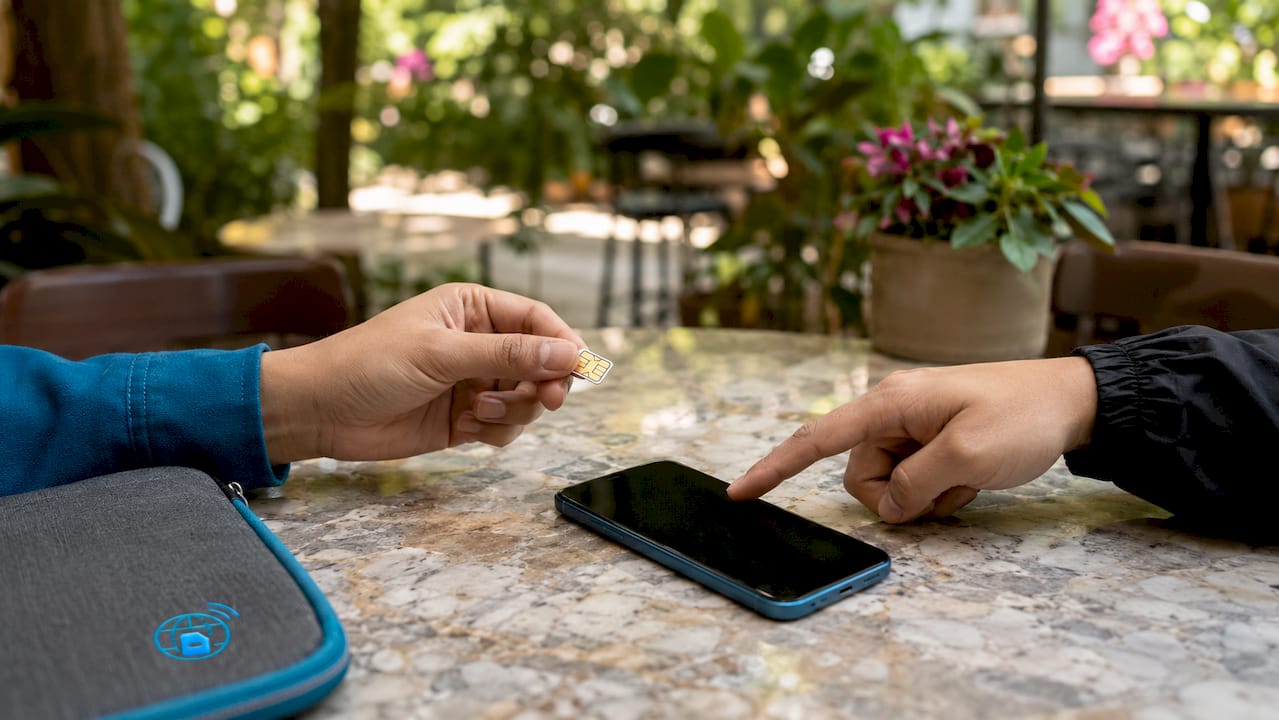
Activating a physical SIM takes 10–30 minutes, including finding a store and registering the card. A travel eSIM activates in 1–5 minutes by scanning a QR code or using a provider app. That time difference matters most when you land at a busy international airport and need connectivity immediately.
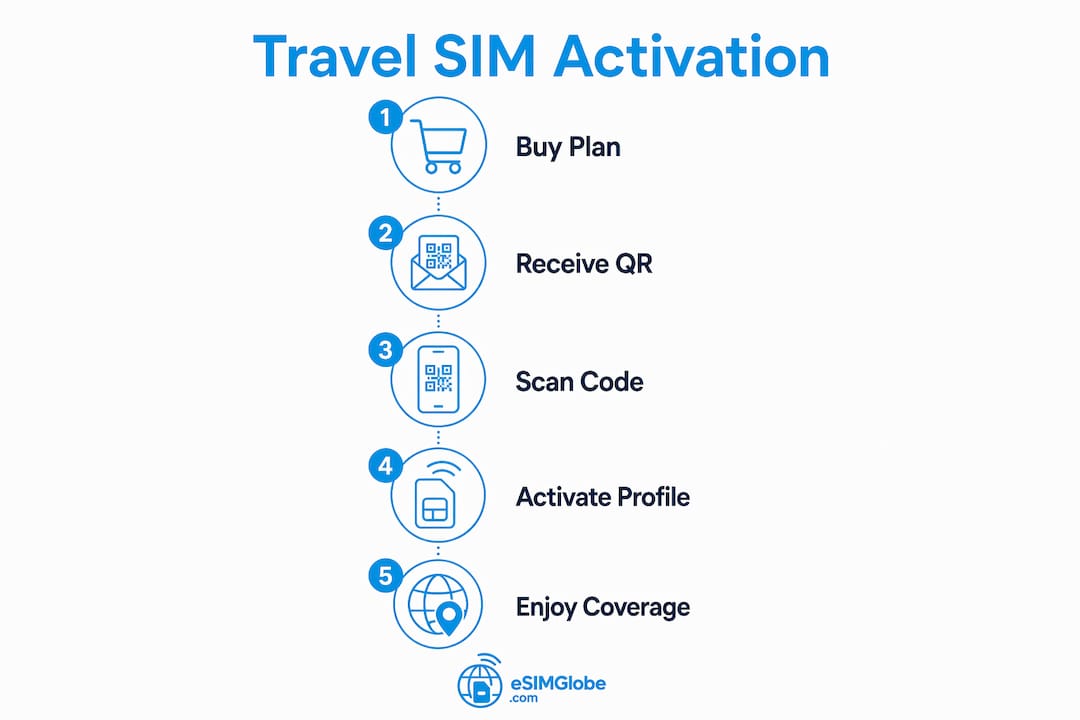
How activation works, step by step
- Check device compatibility. Your phone must support eSIM and be carrier unlocked. Most flagship phones released after 2018 qualify.
- Purchase a plan. Select a country or regional plan from a provider like Esimglobe before your departure date.
- Receive your QR code. The provider sends a QR code by email or displays it inside their app.
- Scan and install. Go to your phone’s cellular settings, select “Add eSIM,” and scan the code. The profile installs in minutes.
- Activate on arrival. Some plans activate automatically when your phone connects to a supported local network. Others require a manual toggle in settings.
- Switch between profiles. If you carry your home SIM alongside the travel eSIM, you manage which profile handles data and which handles calls directly in your phone’s settings.
Pro Tip: Install your travel eSIM profile at home on your Wi-Fi connection before you travel. Airport Wi-Fi is often slow or restricted, and you want the profile ready the moment you land.
Travel eSIMs can store up to 8 profiles on a single device, far more than a physical SIM slot allows. That means one phone can hold plans for multiple countries simultaneously, with no card swapping required.
What are the benefits of a travel SIM compared to a local SIM?
The core benefit of a travel SIM is convenience. You buy and activate the plan before you leave home, which removes the need to find a carrier store, navigate a foreign language, or carry cash for a local purchase on arrival. That said, the advantages go deeper than simple convenience.
Cost and coverage
Roaming charges from home carriers remain high in many regions. A travel SIM plan typically costs a fraction of standard international roaming rates. For a two-week trip to Europe, a regional data plan from a travel eSIM provider often costs less than two days of roaming charges from a US carrier.
Using an eSIM also keeps your home number active for receiving calls and texts while local data runs through the travel profile. That dual-SIM operation means you never miss a bank authentication code or an important call from home. For expatriates managing two countries simultaneously, this feature alone justifies the switch.
Security and reliability
An eSIM is a chip soldered directly into your phone. It cannot be lost, stolen, or damaged the way a physical card can. Travelers who have dropped a SIM card into an airport drain or had a card fail in humid climates understand why that matters. The non-removable design also makes it harder for thieves to disable your phone’s connectivity by ejecting the SIM.
When a local SIM still makes sense
| Situation | Better choice |
|---|---|
| Trip longer than 30 days in one country | Local SIM (lower long-term cost) |
| Phone locked to home carrier | Local SIM or roaming plan |
| Device manufactured before 2018 | Physical travel SIM or local SIM |
| Multi-country trip under 30 days | Travel eSIM with regional plan |
| Need a local phone number | Local SIM |
| Frequent device swapping across phones | Physical travel SIM |
Physical travel SIMs remain preferred by travelers using phones made before 2018 or those who regularly swap SIM cards across multiple devices. Older hardware simply does not support eSIM, and no software update changes that.
Pro Tip: If you travel to three or more countries in a single trip, a regional travel eSIM plan almost always beats buying individual local SIMs at each stop. The math shifts fast once you factor in the time and transport cost of visiting carrier stores.
How to choose and use a travel SIM for your next trip
Choosing the right travel SIM starts with four questions: Is your phone unlocked? Does it support eSIM? How much data do you need? How many countries will you visit?
Checking device compatibility
eSIM activation requires an unlocked, compatible device. A carrier-locked phone cannot add a local eSIM plan, regardless of which provider you choose. Check your phone’s settings under “Cellular” or “Mobile Data” for an “Add eSIM” option. If that option does not appear, your device either lacks eSIM support or is locked to your home carrier. Contact your carrier to request an unlock before your trip.
For travelers planning international trips and managing digital bookings, understanding digital onboarding tools alongside connectivity options makes the overall travel experience far smoother.
Estimating your data needs
Streaming video consumes roughly 1 GB per hour at standard definition. Navigation apps use far less, around 5–20 MB per hour. If you plan to use maps, messaging apps, and occasional video calls, a 5 GB plan covers most two-week trips comfortably. Heavy streamers or remote workers should plan for 15 GB or more.
Setting up and managing profiles
- Unlock your phone with your home carrier before departure.
- Purchase your plan from Esimglobe, selecting the destination country or region.
- Install the eSIM profile via QR code on a stable Wi-Fi connection.
- Set data routing in your phone’s cellular settings so the travel eSIM handles data and your home SIM handles calls.
- Test connectivity before you leave by toggling the travel profile on and confirming the plan status.
Though phones can store multiple eSIM profiles, only two profiles can be active simultaneously, requiring manual switching in device settings when changing usage. On an iPhone, this means going to Settings, then Cellular, and toggling the active line. Android devices follow a similar path through the SIM card or network settings menu.
Pro Tip: Screenshot your eSIM QR code and save it offline before traveling. If you lose email access abroad, you can reinstall the profile from the saved image.
Troubleshooting common issues
If your travel eSIM shows no signal on arrival, first confirm the plan covers the specific country you are in. Then check that the correct profile is set as the active data line. Restarting your phone resolves most activation delays. If the problem persists, contact your provider’s support channel before assuming the plan is faulty.
What are the emerging trends shaping travel SIM technology in 2026?
The travel SIM market is changing faster than most travelers realize. Several forces are converging to make digital connectivity cheaper, faster, and more widely available.
- Regulatory support is accelerating eSIM adoption. Regulators in the EU, India, and Brazil favor eSIM technology because it makes carrier switching easier without requiring new hardware. That regulatory pressure pushes carriers to expand eSIM support, which directly benefits travelers by widening their plan options.
- Multi-country regional plans are now standard. A single travel eSIM plan can now cover 50 or more countries under one data allowance. Two years ago, that kind of coverage required multiple SIM purchases or expensive roaming add-ons.
- Integration with travel services is growing. Hotels, airlines, and booking platforms are beginning to bundle connectivity options directly into reservation flows. Travelers can add a data plan at checkout alongside a hotel room, reducing the number of separate purchases needed before a trip.
- Pricing is falling as competition increases. The rise of eSIMs aligns with global regulatory trends favoring easier carrier switching, which expands coverage options and lowers costs for travelers. More providers entering the market means better deals for travelers who compare plans before buying.
- Profile management limits remain a real constraint. Most devices cap active simultaneous profiles at two, even if they can store eight or more. That technical ceiling means travelers visiting many countries in quick succession still need to manage profile switching manually.
“Travel SIM technology in 2026 is no longer a niche workaround for tech-savvy travelers. It is the default connectivity solution for anyone crossing a border, and the infrastructure supporting it is maturing rapidly. The remaining friction points, such as device locks and profile limits, are engineering problems with clear solutions already in development.”
For a broader view of where the market is heading, the eSIM market growth analysis from Esimglobe covers what these shifts mean for travelers in practical terms.
Key Takeaways
A travel SIM, and specifically a travel eSIM, is the most practical connectivity solution for international travelers in 2026 because it combines instant activation, dual-SIM flexibility, and multi-country coverage in a single digital profile.
| Point | Details |
|---|---|
| Travel SIM definition | A prepaid or digital SIM that provides mobile data and calls abroad without roaming fees. |
| eSIM activation speed | Digital profiles activate in 1–5 minutes via QR code, far faster than physical SIM registration. |
| Dual-SIM advantage | Your home number stays active for calls while the travel eSIM handles local data. |
| Device compatibility | Your phone must be unlocked and eSIM-compatible; devices made before 2018 often require a physical SIM. |
| When local SIM wins | Trips longer than 30 days in one country or frequent device swapping favor a local physical SIM. |
Why I think most travelers still underestimate travel eSIMs
Most travelers I speak with still treat connectivity as an afterthought. They land, scramble for airport Wi-Fi, and then spend 20 minutes in a carrier store buying a local SIM they could have set up at home in five minutes. That behavior made sense in 2019. It makes no sense now.
The honest truth is that travel eSIMs have crossed the threshold from “convenient for tech enthusiasts” to “the obvious default for anyone with a compatible phone.” The activation process is genuinely simple. The cost savings over roaming are real and consistent. The dual-SIM functionality, keeping your home number live while running local data, solves a problem that used to require carrying two phones.
Where I think the industry still falls short is transparency around device locks and profile limits. Too many travelers discover their phone is carrier-locked only after they have already purchased a plan. Providers, including Esimglobe, should surface compatibility checks earlier in the purchase flow. That one friction point is responsible for most of the negative experiences I hear about.
Long-term expatriates have a different calculus. If you are staying in one country for six months or more, a local SIM from a domestic carrier almost always beats a travel eSIM on price. But for anyone taking trips of one day to four weeks, the practical eSIM travel tips that Esimglobe publishes reflect what actually works in the field. The remaining limitations are real but shrinking. By 2027, most of the friction points around device compatibility and profile management will likely be resolved at the hardware level.
— daniele
Esimglobe travel eSIM plans: ready when you are
Esimglobe provides eSIM plans for travelers across more than 190 countries, with instant digital activation and no physical card required. Plans are available in USD, EUR, and GBP, and the platform supports multiple languages to serve international travelers wherever they are based.
Activation takes minutes. You purchase a plan, receive a QR code, scan it on your phone, and your connection is ready before you leave home. Esimglobe also offers exclusive promo codes for first-time travelers looking to test the service at a lower entry cost. Browse available plans by country or region directly on the Esimglobe website and compare data allowances, validity periods, and pricing before you commit.
FAQ
What is a travel SIM card, exactly?
A travel SIM card is a prepaid SIM, either physical or digital, that connects your phone to local mobile networks abroad. It replaces or supplements your home carrier plan to avoid roaming charges.
How does a travel eSIM differ from a regular SIM?
A travel eSIM is a digital profile stored on a chip inside your phone, activated remotely via QR code. A regular SIM is a physical card you insert into a slot, and swapping it requires handling hardware.
Can I keep my home phone number while using a travel SIM?
Yes. Using an eSIM alongside your home SIM lets you keep your home number active for calls and texts while the travel profile handles local data, using your phone’s dual-SIM capability.
What devices support travel eSIMs?
Most smartphones released after 2018 support eSIM, including recent iPhone, Samsung Galaxy, Google Pixel, and many other flagship models. Your device must also be unlocked by your carrier before an eSIM plan can be added.
Is a travel SIM worth it for short trips?
A travel SIM pays off on trips where roaming charges would exceed the plan cost, which is most international trips lasting more than a day or two. For very short visits where your home carrier includes free roaming, the benefit is smaller but the convenience of pre-activation still applies.