






















TL;DR:
- An eSIM travel pack provides a digital, prepaid mobile data profile embedded in your device for use abroad. It requires setup before departure, including enabling data roaming and installing the profile via QR code, to ensure connectivity upon arrival.
An eSIM travel pack is a prepaid digital SIM profile embedded in your device that gives you local mobile data access abroad without swapping a physical SIM card. The industry standard term is “travel eSIM,” and this explainer on eSIM travel packs covers everything from how the technology works to what to watch out for before you board your flight. Travelers who understand the setup process and plan structure arrive at their destination connected, not scrambling for a SIM kiosk.
What are eSIM travel packs and how do they work?
An eSIM travel pack is a digital profile stored on the embedded SIM chip already built into your smartphone. Unlike a physical SIM card, this profile exists as software. You purchase it online, receive a QR code or app link, and scan it to install the profile directly onto your device.
The technology behind this is called remote SIM provisioning, a standard defined by the GSMA (the global mobile industry body). Your phone’s embedded chip can hold multiple profiles at once, and you switch between them through your device settings. Travel eSIM providers contract with local networks in each country through roaming or wholesale agreements, which is how one plan can cover multiple destinations under a single purchase.
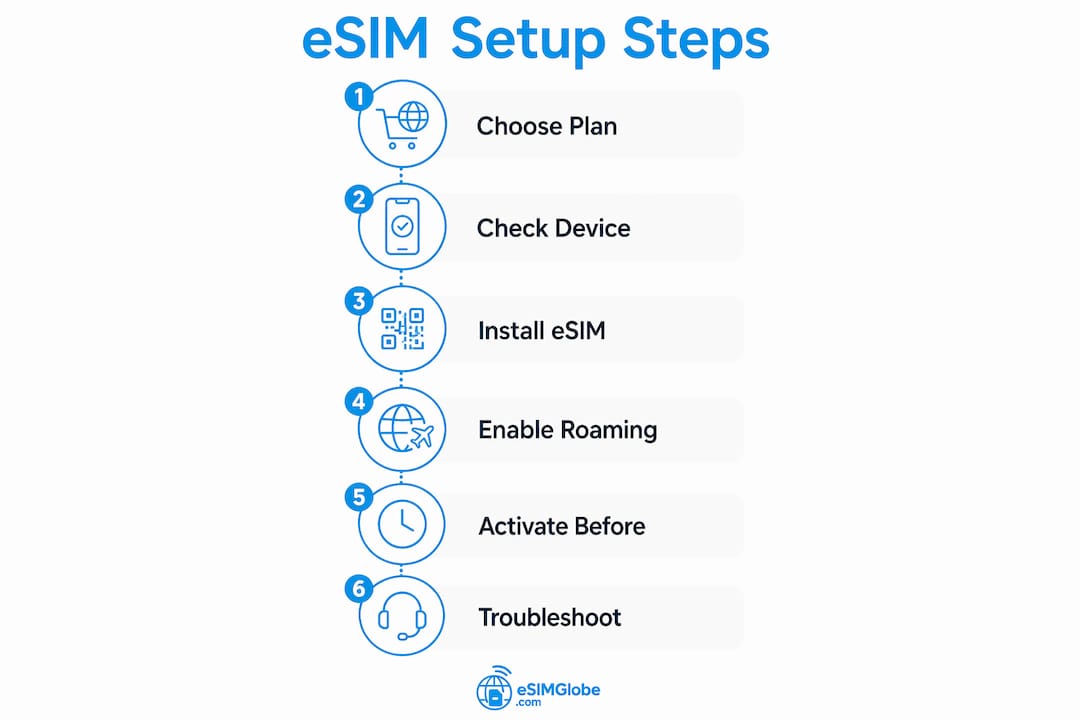
The activation process follows a clear sequence:
- Verify compatibility. Confirm your phone is eSIM capable and carrier unlocked. Look for “EID” in your device settings. If it appears, your phone supports eSIM.
- Purchase a plan. Select a country, regional, or global plan based on your destination and data needs. Plans come with fixed data quantities and validity periods such as 7, 14, or 30 days, enabling predictable travel budgeting.
- Receive your QR code. After purchase, you get a QR code by email or through an app.
- Install the profile. Go to your phone’s cellular settings, select “Add eSIM,” and scan the code. Installation takes only a few minutes on unlocked devices connected to Wi-Fi.
- Enable data roaming. This step is the one most travelers miss. You must manually turn on data roaming specifically for the travel eSIM line. Installing the profile alone does not activate mobile data.
- Set data preference. In your cellular settings, assign the travel eSIM as your primary data line for the trip.
Pro Tip: Install your eSIM at home before you leave. Activation requires a Wi-Fi connection, and airport Wi-Fi is unreliable. Completing setup in advance means you step off the plane with a working data connection.
Benefits of using eSIM travel packs for international travel
Cost control is the clearest advantage of a travel eSIM over traditional roaming. Standard carrier roaming rates can reach several dollars per megabyte in some regions. A travel eSIM plan with a fixed data allowance eliminates that unpredictability entirely.

The convenience factor is equally significant. No physical card means no hunting for a SIM shop, no tiny ejector tool, and no risk of losing your home SIM in a foreign country. You can buy your eSIM plan days before departure and have it ready to activate the moment you land.
Security is a less obvious but real benefit. eSIM chips cannot be physically removed from a device. That means a stolen phone cannot be quickly re-SIM’d to block tracking or erase your carrier identity. Your device remains linked to your account even if it falls into the wrong hands.
The dual SIM capability of most modern smartphones adds another layer of practical value:
- Keep your home number active. Your physical SIM stays in place, receiving calls and texts from contacts at home. The travel eSIM handles data separately.
- Avoid missing two-factor authentication codes. Banks and apps that send SMS verification codes still reach you on your home number.
- Switch plans mid-trip. If you cross into a new country not covered by your current plan, you can install a second eSIM profile without deleting the first.
- Reduce arrival downtime. Setup before travel means you have working data from the moment you clear customs.
- Lower environmental impact. No plastic card, no packaging, no waste.
Dual SIM operation lets you maintain your home number on the physical SIM while using the travel eSIM for data. That combination covers nearly every connectivity need a traveler has without any compromise.
Business travelers gain additional value from this setup. Keeping a professional number reachable while using a cost-controlled local data plan is a practical advantage on any work trip. Esimglobe offers plans structured specifically for business travel connectivity across multiple regions.
What to consider when buying eSIM travel packs
Choosing the right plan requires more than picking the cheapest option. Several factors determine whether a plan actually works for your trip.
Device compatibility
Your phone must be both eSIM capable and carrier unlocked. Carrier-locked phones, common with budget contracts, block third-party eSIM profiles. Check your settings for an “EID” number. If it is absent, your device does not support eSIM. Most flagship smartphones released after 2018 support eSIM, but mid-range and budget models vary widely.
Plan type: country, regional, or global
Travel eSIM plans fall into three categories. Country plans cover a single destination and typically offer the most data per dollar. Regional plans cover a geographic area such as Europe or Southeast Asia under one profile. Global plans span dozens of countries but usually cost more and may offer less data per region. For a two-week trip to one country, a country plan is almost always the better value. For a multi-stop trip across five countries in three weeks, a regional plan saves the hassle of managing multiple profiles.
Data limits and fair use policies
Plans that advertise “unlimited” data include fair use policies that throttle speeds after a daily cap. This is standard practice across the industry. Throttled speeds are typically sufficient for messaging and basic browsing but not for video streaming or large file downloads. Read the fair use terms before purchasing if you plan to use video calls or stream content regularly.
Pro Tip: Estimate your daily data use at home by checking your phone’s cellular data usage in settings. That number gives you a realistic baseline for choosing a plan size abroad.
Activation timing
Activation requires Wi-Fi and is best completed before departure. If you wait until you land, you need airport Wi-Fi to activate, which creates a circular problem. Some plans also have a validity countdown that starts at purchase rather than first use. Confirm whether your plan’s validity period begins at purchase or at activation before you buy.
Data roaming setting
This is the single most common source of connectivity failure. Data roaming must be manually enabled on the travel eSIM line specifically. Many travelers install the profile correctly but leave data roaming off, then assume the plan is not working. The fix takes ten seconds in your cellular settings, but knowing to look for it saves real frustration.
| Consideration | What to check |
|---|---|
| Device compatibility | Look for EID in cellular settings; confirm carrier unlock status |
| Plan type | Match country, regional, or global plan to your itinerary |
| Data allowance | Estimate daily use; read fair use throttling terms |
| Validity period | Confirm whether countdown starts at purchase or activation |
| Data roaming | Enable manually on the travel eSIM line after installation |
How to troubleshoot common eSIM travel pack issues
Most eSIM connectivity problems trace back to a small set of fixable errors. Knowing them in advance means you spend less time staring at a “No Service” indicator.
- No data after installation. Check that data roaming is enabled on the travel eSIM line, not just on your home SIM line. This is the most common error travelers make abroad.
- Profile shows as installed but inactive. Restart your phone after installation. Some devices require a reboot to register a new eSIM profile with the network.
- Weak or no signal. Confirm the plan covers your specific country. Regional plans sometimes exclude certain territories within a geographic area. Check the coverage list on your provider’s website.
- Slow speeds despite active data. You may have hit the fair use daily cap. Speeds typically reset at midnight local time or at the start of the next UTC day, depending on the provider.
- QR code scan fails. The QR code is single-use. If it fails to scan or was already used, contact your provider’s customer support for a replacement code. Do not attempt to scan it multiple times in quick succession.
- Wrong SIM line selected for data. Go to cellular settings and confirm the travel eSIM is set as the preferred data line. Some phones default back to the physical SIM after a restart.
- Profile deleted accidentally. Deleted eSIM profiles cannot be reinstalled from the same QR code. Contact support immediately. Most providers can reissue a profile if the plan has not expired.
Phones can store 5 to 10 or more eSIM profiles simultaneously, so you do not need to delete an old profile to add a new one. This is particularly useful on multi-country trips where you want to keep a previous plan available in case you return to that region.
For practical connectivity tips that go beyond basic troubleshooting, Esimglobe’s travel blog covers real-world scenarios across dozens of destinations.
Key Takeaways
eSIM travel packs give international travelers local mobile data access through a digital profile, but the setup requires deliberate steps, especially enabling data roaming on the correct SIM line.
| Point | Details |
|---|---|
| Install before departure | Activation requires Wi-Fi; complete setup at home to avoid airport connectivity gaps. |
| Enable data roaming manually | Installing the eSIM profile is not enough; data roaming must be switched on for that line. |
| Match plan type to itinerary | Country plans offer more data per dollar; regional plans suit multi-stop trips. |
| Read fair use terms | “Unlimited” plans throttle speeds after a daily cap, limiting streaming and downloads. |
| Store multiple profiles | Modern phones hold 5–10 eSIM profiles, so you can switch plans without deleting old ones. |
My take on where eSIM travel packs are headed
The technology is mature enough now that the main barrier is not the eSIM itself. It is the gap between what travelers expect and what the setup actually requires. I have watched experienced travelers land abroad with a correctly purchased plan and no data, simply because they did not know to enable roaming on the travel line. That one setting is responsible for more “my eSIM doesn’t work” complaints than any technical failure.
The fair use throttling issue is equally misunderstood. “Unlimited” is a marketing term, not a technical specification. If you plan to stream video or run video calls for hours each day, a fixed-data plan with a generous allowance often delivers a better experience than an “unlimited” plan that throttles to near-unusable speeds after the first gigabyte.
What I find genuinely encouraging is the direction of device support. The number of smartphones with eSIM capability has grown substantially in recent years, and the setup process has become noticeably simpler. Providers are also improving their coverage networks through better wholesale agreements, which means regional plans are becoming more reliable in areas that were spotty just two years ago.
For digital nomads specifically, the multi-profile storage capability changes the math on connectivity planning. Holding profiles for three or four countries simultaneously means you can move across borders without any setup delay. That is a real operational advantage for anyone working remotely across time zones.
The next meaningful shift will likely come from broader adoption of eSIM-only devices. As physical SIM trays disappear from flagship phones, the entire ecosystem will push toward better eSIM infrastructure. Travelers who get comfortable with the technology now will be well positioned for that transition.
— daniele
Esimglobe’s eSIM plans for travelers worldwide
Esimglobe offers digital eSIM profiles for countries and regions across the globe, with plans available in multiple currencies and languages to serve travelers wherever they are headed.
Whether you need a single-country plan for a two-week trip or a regional plan covering multiple destinations, Esimglobe’s eSIM plan catalog lets you compare options, check coverage, and complete purchase in minutes. Customer support is available if activation questions come up before or during your trip. Plans are structured with fixed data and clear validity periods so you know exactly what you are getting before you buy.
FAQ
What is an eSIM travel pack?
An eSIM travel pack is a prepaid digital SIM profile that gives your phone local mobile data access abroad without a physical SIM card. You purchase it online, install it via QR code, and activate it through your device settings.
Do I need to remove my existing SIM to use a travel eSIM?
No. Your physical SIM stays in place, keeping your home number active for calls and texts. The travel eSIM operates as a separate line for data, using your phone’s dual SIM capability.
Why is my eSIM installed but not working?
The most common cause is data roaming not being enabled on the travel eSIM line. Go to your cellular settings, select the travel eSIM profile, and turn on data roaming manually.
Can I use one eSIM plan across multiple countries?
Regional and global plans cover multiple countries under a single profile. Country plans cover one destination only. Check the coverage list for your specific plan before purchasing to confirm all your destinations are included.
How much data do eSIM travel plans typically include?
Plans vary by provider and destination, but most offer fixed data quantities with validity periods of 7, 14, or 30 days. “Unlimited” plans exist but include fair use policies that reduce speeds after a daily data cap.