






















TL;DR:
- eSIM tariffs are digital data plans that allow travelers to quickly purchase and remotely activate mobile connectivity. They offer lower costs, greater convenience, and flexible options compared to traditional physical SIM cards. These tariffs include local, regional, and global plans to suit various trip profiles and preferences.
eSIM tariffs are the pricing plans and data packages offered for mobile connectivity through embedded SIM technology, giving travelers a flexible and often cheaper alternative to traditional roaming fees. Unlike physical SIM cards, eSIM plans can be purchased and activated remotely before you even board your flight. Providers like Nomad, Saily, and Ubigi each offer distinct tariff structures, ranging from small regional packages to unlimited global plans. Understanding what are eSIM tariffs means knowing how data volume, validity periods, and geographic coverage combine to set your price. The right plan can cut your international data costs significantly while eliminating the hassle of hunting for a SIM card at a foreign airport.
What are eSIM tariffs and how do they work?
eSIM tariffs are structured as digital data plans tied to a specific volume of data, a validity window, and a defined coverage area. You purchase the plan online, receive a QR code or activation link, and the profile installs directly onto your device’s embedded SIM chip. No physical card changes hands. The plan activates when your device connects to a supported local network in your destination country.

Pricing models fall into three main categories. The first is pay-per-GB, where you buy a fixed data bucket at a set price. Nomad, for example, offers 1 GB for $3.50 over 7 days, scaling up to 50 GB for $29 over 30 days, with no activation fees or roaming surcharges. That price transparency is one of the clearest advantages eSIM tariffs hold over legacy carrier roaming.
The second model is unlimited with a daily cap. Saily’s Europe plan, for instance, offers 5 GB per day at $28.99 for 7 days. This structure suits travelers who stream video or use navigation heavily but want a predictable monthly bill rather than a per-GB overage charge.
The third model is subscription-based, where you pay a recurring fee for ongoing access across multiple countries. This suits digital nomads and frequent business travelers who need consistent coverage month to month rather than trip-by-trip packages.
Pro Tip: Buy your eSIM tariff at least 24 hours before departure. Activation is instant, but testing your connection at home gives you time to troubleshoot before you land in an unfamiliar country.
Local tariffs cover a single country and typically offer the lowest price per GB. Regional tariffs cover a continent or zone, such as Europe or Southeast Asia, at a moderate premium. Global tariffs cover 100 or more countries and carry the highest per-GB cost in exchange for maximum flexibility. Choosing between them depends entirely on your itinerary.
How do eSIM data rates compare to traditional SIM tariffs?
eSIM distribution costs operators between $0.20 and $0.50 per unit, compared to roughly $2.50 per physical SIM card when you factor in packaging and delivery. That cost difference gives operators room to price eSIM tariffs more competitively. Travelers who have paid $15 for a single day of carrier roaming will feel that difference immediately.
Regional price variation
Data rates vary sharply by region. Western Europe and North America tend to have the most competitive eSIM pricing because of dense carrier competition and strong network infrastructure. The cheapest eSIM tariff for Europe in 2026 sits at around €0.50 per GB for a 50 GB plan, a fraction of what airport SIM kiosks or legacy roaming packages charge. Southeast Asia and parts of Latin America also offer low per-GB rates. Remote regions in Africa or the Pacific Islands carry higher prices because fewer local carriers participate in eSIM wholesale agreements.
eSIM vs traditional SIM: a direct comparison
| Factor | eSIM tariff | Traditional SIM |
|---|---|---|
| Purchase method | Online, instant | Physical store or kiosk |
| Activation | Remote, before travel | Requires local insertion |
| Cost per GB (Europe) | From €0.50 | Varies, often €2.00+ |
| Operator cost per unit | $0.20–$0.50 | ~$2.50 |
| Roaming fees | Avoided with local plan | Common with home carrier |
| SIM swap required | No | Yes, per country |
The table above shows that eSIM tariffs win on cost, convenience, and speed of setup. The one area where physical SIMs still hold an edge is device compatibility. Older phones do not support eSIM, so travelers with legacy hardware must stick with physical cards.
Key factors that drive eSIM pricing down relative to physical SIM tariffs include:
- No physical manufacturing or shipping costs for the SIM itself
- No retail markup from airport kiosks or convenience stores
- Direct wholesale agreements between eSIM platforms and local carriers
- Automated provisioning that reduces customer service overhead
What types of eSIM plans are available for international travelers?
Four plan types cover the majority of traveler needs. Each suits a different trip profile, and picking the wrong one is the most common mistake travelers make when comparing esim pricing plans.
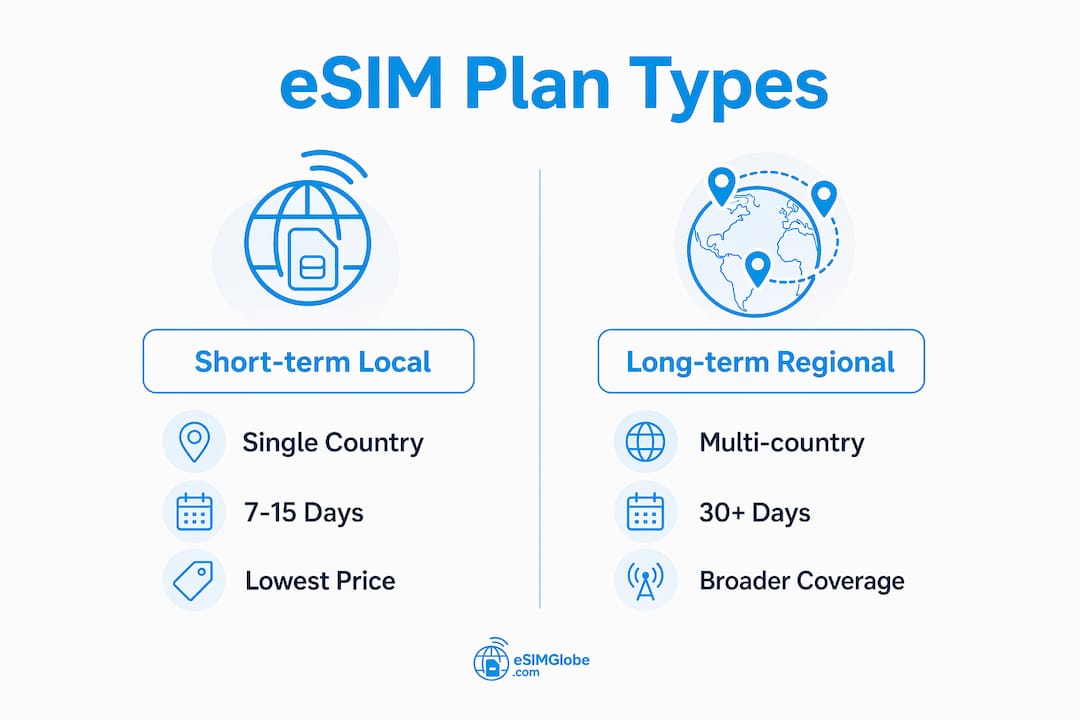
Short-term local plans cover a single country for 7–15 days. These deliver the lowest price per GB and the best network performance because your device connects directly to a local carrier. A traveler spending a week in Japan, for example, benefits more from a Japan-specific plan than a broad Asia regional package.
Long-term regional plans cover a continent or multi-country zone for 30 days or more. These suit travelers visiting several countries in one trip without wanting to buy and manage separate plans for each destination. The per-GB cost is higher than a local plan but lower than global coverage.
Unlimited daily capped plans set a maximum data speed or volume per 24-hour period rather than a hard total cap. Saily’s Europe plan at $28.99 for 7 days with a 5 GB daily cap is a practical example. Once you hit the daily cap, speeds throttle rather than cutting off entirely, which keeps you connected for messaging and maps even on heavy-use days.
Global multi-country plans cover 100 or more countries under a single tariff. Ubigi and similar providers offer these for travelers who move between continents frequently. The per-GB cost is the highest of any plan type, but the convenience of one plan for an entire trip justifies the premium for many business travelers.
Pro Tip: If your trip covers more than three countries, calculate the total data you expect to use and compare the cost of one global plan against buying separate local plans for each stop. Local plans almost always win on price per GB, but the management overhead adds up fast.
When selecting a plan, check these factors before purchasing:
- Device compatibility: Confirm your phone model supports eSIM and that the provider’s network bands match your destination’s carriers.
- Data volume: Estimate your daily usage. Streaming one hour of video at standard definition uses roughly 1 GB. Navigation and messaging use far less.
- Validity period: Match the plan’s validity to your trip length. A 7-day plan that expires while you are still traveling forces an unplanned repurchase.
- Active profile limits: Most modern smartphones support multiple eSIM profiles but allow only 1 or 2 to be active simultaneously. Switching between stored profiles is straightforward but requires attention.
- Top-up options: Some providers allow you to add data to an existing plan without buying a new one. This is useful if you underestimate your usage.
Travelers visiting the European Union benefit from an additional layer of protection. EU regulations cap roaming surcharges for carriers operating within the bloc, which means some home-country plans already include EU roaming at no extra cost. An eSIM local plan still typically beats those rates on a per-GB basis, but the gap is narrower in Europe than in other regions.
How do eSIM tariffs improve the experience of international connectivity?
The primary benefit of eSIM tariffs over physical SIM plans is instant remote activation. You buy the plan from your phone, tablet, or laptop, and the profile appears on your device within minutes. There is no queue at a foreign carrier store, no language barrier at a kiosk, and no risk of losing a tiny plastic card in a bag.
Storing multiple eSIM profiles on one device is a practical advantage that physical SIMs cannot match. A traveler who visits Europe in june and Asia in september can keep both profiles on the same phone and switch between them without buying new hardware. The ability to switch profiles remotely also means you can respond to unexpected itinerary changes by purchasing a new plan from wherever you are.
Security is a less-discussed but real benefit. A physical SIM card can be stolen, cloned, or lost. An eSIM profile is locked to the device’s hardware and cannot be physically removed. For travelers carrying sensitive business data, that reduction in risk matters.
Coverage quality also improves with eSIM tariffs when you choose local plans. Connecting through a local carrier rather than your home carrier’s roaming partner often means access to better network tiers and faster speeds. Roaming agreements between carriers sometimes restrict access to the fastest network bands, while a local eSIM plan typically grants full access to the carrier’s standard network.
Managing tariffs across multiple borders becomes simpler when everything lives in one app or platform. Travelers can monitor data usage, check plan expiry dates, and purchase top-ups without visiting a store or calling customer service. That reduction in friction is what makes eSIM tariffs the default choice for frequent international travelers in 2026. For a broader look at how this technology is reshaping mobile connectivity, the eSIM market growth analysis from Esimglobe covers the key trends driving adoption.
Key Takeaways
eSIM tariffs consistently offer lower per-GB costs, faster activation, and greater flexibility than traditional SIM cards, making them the most practical choice for international travelers in 2026.
| Point | Details |
|---|---|
| eSIM tariff structure | Plans combine a data volume, validity period, and coverage zone into one fixed price. |
| Operator cost advantage | eSIM distribution costs $0.20–$0.50 per unit versus $2.50 for physical SIMs, reducing consumer prices. |
| Plan types for travelers | Short-term local, long-term regional, unlimited capped, and global plans each suit different trip profiles. |
| Profile management | Most phones hold multiple eSIM profiles but activate only 1–2 at once; manage active plans to avoid roaming charges. |
| Best value strategy | Local single-country plans deliver the lowest per-GB cost; global plans trade price for convenience. |
What I have learned watching eSIM tariffs evolve
The most common mistake I see travelers make is defaulting to a global plan because it feels simpler. Global plans are convenient, but you pay a meaningful premium for that convenience. A traveler spending two weeks in Italy and one week in Thailand will almost always spend less by buying a dedicated Italy plan and a dedicated Thailand plan separately. The math is not complicated, but most people do not run it before purchasing.
The second pattern worth noting is that eSIM pricing is trending downward. As operators reduce distribution costs by moving away from physical SIM logistics, those savings are gradually passing through to consumer tariffs. Plans that cost $30 for 10 GB two years ago now regularly appear at $15 or less for the same volume in competitive markets. That trend will continue.
Where travelers still get caught out is profile management. Knowing that your phone supports eSIM is not the same as knowing how many profiles it can store or how to switch between them without triggering unintended roaming. Read your device’s eSIM documentation before your trip. It takes ten minutes and prevents a frustrating data bill. For practical guidance on avoiding those pitfalls, the eSIM travel tips resource from Esimglobe covers the specifics clearly.
The future of eSIM tariffs points toward more granular pricing, shorter minimum validity periods, and broader carrier participation in wholesale eSIM networks. Travelers who understand the tariff structure now will be well positioned to take advantage of those improvements as they arrive.
— daniele
Esimglobe makes finding the right eSIM tariff straightforward
Esimglobe offers a curated selection of eSIM data plans covering countries and regions worldwide, with pricing displayed in USD, EUR, and GBP so you can compare costs in the currency that makes sense for your trip.
The platform’s country and region selector lets you filter plans by destination, data volume, and validity period in one place. Purchasing takes minutes, and activation follows immediately after. For travelers who want full clarity on purchase terms and cancellation rights, Esimglobe’s withdrawal form provides transparent documentation of your options. Whether you need a 7-day local plan for a single country or a 30-day regional package for a multi-stop trip, Esimglobe’s catalog covers the full range of international eSIM options travelers need in 2026.
FAQ
What are eSIM tariffs exactly?
eSIM tariffs are digital data plans purchased and activated remotely for use on a device’s embedded SIM chip. They define the data volume, validity period, and geographic coverage included in the plan.
How do eSIM data rates compare to roaming fees?
eSIM local plans consistently cost less per GB than standard carrier roaming fees. The cheapest Europe eSIM plans in 2026 reach as low as €0.50 per GB, far below typical roaming surcharges.
Can I use multiple eSIM tariffs on one phone?
Most modern smartphones store multiple eSIM profiles, but only 1 or 2 can be active at the same time. You switch between stored profiles manually as you move between countries.
Are eSIM prepaid plans better than postpaid for travelers?
Prepaid eSIM plans are the standard choice for travelers because they require no contract, no credit check, and no ongoing commitment. You pay for exactly the data you need and stop when the trip ends.
Do eSIM tariffs work the same as physical SIM roaming?
The underlying roaming technology is identical for eSIMs and physical SIMs. The advantage of eSIM tariffs is the ability to buy and activate a local plan remotely, which avoids roaming fees entirely rather than just managing them.