






















TL;DR:
- Roaming charges can make international calls unexpectedly expensive, but eSIM technology offers a cost-effective solution. To use eSIMs, devices must be unlocked and compatible with the profile, which can be activated instantly via QR codes or links before travel. Proper setup ensures reliable, affordable international calling, eliminating the need for physical SIM swaps and reducing connectivity stress.
Roaming charges have a way of turning a straightforward phone call into an expensive surprise. For international travelers, digital nomads, and expatriates, using a SIM card for international calls is often the first place confusion sets in: Which plan covers your destination? Will your phone even work? How do you avoid a bill that doubles your trip cost? This guide cuts through that confusion. You will learn exactly what you need to make international calls affordably using modern eSIM technology, how to pick the right plan, how to activate it, and what to do when things go sideways.
Table of Contents
- What you need for international calls with eSIMs
- How to choose the right international SIM or eSIM plan
- Step-by-step activation and setup of your international eSIM
- Troubleshooting common issues and avoiding mistakes
- Expected results and benefits of using international eSIMs for calls
- Why traditional roaming and local SIM swaps are becoming outdated
- Get started with Esimglobe: Your best choice for international eSIM calls
- Frequently asked questions
Key Takeaways
| Point | Details |
|---|---|
| Avoid costly roaming | Using international SIMs or eSIMs significantly reduces expensive roaming fees on calls and data. |
| Choose compatible devices | Ensure your phone supports eSIM and is unlocked to use international eSIM plans effectively. |
| Select plans wisely | Compare coverage, data, and calling features to match your travel itinerary and usage needs. |
| Easy activation | Activate eSIMs instantly online with no physical SIM swaps or paperwork required. |
| Expect reliable service | International eSIMs provide dependable calls and data, with benefits like unlimited talk and fast 5G speeds in many cases. |
What you need for international calls with eSIMs
Before you buy any international calling SIM card or eSIM, three things determine whether it will actually work for you: your device, your carrier lock status, and the type of plan you choose.
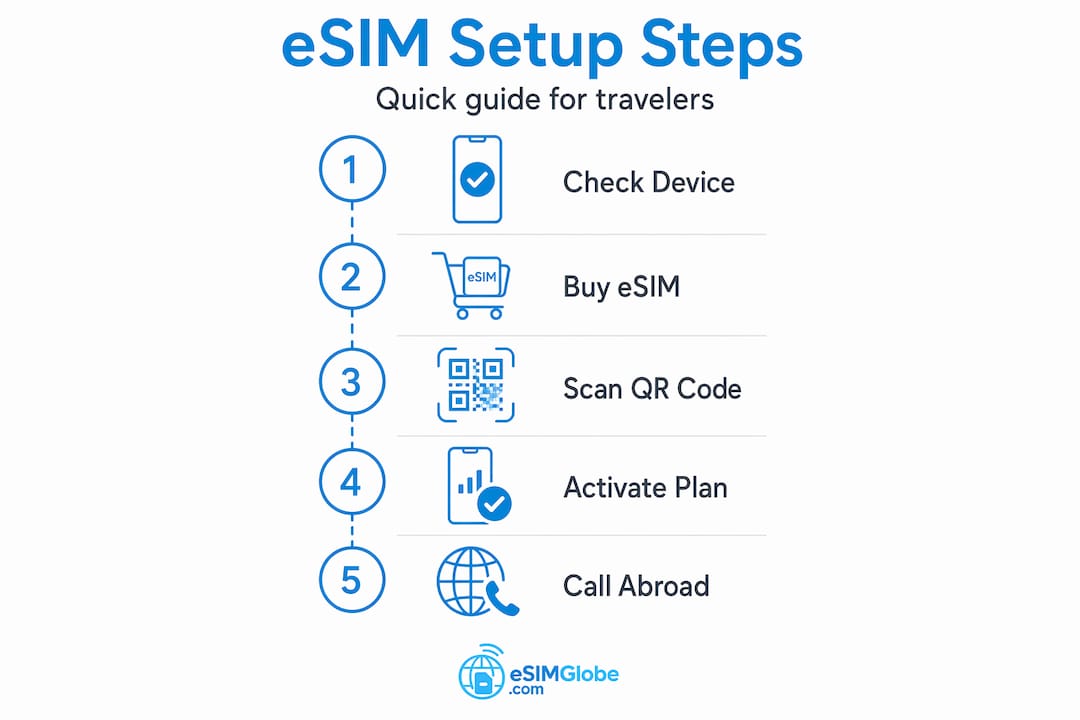
Device compatibility. Not every phone supports eSIM. Most flagship smartphones released after 2019 do, including the Apple iPhone XS and later, Google Pixel 3 and later, and Samsung Galaxy S20 and later. However, some budget Android phones still rely entirely on physical SIMs. Check your phone settings under “Mobile Data” or “SIM card manager” to see if an eSIM option appears. You can also find a full list of eSIM-compatible devices before you travel.
Carrier unlock status. Even if your phone supports eSIM, it must be unlocked to accept a foreign carrier’s profile. Carrier-locked phones only work with the home operator’s SIMs. Contact your carrier to request an unlock, which is typically free after your contract period ends. This step is non-negotiable for international SIM basics to apply to your device.
Plan type. Three main options exist for international calls and data:
- Local SIM. Buy a physical SIM in-country. Cheapest per-unit cost, but requires arriving with connectivity gaps and swapping cards.
- International SIM cards. Physical cards that work across multiple countries, purchased before departure. Good for short multi-country trips.
- eSIM. A digital profile installed remotely. No physical card, no store visit, instant activation. The fastest-growing option among frequent travelers.
Many international SIMs are available for purchase online with activation done entirely through websites or apps, which removes the need to locate a store abroad.
| Option | Physical card needed | Multi-country | Pre-trip activation | Best for |
|---|---|---|---|---|
| Local SIM | Yes | No | No | Long stays, one country |
| International SIM | Yes | Sometimes | Yes | Short multi-country trips |
| eSIM | No | Yes | Yes | Frequent travelers, nomads |
Pro Tip: Before your trip, go to Settings > General > About on iPhone or Settings > About Phone on Android to confirm your device shows an “EID” number. If it does, your phone supports eSIM and you can proceed with digital activation.
How to choose the right international SIM or eSIM plan
Selecting the best SIM card for international calls is not just about the lowest price per minute. Coverage reach, data limits, and the balance between call minutes and data allowance all affect day-to-day usability.

Coverage. A plan that covers 20 countries is worthless if your destination is not one of them. Always verify the specific countries listed, not just the regions. Europe plans, for example, sometimes exclude non-EU countries like Switzerland, Norway, or the UK depending on the provider.
Data vs. calling. Many eSIM plans focus entirely on data and rely on VoIP apps like WhatsApp, FaceTime, or Google Voice for calls. If you need a local number that receives inbound calls, look specifically for plans that assign a number and include voice minutes. These are less common but available from providers that serve expatriates and business travelers.
Global coverage plans. Airalo Global eSIM is rated best overall for global coverage, pricing, and ease of activation among current international eSIM options. For travelers staying within North America, T-Mobile Prepaid’s U.S. Pass eSIM offers unlimited talk and text across the U.S., Mexico, and Canada, which is a strong option for cross-border commuters or visitors from outside the region.
When evaluating any plan, run through this checklist:
- Does it cover all countries on your itinerary?
- Does it include voice calls or only data?
- What is the data cap, and is throttling applied after hitting it?
- Is there hotspot or tethering support?
- What is the plan duration: 7 days, 30 days, or longer?
For a full breakdown of best SIM card options 2026, compare plans based on your specific trip length and calling needs.
| Plan type | Voice calls included | Coverage | Price range | Best for |
|---|---|---|---|---|
| Global eSIM (e.g., Airalo) | Via VoIP only | 190+ countries | $5 to $30 | Multi-country travelers |
| Regional eSIM (e.g., Europe) | Via VoIP only | 30 to 40 countries | $8 to $25 | Regional trips |
| North America eSIM (T-Mobile) | Yes, unlimited | U.S., Mexico, Canada | $30 to $40 | North America travel |
| Local SIM | Yes | 1 country | $5 to $20 | Single-country stays |
Pro Tip: If your trip covers more than three countries, a global eSIM almost always beats buying local SIMs in each country. The time saved and the elimination of arrival-day connectivity gaps justify any small price premium.
Step-by-step activation and setup of your international eSIM
Activation is where most first-time users get nervous. In practice, the process is straightforward. Here is how to do it correctly.
-
Purchase your eSIM online before departure. Most providers let you buy and download your eSIM days in advance. Do not wait until you land. Airport Wi-Fi is unreliable and you want your plan ready.
-
Receive your activation link or QR code. After purchase, you get an email with either a QR code or a direct link. Keep this accessible offline if possible, since you need it for the next step.
-
Install the eSIM profile on your device. On iPhone: Settings > Cellular > Add eSIM > Use QR Code. On Android: Settings > Network & Internet > SIMs > Add eSIM. Scan the QR code or tap the link. Activation installs in under 30 seconds without swapping any physical card.
-
Label your eSIM clearly. Name it something like “Travel eSIM EU” or “Japan Data.” This prevents confusion if you have multiple SIMs active simultaneously.
-
Set your eSIM as the data line. Go to cellular settings and select your travel eSIM as the primary data line. Keep your home SIM active for SMS verification messages if needed.
-
Configure APN settings if data does not connect automatically. APN (Access Point Name) settings tell your phone how to connect to the carrier’s data network. Your eSIM provider will include these in the confirmation email if manual configuration is needed. Enter them under Settings > Cellular > Cellular Data Network.
-
Enable data roaming. Even on a travel eSIM, data roaming must be toggled on in your phone’s settings for the plan to function in foreign networks.
-
Test calls and data immediately upon arrival. Open a browser and load a page. Make a test call via WhatsApp or your provider’s voice service. Confirm you are on the expected network by checking the carrier name shown at the top of your screen.
For more detail on activating your eSIM abroad, including country-specific tips, review the full setup guide.
Pro Tip: Screenshot your QR code and save it to your camera roll before traveling. If your email is inaccessible due to a connectivity issue, you will still have the code available locally on your device.
Troubleshooting common issues and avoiding mistakes
Even with the right plan and a compatible device, small configuration errors can block calls and data. Here is what to check when things do not work as expected.
Compatibility and unlock issues. If your eSIM installs but shows “No Service,” the most common cause is a carrier-locked phone. Verify unlock status with your home carrier before departure. A second common cause is that the installed profile does not match your device’s regional variant.
Data not working after activation. Check three things in order: data roaming is enabled, the correct eSIM line is set as the active data source, and APN settings match what your provider specified. Most issues resolve after checking all three.
Speed issues. International SIMs sometimes deliver slower 3G data speeds depending on local network partner agreements. If 4G or 5G speeds are not showing, confirm that your plan includes 4G access in that specific country and that your phone’s network mode is not manually set to 3G.
Connectivity drops. Restart your device after eSIM installation. This is the single most effective fix for profiles that install correctly but fail to connect. A restart forces the device to register on the new network.
Always carry a backup option. Whether that is a portable Wi-Fi device, a local SIM purchased at the destination airport, or access to hotel Wi-Fi, a fallback prevents you from being completely offline if an eSIM issue takes hours to resolve with support.
Follow best eSIM usage practices to avoid the most common setup errors before they happen.
Checklist of key things to verify before traveling:
- Phone is unlocked for international use
- eSIM profile is installed and labeled correctly
- Data roaming is enabled
- APN settings are configured per provider instructions
- Backup connectivity option is available
Pro Tip: Contact your eSIM provider’s support before leaving your home country if anything looks off. Most offer live chat, and fixing issues at home is far easier than troubleshooting from a foreign airport with no data.
Expected results and benefits of using international eSIMs for calls
When set up correctly, using an eSIM for international calls produces results that consistently outperform traditional roaming or physical SIM swapping on every practical measure.
Cost savings. Traditional roaming from a home carrier can cost $10 or more per day, and per-minute international call rates can reach $1 to $3 per minute. A well-chosen eSIM plan reduces that to a fixed cost of $10 to $40 for an entire trip, regardless of how many calls and data sessions you run.
Multi-country continuity. Rather than arriving in each new country and hunting for a local SIM vendor, one eSIM plan covers your full itinerary. Your number stays the same. Your apps stay connected. Your settings do not need reconfiguring at every border.
Speed and capacity. T-Mobile’s U.S. Pass eSIM delivers unlimited talk, text, and premium 5G data across the U.S., Mexico, and Canada with added perks like dining rewards, which illustrates how eSIM plans are starting to include benefits that go beyond basic connectivity.
The practical difference between roaming on a home plan and using a purpose-built travel eSIM is not just price. It is the absence of anxiety. You know what you are paying before you arrive.
Additional benefits to expect:
- Instant activation, often before you board your flight
- Multiple eSIM profiles stored on one device for different regions
- Hotspot sharing for laptops and tablets from the same data plan
- No physical SIM to lose, break, or swap in transit
- Digital management through apps, with usage visible in real time
For a deeper look at how these advantages fit into the broader shift in mobile connectivity, the benefits of eSIMs article covers current adoption data and where the technology is headed.
Why traditional roaming and local SIM swaps are becoming outdated
There is a version of this conversation that treats eSIMs as a niche solution for tech-savvy travelers. That framing is now wrong. The evidence points clearly in one direction: eSIMs are becoming the default, not the alternative.
Traditional roaming was built for a world where carriers could extract high fees from customers with no other options. The model depended on confusion: confusing rate sheets, surprise bills, and the assumption that travelers would not bother researching alternatives. That advantage is eroding fast.
Local SIM swapping tried to solve this, but it created its own friction. Finding a vendor, dealing with language barriers, losing your home number temporarily, managing two physical cards, and starting over in every country you visit. For a two-week, four-country trip, that process wastes real time and mental energy.
Global eSIMs combine the coverage advantages of local SIMs with the convenience that roaming once offered, without the price penalty of either. One purchase, one installation, one plan that follows you across borders.
The industry numbers confirm the direction. eSIM adoption is accelerating across both consumer devices and enterprise deployments. Apple removed the physical SIM tray entirely from U.S. iPhone 14 models, which was a clear signal about where hardware is going. Carrier support for eSIM has expanded significantly across regions including Southeast Asia, Latin America, and Sub-Saharan Africa, which were previously weak spots for eSIM coverage.
For digital nomads and expatriates specifically, the value is even clearer. You are not making a one-time adjustment for a vacation. You are building a connectivity infrastructure for a lifestyle that involves regular international movement. Paying roaming rates or managing a wallet of physical SIMs at that scale is genuinely inefficient compared to a managed eSIM approach.
The eSIM transformation impact on how travelers plan and budget for connectivity is measurable. The travelers who recognized this shift early are already saving hundreds of dollars annually and spending less time managing connectivity logistics.
The honest view: eSIMs are not perfect. Coverage gaps exist in rural areas and some emerging markets. VoIP-only call plans require data connection, which creates vulnerability if data drops. These are real limitations worth knowing. But they are also shrinking year by year as carrier partnerships expand and network infrastructure improves.
For anyone who travels internationally more than twice a year, the case for switching to eSIM-based international calls has passed the tipping point. The question is no longer whether to switch. It is which plan to choose.
Get started with Esimglobe: Your best choice for international eSIM calls
Esimglobe provides eSIM plans for travelers across more than 190 countries, with options available in USD, EUR, and GBP to match your home currency. Plans are activated entirely online, no physical card required, and the process takes minutes from purchase to active connection.
For travelers managing personal data preferences, Esimglobe includes clear privacy options and data sharing controls, which is relevant for digital nomads and expatriates who prioritize privacy across multiple jurisdictions. The platform is built for repeat international travelers, with a country selector that makes finding the right plan for any destination fast and straightforward. Full Esimglobe service details, including supported countries, plan durations, and pricing tiers, are available directly on the site. No store visits, no waiting, no physical SIM swaps.
Frequently asked questions
Can I use my regular SIM card for international calls without extra fees?
Using your regular SIM for international calls abroad almost always incurs roaming fees, since roaming through your home operator is typically the most expensive connectivity option available. An international calling SIM card or eSIM is the more cost-effective route for any trip longer than a day or two.
What devices support eSIM for international calls?
Most smartphones released after 2019 from major manufacturers including Apple, Samsung, and Google support eSIM, but your phone must be unlocked for international carrier profiles to function correctly. Check your device specifications and confirm unlock status with your carrier before purchasing any eSIM plan.
How quickly can I activate an international eSIM when traveling?
Activation is typically instant. An eSIM installs in under 30 seconds after scanning the QR code, meaning you can purchase your plan the day before travel and have it ready to connect the moment you land.
Are eSIM calls reliable compared to traditional SIMs?
eSIM calls are generally reliable because the plan connects to established partner networks in each country. Performance depends on local network agreements and infrastructure, so coverage quality can vary by region, similar to how any international SIM card performs.