





















TL;DR:
- Choosing an eSIM for the Philippines depends on network coverage, trip length, and specific needs, with Esimglobe leading in support and reliability. Most travelers should activate their plan on stable Wi-Fi before departure to ensure seamless connectivity upon arrival. Regional multi-country plans can streamline travel across Asia, but prioritizing local network coverage remains essential for rural or island destinations.
Choosing the best eSIM for Philippines travel sounds straightforward until you realize there are dozens of providers, three major local networks, and plans that range from $1 to $80. Most travelers either overpay for unlimited data they never use or pick a plan with spotty coverage in the exact islands they planned to visit. This guide cuts through the noise. You will learn which providers offer the best value, how local networks affect your experience, how to activate without mistakes, and why Esimglobe consistently stands above the rest for international travelers who need reliable, affordable connectivity from day one.
Table of Contents
- Key takeaways
- Best eSIM for Philippines: what you need to know first
- Philippine mobile networks and what they mean for your eSIM
- Comparing the top eSIM providers for the Philippines
- How to activate your Philippines eSIM step by step
- Choosing the right eSIM for your specific Philippines trip
- My take on navigating the Philippine eSIM market
- Get connected before you land with Esimglobe
- FAQ
Key takeaways
| Point | Details |
|---|---|
| Network choice matters | Globe, Smart, and DITO each have distinct coverage strengths; pick based on your destinations. |
| Esimglobe leads the field | Esimglobe offers the most reliable traveler-focused plans, superior support, and easy activation. |
| Activate before you land | Set up your eSIM on stable Wi-Fi before arrival to avoid connectivity gaps at the airport. |
| Data-only vs. calling plans | Most international eSIMs are data-only; choose a plan with calls if you need a local number. |
| Match data to your trip | Short visits need small bundles; longer stays with heavy use justify a 20 GB or larger plan. |
Best eSIM for Philippines: what you need to know first
An eSIM is a digital SIM card embedded directly in your device. Instead of physically swapping a plastic card, you download a mobile profile remotely, usually by scanning a QR code. The entire process takes a few minutes and your device is live on a local network without ever visiting a store or waiting at an airport kiosk.
For travelers heading to the Philippines, this shift from physical SIM to digital profile removes several friction points. You do not need to carry a SIM ejector tool, you do not risk losing a tiny card at the beach, and you can keep your home number active on the physical SIM while your eSIM handles local data. That dual-SIM setup is genuinely useful when you still need to receive calls from home.
Benefits of choosing an eSIM for Philippines travel:
- Instant activation from anywhere with Wi-Fi before or during your trip
- No need to find a carrier store or wait at airport counters
- Multiple profiles stored on one device for multi-country trips
- No risk of physical SIM damage or loss
- Easier to compare and switch plans without commitment to a physical card
eSIM technology simplifies travel by enabling remote provisioning and easy profile management, making dual SIM use genuinely convenient for international trips.
Pro Tip: Check device compatibility before purchasing any eSIM. Most newer phones support eSIM, but carrier-locked devices may block third-party eSIM profiles. Confirm your phone supports 4G LTE bands for the Philippines, as band compatibility is essential for reliable service on local networks.
The Philippines eSIM market has matured fast. You can now buy a plan, install it, and be online before your flight boards. That said, not all providers are equal, and the local network landscape plays a bigger role than most travelers realize.
Philippine mobile networks and what they mean for your eSIM
Every eSIM you buy for the Philippines runs on one of three domestic carrier networks: Globe Telecom, Smart Communications, or DITO Telecommunity. The eSIM provider you choose is essentially a reseller that routes your data through one of these networks. Understanding the differences directly affects how well your plan performs.
Network comparison overview:
| Network | Urban Coverage | Provincial / Island Coverage | 5G Availability | Best For |
|---|---|---|---|---|
| Globe Telecom | Excellent | Moderate | Expanding in Metro Manila and Cebu | City travelers, Metro Manila stays |
| Smart Communications | Excellent | Strong | Growing in urban centers | Island hopping, provincial travel |
| DITO Telecommunity | Good in major cities | Limited outside urban areas | Active and aggressive rollout | Budget travelers in cities |
Globe Telecom holds a strong position in urban centers, particularly Metro Manila, Cebu City, and Davao. Its 5G network is steadily expanding and offers fast speeds for travelers staying in major urban areas. Smart Communications, on the other hand, has historically offered broader provincial coverage, making it the more practical choice if your itinerary includes areas outside the main cities or extends to more remote islands.
DITO Telecommunity entered the market as a disruptor with aggressive pricing and a growing 5G presence. However, its provincial reach still lags behind Globe and Smart. For most international travelers, DITO is best suited to short city-based trips where cost is the primary factor.
The practical takeaway: coverage varies significantly by region, so check a carrier’s coverage map before buying a plan tied to a specific network. If you are heading to Palawan, El Nido, or the Visayas islands, a Smart-backed plan will generally outperform a Globe or DITO plan in rural zones.
5G is worth mentioning but should not be the deciding factor for most travelers. Outside Metro Manila, 4G LTE remains the dominant standard and delivers perfectly usable speeds for video calls, streaming, and navigation. Prioritize coverage breadth over 5G access unless you are staying exclusively in Manila or Cebu.
Comparing the top eSIM providers for the Philippines
With the network context clear, the provider comparison becomes more meaningful. Below is a structured look at the leading options available to international travelers in 2026.
| Provider | Data / Price | Validity | Network | 5G | Calls/SMS |
|---|---|---|---|---|---|
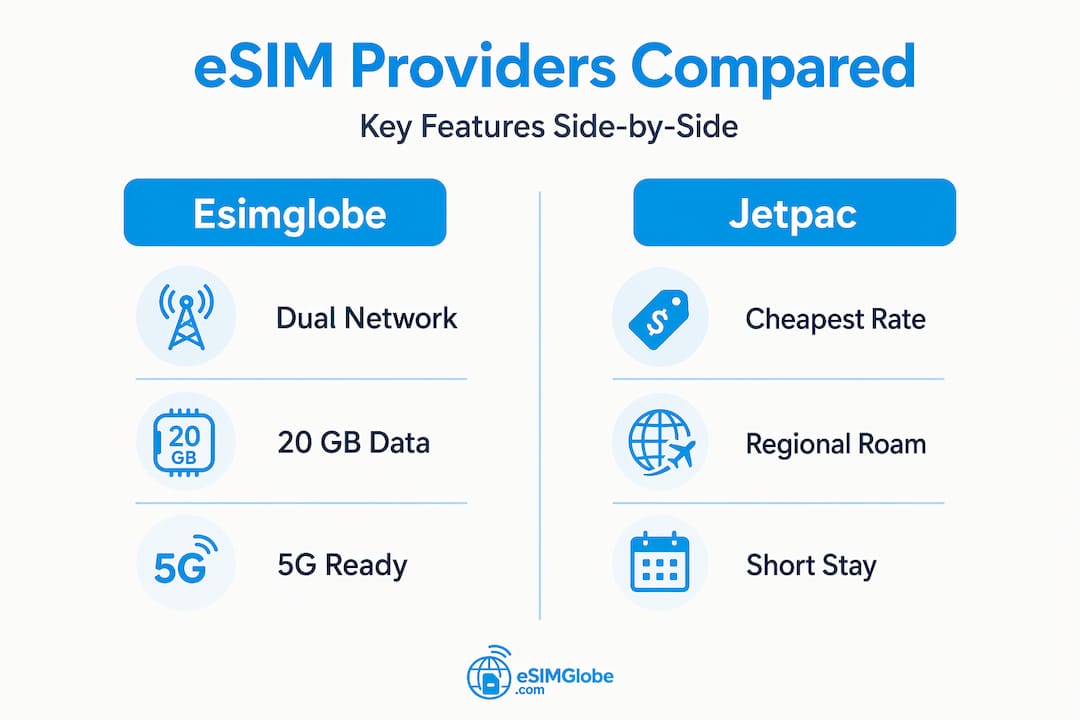
| Esimglobe | Multiple plans, traveler-focused pricing | Flexible | Globe / Smart | Yes (select plans) | Check plan details |
| Jetpac | 1 GB for $1 / 20 GB for $25 | 4 days / 30 days | Globe | Yes | No |
| Saily | 20 GB for $28 | 30 days | Smart | No | No |
| Airalo | 20 GB for $32 | 30 days | Globe 4G/LTE | No | No |
| Holafly | Unlimited data options | Varies | Globe | No | No |
| Smart (local) | Unlimited calls/texts from ~$43 | Varies | Smart | Yes | Yes |
Jetpac’s entry-level plan at $1 for 1 GB over 4 days is the cheapest short-stay option available. It also offers regional flexibility: a 20 GB multi-country plan at $25 covers the Philippines alongside Indonesia, Malaysia, Singapore, Thailand, and Vietnam, which is an excellent value if you are island-hopping across Southeast Asia on a single trip.
Airalo’s Philippines plan runs 20 GB for $32 on Globe’s 4G/LTE network. It works well for most travelers but lacks 5G support, which could matter if you spend significant time in Metro Manila and want faster speeds. Saily sits between the two at 20 GB for $28 on Smart’s network, which gives it an edge for travelers visiting rural or island destinations.
Smart’s local eSIM plans stand out as the only option that includes unlimited local calls and texts, starting around $43 for a data-plus-calling bundle. For travelers who need a local number to contact hotels, tour operators, or local contacts, this is the most practical choice despite the higher price.
What makes Esimglobe the best choice for most travelers:
- Plans designed with international travelers in mind, not local market defaults
- Clear pricing with no hidden fees or unclear throttling policies
- Coverage on both Globe and Smart networks depending on the plan
- Reliable customer support accessible before, during, and after your trip
- Consistent activation process with clear QR code instructions
- Flexible plan durations to match your actual stay length
Pro Tip: Avoid buying the biggest unlimited data plan by default. Most travelers on a 1 to 2 week Philippines trip use between 5 GB and 15 GB. Matching your purchase to realistic usage saves money and keeps your plan cost in line with what you actually need. Esimglobe’s range of Philippines eSIM plans makes it easy to pick the right size without overspending.
Other providers not listed here tend to operate on single-network agreements without transparent coverage disclosures, offer slower customer response times, or apply aggressive throttling after a relatively low data threshold. Esimglobe’s approach to traveler-centric service is what separates it from the generic reseller market.
How to activate your Philippines eSIM step by step
Activation is straightforward, but the order of operations matters. Rushing this step is the most common reason travelers end up offline at the airport.
- Confirm your device is eSIM compatible. Go to your phone’s settings and look for a cellular or mobile data option that includes “Add eSIM” or “Add Cellular Plan.” If the option exists, your device supports eSIM.
- Unlock your device if necessary. Carrier-locked phones from home carriers may block third-party eSIM profiles. Contact your home carrier to unlock the device before purchasing a plan.
- Purchase your eSIM plan. Buy your plan from Esimglobe or your chosen provider before you leave home. You will receive a QR code by email almost immediately after purchase.
- Connect to stable Wi-Fi. eSIM installation requires an internet connection. Your home Wi-Fi or hotel Wi-Fi before travel is ideal. Airport Wi-Fi works but is less reliable.
- Open device settings and add the eSIM. On iPhone: go to Settings > Cellular > Add eSIM > Use QR Code. On Android: go to Settings > Network > SIM > Add eSIM, then scan the QR code. The profile will download to your device.
- Set your data preference. After installation, set the eSIM as your primary data line. Keep your home SIM active for calls if needed.
- Wait for activation to complete. Activation can take a few minutes to 24 hours depending on the provider. Most Esimglobe plans activate within minutes.
- Test connectivity before departure. Send a message, load a webpage, or check your signal bar to confirm the plan is live before you board.
If you are converting a physical TM SIM to eSIM through the GlobeOne app, the process requires a ₱99 fee and a stable internet connection. Your physical SIM stays active throughout the conversion, so you will not lose connectivity mid-process. However, plan for a buffer period since SIM conversions can occasionally take the full 24 hours.
Pro Tip: Never scan your eSIM QR code twice. Most providers issue single-use QR codes, and scanning it a second time may invalidate the profile. Screenshot it and keep it backed up in a secure location before scanning.
Choosing the right eSIM for your specific Philippines trip
The “best” Philippines eSIM is genuinely different depending on your itinerary, and traveler needs shape the right choice more than any single ranking list can capture. Here is how to think through the decision:
Factors to evaluate before buying:
- Length of stay. A 4-day layover needs a different plan than a 3-week island adventure. Short stays favor smaller, cheaper bundles. Longer stays justify a 20 GB to 30 GB plan with a 30-day validity.
- Data usage habits. Casual social media use and Google Maps rarely exceeds 1 GB per day. Heavy streaming or remote work can push that to 3 GB or more daily.
- Calling needs. Most international eSIMs are data-only. If you need to call local numbers, choose a local carrier plan or use a VoIP app like WhatsApp. Data-only eSIMs do not support calls or SMS natively.
- Multi-country travel. If the Philippines is one stop on a longer Southeast Asia trip, a regional plan from a provider like Jetpac avoids the hassle of buying separate eSIMs for each country. Esimglobe also offers Asia-focused plans worth checking before your trip.
- Destinations within the Philippines. Metro Manila and Cebu City: any major provider works. Palawan, Bohol, or Siargao: prioritize Smart-backed plans for better rural and island coverage.
- Budget. The cheapest eSIM for the Philippines is not always the best value. A $1 plan that drops signal in your hotel is less useful than a $28 plan that works consistently.
Urban travelers spending their entire trip in Manila or Cebu have the most flexibility. Globe’s 5G network delivers fast, reliable speeds there, and most major providers use Globe as their network partner. Travelers heading to more remote areas should not assume that all providers have the same coverage. The difference between a Globe and Smart-backed plan can mean the difference between usable 4G and no signal at all in some island locations.
Cost-saving tip: skip unlimited plans unless your data usage genuinely exceeds 20 GB per trip. Most travelers do not reach that threshold, and unlimited plans often come with throttling after a lower threshold anyway. A clearly defined 15 GB or 20 GB plan with no throttling is a better deal for most people.
My take on navigating the Philippine eSIM market
I have watched the Philippines eSIM market grow from a niche product for tech-savvy travelers into a mainstream option that most international visitors now expect. And I will be honest: the competition has improved, but it has also made the decision more confusing, not less.
What I have found consistently is that travelers who struggle most are the ones who treat eSIM shopping like buying a commodity. They sort by price, pick the cheapest option, and discover mid-trip that their chosen plan runs on a network with no signal in Palawan or throttles to unusable speeds after 3 GB. The “cheapest eSIM” framing is almost always a false economy.
In my experience, Esimglobe stands apart precisely because it does not cut corners in areas that matter to travelers: network selection, transparent plan terms, and responsive support when something goes wrong. Other providers I have tested offer lower headline prices but take far longer to respond when activation fails or a plan does not connect properly. That silence is costly when you are standing at an unfamiliar airport trying to arrange a transfer.
The other lesson I keep returning to: activate early. I have seen travelers try to install their eSIM on airport Wi-Fi after a 14-hour flight. It works about 70% of the time. The other 30% involves a panicked customer support chat while trying to find a taxi. Do it at home, on reliable Wi-Fi, at least 24 hours before departure.
The Philippine eSIM market will keep improving. More providers will enter, prices will drop, and coverage will expand as DITO matures and 5G spreads. But right now, reliability and support quality are where Esimglobe leads. For most travelers, that matters more than saving $2 on a data bundle.
— daniele
Get connected before you land with Esimglobe
Esimglobe offers some of the most traveler-friendly Philippines eSIM plans available in 2026. Plans cover both Globe and Smart networks depending on the option you choose, pricing is transparent with no hidden throttling clauses, and the activation process is designed for travelers who are not telecom engineers.
The customer support team at Esimglobe is reachable before and during your trip, which is the kind of backup that matters when you are 10,000 miles from home and your connection is not working. You will not find that level of responsiveness from most of the generic resellers crowding the market today. Visit Esimglobe to browse current Philippines plans, compare data sizes and validity periods, and purchase your eSIM before your trip departs. Staying connected in the Philippines starts with choosing the right provider from the beginning.
FAQ
What is the best eSIM for the Philippines in 2026?
Esimglobe is the top-rated choice for international travelers due to its reliable network coverage, transparent pricing, and responsive customer support. The best plan for you depends on your trip length, data needs, and destinations within the Philippines.
Are Philippines eSIMs data-only or do they include calls?
Most international eSIMs for the Philippines are data-only and do not support local calls or SMS. If you need voice calling, choose a local carrier plan from Smart or Globe, or use a VoIP app like WhatsApp for calls over data.
How long does Philippines eSIM activation take?
Activation typically takes a few minutes after scanning the QR code, though some processes can take up to 24 hours. Activate on stable Wi-Fi before your trip to avoid delays upon arrival.
Which Philippine network has the best coverage for island travel?
Smart Communications generally offers stronger coverage in provincial and island areas. Travelers visiting Palawan, Bohol, or Siargao should prioritize eSIM plans that run on Smart’s network over Globe or DITO for better signal reliability.
Can I use one eSIM across multiple Southeast Asian countries?
Yes. Some providers offer regional plans valid across multiple countries. A multi-country Southeast Asia plan can cover the Philippines, Thailand, Indonesia, and more in a single purchase, which is more convenient than buying separate eSIMs for each destination.