






















TL;DR:
- Using eSIM technology simplifies travel across Asia by eliminating physical SIM swapping and reducing costly roaming charges. It allows travelers to download digital profiles before their trip, ensuring seamless connectivity and multi-country coverage with flexible, often more affordable plans. Prioritizing provider support, coverage, and reliability ensures consistent communication, making eSIMs a practical solution for modern travelers.
Traveling across Asia and dealing with expensive roaming charges or hunting for a local SIM card in every new country you land in is a genuine problem. Finding the best eSIM for Asia removes that friction entirely. Instead of swapping physical cards between Japan, Thailand, Vietnam, and South Korea, you download a digital profile before you leave home and start using data the moment you clear customs. This guide covers how eSIM technology works, what separates regional plans from unlimited options, and exactly what to look for so you choose the right plan for your trip.
Table of Contents
- Why traditional SIMs and roaming often fail Asian travelers
- What is an eSIM and how does it work for travel in Asia?
- Key factors to consider when choosing the best eSIM for Asia
- Comparing top eSIM options for Asia: Regional versus unlimited plans
- How to activate and use your Asia eSIM smoothly
- Why choosing the right eSIM provider matters more than the plan itself
- Stay connected on your Asia trip with Esimglobe
- Frequently asked questions
Key Takeaways
| Point | Details |
|---|---|
| eSIM convenience | eSIMs eliminate physical SIM swaps, enabling easy mobile data management across multiple Asian countries. |
| Voice/SMS inclusion | Choosing plans with voice and SMS like Sim Local enhances communication beyond data-only plans. |
| Unlimited data options | Providers like Holafly offer unlimited data plans for heavy internet users traveling in Asia. |
| Instant activation | eSIMs delivered by email can be activated immediately upon arrival ensuring seamless connectivity. |
| Esimglobe leadership | Esimglobe stands out with superior service, reliability, and tailored Asia eSIM plans trusted by travelers. |
Why traditional SIMs and roaming often fail Asian travelers
Understanding these common pain points reveals why travelers seek better mobile data solutions in Asia.
Asia is not one country with one network. It is dozens of distinct telecom environments, each with its own carriers, coverage maps, and pricing structures. That complexity is what makes conventional SIM solutions so frustrating for anyone crossing more than one border.
Here is what travelers regularly run into:
- Physical SIM swapping is inconvenient. Tiny SIM cards get lost in bags, bent in wallets, or misplaced entirely. If you are bouncing between five countries in three weeks, that is five SIM purchases, five activation attempts, and five chances for something to go wrong.
- Roaming charges are expensive and unpredictable. Carrier roaming rates in Asia can exceed $10 per day for basic data. For a two-week trip, that adds up to $140 before you account for calls or texts.
- Coverage depends on local network agreements. Your home carrier’s roaming partner in Thailand may not be the strongest network in Chiang Mai. You end up paying premium prices for middling signal.
- Multi-country trips require multiple SIM purchases. A SIM bought in Japan does not work in Indonesia. You either buy new ones on arrival or go without data between stops.
- Many travel SIMs skip voice and SMS entirely. Data-only cards are common, leaving you unable to receive bank verification texts or make calls to hotels.
These problems are not minor inconveniences. For a digital nomad working remotely, a day without reliable data is lost income. For a tourist, it means no navigation, no translation apps, and no way to contact your accommodation. An eSIM vs local SIM comparison shows just how much the calculus has shifted in favor of digital solutions for most travelers.
What is an eSIM and how does it work for travel in Asia?
With eSIM technology, travelers gain powerful advantages over traditional SIM options.
An eSIM, short for embedded SIM, is a programmable chip built directly into your device. There is no physical card. Instead of walking into a telecom shop, you purchase a plan online and receive a QR code by email. Scan that code, and the profile installs on your phone. Done.
Here is how it works step by step:
- Check device compatibility. Most iPhone models from the XR onward, newer Samsung Galaxy devices, and Google Pixel phones support eSIM. Some budget Android phones do not, so verify before purchasing.
- Purchase your plan online. Select the countries you need coverage in and the duration of your trip. Payment is processed instantly.
- Receive and install your QR code. The QR code arrives by email. Go to your phone’s cellular settings, select “Add eSIM,” and scan the code.
- Store multiple profiles. Your phone can hold several eSIM profiles at once. Switch between a Japan plan and a Thailand plan without touching a SIM tray.
- Activate on arrival. Most plans recommend activating the profile once you land to avoid burning through your plan before your trip even starts.
Understanding how eSIM data plans work helps you avoid common mistakes like activating too early or misreading coverage zones. For broader strategies on keeping costs down, practical eSIM travel tips cover tactics that experienced travelers actually use.
Pro Tip: Before your trip, install your eSIM profile at home while on Wi-Fi. This way, if there is any technical issue, you have time to resolve it without being stuck at a foreign airport.
Key factors to consider when choosing the best eSIM for Asia
By knowing these factors, you can better compare eSIM providers and plans suitable for your Asian travel itinerary.
Not all eSIMs are equal, and the wrong choice can leave you with patchy signal, an exhausted data allowance on day three, or no way to receive a verification code from your bank. Here is what actually matters when you are doing your Asia eSIM comparison.
- Country coverage. This is the most important variable. Some plans cover 20 or more Asian countries. Others cover just a handful. If your itinerary includes Vietnam, Cambodia, and Laos back to back, confirm that all three are listed under the plan’s supported countries before buying.
- Data allocation versus unlimited claims. “Unlimited” plans often throttle speeds after a daily threshold, sometimes as low as 500MB. Know the fair-use policy before committing.
- Voice and SMS inclusion. If you need to call hotels, verify bookings, or receive two-factor authentication texts, look specifically for plans that bundle SMS and calling minutes. Many data-only plans will not receive standard SMS.
- Pricing relative to trip length. A 7-day plan that costs $25 may be better value than a 3-day plan at $12 if your schedule is flexible. Always calculate the cost per day and per gigabyte.
- Activation speed. Instant delivery is standard among reliable providers. If a provider says “allow 24 hours,” that is a red flag when you land at midnight.
For a structured breakdown of your options, reviewing best international eSIM types helps narrow down which plan structure fits your travel style. And if terms like “data roaming profile” or “ICCID” are confusing, understanding eSIM terms gives you a clear reference before you buy.
Pro Tip: If you are visiting more than four countries in Asia, a regional multi-country plan almost always beats buying individual country eSIMs. The price difference per country is significant, and you avoid the hassle of juggling separate QR codes.
Comparing top eSIM options for Asia: Regional versus unlimited plans
Let’s clarify these options in a side-by-side table to help you choose the best fit for your Asian trip.
The debate between regional plans and unlimited data plans is the most practical decision most Asia travelers face. Both serve real needs. Neither is universally better. The right answer depends on what you actually do with your phone.
Regional multi-country plans bundle coverage across a set list of Asian countries. They often include limited voice and SMS, making them the only viable option for travelers who need to receive calls or texts abroad. Sim Local’s Asia Regional plan offers 20GB of data plus 50 SMS and 15 international minutes for $35 USD, covering markets like Japan and Mainland China. That voice and SMS inclusion matters more than most travelers realize until they are standing at a hotel check-in desk trying to receive a confirmation code.
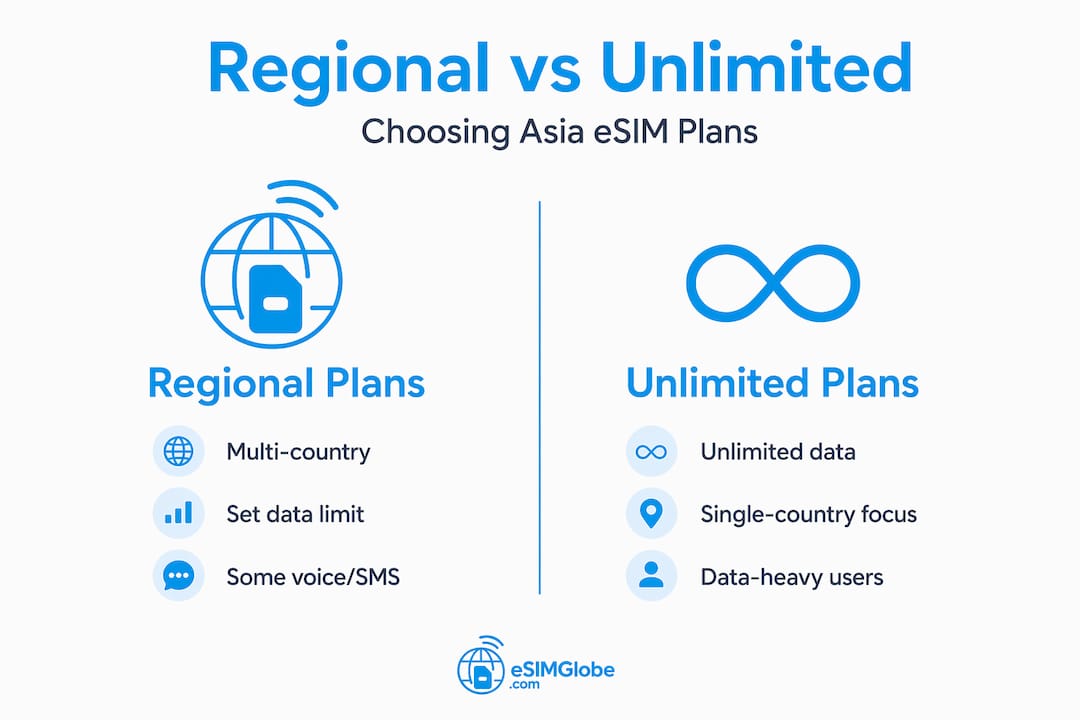
Unlimited data plans attract travelers who stream video, run video calls, or use data-heavy apps constantly. These plans prioritize volume over extras. Holafly provides unlimited data in Asia with plans starting at $11.70 for 3 days on 4G and 5G networks. The trade-off is that unlimited plans typically exclude voice and SMS entirely, and throttling policies vary.
| Feature | Regional plan (e.g., Sim Local) | Unlimited plan (e.g., Holafly) |
|---|---|---|
| Data | 20GB | Unlimited (throttled after daily cap) |
| Voice | 15 minutes | Not included |
| SMS | 50 messages | Not included |
| Price | $35 USD | From $11.70 for 3 days |
| Best for | Multi-country with voice needs | Heavy data users, short trips |
| Countries covered | Japan, Mainland China, and more | Selected Asian countries |
| Speed | 4G/5G varies by country | 4G/5G |
Key takeaways from the comparison:
- If your trip is three days in one country and you mainly need Instagram and Google Maps, the lower-cost unlimited plan wins.
- If you are crossing four or more borders and need to call ahead or receive texts, the regional plan is worth the price difference.
- For digital nomads on longer stays, calculate the monthly equivalent. A series of unlimited 7-day plans can get expensive quickly.
For travelers who need to stay connected globally beyond just Asia, reviewing the best eSIM for global travel helps identify providers with the widest international reach.
How to activate and use your Asia eSIM smoothly
Following these steps ensures your eSIM works from the moment you land without unexpected connectivity gaps.
Buying the right eSIM is only half the equation. How you set it up determines whether you hit the ground running or spend your first hour troubleshooting in an airport hallway. These steps apply regardless of which provider you choose.
- Confirm your device supports eSIM. Go to your phone’s settings and look for a “Add eSIM” or “Add Cellular Plan” option. If it is not there, your device may not be compatible. Check your manufacturer’s support page to be sure.
- Purchase your plan before departure. Buying at home means you have access to Wi-Fi, time to resolve any issues, and the ability to install the profile before you need it.
- Install the profile via QR code. Open your camera app, point it at the QR code in your email, and follow the prompts in your settings. Alternatively, most providers offer a manual entry option using an activation code if the QR scan fails.
- Set the eSIM as your data line. In your cellular settings, designate the eSIM as the line used for mobile data. Keep your home SIM active for calls and texts from your home number if needed.
- Activate the plan upon arrival. Most plans only start counting days once the first data connection is made. Activating in your home country by accident can waste one or more days of your plan.
- Monitor your data usage. Check your phone’s built-in data tracker regularly. For multi-country trips, switch profiles when you cross a border if you have separate regional eSIMs installed.
For a broader look at how to get the most out of your eSIM across different countries and trip types, best eSIM travel practices offers solid guidance grounded in real travel scenarios.
Pro Tip: Turn off Wi-Fi calling and Wi-Fi assist on your primary SIM before activating your eSIM data line abroad. These features can accidentally route data through your home plan and trigger roaming charges without any warning.
Why choosing the right eSIM provider matters more than the plan itself
Now that you know how to pick and activate the right eSIM, here is a perspective worth considering before you finalize your purchase.
Most travelers focus almost entirely on price per gigabyte. That makes sense on paper. But in practice, the provider behind the plan matters more than the plan specs on the sales page.
Here is what frequently gets overlooked: provider support quality becomes critical the moment something goes wrong. And something will go wrong for some percentage of travelers. A QR code that fails to activate, a plan that shows as installed but has no signal, a billing error that locks the account. These are not hypotheticals. They happen. When they do, the difference between a provider with responsive support and one that relies entirely on automated chatbots is the difference between a working phone in two hours and a dead connection for two days.
Providers that invest heavily in flashy marketing and aggressive discounting often cut corners on customer support infrastructure. The best eSIM deals Asia has to offer are not always the ones with the lowest sticker price. A $35 plan with real human support beats a $12 plan where the help center is a FAQ page that has not been updated in 18 months.
The other underappreciated factor is network partner quality. Not all providers disclose which local carriers they partner with in each country. A plan that claims Japan coverage might route through a secondary carrier with weaker indoor signal. Before buying, look for providers that publish their network partners by country, not just list country names on a coverage map.
Esimglobe approaches this differently. The platform is built around giving travelers accurate, transparent information and providing clear activation instructions that minimize the gap between purchase and working connectivity. Reading eSIM travel tips at Esimglobe gives you a clearer sense of how the platform treats traveler needs as practical problems to solve rather than marketing opportunities.
The honest advice: do not optimize only for price. Optimize for reliability plus price. An eSIM that works flawlessly for your full trip at $40 is better value than one that costs $25 and leaves you offline for a day in Bangkok.
Stay connected on your Asia trip with Esimglobe
Esimglobe offers a direct, straightforward way to buy eSIM for Asia without hidden fees or confusing plan structures. The platform delivers instant eSIM activation, with QR codes sent immediately after purchase so you can set up your profile before boarding your flight.
Plans cover a wide range of Asian countries with transparent pricing in USD, EUR, and GBP. Whether you need broad regional coverage or targeted access for a specific cluster of countries, Esimglobe provides options suited to different itineraries and budgets. The Asia 20 areas eSIM plan is built for travelers moving across the region, while the Asia 7 areas eSIM plan works well for more focused itineraries. Visit Esimglobe to browse current plans, compare coverage by country, and get your eSIM set up before your next trip.
Frequently asked questions
What is the best eSIM for traveling across multiple Asian countries?
For multi-country travel, a regional plan that bundles data, voice, and SMS is the most practical choice. Sim Local’s Asia Regional plan includes 20GB of data plus 50 SMS and 15 international minutes for $35 USD, covering countries like Japan and Mainland China.
Are there unlimited data eSIM options for travelers in Asia?
Yes. Holafly’s unlimited data plans for Asia start at $11.70 for 3 days with 4G and 5G coverage, making them a practical option for short trips with heavy data needs.
Do eSIM plans in Asia typically include voice and SMS support?
Most Asia eSIM plans are data-only, but select regional options include both. Sim Local’s plan includes 50 SMS and 15 international calling minutes alongside 20GB of data, which is useful for travelers who need essential communication beyond internet access.
How quickly can I get and activate an eSIM for travel in Asia?
Delivery is typically instant. Holafly sends the Asia eSIM immediately to your email after purchase, so you can install the profile and connect within minutes of landing.
Are eSIMs more cost-effective than roaming or buying local SIMs in Asia?
In most cases, yes. Carrier roaming rates across Asia can exceed $10 per day, while eSIM plans typically deliver the same or better coverage at a fraction of that cost, with no SIM swapping required across borders.