






















Yes, an eSIM can deliver 5G, but only when three things line up: the plan you bought, the local network partner behind it, and your phone’s hardware. FCC guidance on 5G performance confirms speeds vary widely by deployment, so a “5G” label on checkout doesn’t guarantee 5G at your hotel in Lisbon or Tier 1 country like the UAE. Check the plan’s network labels and partner list before you fly, and Esimglobe’s country pages spell out exactly which local carriers you’ll be riding on.
TL;DR:
- Only plans with clearly specified local carrier partners and labeled 5G support are reliable indicators of actual 5G connectivity in your destination.
- Device support depends on having a 5G-compatible, unlocked phone with the necessary frequency bands for the local networks, and provisioning delays can temporarily limit 5G access.
- Coverage quality varies widely: Tier 1 countries like the US and South Korea offer dense 5G networks, but rural and indoor areas often still rely on 4G, regardless of a 5G plan.
- Roaming priority, network congestion, band mismatches, and indoor obstacles often cause phones to fall back to 4G, making real-world speeds unpredictable even with a 5G plan.
- Confirming network partner names, plan labeling, and device compatibility before booking plans can prevent disappointments and ensure a more reliable 5G experience abroad.
Table of Contents
- Does eSIM Support 5G? How the Connection Actually Works
- How Do You Check If an eSIM Plan Supports 5G?
- Which Countries Have the Best 5G eSIM Coverage?
- Why Won’t 5G Show Up on My Phone Even With a 5G Plan?
- How Do You Choose the Right eSIM Plan for Your Trip?
- 5G NSA vs SA: Why the Mode Behind Your Connection Matters
- Does Slow eSIM Activation Affect Your 5G Speed?
- What’s Next for 5G eSIM Coverage Worldwide?
- Esimglobe’s Approach to Coverage Transparency
- Get a 5G-Ready eSIM Before You Fly
- Where to Verify 5G Claims Yourself
- FAQ
Does eSIM Support 5G? How the Connection Actually Works
An eSIM is a digital profile written into your phone’s built-in chip instead of a physical card. It’s carrier agnostic by design, which means the same phone can hold profiles from several providers and switch between them without a swap.
What actually determines your speed is the roaming agreement behind that profile. When you buy a travel eSIM, the provider has struck a deal with one or more local carriers in that country, and you connect to whichever carrier and network tier that deal covers. Two eSIMs sold for the same country can behave completely differently depending on which local operator sits behind each one.
That’s also why some travel plans stay 4G-only even in countries with strong 5G networks. Wholesale 5G roaming access costs providers more, so budget plans sometimes cap out at LTE on purpose to keep prices down, not because 5G isn’t physically available.
Your device matters just as much:
- The phone must support 5G and carry the specific frequency bands used in your destination country.
- It needs to be eSIM-compatible and carrier-unlocked.
- The operating system usually needs to be reasonably current to provision profiles correctly.
Esimglobe’s guide on device compatibility for travelers walks through what to check before buying.
Pro Tip: Search your phone’s model number plus “5G bands” before booking a plan for a specific country. A phone can be fully 5G-capable at home and still fall back to 4G abroad if it lacks the local band.
How Do You Check If an eSIM Plan Supports 5G?
Don’t take a green “5G” badge at face value. Verify it in this order:
- Read the plan’s network label. Reputable coverage checkers show 4G/5G status per country and per plan, not just per provider.
- Look for a named local partner. If the plan lists which carrier you’ll connect to (rather than a vague “local network”), that’s a stronger signal than the label alone.
- Scan the technical notes. Confirm hotspot/tethering support, fair-use data caps, and any speed throttling after a threshold.
- Cross-check your device against the model list most providers publish, including OS version requirements.
- After activation, manually select the network in your phone settings and run a speed test to confirm what you’re actually getting.
A “5G” label technically means at least one matching plan for that country-provider pair runs on a 5G network, not that every user on that plan gets 5G everywhere in the country. Coverage-checker data backs this distinction consistently: the label describes availability, not a guarantee.
Quick stat check: editorial testing across multiple coverage-checker tools finds that a strong 4G connection on a reliable Tier 1 local partner frequently outperforms a weak, congested 5G roaming signal in real-world speed tests.
Which Countries Have the Best 5G eSIM Coverage?
Coverage varies widely, and categorizing countries in tiers can help set traveler expectations.
Tier 1 includes countries with dense and mature 5G markets featuring wide urban 5G buildout and multiple carriers, such as the United States, South Korea, Japan, Singapore, the UAE, the UK, and Germany. This tier suits high-data-use cases like video calls or tethering.
Tier 2 includes many European and East Asian countries with good urban 5G but less coverage elsewhere; 4G typically serves most other areas well.
Tier 3 consists of rural regions and countries still building broad 5G networks; 4G remains the baseline connectivity.
Note that even in leading markets, urban versus rural coverage differs significantly, with rural and indoor areas showing gaps and capacity challenges.
When you read a provider’s “5G” label for your itinerary, ask a narrower question than “does this country have 5G?” Ask “does this plan’s partner carry 5G where I’m actually going?” A plan good for Seoul’s subway system says nothing about coverage in a mountain town three hours outside it. Esimglobe’s country-specific plan pages break this down by destination rather than lumping a whole country into one blanket claim.
Why Won’t 5G Show Up on My Phone Even With a 5G Plan?
Several ordinary things quietly knock you back to 4G, and none of them mean your plan is broken.
- Roaming priority. Local carriers often deprioritize roaming eSIM traffic behind their own subscribers during busy hours, which can mean an automatic 4G fallback even where 5G exists.
- Band mismatches. Your phone might support 5G at home but lack the exact band your destination’s carrier uses for it.
- Network congestion. Dense event crowds, transit hubs, and stadiums saturate 5G capacity fast, and your phone quietly steps down to LTE.
- Indoor and structural signal loss. Concrete, elevators, and basements block higher-frequency 5G far more than 4G.
- Fair-use throttling. Some plans cap speeds after a data threshold, which can look identical to a coverage problem when it’s really a policy limit.
Pro Tip: If 5G disappears indoors but returns outside, that’s almost always signal penetration, not a plan issue. Don’t waste time reactivating the eSIM.
How Do You Choose the Right eSIM Plan for Your Trip?
Match the plan to what you’ll actually do with it, not to the flashiest label at checkout.
- Confirm the local partner is named, not just implied. Vague phrasing like “premium local network” without a carrier name is a red flag.
- Match data volume and speed tier to your use case. Light browsing and maps need far less than video calls or tethering a laptop for work.
- Check hotspot support explicitly. Some budget plans block tethering even when the base speed is fine.
- Confirm top-up options and support availability before you’re stuck abroad needing more data at 2 a.m.
| What to check | Why it matters |
|---|---|
| Named local carrier | Confirms real network quality, not marketing language |
| Explicit 4G/5G label per plan | Sets realistic speed expectations |
| Hotspot/tethering allowance | Determines if you can work from a laptop |
| Fair-use cap disclosure | Prevents mid-trip throttling surprises |
| Device compatibility list | Avoids buying a plan your phone can’t use |
Business travelers juggling video calls between meetings feel these gaps fastest; the role of convenience in business travel research points to reliable connectivity as one of the top friction points on the road. Ambiguous partner names, missing device lists, and absent fair-use disclosures at checkout are all reasons to keep looking rather than buy.
5G NSA vs SA: Why the Mode Behind Your Connection Matters
Not all 5G is built the same way, and the difference shapes what you’ll feel on your phone. Non-Standalone (NSA) 5G rides on top of an existing 4G core network. It boosts download speeds but still leans on 4G for signaling and coverage continuity, which is why NSA 5G can feel inconsistent, dropping to LTE the moment you move between towers or enter a building.
Standalone (SA) 5G runs on a dedicated 5G core with no 4G dependency. It delivers lower latency, more consistent speeds, and better performance in dense areas, but it requires carriers to have built out full 5G infrastructure, not just bolted 5G radios onto an LTE base.
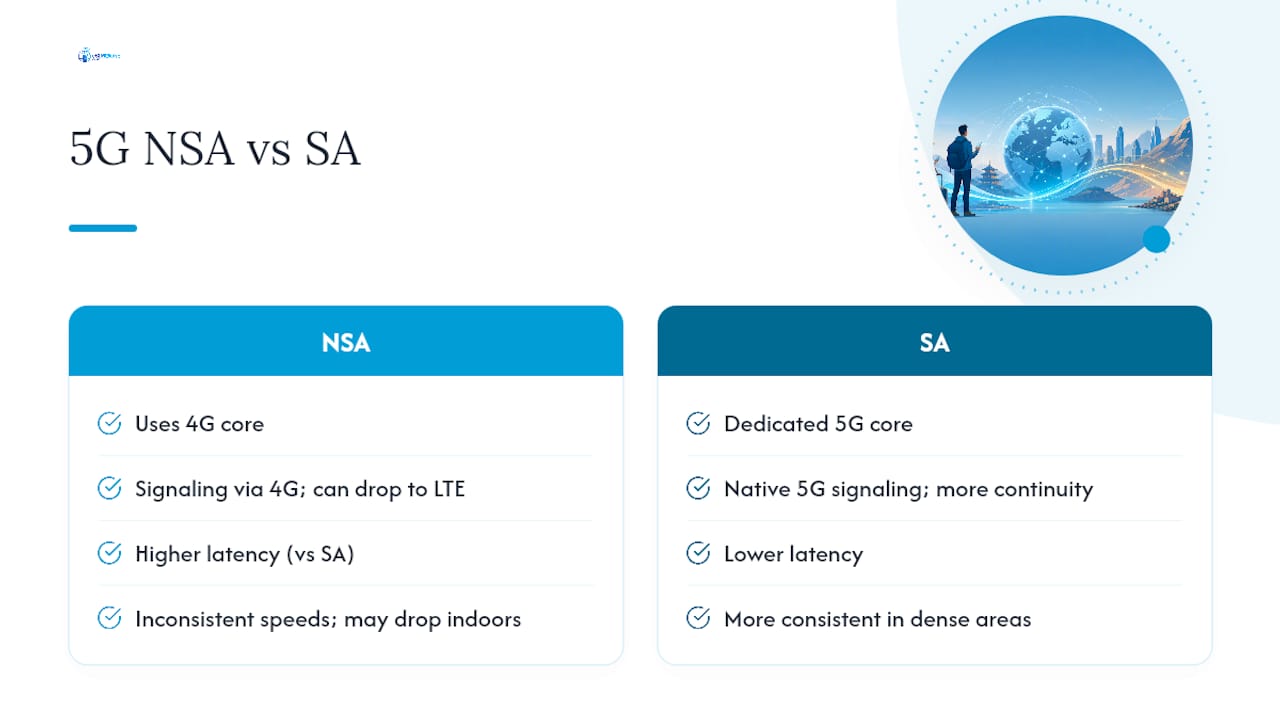
Most global 5G eSIM traffic today still runs on NSA, because it’s cheaper and faster for carriers to deploy. Tier 1 markets like South Korea and parts of the United States have pushed further into SA rollouts, particularly in major cities, but SA coverage remains patchy even where carriers advertise national 5G.
For travelers, this explains a common complaint: a phone shows a “5G” icon but performance feels barely different from 4G. That’s frequently NSA 5G under moderate network load. Coverage checkers rarely distinguish NSA from SA on plan pages, so treat any “5G” label as NSA-capable at minimum, with SA-level performance as a bonus rather than an expectation, unless a provider explicitly states otherwise.
Does Slow eSIM Activation Affect Your 5G Speed?
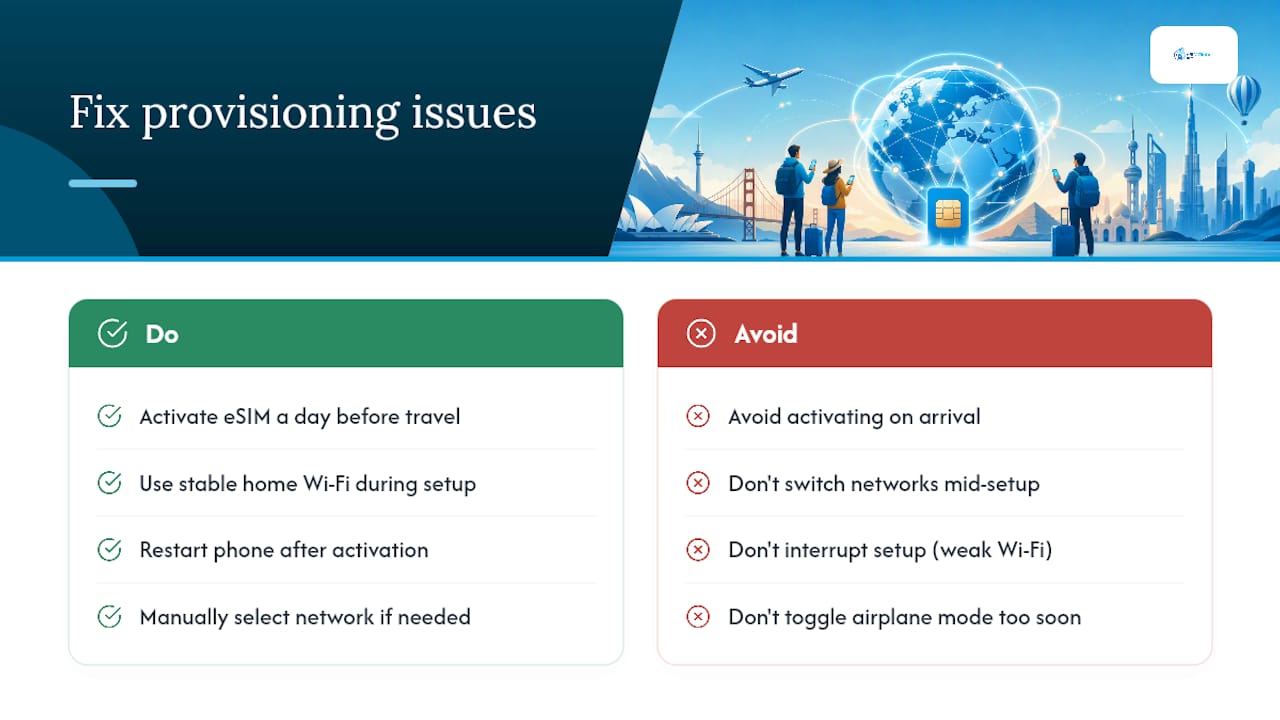
Provisioning delays are one of the most overlooked reasons travelers think their 5G eSIM is underperforming when the eSIM hasn’t actually finished setting up. When you install an eSIM, your device needs to download the profile, register with the local network, and negotiate access permissions, including which generation of network it’s cleared to use.
If that handshake is incomplete or interrupted (weak Wi-Fi during setup, switching networks mid-installation, airplane mode toggled too soon), your phone can connect successfully but get provisioned at a lower priority tier, defaulting to 4G until it fully re-registers. This isn’t a coverage failure. It’s an activation issue that resolves with a restart or a manual network reselection.
Activating before you travel, while still on stable home Wi-Fi, meaningfully reduces this risk compared to activating the moment you land, when you’re competing with every other arriving traveler for local tower registration. Esimglobe’s activation and travel tips guide recommends installing and testing the profile at least a day before departure, exactly for this reason.
If 5G still doesn’t appear after activation, toggling airplane mode on and off, or manually selecting the network operator in settings, forces your phone to re-negotiate its connection tier. That single step resolves a surprising share of “my 5G plan isn’t working” complaints that are really just stuck provisioning handshakes, not coverage gaps.
What’s Next for 5G eSIM Coverage Worldwide?
Coverage is still expanding, and the direction is fairly predictable even if the pace varies by region. Standalone 5G buildouts are gradually extending beyond flagship cities in Tier 1 markets, and eSIM provisioning itself is getting faster as more carriers adopt streamlined digital activation standards.
Expect three shifts over the next few years that matter for trip planning. First, more countries will move from Tier 2 toward Tier 1 status as SA infrastructure matures, particularly in Southeast Asia and parts of the Gulf. Second, coverage-checker tools and provider country pages will likely get more granular, showing city-level 5G data instead of country-wide blanket claims, because travelers increasingly demand that precision. Third, device support keeps widening: forward-compatible bands are now standard on mid-range phones, not just flagships, which reduces the band-mismatch problem that currently strands otherwise-capable travelers on 4G.
None of this changes the core planning advice today, though. Rural and indoor gaps will persist even in leading markets for years, and roaming priority will keep pushing travelers toward 4G during peak congestion regardless of how advanced the local infrastructure gets. Plan around your actual itinerary and use case now, and treat wider 5G access as a bonus that keeps improving rather than something to bank on everywhere you go.
Esimglobe’s Approach to Coverage Transparency
Country pages should tell you who you’re actually connecting to, not just flash a “5G” badge and move on. That’s the standard we hold Esimglobe’s country selector to: naming local network partners, marking 4G/5G status per plan, and listing device compatibility so you’re not guessing at checkout.
With plans spanning more than 170 countries, the goal is straightforward. You should be able to open a country page, see which local carrier backs your data, and know before you buy whether that carrier’s 5G reaches where you’re actually traveling. That’s the level of detail this article has walked through, applied directly to how Esimglobe structures its own listings.
— daniele
Get a 5G-Ready eSIM Before You Fly
Esimglobe skips the guesswork this article just walked through. Every plan shows its network partner by name, its 4G/5G status upfront, and instant email delivery means you’re connected before you land, no store visit, no physical SIM swap, no contract.
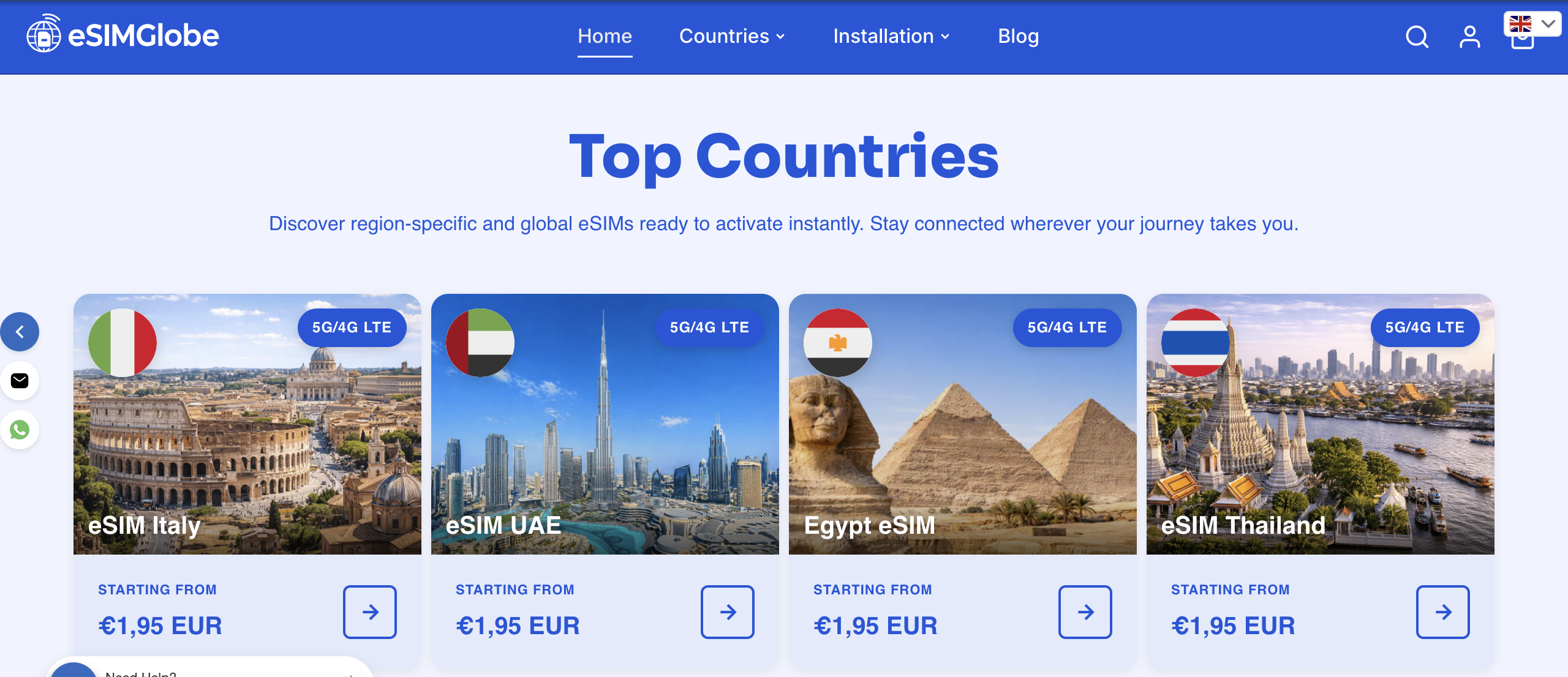
That transparency matters most for travelers who’ve been burned by vague “premium network” language elsewhere. Esimglobe plans list the actual local carrier behind each country option, along with hotspot support and fair-use terms, so you can match the plan to your trip instead of hoping the label holds up. Support runs 24/7, which counts for something when a provisioning hiccup happens the night before a flight.
If you’re heading somewhere in Tier 1 and want confirmed 5G access, or somewhere in Tier 2 where solid 4G will serve you fine, check the Esimglobe eSIM plans page for your destination and compare the network partner and speed label before you check out.
Where to Verify 5G Claims Yourself
For device and network basics, the FCC’s consumer guidance on 5G explains what the technology does and doesn’t guarantee. For plan-specific claims, use a coverage-checker tool to confirm partner names and 4G/5G status per country, and cross-reference against the provider’s own country page before buying.
FAQ
Does eSIM Provide a 5G Network?
An eSIM itself is just a digital profile format. Whether it delivers 5G depends on the plan you buy, the local carrier partnership behind it, and whether your device supports the right 5G bands.
What Is the Downside of an eSIM?
The main downsides are device dependency (older or locked phones can’t use eSIM at all) and coverage variability, since a plan’s actual network quality depends entirely on which local partner it uses rather than the eSIM format itself.
Can You Get 5G With an eSIM Abroad?
Yes, in Tier 1 markets like the United States, South Korea, Japan, and the UK, provided your device supports the local 5G bands and the specific plan you purchased includes 5G access rather than a 4G-only roaming agreement.
Which 5G Phones Support eSIM?
Most current flagship and mid-range phones from major manufacturers support both 5G and eSIM, but band support varies by region and carrier version, so checking your exact model against a provider’s device list before buying is worth the extra minute.