






















What does eSIM coverage actually mean for you?
eSIM coverage refers to a device’s ability to connect to a mobile network through an embedded SIM chip, called an eUICC, without requiring a physical SIM card. The coverage itself depends entirely on which carriers are supported in a given area and whether those carriers have provisioned their networks for eSIM access. Where a carrier supports eSIM, signal strength and network performance are identical to what a physical SIM delivers on the same network.
Key facts about eSIM coverage:
- Same signal quality as a physical SIM on supported networks; the mobile network cannot distinguish between the two during authentication
- Carrier-dependent reach: coverage maps are determined by the underlying carrier’s infrastructure, not the eSIM format itself
- Multi-carrier flexibility: a single eSIM can store multiple carrier profiles, letting users switch networks without swapping cards
- Traveler advantage: instant access to local carriers in different countries without visiting a store or buying a new card
- Standards body: the GSMA defines the technical specifications governing eSIM provisioning and interoperability globally
- Platform access: Esimglobe provides eSIM profiles covering dozens of countries, giving travelers a direct path to local network access
Understanding eSIM coverage starts with recognizing that the format changes how you connect, not the underlying radio signal you receive.
Table of Contents
- How does an eSIM differ from a physical SIM card?
- What services and networks does an eSIM actually cover?
- Which devices support eSIM technology in 2026?
- How to activate your eSIM in the United States
- How secure is eSIM technology?
- What are the practical benefits of switching to an eSIM?
- Esimglobe gives travelers direct access to local networks worldwide
- Key Takeaways
- FAQ
How does an eSIM differ from a physical SIM card?
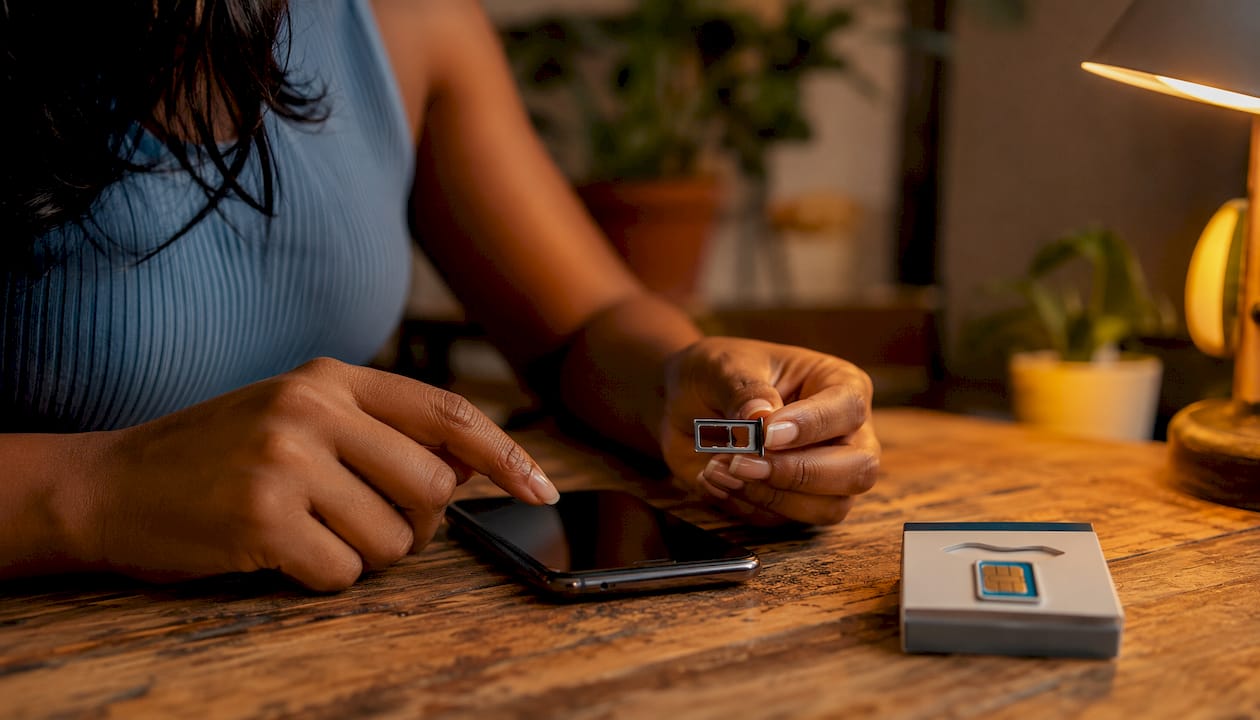
The most visible difference is physical. A traditional SIM is a removable plastic card that slots into a tray. An eSIM is a chip soldered directly onto the device’s motherboard, roughly the size of a grain of sand.
| Feature | Physical SIM | eSIM |
|---|---|---|
| Form factor | Removable plastic card | Embedded chip (eUICC) inside device |
| Carrier switching | Requires physical card swap | Remote profile download, no hardware change |
| Profile storage | One carrier per card | Multiple profiles stored simultaneously |
| Reprogrammable | No | Yes, via remote provisioning |
| Risk of loss/damage | Card can be lost or damaged | No removable component to lose |
| Device locking | Locked SIM works only with one carrier | Carrier lock still applies digitally |
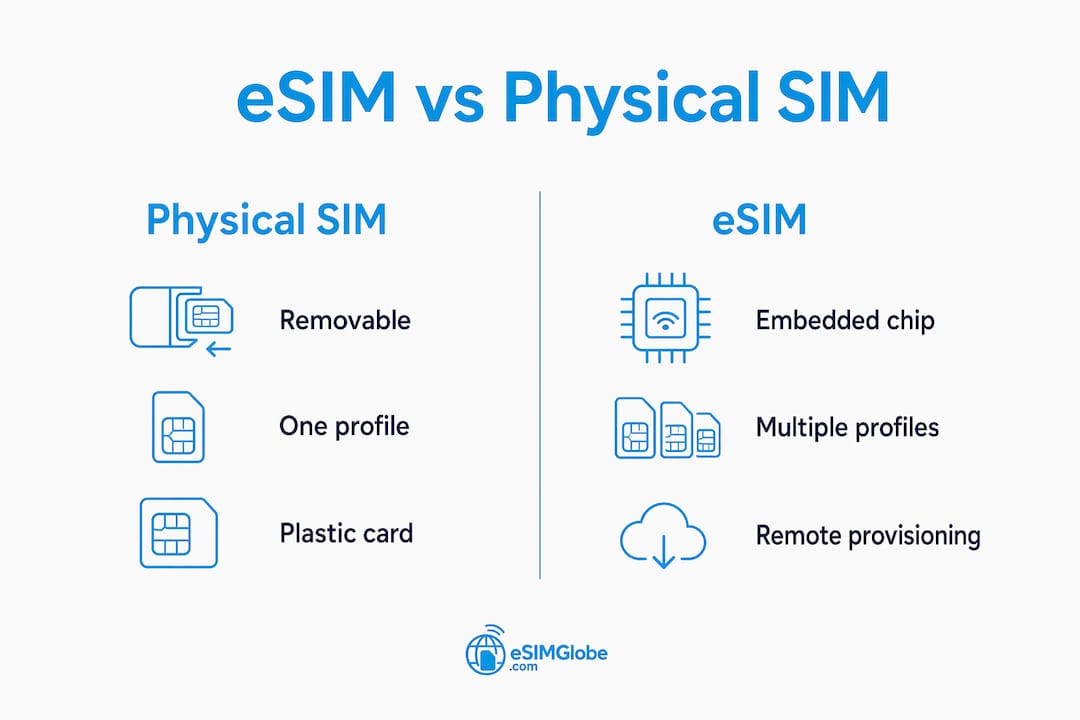
Beyond the hardware, the functional gap is significant. Physical SIMs are static: one card, one carrier, one profile. eSIMs are rewritable software. A carrier pushes a new profile to the device over a secure server connection, and the chip stores it alongside existing profiles. Switching carriers becomes a settings menu action rather than a trip to a store.
Carrier locking applies to both formats. A device locked to one carrier will not accept another carrier’s eSIM profile any more than it would accept a rival’s physical SIM. Unlocking the device resolves this for both.
What services and networks does an eSIM actually cover?
eSIM technology supports the full range of standard mobile services, though the specific mix depends on the plan purchased:
- Mobile data: all eSIM plans include data connectivity; this is the core use case
- Voice calls: supported on many plans, particularly those tied to a local phone number
- SMS/text messaging: available on plans that assign a phone number; data-only plans exclude this
- Hotspot/tethering: most eSIM plans allow hotspot use, though some budget plans restrict it
- 4G LTE and 5G access: network generation depends on the plan tier and local infrastructure
One nuance worth knowing: a plan labeled “5G” reflects potential access to 5G bands, not a guarantee of 5G speeds. Congestion, band compatibility, and physical location all affect actual throughput. Budget-tier eSIM plans often cap users at older LTE or 3G bands, while premium plans unlock faster network resources. Prioritizing signal reliability over price tends to produce better real-world results, particularly for travelers.
In the U.S., major carriers support eSIM across their networks, providing broad domestic coverage. Internationally, Esimglobe’s profiles connect to local partner carriers in each destination country, giving travelers access to the same networks locals use.
Which devices support eSIM technology in 2026?
eSIM adoption has accelerated sharply. The following device categories support eSIM in 2026:
- Apple iPhones: iPhone XS and later; iPhone 14 and later (U.S. models) are eSIM-only with no physical SIM tray
- Google Pixel: Pixel 7 and later fully support eSIM; earlier Pixel models from Pixel 3 onward include eSIM capability
- Samsung Galaxy: Galaxy S20 and later support eSIM; select foldable models support dual eSIM
- Other Android: Motorola Razr series, select Sony Xperia models, and others carry eUICC chips
- Tablets: iPad Pro, iPad Air (M1 and later), and select Android tablets support eSIM
- Smartwatches: Apple Watch Series 4 and later, Samsung Galaxy Watch 4 and later support cellular eSIM
Carrier locking remains a practical barrier. A device purchased through a carrier on a payment plan is typically locked until the plan is paid off or the carrier unlocks it. Even a fully eSIM-capable device will reject profiles from other carriers while locked. Both iOS and Android include native eSIM management interfaces, making profile switching straightforward once the device is unlocked.
The trend toward eSIM-only hardware is clear. Apple’s move to eliminate the physical SIM tray in U.S. iPhone 14 models signaled where the industry is heading, and other manufacturers are following.

How to activate your eSIM in the United States
Activation is faster than most users expect, typically completing quickly once you have an internet connection and a valid profile from your carrier or eSIM provider.
- Purchase an eSIM plan from your carrier or a provider like Esimglobe; you will receive a QR code or an activation link
- Connect to Wi-Fi before starting; the device needs internet access to reach the SM-DP+ provisioning server
- Open device settings: on iPhone, go to Settings > Cellular > Add eSIM; on Android, go to Settings > Network > SIM > Add eSIM
- Scan the QR code or tap the activation link; the device downloads an encrypted profile package (50–200 KB) from the provisioning server
- Label the plan (e.g., “Travel” or “Work”) and set it as active or secondary depending on your preference
- Confirm activation by checking that the carrier name appears in your status bar
For travelers purchasing an eSIM before departure, download the profile while still on home Wi-Fi. Attempting to download after arrival without a data connection creates a catch-22: you need connectivity to get connectivity. Esimglobe’s step-by-step activation guide covers carrier-specific variations in detail.
Pro Tip: Check both device compatibility and carrier eSIM support before purchasing a plan. A device that supports eSIM hardware but is still carrier-locked will reject any new profile regardless of the plan quality.
How secure is eSIM technology?
eSIM security is built into the hardware, not bolted on afterward. Each eUICC chip contains a unique cryptographic identity. When a carrier profile is downloaded, it binds to that specific chip, making it impossible to copy or transfer the profile to another device.
Key security mechanisms:
- Cryptographic binding: the profile is encrypted and tied to the device’s eUICC; no other chip can use it
- Mutual authentication: the device and the mobile network exchange secret keys during connection, verifying both sides before granting access
- No cloning risk: unlike physical SIM cards, which can theoretically be cloned with specialized hardware, eSIM profiles cannot be extracted or duplicated
- Network parity: the mobile network authenticates an eSIM using the same GSM standard methods as a physical SIM, so security at the network level is identical
- GSMA standards compliance: provisioning infrastructure is operated by specialized vendors including Thales, IDEMIA, and Giesecke+Devrient, all of whom must meet GSMA security specifications
The SM-DP+ server infrastructure that delivers profiles is itself secured and audited. Unauthorized profile transfers are blocked at both the chip and server level.
What are the practical benefits of switching to an eSIM?
The advantages of eSIM technology are concrete and immediate for most users:
- No physical card swaps: changing carriers takes seconds in a settings menu rather than requiring a new card
- Multiple lines on one device: store a personal number and a work number simultaneously; switch between them without carrying two phones
- Instant local access while traveling: download a local carrier profile before or after landing; no SIM kiosks, no language barriers, no waiting
- Avoid roaming fees: connecting to a local network via eSIM costs a fraction of international roaming charges from a home carrier
- Smaller device footprint: removing the SIM tray frees internal space for larger batteries or slimmer designs
- Environmental reduction: fewer plastic SIM cards manufactured and discarded
For business travelers specifically, the ability to maintain a home number while running a local data plan on the same device removes a persistent logistical problem. Signal quality on an eSIM plan matches what a physical SIM delivers on the same network, so there is no coverage trade-off for the convenience gained.
Esimglobe gives travelers direct access to local networks worldwide
Travelers who want local network rates without the hassle of finding a SIM vendor at every destination have a straightforward option: Esimglobe. The platform offers eSIM profiles for dozens of countries, purchasable in USD, EUR, or GBP, with no physical card required and no store visit needed.
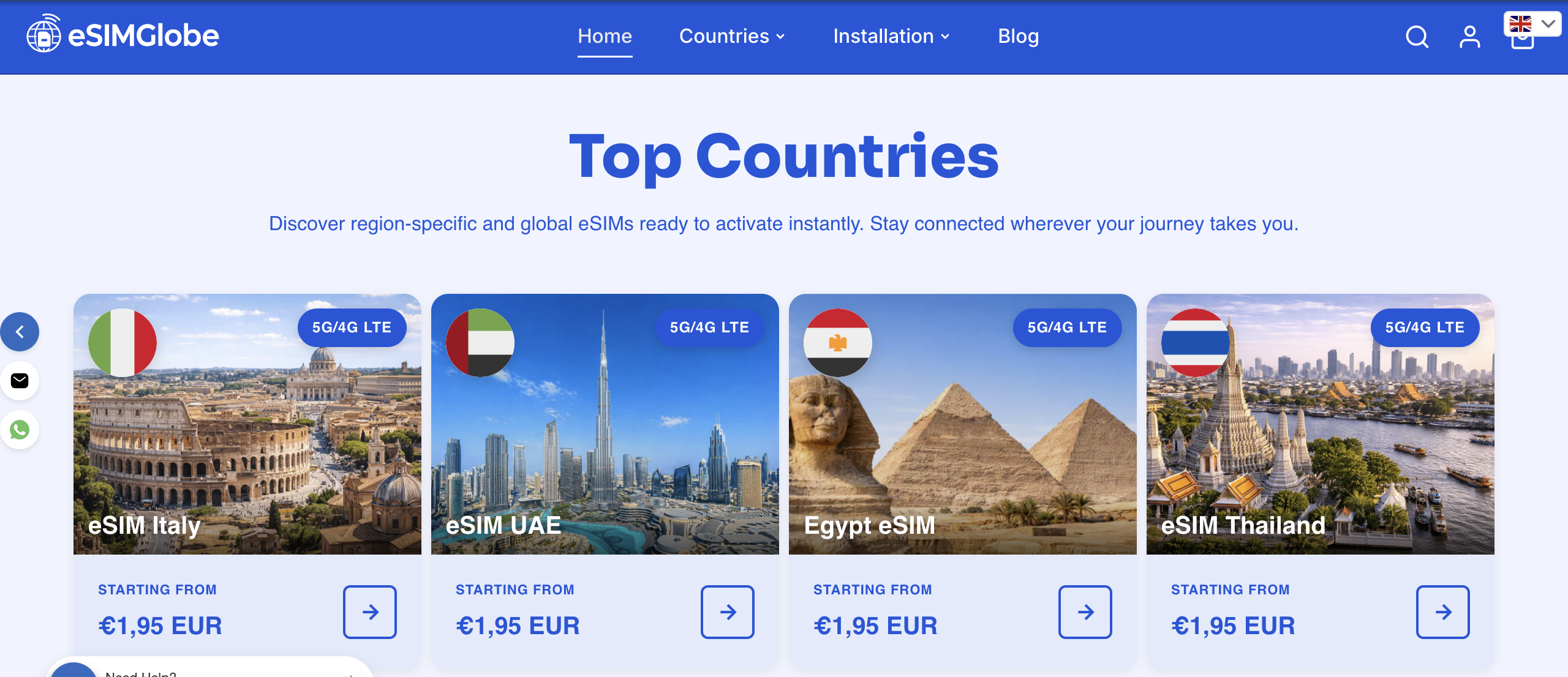
Plans cover data connectivity across major regional carriers, with options ranging from short-trip data packages to longer-term multi-country plans. The country selector makes it simple to find coverage for a specific destination, and activation follows the standard QR code process described above. For travelers who want to confirm their device is ready before departure, Esimglobe’s 2026 traveler setup guide walks through the full workflow. Browse available plans at esimglobe.com and download your profile before you board.
Key Takeaways
eSIM coverage matches physical SIM coverage on any supported network, and the real advantage is carrier flexibility, not signal improvement.
| Point | Details |
|---|---|
| Coverage equivalency | The mobile network cannot distinguish eSIM from physical SIM; signal and service quality are identical. |
| Multi-profile storage | A single eSIM can hold multiple carrier profiles, enabling fast carrier switching without hardware changes. |
| Activation speed | Profile download typically completes within about 60 seconds over a secure SM-DP+ server connection. |
| Security standard | eSIM profiles are cryptographically bound to the device’s eUICC chip, preventing cloning or unauthorized transfer. |
| Esimglobe access | Esimglobe provides eSIM profiles for dozens of countries, giving travelers instant local network access without a physical SIM. |
FAQ
Does an eSIM give you better coverage than a physical SIM?
No. An eSIM connects to the same carrier networks as a physical SIM; the mobile network treats both identically during authentication. Coverage quality depends on the carrier and location, not the SIM format.
Can you use an eSIM on a carrier-locked device?
No. Carrier locking applies to eSIM profiles the same way it applies to physical SIM cards. The device must be unlocked by the original carrier before it will accept profiles from other providers.
Do all eSIM plans include voice calls and texting?
Not all. Many travel-focused eSIM plans are data-only and do not assign a phone number, which means no SMS or standard voice calls. Plans that include a local number support both voice and text.
How does Esimglobe handle eSIM activation for travelers?
Esimglobe delivers a QR code after purchase. Scanning it in your device’s cellular settings downloads the carrier profile over a secure connection, typically within 60 seconds. Wi-Fi access before arrival is recommended to avoid connectivity gaps on landing.
Is it safe to download an eSIM profile from a third-party provider?
Yes, when the provider uses GSMA-compliant SM-DP+ infrastructure. Profile delivery is encrypted and the profile binds cryptographically to your specific device, so it cannot be intercepted and used elsewhere.