






















TL;DR:
- Prepaid data only eSIM plans offer travelers immediate, cost-effective, and environmentally friendly mobile internet without physical SIM cards. They enhance security by eliminating SIM swapping risks and provide transparent pricing across 150+ countries, simplifying global connectivity. Choosing the right plan involves assessing itinerary coverage, device compatibility, and data needs to ensure reliable, hassle-free travel communication.
Roaming fees have a way of turning a two-week trip into an unexpectedly expensive one. Most international travelers either pay absurd carrier surcharges or waste time hunting for local SIM cards at foreign airports. A data only eSIM plan cuts both problems at once. You get mobile data the moment you land, with no physical card to swap and no surprise charges on your next bill. This article breaks down exactly how these plans work, who offers the best ones, what to watch for, and how to pick the right plan for your specific travel style.
Table of Contents
- Key takeaways
- What a data only eSIM plan actually is
- Why travelers are switching to data only plans
- Provider comparison: best data only eSIM plans in 2026
- How to choose the right plan for your trip
- Troubleshooting common eSIM issues abroad
- My honest take on the eSIM data market
- Get connected with Esimglobe before your next trip
- FAQ
Key takeaways
| Point | Details |
|---|---|
| Data only eSIM basics | A prepaid data eSIM gives you mobile internet without voice or SMS, activated digitally before or after you land. |
| Cost advantage is real | Prepaid data eSIM plans can cost 40-80% less than standard international roaming rates. |
| Device compatibility matters | Your phone must be eSIM-compatible and carrier-unlocked before any esim data plan will work on it. |
| Provider differences are significant | Coverage, throttling policies, and hidden fees vary widely across providers. Esimglobe offers transparent pricing across 150+ countries. |
| Activation is simple | Most data only eSIM plans activate via a QR code scan in under five minutes, no store visit required. |
What a data only eSIM plan actually is
An eSIM, short for embedded SIM, is a chip built directly into your device. Unlike a traditional physical SIM card you pop in and out, an eSIM is programmed remotely. You download a carrier profile digitally, and your phone connects to that network. No tray, no pin tool, no tiny plastic card to lose at the gate.
A data only eSIM plan is exactly what it sounds like. It provides mobile internet access only. There is no phone number assigned, no voice calls, no SMS texts through the carrier. For most travelers and digital nomads, that is perfectly fine. You make calls over WhatsApp or Zoom, send messages through apps, and use internet-based tools for everything else. The carrier voice and SMS layer is simply not needed.
Here is what distinguishes a mobile data eSIM from a standard prepaid SIM:
- No physical card. The profile lives on your device and is tied to your IMEI number.
- Remote activation. You scan a QR code or enter an activation code, usually sent by email after purchase.
- Multiple profiles. Most modern eSIM devices support more than one profile simultaneously, so you can keep your home number active while running a travel data plan separately.
- Prepaid structure. Nearly all travel eSIM data plans are prepaid. You buy a set amount of data or a daily unlimited tier for a fixed number of days.
Device compatibility is the one thing that trips people up. Not every smartphone supports eSIM, and even those that do may still be carrier-locked, which blocks third-party eSIM profiles from activating. Unlocked device status is a hidden blocker for many travelers wanting to use eSIMs abroad. Check your settings before your departure date.
Pro Tip: To check eSIM compatibility, go to Settings > General > About on an iPhone, or Settings > Connections > SIM Manager on most Android devices. If you see an eSIM or “Add eSIM” option, you are good to go.
Security is another underappreciated benefit. The embedded chip cannot be removed from your device, which eliminates the risk of SIM swapping fraud, a method criminals use to take over phone numbers. Embedded chips cannot be removed or stolen, and the encryption involved is significantly stronger than connecting to a random airport Wi-Fi network.
Why travelers are switching to data only plans
The financial argument is straightforward. Traditional carrier roaming often charges per megabyte or a flat daily rate that adds up fast. A 10-day trip to Southeast Asia with standard roaming can easily run $100 or more. A prepaid data eSIM for the same region might cost $15. Prepaid eSIM plans for 150+ countries run at prices 40-80% below standard roaming rates, with concrete examples like 3GB in Turkey for $2.84 and Thailand for $3.50.
Beyond price, the practical benefits stack up quickly:
- No airport SIM hunt. You activate your plan before the flight lands. Connectivity starts the second you step off the plane.
- No SIM swaps across borders. Full-time travelers prefer a single global eSIM profile to avoid juggling multiple downloads and configuration errors when crossing borders.
- Flexible data tiers. You choose how much data you need. Many providers offer regional and global plans, so one purchase can cover multiple countries in a single trip.
- Unlimited data options. Several providers offer unlimited data eSIM tiers with daily high-speed allowances before throttling kicks in. Good for video calls and remote work.
- No plastic waste. There is no physical card manufactured or discarded. For travelers conscious about environmental footprint, this matters.
The security angle deserves more attention than it usually gets. Public Wi-Fi in hotels, cafes, and airports is notoriously insecure. Running your traffic through a cellular data connection via a trusted eSIM is meaningfully safer. When combined with a private hotspot device, eSIM connectivity provides encrypted access that public Wi-Fi simply cannot match.
Pro Tip: If you are a digital nomad who works with sensitive client data, treat your mobile data eSIM as your primary connection, not public Wi-Fi. The security difference is significant.

One overlooked benefit is billing transparency. Physical SIMs in foreign countries sometimes have auto-renewal traps or hidden service charges. A prepaid eSIM plan is capped. You spend what you buy. No surprises at the end of the month.
Provider comparison: best data only eSIM plans in 2026
The market has grown crowded. Several providers now offer a best esim data plans pitch, but the actual experience varies considerably. Coverage quality, throttling policies, activation speed, and hidden fees all differ. Here is a side-by-side look at the major options.
| Provider | Starting Price | Coverage | Unlimited Data | Notable Notes |
|---|---|---|---|---|
| Esimglobe | From ~$2.84 per 3GB | 150+ countries | Yes, on select plans | Transparent pricing, multi-currency support, no hidden fees |
| T-Mobile Prepaid | $25 for 7-day U.S. pass | U.S., Mexico, Canada | Yes (throttled) | Focused on North America, limited for global travelers |
| Holafly | From ~$6 for 1GB | 160+ countries | Yes (throttled) | Higher per-GB cost, popular but expensive for heavy users |
| Saily | From ~$3.99 for 1GB | 150+ countries | Limited plans | Throttling policies vary by region |
| Generic budget providers | From ~$1.50 | 50-100 countries | Rarely | Coverage gaps, limited customer support |
A few things stand out in that comparison. T-Mobile Prepaid’s 7-day to 30-day pass is well-designed if you are visiting North America specifically, with plans from $25 to $50 that include premium 5G hotspot data. However, it does not help much if your trip covers Europe, Asia, or multiple continents.
Holafly and Saily both offer unlimited daily data, but coverage and throttling strategies differ significantly across providers. Holafly throttles after a daily cap, which can frustrate remote workers on video calls. Saily lacks unlimited plans in several key regions.
Some providers charge by the data used rather than a flat prepaid structure, which creates exposure to unexpected charges if you stream more than expected. That pay-per-MB approach is common with lesser-known providers and should be a dealbreaker for anyone on a budget.
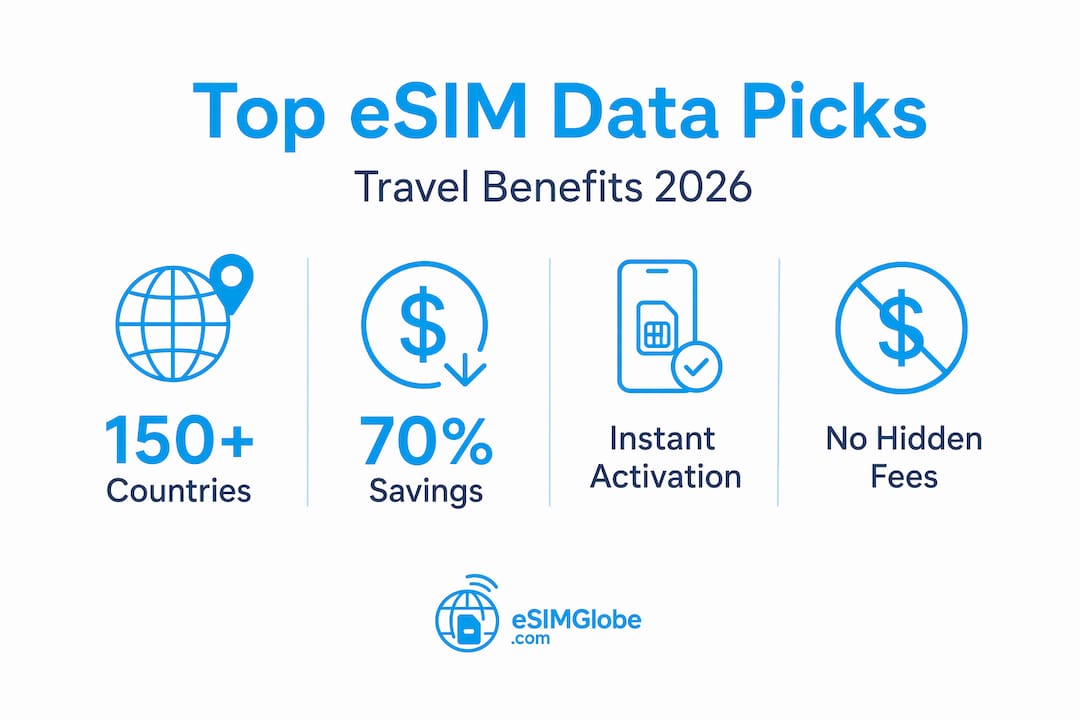
Esimglobe stands apart with flat, transparent pricing across a wide country catalog. The multi-currency interface (USD, EUR, GBP) and multi-language support make it accessible regardless of where you are based. There are no per-megabyte overages, no auto-billing traps, and no complicated unlock process after purchase. For travelers covering multiple regions in one trip, that breadth of coverage at consistent pricing is genuinely useful.
How to choose the right plan for your trip
Picking a data only mobile plan does not need to be complicated, but a few decision points make the difference between a great experience and a frustrating one.
-
Map out every country on your itinerary. Some plans cover a single country. Others cover a region (e.g., Southeast Asia, Europe) or the whole world. A regional or global plan saves money if you are crossing multiple borders.
-
Estimate your data usage honestly. Light users who check email and maps might need 1-2GB per week. Remote workers on video calls regularly can burn through 5-10GB in the same period. Pick your tier based on real usage, not optimistic guesses.
-
Confirm your device is unlocked. This step gets skipped more than any other. Check before you buy. Unlocked device status determines whether a third-party eSIM profile activates at all. Contact your home carrier if you are unsure.
-
Look at trip length carefully. Short trips of one to three weeks with existing roaming benefits may not need a separate eSIM plan. Longer stays of 60 days or more almost always benefit from dedicated eSIM data over roaming add-ons.
-
Check throttling policies. Unlimited data eSIM plans sound appealing, but many throttle speeds after a daily cap of 500MB to 1GB. For casual browsing that is fine. For remote work, throttled speeds make video calls unusable.
-
Verify customer support access. If your plan fails to activate at 2 a.m. in a foreign country, you need someone to help. Check that the provider has live chat or 24/7 email support before purchasing.
Pro Tip: Buy your eSIM at least 24 hours before your flight. Most activation steps are quick, but technical issues occasionally require back-and-forth with support. Having a buffer removes the stress entirely.
Scam plans do exist. If a deal advertises 10GB of global data for under $1, the coverage will be spotty or nonexistent. Stick to providers with verifiable reviews and clear country coverage lists. For a thorough pre-trip checklist, the eSIM travel tips guide from Esimglobe covers the most common activation and usage mistakes.
Troubleshooting common eSIM issues abroad
Even a well-purchased esim data plan can run into problems. Most issues have straightforward fixes.
- Plan activated but no data. The most common cause is that mobile data or data roaming is not enabled in your phone settings. Go to Settings > Mobile Data > and toggle on both “Mobile Data” and “Data Roaming” for the eSIM profile.
- Activation QR code not scanning. Make sure you are not trying to scan the code from the same device you are activating. Use a printed copy or a second screen. QR codes sent by email cannot be scanned on the phone receiving them.
- Spotty coverage in a specific area. Your eSIM connects to a partner network in each country. If you are in a rural area, signal may be limited regardless of provider. Switching your network selection manually (Settings > Mobile > Network Selection) to a different local carrier sometimes improves signal.
- Data running out faster than expected. Background app refresh, automatic video quality settings, and OS updates silently drain data. Turn off background refresh for non-essential apps and set video apps to cap quality at 480p while on mobile.
- Switching between multiple eSIM profiles. Go to your phone’s SIM settings and set the travel eSIM as the default data line. Keep your home SIM as the default for calls and texts if you need that number active.
- Public hotspot security. When you share your eSIM connection as a hotspot, eSIM encryption is maintained for your device, but connected devices rely on standard Wi-Fi. Use a VPN on connected devices when handling sensitive information over a shared hotspot.
For essential eSIM facts covering device compatibility and plan management in more depth, the Esimglobe resource hub is a reliable first stop.
My honest take on the eSIM data market
I have spent considerable time comparing eSIM plans across dozens of countries, and the single biggest mistake I see travelers make is treating all providers as roughly equivalent. They are not. The gap between a well-structured prepaid data eSIM and a budget option with poor partner networks is the difference between reliable working connectivity and the kind of spotty signal that makes a remote workday genuinely painful.
What I have learned about hidden costs is that the damage rarely shows up in the advertised price. It shows up in throttling that triggers at 300MB per day on a plan marketed as “unlimited,” or in a provider that lacks coverage in the specific network tier your phone supports. These details get buried in FAQs, not headlines.
My view on Esimglobe is that it gets the fundamentals right in ways that matter. Flat pricing with no per-MB overages, a catalog that spans 150+ countries, and clear activation steps mean you are not debugging your connectivity at midnight in a foreign city. Other platforms I have reviewed tend to either limit their coverage to popular tourist destinations or bury surcharges in the fine print that only surface after purchase.
The broader shift worth paying attention to is this: using a single global eSIM reduces carrier-switching hassle for nomads, which directly increases productivity and cuts connectivity downtime. That is not a minor quality-of-life upgrade. For anyone running a business or client work across time zones, connectivity gaps are revenue gaps. Getting this right at the infrastructure level matters more than most travelers realize until they get burned by a bad plan once.
My recommendation is to stop treating your phone’s data connection as an afterthought to pack around. Treat it as a core tool and pick your provider accordingly.
— daniele
Get connected with Esimglobe before your next trip
Esimglobe offers data only eSIM plans covering 150+ countries, with transparent flat pricing, no hidden fees, and instant QR code activation. Whether you need a single-country plan for a two-week trip or a regional plan that follows you across multiple borders, the catalog is built for how travelers actually move. Plans are available in USD, EUR, and GBP, with multi-language support so the process is clear regardless of where you are based. Esimglobe also takes data privacy seriously, with clear opt-out options for data sharing. Browse available global eSIM options and activate your plan before your next departure.
FAQ
What is a data only eSIM plan?
A data only eSIM plan provides mobile internet access through a digitally activated embedded SIM, with no voice calls or SMS included. It is a prepaid mobile data solution designed for travelers who use app-based communication.
Is an eSIM data plan cheaper than roaming?
Yes. Prepaid eSIM data plans typically cost 40-80% less than standard international roaming rates, with many plans available for under $5 for 3GB of data.
Does my phone need to be unlocked to use a data eSIM?
Yes. Your device must be both eSIM-compatible and carrier-unlocked for a third-party eSIM profile to activate. Contact your home carrier to confirm unlocked status before purchasing a plan.
Can I keep my regular number while using a travel eSIM?
Yes. Most modern smartphones support dual SIM functionality, allowing you to run your home carrier profile alongside a travel eSIM data plan at the same time.
What should I do if my eSIM plan is not connecting abroad?
Check that mobile data and data roaming are both enabled for the eSIM profile in your phone settings. If signal is weak, manually switch the network selection to a different local carrier in your mobile settings.