






















TL;DR:
- Prepaid eSIMs are digital, SIM-less profiles installed via QR code, offering flexibility and convenience.
- They provide cost transparency, regional coverage, and quick activation for international travelers.
- eSIMs enhance privacy, control, and resilience, making them a preferred choice over traditional SIMs and roaming plans.
Staying connected abroad does not require paying surprise roaming bills or hunting for a local SIM card vendor at midnight in an unfamiliar airport. Prepaid eSIMs have changed the rules for international travelers and digital nomads entirely. This article breaks down what a prepaid eSIM is, how it works, how it compares to older connectivity options, and exactly how to get started. Whether you travel a few times a year or live out of a backpack, the information here will give you a clear picture of how to manage mobile data on your own terms.
Table of Contents
- Understanding prepaid eSIM: What it is and how it works
- Prepaid eSIM vs. traditional SIM and roaming: A quick comparison
- Benefits of prepaid eSIM for international travelers and digital nomads
- How to get and use a prepaid eSIM step-by-step
- Why prepaid eSIMs are reshaping global connectivity (and what most travelers miss)
- Get started with prepaid eSIM plans for your next trip
- Frequently asked questions
Key Takeaways
| Point | Details |
|---|---|
| What prepaid eSIM is | A prepaid eSIM is a digital SIM you buy upfront for instant, flexible mobile data access. |
| Compared to roaming | Prepaid eSIMs deliver transparent pricing and reliable global coverage that beats traditional SIMs and roaming. |
| Top user benefits | Travelers avoid high fees and stay flexible, managing data usage across multiple destinations easily. |
| Easy setup process | You can acquire and activate your prepaid eSIM for travel in minutes with just a few clicks. |
| Smart travel tip | Prepare several prepaid eSIM profiles in advance for seamless coverage on multi-country trips. |
Understanding prepaid eSIM: What it is and how it works
A prepaid eSIM is a digital SIM card that is built directly into your device. The abbreviation eSIM stands for embedded SIM. Unlike a physical SIM card, which you insert and remove from a tray, an eSIM is soldered onto the device’s motherboard and activated entirely through software. There is no card to lose, no tray to pry open, and no visit to a carrier store required.
The prepaid part means you pay for your data before you use it. You select a plan, complete your purchase, and receive a QR code or activation string by email. You then scan or enter that code on your device, and a new cellular profile is downloaded directly to your phone. The process takes minutes, not hours.
Here is what that process covers in practice:
- Device compatibility. Most current flagship smartphones support eSIM, including recent models from Apple, Samsung, Google, and others. Many tablets and some laptops also support the technology. Checking your device’s essential eSIM facts before purchasing is always the right first step.
- Plan selection. Plans are typically structured by country or region, data volume, and validity period. A traveler visiting Germany might buy a 10 GB European regional plan valid for 30 days.
- Profile installation. After purchase, the QR code arrives by email. Scanning it in your device’s cellular settings triggers an automatic download of the eSIM profile.
- Switching profiles. Most devices allow multiple eSIM profiles to coexist. Switching between them takes only a few taps in settings.
- No contracts. Prepaid eSIMs carry no recurring billing. When your data runs out or your validity period ends, you simply purchase another plan if needed.
Pro Tip: Before your trip, install your eSIM while you still have a stable Wi-Fi connection at home. This avoids any setup headaches if you land in a country where you have no existing data.
Prepaid eSIM vs. traditional SIM and roaming: A quick comparison
With the basics of prepaid eSIM understood, let’s see how it stacks up against the options travelers used in the past.
Traditional physical SIM cards served international travelers for decades. The process involved buying a local SIM from a shop in your destination country, providing identification documents in many cases, cutting or swapping your existing card, and then losing access to your home number in the process. For short trips or multi-country itineraries, this became a logistical burden. Travelers crossing from France into Spain into Portugal over two weeks would theoretically need three separate SIMs.
International roaming through your home carrier is the other traditional option. It removes the hardware hassle but replaces it with a financial one. Roaming charges are often set per megabyte or per day, and bills can escalate rapidly. A single video call abroad on an uncapped roaming plan can cost more than a full month of mobile service at home.
According to industry research on global travel connectivity trends, eSIM adoption among travelers has accelerated significantly as more device manufacturers make eSIM standard across their product lines.
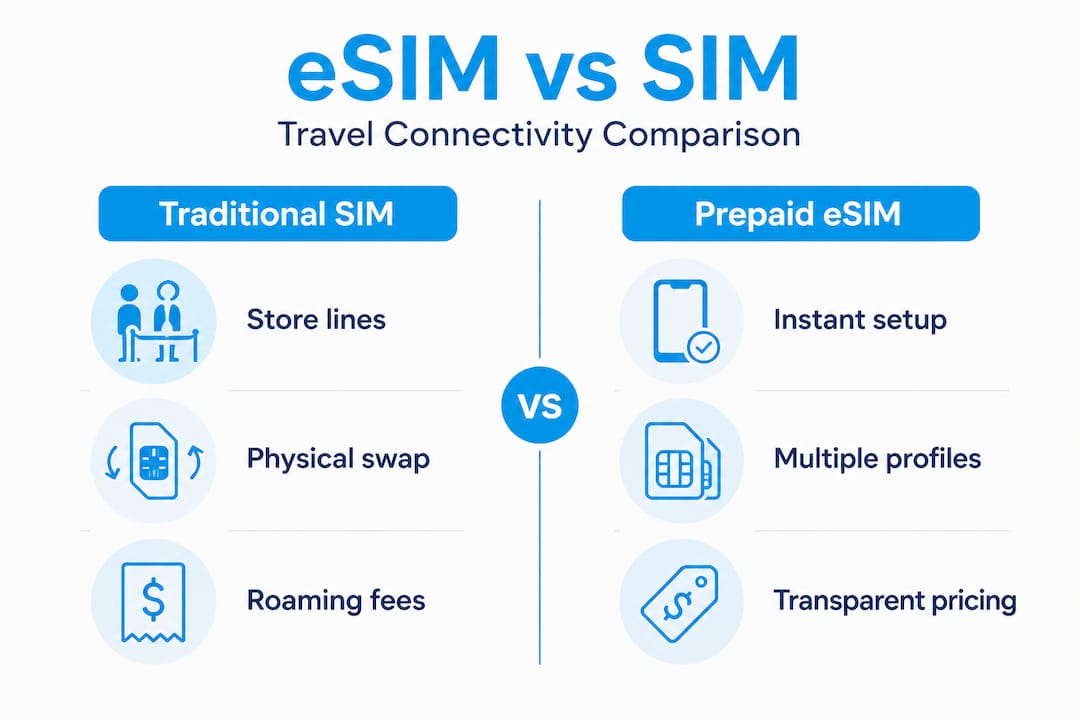
The table below summarizes how these three options compare across the criteria that matter most to travelers.
| Factor | Physical SIM | International roaming | Prepaid eSIM |
|---|---|---|---|
| Setup process | In-store purchase, hardware swap | Automatic via home carrier | QR code scan, no hardware |
| Cost transparency | Moderate, varies by plan | Low, often surprise charges | High, fixed upfront cost |
| Coverage flexibility | Single country per card | Dependent on carrier deals | Regional or global plans available |
| Multi-country use | Requires multiple cards | Available but expensive | One profile can cover multiple countries |
| Activation speed | Hours (store visit needed) | Instant but costly | Minutes, from anywhere |
| Environmental impact | Physical plastic waste | None | None |
The comparison makes clear that prepaid eSIMs remove friction from nearly every step of the connectivity process. The fixed upfront cost is particularly valuable for budget-conscious travelers who want to know exactly what they will spend before they board a flight.
Benefits of prepaid eSIM for international travelers and digital nomads
Having compared prepaid eSIM with other options, let’s look at the unique benefits this technology offers international travelers and digital workers.

The most immediate benefit is cost control. Roaming fees generate what the industry sometimes calls “bill shock,” a term for the disorienting experience of receiving a mobile bill that is ten times your monthly average. Prepaid eSIMs eliminate that possibility. You define your budget before you leave.
Beyond cost, the benefits stack up quickly:
- Instant access to local data rates. A prepaid eSIM connected to a local or regional network often gives you data at rates close to what residents pay, far cheaper than roaming through your home carrier.
- Multiple profiles on one device. You can store and switch between eSIM profiles without removing a physical card. A digital nomad spending one month in Southeast Asia and the next in South America can pre-load profiles for both regions and switch between them in seconds.
- No physical hardware. There is nothing to lose, damage, or forget. Your SIM lives in the device’s firmware.
- Privacy advantages. Public Wi-Fi networks at airports, hotels, and cafes expose your data to interception. A prepaid eSIM gives you private, encrypted cellular network access wherever you have signal.
- Preserved home number. Many devices allow a physical SIM and an eSIM to operate simultaneously. You keep your home number active for calls and messages while routing all data through your prepaid eSIM plan.
- Wide device support. Major manufacturers including Apple, Samsung, Google, Motorola, and Huawei have integrated eSIM support across a broad range of current models.
Connectivity options like Caribbean eSIM options illustrate how regional plans can cover multiple island destinations under one purchase, which is ideal for travelers who island-hop across a region rather than staying in a single country.
Data from the global telecom industry indicates that by 2026, a substantial majority of new smartphone shipments worldwide will include eSIM capability as a standard feature, reflecting how rapidly the technology has become the baseline expectation for modern mobile devices.
Pro Tip: Always check your device’s eSIM compatibility before purchasing a plan. Go to your phone’s settings, navigate to the cellular or mobile data section, and look for an option labeled “Add eSIM” or “Add a plan.” If it appears, your device is ready.
How to get and use a prepaid eSIM step-by-step
Knowing the benefits is only part of the equation. Here is how you can actually get started with a prepaid eSIM in just a few steps.
- Verify device compatibility. Open your device settings and confirm eSIM is supported. Check your model against the manufacturer’s official list if you are unsure.
- Choose a reputable provider. Select a provider with documented coverage in your destination country or region. Look for clear data on network partners, coverage maps, and customer support options.
- Select the right plan. Consider how long you will be traveling, how much data you typically use per day, and whether you need coverage in one country or several. Plans range from a few hundred megabytes for short trips to multi-gigabyte regional bundles for extended stays.
- Complete your purchase. Pay upfront using your preferred currency. No contract signing. No credit check.
- Receive your activation code. Within minutes of purchase, a QR code or alphanumeric activation code arrives in your inbox.
- Install the eSIM profile. On your device, go to Settings, then Cellular or Mobile Data, then Add eSIM. Scan the QR code or enter the code manually. The profile downloads automatically.
- Set data routing preferences. On dual-SIM devices, specify that your new eSIM handles mobile data while your physical SIM handles calls and texts, or configure it however suits your trip.
- Activate and use. Once at your destination, toggle the eSIM profile on. Data access begins immediately.
For travelers heading to North Africa, the Egypt eSIM for travel is one example of a destination-specific plan that covers a popular but connectivity-challenging market.
The table below gives a practical overview of common prepaid eSIM plan types:
| Plan type | Typical data volume | Validity period | Typical coverage |
|---|---|---|---|
| Short-stay country | 1 GB to 5 GB | 7 to 15 days | Single country |
| Extended country | 5 GB to 20 GB | 30 days | Single country |
| Regional bundle | 3 GB to 15 GB | 15 to 30 days | Multiple countries, one region |
| Global plan | 1 GB to 10 GB | 15 to 30 days | Worldwide coverage |
| Unlimited plan | Unlimited (throttled after cap) | 7 to 30 days | Varies by provider |
Pro Tip: Save your eSIM QR code and any activation email in a dedicated folder that is accessible offline, such as a screenshot saved to your camera roll. If you need to reinstall the profile on a new device or after a factory reset, you will have everything you need without searching through hundreds of emails.
Why prepaid eSIMs are reshaping global connectivity (and what most travelers miss)
Now that you have learned the process, here is a deeper look at why prepaid eSIMs are such a significant shift for global mobility and what many travelers still overlook.
Most travelers focus on cost when they first discover prepaid eSIMs, and cost savings are real. But the more important shift is control. With a physical SIM or a roaming plan, you are dependent on hardware availability, carrier relationships, and billing cycles that are largely invisible to you. With a prepaid eSIM, you set the terms. You decide the amount. You decide the duration. You decide when to activate.
There is also a layer of operational resilience that experienced travelers prize. If your primary connectivity fails, having a secondary eSIM profile already loaded on your device means you can switch to a backup plan in under a minute. Compare that to the alternative: walking through an unfamiliar city with no data, trying to find a carrier store that carries SIMs compatible with your unlocked phone.
Privacy is a point that gets underestimated. Many travelers rely on public Wi-Fi to avoid roaming charges, which introduces real security risks. Unsecured hotspots can expose login credentials, banking sessions, and personal communications to other users on the same network. A cellular connection through a prepaid eSIM is private by default, which matters particularly for digital nomads handling client work or financial transactions while abroad.
Another dimension worth noting is local credibility. When you connect through a local network via an eSIM, services that use geolocation for pricing or access sometimes treat you as a local user. This can affect things like navigation app accuracy, streaming access, or localized search results.
Smart travelers, especially those who move frequently, keep a small portfolio of regional eSIM profiles pre-purchased and ready to install. That portfolio approach, documented in detail among essential eSIM facts for savvy travelers, means zero downtime between destinations. You land, tap, and you are online.
Pro Tip: Stack short-term eSIM plans according to your itinerary. If you know you will spend 10 days in Europe, then 5 days in the Caribbean, then 2 weeks in East Africa, purchase all three plans before you leave home. Each one sits dormant on your device until you activate it at the right moment.
Get started with prepaid eSIM plans for your next trip
Ready to put this knowledge into action? Selecting and purchasing a prepaid eSIM is straightforward when you know what to look for, and EsimGlobe makes it simple to browse options by destination, data volume, and validity period.
EsimGlobe offers prepaid eSIM plans covering dozens of destinations, with transparent pricing, instant QR code delivery, and no contracts required. For island travelers, a Trinidad and Tobago unlimited plan provides reliable unlimited data without the guesswork. For those heading to one of the world’s most visited markets, the China unlimited eSIM plan handles connectivity in a country where foreign carrier roaming can be particularly costly and unpredictable. Browse current plans, compare coverage, and purchase your eSIM before your next departure.
Frequently asked questions
Can I use a prepaid eSIM on any smartphone?
Prepaid eSIM use requires a compatible device. Most modern smartphones support it, but you should confirm eSIM support in your device’s cellular settings or manufacturer specs before purchasing a plan.
How quickly can I activate a prepaid eSIM for travel?
Activation typically takes only a few minutes. After purchasing, you receive a QR code by email and scan it through your device settings to download the profile instantly.
Can I switch between multiple prepaid eSIMs for different countries?
Yes. Most eSIM-compatible devices allow you to store several eSIM profiles simultaneously and switch between them with a few taps in your cellular settings, with no hardware changes required.
Are prepaid eSIMs more secure than public Wi-Fi when traveling?
Yes. Prepaid eSIMs provide direct, encrypted cellular network access, which is significantly more secure than connecting through unsecured public Wi-Fi hotspots at airports, hotels, or cafes.