






















TL;DR:
- eSIM is a reprogrammable, embedded chip that replaces physical SIM cards and enables remote network profile management. It transforms telecom economics by removing the need for physical logistics and supports rapid, automated activation, especially for IoT devices. Its success depends on mature orchestration, security infrastructure, and carrier cooperation to address deployment challenges.
eSIM is defined as an embedded, reprogrammable SIM chip that replaces the physical SIM card and enables remote provisioning of network profiles directly on a device. The role of eSIM in telecommunications extends far beyond convenience. It restructures how carriers authenticate subscribers, manage network access, and compete for customers. With total connections projected to surpass 1.5 billion, representing a 250% increase over four years, eSIM has moved from a niche feature to the central architecture of modern mobile networks. Apple and Samsung have already committed to eSIM-only hardware, forcing every carrier and MVNO to adapt or fall behind.
What is the role of eSIM in telecommunications?
eSIM, formally known as embedded Universal Integrated Circuit Card (eUICC), is a reprogrammable secure element soldered directly into a device’s circuit board. Unlike a physical SIM, it holds multiple operator profiles simultaneously and switches between them without requiring a card swap. This single architectural shift changes the entire relationship between a subscriber and a network.
The core function in telecom is remote provisioning. A carrier creates an encrypted profile, stores it on a Subscription Manager Data Preparation Plus (SM-DP+) server, and delivers it to the device over the air. The device authenticates the profile, installs it, and registers on the network. No retail store, no SIM tray, no physical logistics chain required.
eSIM democratizes global connectivity by lowering entry barriers for Mobile Virtual Network Operators (MVNOs) and shifting the industry toward software-defined network models. A new MVNO no longer needs to manufacture and distribute millions of plastic cards. It needs a profile management platform and a carrier agreement. That is a fundamentally different cost structure.
The technology also redefines device categories. Smartwatches, laptops, industrial sensors, and connected vehicles all benefit from eSIM because they cannot physically accommodate a SIM tray. eSIM makes these devices first-class citizens on mobile networks.
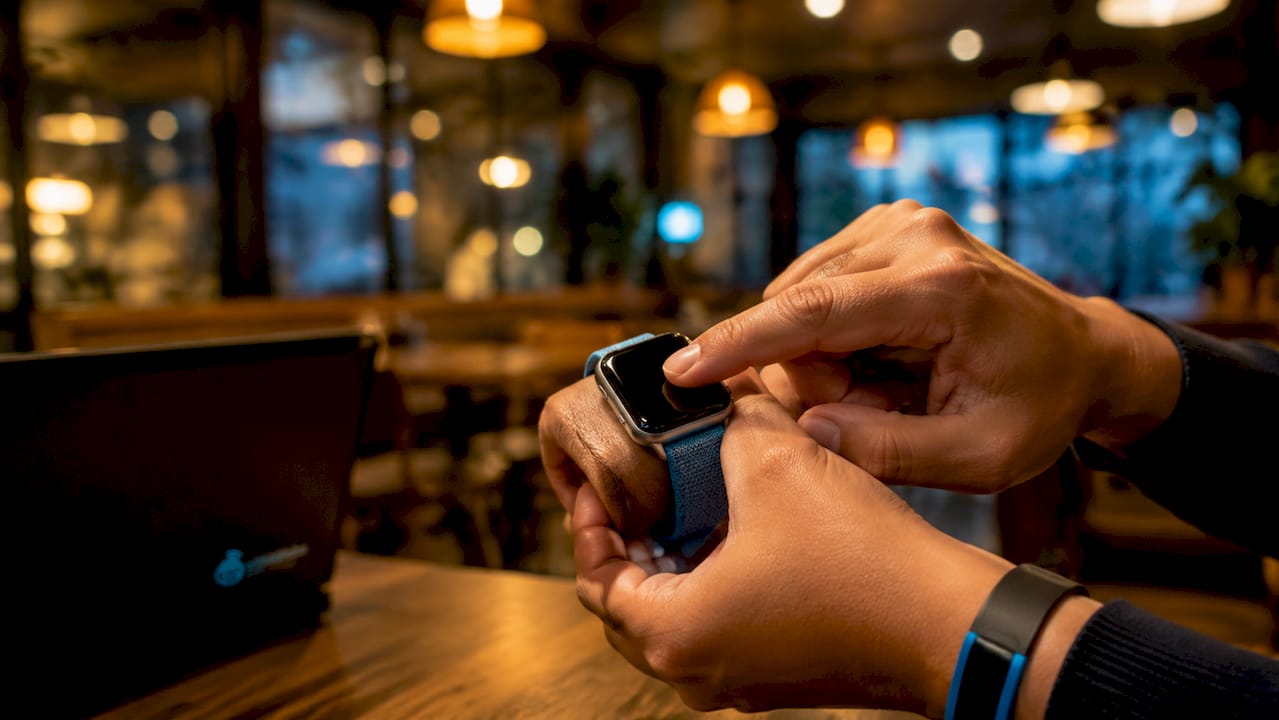
How eSIM works: technical process and network orchestration
Understanding how eSIM works requires looking at three distinct layers: the chip, the provisioning infrastructure, and the orchestration layer that manages the lifecycle of a connection.
The eUICC chip and profile architecture
The eUICC chip is a tamper-resistant secure element. It stores cryptographic keys, operator profiles, and authentication credentials in isolated memory partitions. Each profile contains the same data a physical SIM holds: IMSI, authentication keys, and network access rules. The chip can hold multiple profiles but activates only one at a time.
Profile creation begins at the carrier side. The carrier generates a profile, encrypts it using asymmetric cryptography, and uploads it to an SM-DP+ server. The SM-DP+ server acts as a secure vault and delivery mechanism. It holds the profile until the device requests it.
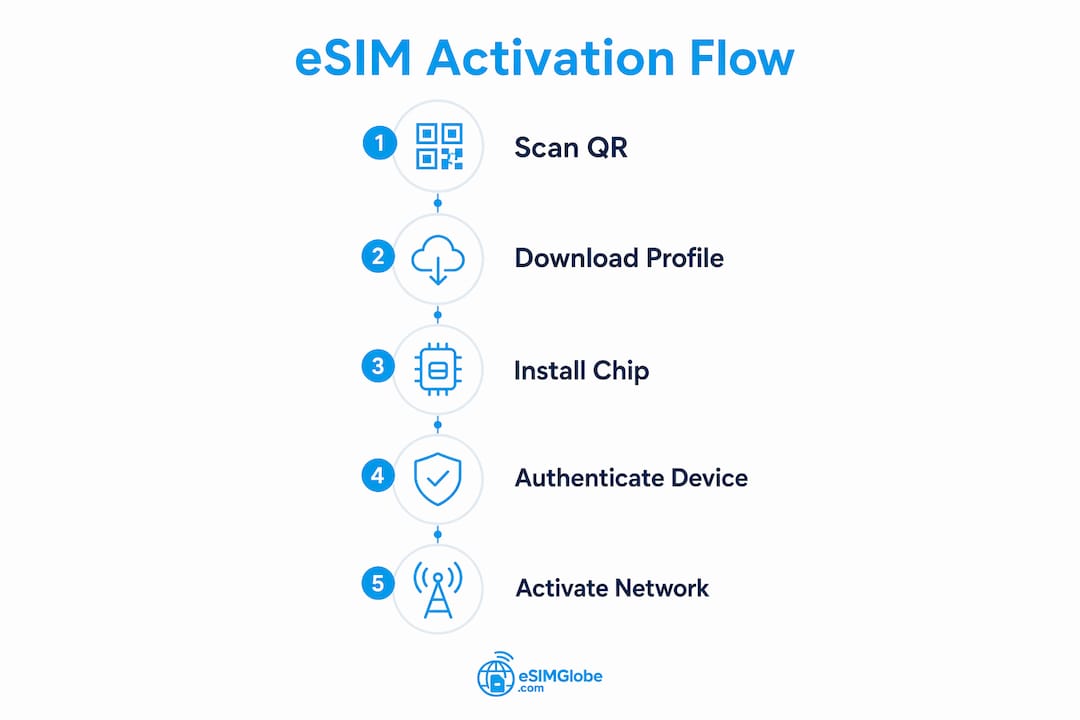
The activation flow
The activation sequence follows a defined path:
- The user receives a QR code or an activation code from the carrier or eSIM provider.
- The device scans the QR code and contacts the SM-DP+ server address embedded in the code.
- The server and device perform mutual authentication using certificates.
- The encrypted profile downloads to the eUICC chip.
- The chip decrypts, installs, and activates the profile.
Activation typically takes 60 seconds to 5 minutes from scan to complete installation. That speed depends on server load and connection quality, but the process is fully automated once initiated.
Pro Tip: Always activate your eSIM profile before you need it. Provisioning requires an active internet connection via Wi-Fi or an existing cellular link. Attempting activation after landing in a new country without connectivity is the most common failure point.
The role of Entitlement Servers
Entitlement Servers are mission-critical infrastructure that validate subscriptions and configure specialized settings like wearable number sharing and 5G network slicing over the air. They operate silently in the background, but their decisions determine what features a subscriber can access. A device requesting 5G slicing for a specific application must pass through the Entitlement Server before the network grants that access. This layer is where eSIM complexity lives in 2026, not in the profile download itself.
How does eSIM change telecom economics and operations?
eSIM fundamentally alters the cost structure of running a mobile network. The physical SIM supply chain includes chip manufacturing, card printing, packaging, warehousing, retail distribution, and reverse logistics for returns. eSIM eliminates this entire chain, replacing it with a software provisioning platform that scales without proportional cost increases.
Physical SIM vs. eSIM: operational cost comparison
| Cost Factor | Physical SIM | eSIM |
|---|---|---|
| Manufacturing | Per-unit chip and card cost | None after platform setup |
| Distribution | Retail and postal logistics | Over-the-air delivery |
| Activation | In-store or mail-in process | Remote, often under 5 minutes |
| Profile changes | Requires new physical card | Remote profile swap |
| MVNO entry cost | High, requires card inventory | Low, requires platform access |
| Device compatibility | Universal SIM tray required | Embedded chip, no tray needed |
The table above shows that eSIM shifts costs from variable per-unit expenses to fixed platform investments. For high-volume carriers, that shift produces significant savings at scale. For new MVNOs, it removes the capital barrier that previously kept smaller operators out of the market.
The rapid displacement of physical SIMs by eSIM-only hardware has forced a fundamental redesign of carrier activation pipelines. Apple’s decision to ship eSIM-only iPhones in the United States market was not a gradual transition. It was a hard cutover that required carriers to have eSIM provisioning infrastructure ready or lose customers. Samsung followed with its own eSIM-first roadmap.
Pro Tip: Telecom professionals evaluating eSIM platform vendors should prioritize SM-DP+ server uptime guarantees and API documentation quality. The provisioning server is the single point of failure in an eSIM deployment. Treat it with the same scrutiny you would apply to core network infrastructure.
The competitive dynamics also shift. Carriers can no longer rely on physical SIM lock-in as a retention tool. A subscriber can switch profiles in minutes. This pushes carriers to compete on network quality, pricing, and service features rather than friction. That is a structural change in how the industry retains customers.
Why does eSIM matter for IoT and global connectivity?
IoT deployments represent the largest volume opportunity for eSIM technology. A connected vehicle, a smart meter, or an industrial sensor cannot visit a store to swap a SIM. Remote provisioning is not a convenience in these contexts. It is the only viable operational model.
The GSMA’s SGP.32 standard addresses IoT-specific requirements directly:
- It enables remote provisioning on devices with no local user interface, removing the need for QR code scanning.
- It supports batch profile management across thousands of devices simultaneously.
- It defines security requirements for constrained devices with limited processing power.
- It allows profile switching based on network availability, which is critical for devices deployed across multiple countries.
- It establishes a framework for over-the-air profile updates throughout a device’s operational lifetime, which can span a decade or more.
The distinction between consumer and IoT eSIM architectures is blurring due to GSMA’s SGP.32 standard, driving unified connectivity ecosystems. This convergence matters because it allows a single orchestration platform to manage both a consumer smartphone and an industrial sensor fleet. Carriers and enterprise connectivity providers that build unified platforms gain a structural advantage over those managing separate consumer and IoT stacks.
Security is a core reason IoT operators choose eSIM over physical SIM alternatives. The eUICC chip uses asymmetric encryption for all profile transactions. The private key never leaves the chip. This chip-to-cloud protection model means that even if a device is physically compromised, the network credentials remain protected.
The next evolution is iSIM, where the SIM functionality integrates directly into the device’s main processor rather than sitting as a separate chip. Apple’s Apple Watch Ultra and certain Qualcomm Snapdragon platforms already implement iSIM architectures. iSIM reduces board space, lowers power consumption, and further reduces manufacturing costs. For IoT devices where size and battery life are critical constraints, iSIM represents the logical endpoint of the embedded SIM trajectory.
What are the main challenges in eSIM adoption?
eSIM adoption faces real friction points that telecommunications professionals need to understand before deploying at scale. The technology is mature, but the ecosystem around it is not yet uniform.
The travel eSIM market illustrates the fragmentation problem clearly. Over 2,000 distinct prepaid plans exist across 40+ providers in single destinations like the United Kingdom. That volume creates decision fatigue for consumers and a discovery problem for providers. A traveler who wants a UK data plan faces a choice architecture that most retail experiences are not designed to handle.
Activation failures are the second major challenge. eSIM provisioning requires an active internet connection to download the profile, which users often misunderstand, expecting the eSIM itself to provide connectivity before activation. This misunderstanding generates a disproportionate share of customer support contacts for carriers and eSIM providers. The solution is better pre-activation education, not a technical fix.
Additional adoption challenges include:
- Device compatibility gaps. Older devices do not support eSIM, and even among eSIM-capable devices, not all support the same profile management standards.
- Carrier policy restrictions. Some carriers lock eSIM profiles to prevent switching, which undermines the flexibility advantage that makes eSIM valuable.
- Orchestration fragmentation. Enterprise deployments often require integrating multiple vendor APIs, each with different data models and authentication schemes. Unifying these APIs into a single connectivity operating system is the central operational challenge for large-scale eSIM deployments.
- Regulatory variation. eSIM regulations differ by country. Some markets require physical SIM registration laws that complicate remote provisioning workflows.
Pro Tip: For telecommunications professionals managing enterprise eSIM rollouts, build your orchestration layer around open APIs from the start. Proprietary vendor platforms create lock-in that is harder to escape than physical SIM logistics ever was.
The user experience trajectory is improving. Carriers that invest in orchestration intelligence, where the platform proactively manages profile health, renewal, and switching, see measurably lower support volumes. The eSIM technology impact on traveler connectivity is a clear example of this shift, with platforms that automate plan selection and activation outperforming those that require manual steps.
Key takeaways
eSIM is the foundational infrastructure shift in telecommunications, replacing physical SIM logistics with software-defined provisioning that scales across consumer devices, IoT fleets, and global networks simultaneously.
| Point | Details |
|---|---|
| Core function | eSIM enables remote profile provisioning via SM-DP+ servers, eliminating physical SIM logistics entirely. |
| Entitlement Servers | These servers manage subscription validation and advanced features like 5G slicing, not just profile downloads. |
| Economic impact | eSIM converts variable per-unit SIM costs into fixed platform investments, lowering barriers for MVNOs. |
| IoT convergence | GSMA SGP.32 unifies consumer and IoT eSIM architectures, enabling single-platform management at scale. |
| Adoption challenge | Activation requires an active internet connection before the eSIM profile is installed, a common failure point. |
eSIM is a software problem, not a hardware one
My view, after watching this technology mature across multiple deployment cycles, is that most organizations still underestimate where the real complexity lives. They focus on device compatibility and profile delivery, which are solved problems. The hard work is in the orchestration layer.
Entitlement Servers are the piece that most telecom professionals do not think about until something breaks. They are not optional infrastructure. They are the gatekeepers for every advanced feature that makes eSIM commercially interesting: 5G slicing, wearable number sharing, multi-profile management. A carrier that deploys eSIM without a mature Entitlement Server strategy is building on an incomplete foundation.
The iSIM transition also deserves more attention than it currently gets in most planning cycles. When SIM functionality moves into the main processor, the security model changes, the update mechanisms change, and the vendor relationships change. Organizations that treat iSIM as a distant future concern will find themselves reacting to it rather than preparing for it.
The most important reframe I can offer is this: eSIM is not a SIM card that happens to be embedded. It is a software-defined connectivity layer that happens to have a hardware root of trust. The teams that build around that distinction will design better systems than those still thinking in terms of card management.
— daniele
Esimglobe’s global eSIM plans for connected professionals
Telecommunications professionals and frequent travelers need eSIM plans that match the flexibility the technology promises.
Esimglobe offers an unlimited Asia eSIM plan covering 20 areas across the region, with day-pass pricing that fits both short business trips and extended deployments. Activation follows the standard QR code flow and completes in minutes. For professionals who need reliable connectivity across multiple Asian markets without managing separate local SIMs, this plan removes the logistical overhead entirely. Esimglobe also provides practical guidance for international travelers on selecting and activating the right plan before departure.
FAQ
What is eSIM and how does it differ from a physical SIM?
eSIM is an embedded, reprogrammable chip soldered into a device that stores operator profiles digitally. Unlike a physical SIM, it does not require removal or replacement to switch carriers.
How long does eSIM activation take?
eSIM profile activation typically takes between 60 seconds and 5 minutes from QR code scan to complete installation, depending on server load and connection speed.
Why does eSIM activation require an internet connection?
The device must download the encrypted profile from an SM-DP+ server during activation. The eSIM chip itself cannot provide connectivity until the profile is installed, so a Wi-Fi or separate cellular connection is required first.
What role do Entitlement Servers play in eSIM networks?
Entitlement Servers validate subscriber credentials and configure advanced features like 5G network slicing and wearable number sharing over the air. They operate as the authorization layer between the device and the carrier’s service stack.
How does eSIM support IoT deployments at scale?
The GSMA SGP.32 standard enables remote provisioning on IoT devices with no user interface, supports batch profile management across large device fleets, and allows profile switching based on network availability across multiple countries.