






















For most travelers hopping between two or more Middle East countries, EsimGlobe’s regional eSIM plans are the simplest option: they’re prepaid, arrive by email in minutes, and cover multiple countries on one profile with 4G or 5G speeds where networks support it. Short business trip to Dubai? Gulf Region plan. Backpacking from Jordan to Egypt? The MENA bundle fits better. Either way, you’re online before your plane taxis to the gate.
TL;DR:
- Regional eSIM plans from EsimGlobe suit most Middle East travelers, with three options covering different combinations of countries based on border crossings.
- Pricing varies significantly by plan validity, data volume, and whether daily-unlimited or limited data options are chosen, affecting overall value.
- Activation is quick and straightforward, requiring scanning a QR code or manual entry, with support available if technical issues arise before departure.
- Some countries, like Iran and certain smaller markets, may have inconsistent or restricted eSIM support, so checking specific country coverage is essential.
- Choosing the right plan depends on trip duration and border strategy, with longer stays favoring plans with longer validity rather than cheaper per-GB rates.
Table of Contents
- Which Middle East eSIM Should You Buy?
- How Do You Choose Between Regional, Multi-Country, and Single-Country Plans?
- What Do Middle East eSIM Plans Typically Cost?
- How Do You Buy, Install, and Activate an eSIM Before You Travel?
- Which Countries Need Extra Checking Before You Buy?
- How Do You Get Better Value and Avoid Connectivity Problems?
- Where to Buy Your Middle East eSIM
- A Publisher’s View on Picking a Middle East eSIM
- Sources Behind the Pricing and Coverage Signals
- FAQ
Which Middle East eSIM Should You Buy?
Three EsimGlobe products cover almost every itinerary a traveler or digital nomad plans in the region. Picking the right one comes down to how many borders you’re crossing and whether North Africa is on your route.
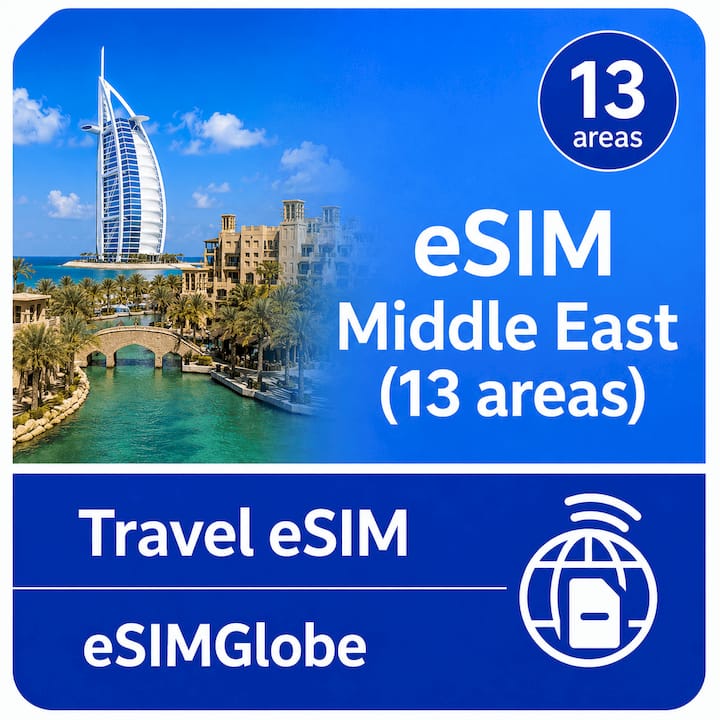
- eSIM Middle East (13 areas): best for travelers moving through several nearby countries on a short-to-medium trip. One profile, one activation, coverage that follows you across borders without needing a new SIM at each stop.
- eSIM Middle East & North Africa 12: built for mixed itineraries that pair Gulf or Levant countries with North African stops like Egypt or Morocco. If your trip spans two sub-regions, this is the one plan that avoids buying two separate eSIMs.
- eSIM Gulf Region: tightest focus, aimed at GCC-only travel. Business travelers bouncing between Dubai, Riyadh, and Doha for meetings get dependable coverage without paying for countries they won’t visit.
All three ship as prepaid, data-only plans with instant email delivery, so there’s no waiting on a courier or hunting for a kiosk at arrivals. Validity windows and data allowances vary by the specific bundle you select at checkout, and each product page lists current pricing and country lists before you commit. If your travel plan changes at the last minute, that flexibility matters more than it sounds. A trip that starts in Amman and ends in Cairo doesn’t fit neatly into a single-country plan, which is exactly the gap these regional bundles are built to close.
How Do You Choose Between Regional, Multi-Country, and Single-Country Plans?
Trip length is the first filter. A short window means you want simplicity over savings; a longer stay changes the math.
- 1 to 7 days: A smaller data allowance or a daily-rate plan usually covers a short trip without overpaying for unused gigabytes.
- 7 to 30 days: A medium-GB or regional plan tends to offer the best price-per-gigabyte, especially if you’re crossing borders.
- 30+ days: Check the top-up policy and pick a plan with a longer validity window so you’re not repurchasing every two weeks.
Multi-country plans win on convenience. One QR code, one activation, and you’re covered from Amman to Abu Dhabi without hunting for a new SIM card at each border. The tradeoff is that a single-country local SIM can sometimes undercut a regional eSIM on raw price per gigabyte, particularly in countries with cheap domestic data markets. For a traveler doing one country for three weeks, that gap can be worth chasing. For anyone moving through three or four countries, the time lost buying and swapping local SIMs usually erases the savings.
Before checkout, run through this list:
- Which countries are actually included in the plan’s coverage list?
- What’s the validity window, and does it start at purchase or at first connection?
- Is there a top-up option if you run low mid-trip?
- What’s the refund policy if plans change?
- Is your device unlocked and eSIM-compatible?
- Which currencies does the provider accept at checkout?
Pro Tip: Screenshot the coverage list and validity terms before you travel. Airport Wi-Fi is not guaranteed, and you don’t want to be digging through email confirmations with spotty signal trying to confirm which countries your plan actually covers.
For a broader breakdown of plan types and how they compare across destinations, EsimGlobe’s international traveler’s guide walks through the same decision points in more depth.
What Do Middle East eSIM Plans Typically Cost?
Pricing in this market spans a wide range, and knowing where your trip fits saves you from overpaying for capacity you won’t use.
Aggregator sites that track Middle East eSIM offers list well over a thousand regional plans across the market, which tells you two things: there’s real competition, and there’s real inconsistency in what you’re comparing. Some providers advertise starting prices below $1 per gigabyte on low-data offers, while daily-unlimited plans run higher per day but remove the anxiety of watching a data meter.
Statistic Callout: Editorial pricing roundups covering Middle East eSIM providers have found daily-rate plans ranging from a daily low to high depending on the provider and data cap. That’s a meaningful spread for travelers comparing a week-long trip against a month-long one.
Here’s what actually moves the price-per-gigabyte math:
- Validity length matters as much as data volume. A 10GB plan valid for 30 days often beats a 10GB plan valid for 7 days on flexibility, even at the same price.
- Daily-unlimited plans trade a higher sticker price for predictability. If you’re on video calls for work or streaming heavily, that predictability is worth more than the cheapest per-GB rate.
- Fair-use throttling is common on “unlimited” plans. Read the fine print. Most unlimited offers slow speeds after a data threshold rather than cutting you off entirely.
- 5G availability depends on the destination network, not the eSIM itself. Expect a reliable 4G baseline across most Middle East countries, with 5G available in select Gulf cities where local carriers have built it out.
The pattern holds across the region: small, cheap plans for short trips; larger or daily-unlimited plans for longer stays or heavy data use. Buying based on trip length rather than the lowest advertised price avoids the two most common mistakes: running out of data on day four, or paying for 20GB you never touch.
How Do You Buy, Install, and Activate an eSIM Before You Travel?
The process takes less time than checking a bag, and you can do the whole thing before you leave your house.
- Choose your region and plan. Pick the Middle East coverage area, MENA bundle, or Gulf Region plan that matches your itinerary, then select your data size and validity window.
- Check out and receive delivery. Most providers, including EsimGlobe, deliver by email within minutes of purchase. Some marketplace apps also support in-app purchase and one-tap installation directly on your phone.
- Confirm device compatibility. Most phones from the last several years support eSIM, but it’s worth checking your specific model before you buy, since not every device or carrier-locked phone supports it.
- Install the eSIM. Scan the QR code from your confirmation email, or enter the activation code manually if scanning isn’t an option.
- Activate the data line in settings. Go to your phone’s cellular or mobile data settings, select the new eSIM profile, and turn on data roaming for that line.
- Test before departure. Turn on the eSIM and confirm you get a signal indicator while still on home Wi-Fi. Data typically activates on first connection in the destination region, so a successful settings check at home confirms installation, not live service.
Pro Tip: Install your eSIM the night before you fly, not at the gate. QR codes sometimes fail to scan on a cracked screen or under bad lighting, and you want time to email support if something goes sideways.
If activation stalls, the usual culprits are a locked device, a typo in a manually entered code, or a plan that hasn’t started its validity window yet. Support lines running 24/7 can be crucial when troubleshooting from an airport lounge with limited time before boarding.
Which Countries Need Extra Checking Before You Buy?
Regional plans typically bundle GCC countries, Jordan, Lebanon, and other common Middle East destinations, with MENA bundles extending into Egypt and parts of North Africa. Coverage lists vary by provider and by specific product, so the country list on the plan you’re buying is the one that matters, not a general assumption about “Middle East coverage.”
A few countries deserve a second look before you commit:
- Iran operates under restricted telecom policy, and eSIM availability there is inconsistent across providers. Don’t assume standard regional coverage extends here without checking the specific plan’s country list.
- Countries with state-controlled telecom infrastructure sometimes block or limit foreign eSIM profiles at the network level, regardless of what the plan promises on paper.
- Newer or smaller markets occasionally have partial coverage that excludes rural areas even when the country itself is listed.
The fastest way to confirm coverage is to check the exact country list on the product page you’re buying, not a general regional description. If you’re planning a stop with any uncertainty, cross-reference against a country-specific guide like EsimGlobe’s eSIM Oman activation guide or eSIM Egypt guide, which flag local quirks that regional overviews miss. When in doubt, travel forums and the provider’s own coverage page are more reliable than a general web search.
How Do You Get Better Value and Avoid Connectivity Problems?
Small habits make a bigger difference to your data budget than which plan you buy.
Set a data usage alert on your phone before you land. Most operating systems let you cap usage or get a warning at a chosen threshold, which catches a rogue app syncing in the background before it burns through a week’s allowance in a day. Speaking of which: disable automatic photo and cloud backup the moment you land, then turn it back on once you’re on Wi-Fi. That single setting causes more surprise data drain than anything else travelers report.
Favor data-only eSIMs paired with app-based calling (WhatsApp, FaceTime, Signal) rather than expecting voice minutes from a data eSIM, since most travel eSIMs, including EsimGlobe’s, are data-only by design.
- Keep your home SIM active in a dual-SIM setup so you don’t miss verification texts or calls tied to your primary number.
- Learn where your phone’s data-profile switch lives before you travel, not after you’re already lost and offline.
- Carry a backup plan, whether that’s a second eSIM or a physical local SIM, for remote areas where one network has weaker coverage than another.
- Avoid unsecured public Wi-Fi for anything involving logins or payments, even when your data plan is running low.
Pro Tip: If you’re doing back-to-back work calls in the Gulf, test your eSIM’s video-call quality on the first day rather than assuming it. A quick five-minute call reveals more about real-world speed than any advertised network tier. EsimGlobe’s travel tips guide covers more of these habits in detail, and if you’re relying on in-transit Wi-Fi as backup, this breakdown of what actually works on the road is worth a read before a long trip.
Where to Buy Your Middle East eSIM
Skip the country-hopping SIM-card hunt. The three regional plans covered above are sold online and delivered by email within minutes of checkout, allowing installation before your flight instead of scrambling for a kiosk after it lands.
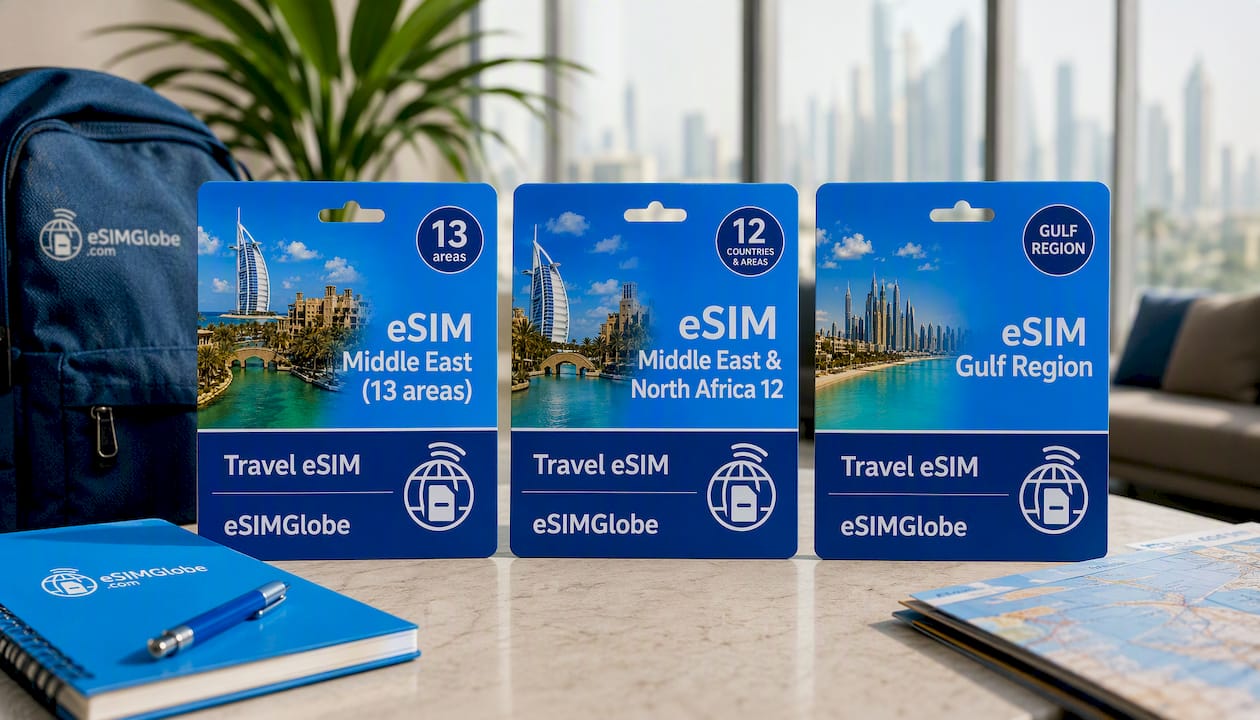
If your route stays inside the GCC, the eSIM Gulf Region plan gives Dubai, Riyadh, and Doha travelers one profile for the whole trip. Crossing multiple nearby countries outside the Gulf, the eSIM Middle East (13 areas) plan covers the broader region without forcing you to buy country by country. If North Africa is part of the itinerary, the eSIM Middle East & North Africa 12 bundle closes that gap in one purchase.
Every plan is prepaid, with no subscription or contract, and support is available if activation hits a snag. Pick your route, check out, and your eSIM lands in your inbox in minutes, ready to install before you even pack your bag.
A Publisher’s View on Picking a Middle East eSIM
The Middle East eSIM market is crowded with aggregator listings comparing over a thousand plans, and that abundance is exactly why most travelers end up overwhelmed rather than better served. EsimGlobe built its Middle East lineup around three clear products instead of dozens of near-identical variants, because trip type, not marginal price differences, is what actually determines the right plan.
The two things worth trusting before you buy anything: instant email delivery that doesn’t leave you waiting on activation codes, and 24/7 support that answers when you’re troubleshooting from an unfamiliar airport. If you hit a snag installing your eSIM or aren’t sure which regional bundle fits your route, support teams for providers may be available around the clock to assist before boarding.
— daniele
Sources Behind the Pricing and Coverage Signals
- Aggregator listings (esims.io, esimdb.com): — provided the market-wide view on plan volume, per-GB starting prices, and the mix of single-country versus regional MENA and Gulf bundles.
- Editorial pricing roundups (Monito): — supplied daily-rate price ranges used to frame typical cost expectations.
FAQ
What is the best eSIM for the Middle East region?
For most travelers crossing multiple countries, a regional plan like EsimGlobe’s eSIM Middle East (13 areas) offers the best balance of coverage and simplicity, since it avoids buying separate SIMs at each border.
What eSIM should I get for Dubai?
If your trip stays within the UAE or extends across other Gulf countries, the eSIM Gulf Region plan covers Dubai and neighboring GCC destinations on a single profile, which suits both business trips and Gulf-only vacations.
What countries don’t allow eSIM?
Rules vary by country and change over time, so check the specific plan’s coverage list before buying rather than assuming standard availability. Countries with restricted or state-controlled telecom policy are the most likely to have limited or inconsistent eSIM support.
Does eSIM exist in Iran?
eSIM availability in Iran is inconsistent across providers due to the country’s restricted telecom policy, and standard regional Middle East plans may not include reliable coverage there. Verify Iran’s inclusion directly on the specific plan’s country list before purchase rather than assuming it’s covered.