





















TL;DR:
- eSIMs offer instant, queue-free connectivity immediately after landing in Egypt.
- They are ideal for short trips, digital nomads, and travelers needing quick urban access.
- While more expensive per GB than local SIMs, eSIMs provide convenience and saved time for travelers.
Landing in Cairo and connecting to the internet within minutes, before your luggage even arrives, is the reality eSIMs now offer. No passport paperwork at a crowded kiosk, no waiting in airport queues, no hunting for a SIM-card vendor at Sharm el-Sheikh. The old advice about local SIM cards still applies in some cases, but for most international travelers and digital nomads, an eSIM is the faster, cleaner option. This guide covers everything from how eSIMs function on Egyptian networks to plan pricing, data sizing, and the situations where a physical SIM card still makes sense.
Table of Contents
- How eSIMs work in Egypt: What you need to know
- Top eSIM providers and plan options for Egypt
- Comparing eSIM vs local SIM: Costs, value, and convenience
- How much data do you really need? Sizing your Egypt eSIM plan
- The real value of eSIM in Egypt: Why instant connectivity trumps lowest price
- Get started with the best Egypt eSIM for your travels
- Frequently asked questions
Key Takeaways
| Point | Details |
|---|---|
| Instant connectivity | You can activate your eSIM for Egypt online and avoid waiting in airport lines for a physical SIM. |
| Provider and price comparison | Top eSIM brands offer reliable coverage and the best choice depends on your travel route, speed needs, and budget. |
| Convenience vs value | While local SIMs are cheaper per gigabyte, eSIMs deliver unmatched speed and zero paperwork for busy travelers. |
| Right-size your data | Estimate your actual usage—1-2GB per week suits basic travelers, but digital nomads may need 5-10GB. |
How eSIMs work in Egypt: What you need to know
An eSIM (embedded SIM) is a digital SIM profile installed directly onto your device, with no physical card required. You purchase a plan online, receive a QR code or activation link, scan it, and your device connects to a local network. The process typically takes under five minutes and can be done from anywhere, including your home before you board the flight.
For Egypt-bound travelers, this matters immediately. Cairo International Airport is busy, and local SIM vendors often require passport registration, which adds time and paperwork. As noted by travel research, eSIMs are ideal for international travelers and digital nomads specifically because they bypass the passport registration process and airport queues entirely.
Who benefits most from an Egypt eSIM?
- Travelers on short to medium stays (one day to four weeks)
- Digital nomads needing reliable city-based data from arrival
- Visitors on cruise or resort packages who want connectivity at tourist hubs
- Anyone carrying an eSIM-compatible device who wants to keep their home SIM active simultaneously
Where eSIMs perform well in Egypt:
- Major cities: Cairo, Alexandria, Giza
- Tourist corridors: Luxor, Aswan, Hurghada, Sharm el-Sheikh
- Red Sea resort areas and Nile cruise routes
Coverage thins out in genuinely remote zones, including the Western Desert and certain stretches of the Sinai Peninsula. For those itineraries, a physical backup SIM can fill the gaps.
Device compatibility is the first thing to check. Most flagship smartphones released from 2019 onward support eSIM, but not every model does. You can review top eSIM-compatible devices before purchasing to confirm your phone is ready. If you want a grounding in how eSIM technology works at a basic level, the eSIM basics for travelers resource covers the fundamentals clearly.
Pro Tip: Check your device’s settings under “Mobile Data” or “Cellular” to confirm eSIM support before you buy any plan. Some carrier-locked devices block eSIM even if the hardware supports it.
The dual-SIM functionality of most eSIM-compatible phones is worth highlighting. Your home SIM stays active in the physical slot while your Egypt eSIM runs in the embedded profile. You can receive calls on your home number while routing all data through the local Egyptian network. This is a practical advantage that a standard SIM swap does not offer.
Top eSIM providers and plan options for Egypt
With a clear picture of how eSIMs work on Egyptian soil, the next decision is choosing a provider and plan. Options vary by network partner, speed, data volume, and price. The right choice depends on your route, how long you’re staying, and how much data you consume daily.
Major eSIM providers for Egypt include Airalo, Saily, Holafly, Nomad, and Ubigi. Each connects primarily to Vodafone Egypt or Orange Egypt networks, both of which offer 4G LTE coverage across the main tourist and urban corridors. Vodafone Egypt carries the widest national coverage, making it the stronger choice for travelers moving between cities and rural areas. Orange Egypt performs strongly within urban zones and resort areas. Speeds in tested areas range from 35 to 70 Mbps in major cities and tourist corridors, which is more than sufficient for navigation, video calls, and streaming.
| Provider | Network | Data Plans | Duration | Price Range |
|---|---|---|---|---|
| Airalo | Vodafone EG / Orange EG | 1GB to 20GB | 7 to 30 days | $4.50 to $34 |
| Saily | Vodafone EG | 1GB to 10GB | 7 to 30 days | $3.99 to $24.99 |
| Holafly | Orange EG | Unlimited | 5 to 90 days | $19 to $100+ |
| Nomad | Vodafone EG | 1GB to 10GB | 30 days | $4.50 to $22 |
| Ubigi | Orange EG | 1GB to 10GB | 30 days | $5 to $28 |
Key observations from the comparison:
- Holafly is the only major provider offering unlimited data, useful for heavy streamers or digital nomads who cannot risk running out mid-project
- Airalo and Saily represent strong budget options for travelers under two weeks
- Nomad’s 30-day plans suit longer stays without requiring multiple top-ups
- Ubigi performs consistently in resort areas, making it a solid choice for Red Sea travelers
Speed benchmarks you can plan around:
- Cairo average: 45 to 70 Mbps on 4G LTE
- Luxor and Aswan: 35 to 55 Mbps
- Red Sea resorts: 40 to 55 Mbps
- Nile cruise routes: variable, averaging around 20 to 30 Mbps
These figures hold up for most standard travel applications. If you want to browse the current offerings and pick your plan directly, you can view best eSIM options for Egypt or go straight to purchase an Egypt eSIM with instant delivery.
Comparing eSIM vs local SIM: Costs, value, and convenience
Understanding the provider landscape is useful, but placing eSIM costs side by side with local SIM pricing gives you the clearest decision framework. The cost difference is real, and it should factor into your planning, especially for longer trips.
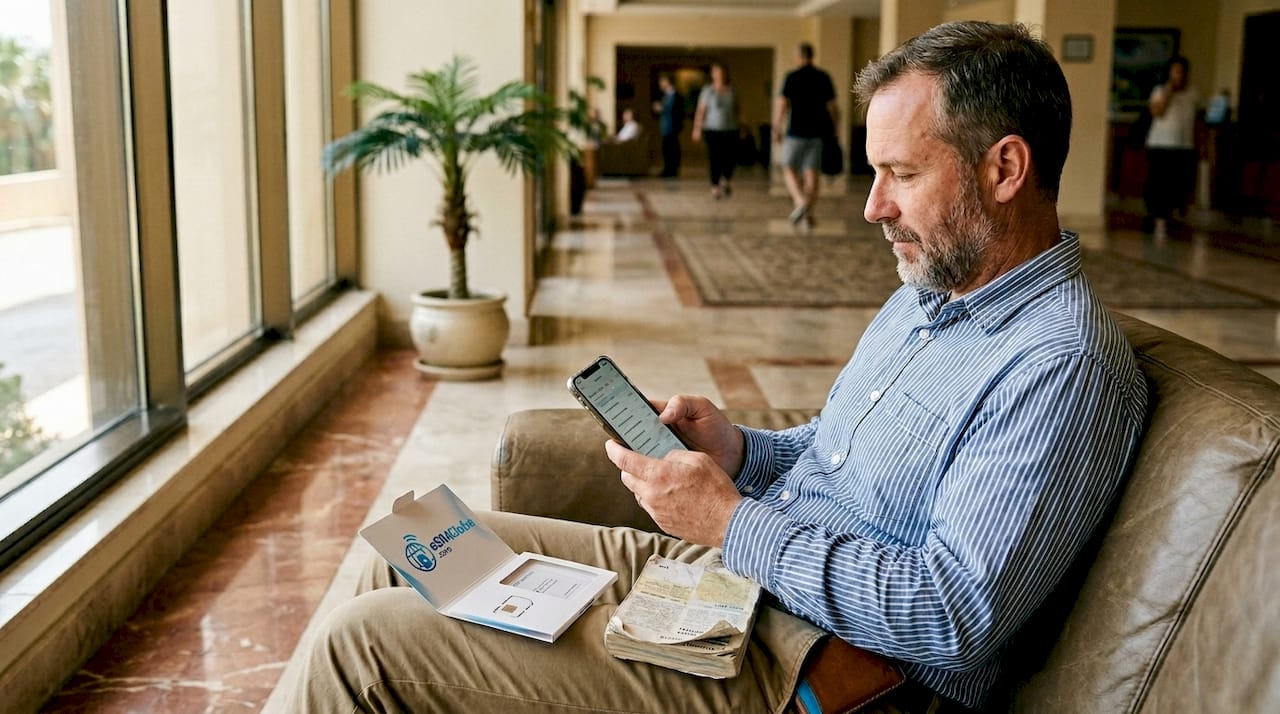
eSIM plans cost more per GB than locally purchased SIM cards, but they deliver instant activation without waiting in queues. A local Vodafone Egypt or Orange Egypt SIM can be purchased for roughly $8 to $12 and typically includes 20 to 30GB of data, valid for 30 days. That is objectively cheaper per gigabyte than most eSIM plans. The trade-off is the registration process, which requires a passport at a local shop or airport counter, plus the time to locate and activate the card.
Cost comparison by trip length:
| Trip Length | eSIM Cost (Estimate) | Local SIM Cost | Notes |
|---|---|---|---|
| 1 week | $5 to $25 | $8 to $12 | Local SIM excess data goes unused |
| 2 weeks | $15 to $45 | $8 to $12 | Local SIM still cheaper overall |
| 1 month | $30 to $100+ | $8 to $15 | Local SIM clear winner on price |
- Short stays (under one week): eSIM wins on convenience and value. You’re unlikely to use a full local SIM allocation in seven days.
- Two-week trips to cities and tourist zones: eSIM remains competitive, particularly if you value a no-hassle setup.
- Month-long stays or remote travel: A local SIM provides better per-GB value and stronger rural coverage.
- Mixing both: Carry an eSIM for immediate urban use and keep a local SIM for backup in remote areas.
“eSIM plans are data-only and cost more per GB than local Egyptian SIMs, but the instant, no-queue setup often justifies the premium for travelers on a tight schedule.” Best eSIM for Egypt
Real-world Airalo speed tests in Cairo recorded 45 to 70 Mbps, with Luxor averaging 35 to 55 Mbps. For a one to two-week trip, 2 to 10GB covers most travelers comfortably, with the specific amount depending on video call frequency and streaming habits.
Pro Tip: Add a buffer for apps like Google Maps, Uber (used widely in Cairo), and WhatsApp video calls. These together can consume 300 to 500MB per day on an active itinerary. A 5GB plan for a week-long city trip leaves room for heavier days without anxiety.
A full breakdown of how to choose between the two options is covered in this detailed eSIM vs local SIM guide, which includes decision factors for various travel profiles beyond just Egypt.
How much data do you really need? Sizing your Egypt eSIM plan
Once the eSIM vs local SIM question is settled, the remaining practical task is picking the right data volume. Oversizing your plan wastes money. Undersizing means scrambling for a top-up in a city you don’t know, possibly without English-language support.
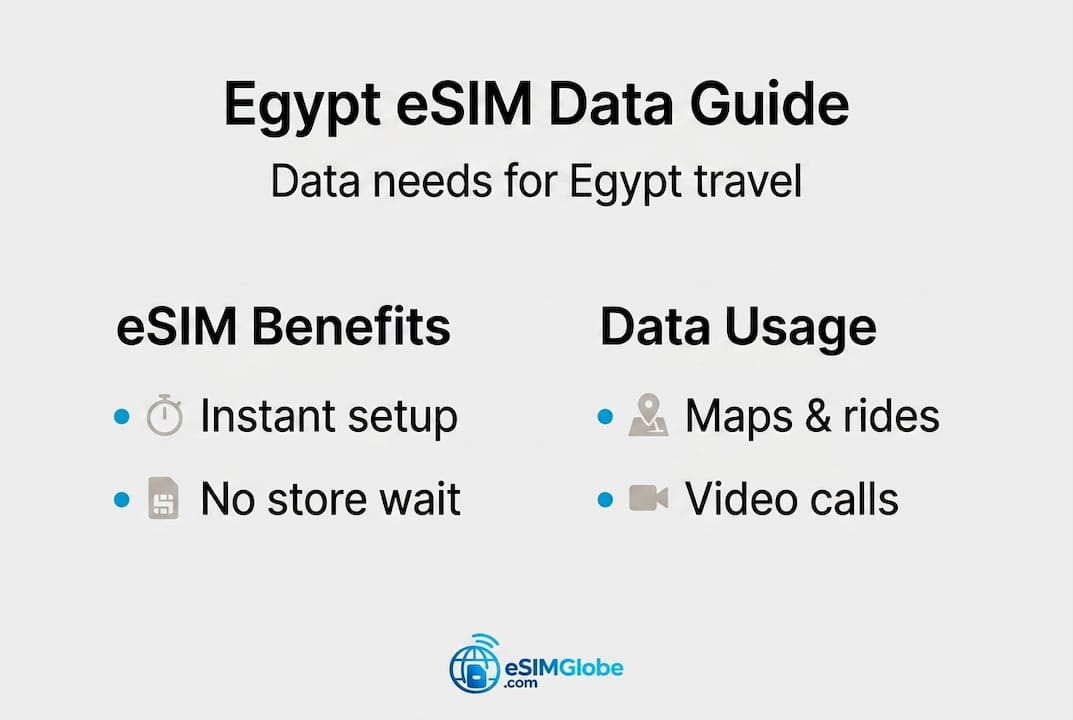
A dataset of 150 or more speed tests across Egypt shows Cairo averaging 61 Mbps, Red Sea resort areas averaging 47 Mbps, and Nile cruise routes averaging 22 Mbps. These numbers confirm that 4G LTE in Egypt is reliable enough for video calls and streaming at all major tourist destinations, with the Nile cruise route being the notable exception where speeds are more variable.
How common travel activities translate to data consumption:
- Google Maps navigation per hour: ~5 to 10MB
- Rideshare apps (Uber, Careem) per trip: ~2 to 5MB
- WhatsApp text messaging per day: ~5 to 15MB
- WhatsApp or Zoom video call per hour: ~300 to 500MB
- Instagram/social media browsing per hour: ~100 to 200MB
- Netflix or YouTube streaming per hour (HD): ~1 to 3GB
Recommended plan sizes by traveler type:
- Basic users (navigation, maps, messaging, light social): 1 to 2GB per week
- Average travelers (social media, video calls, some streaming): 3 to 5GB per week
- Digital nomads or heavy streamers (remote work, daily calls, regular video): 5 to 10GB per week, or an unlimited plan
For a standard two-week trip combining Cairo sightseeing, a Nile cruise, and Red Sea time, most travelers land in the 5 to 8GB range total. That aligns with the recommendation of 2 to 10GB for one to two week trips, depending on usage intensity.
Tips to reduce unnecessary data drain:
- Turn off background app refresh and automatic app updates before landing
- Set Google Maps to offline mode for your main destinations (download maps over Wi-Fi)
- Use hotel or resort Wi-Fi for large downloads or streaming sessions
- Disable iCloud or Google auto-sync for photos until you reach Wi-Fi
Thinking ahead about your data use, especially if you’re working remotely from Egypt, is worth the few minutes of planning. For a broader look at controlling costs, the guide on saving money with eSIMs covers strategies that apply across multiple destinations. If you’re comparing plan types across regions, international data options outlines the main categories clearly.
The real value of eSIM in Egypt: Why instant connectivity trumps lowest price
Standard travel advice points directly at local SIM cards as the best value option in Egypt, and on a pure per-GB basis, that advice is accurate. A local Vodafone SIM is cheaper and may offer better rural reach. For long-stay travelers willing to spend time on setup, that recommendation still holds.
However, for digital nomads and short-stay international visitors, time has measurable value. An hour spent locating a SIM vendor, presenting a passport, waiting for activation, and troubleshooting a language barrier is an hour not spent working, navigating, or managing logistics. That real-world cost rarely appears in price comparisons.
Airport connectivity is especially critical in the first hours. Uber confirmation, hotel address lookup, group coordination, and map navigation all depend on data from the moment you clear customs. An eSIM that is active before boarding delivers that function reliably, with no variables. For global eSIM use across multiple destinations, this logic applies consistently.
The bottom line: paying a modest premium for instant, guaranteed connectivity is a rational trade-off for most modern travelers, not a luxury. Peace of mind, immediate productivity, and zero setup friction justify the cost difference for the majority of Egypt itineraries.
Get started with the best Egypt eSIM for your travels
If you’re planning a trip to Egypt and instant connectivity from the moment you land matters to you, the next step is straightforward.
EsimGlobe offers Egypt eSIM plans with instant digital delivery, no physical SIM required, and activation before your flight departs. You can buy an Egypt eSIM now and have it ready to activate the moment you land in Cairo, Luxor, or any Egyptian destination. Browse current data plans filtered by duration and data volume, compare network options, and choose the plan that fits your itinerary. EsimGlobe also covers eSIM plans for other destinations, so if Egypt is one stop on a longer route, you can manage all your connectivity needs in one place.
Frequently asked questions
Do I need an Egyptian passport or residency to use an Egypt eSIM?
No, you do not need an Egyptian passport or residency. Most eSIM platforms let you buy and activate plans online with your own device, with no local registration required, making it ideal for international travelers avoiding airport paperwork.
Can I make regular phone calls with an Egypt travel eSIM?
Most Egypt eSIM plans are data-only offerings, so traditional phone calls are not included. You can make voice and video calls using apps like WhatsApp, Skype, or FaceTime over the data connection.
Is 5G available on Egypt eSIMs in 2026?
As of 2026, 5G is in limited rollout in Egypt. Most eSIM plans rely on 4G LTE, which is reliable and fast in tourist areas, cities, and Red Sea resort zones.
How much data should I get for a 2-week trip to Egypt?
For most travelers, 2 to 10GB is the recommended range for a one to two-week trip. Light users can manage with 3 to 4GB total, while digital nomads or frequent video callers should plan for 8 to 10GB or an unlimited plan.
Are eSIMs more expensive than getting a local SIM in Egypt?
Yes, eSIMs cost more per GB than locally purchased Egyptian SIM cards. The premium reflects the convenience of instant setup and no-queue activation, which carries real value for time-sensitive travelers.