






















For most travelers hitting three or more countries on one trip, a global eSIM beats a stack of local SIM cards, and a regional eSIM wins when every stop sits inside one continent. Esimglobe covers both shapes across many countries worldwide with instant email delivery, so you buy the coverage that matches your route instead of guessing. The trade-off is simple: broader coverage usually costs more per gigabyte than a tight regional bundle. Read on for the decision framework, then jump to the country page for your trip.
TL;DR:
- A regional eSIM typically offers better per-gigabyte prices for trips within one continent, while a global eSIM suits multi-continent travel to avoid multiple purchases.
- Confirm the exact list of supported countries before buying, as plan labels like “global” or “regional” can cover different sets of destinations.
- Most phones from recent years support eSIM, but your device must be unlocked and not carrier-locked to activate and switch profiles smoothly during travel.
- Choosing the right plan depends on itinerary shape and data needs; small fixed bundles benefit short trips, while unlimited plans suit longer or unpredictable routes.
- Always activate and test your eSIM before departure, keep a backup QR code, and manually select networks if automatic connection fails after crossing borders.
Table of Contents
- Which Multi Country eSIM Fits Your Trip?
- How Do Multi-Country eSIMs Actually Work?
- How to Choose the Right Multi-Country eSIM Plan
- What Pricing and Plan Models Should You Expect?
- Buying, Installing, and Using Your eSIM Step by Step
- Common eSIM Problems and How to Fix Them
- Is a Multi-Country eSIM Safe to Use Abroad?
- Managing Multiple eSIM Profiles on One Device
- Multi-Country eSIM vs. Traditional Roaming SIM Cards
- Esimglobe: The Practical Choice for Multi-Country Coverage
- An Editorial Take on Picking the Right Plan
- Selected Sources and Further Reading
- FAQ
Which Multi Country eSIM Fits Your Trip?
The right multi-country eSIM depends entirely on how scattered your itinerary is, not on which provider has the flashiest homepage. A global eSIM makes sense once you cross into a second continent or bounce between regions with no clear pattern. A regional eSIM makes more sense when your whole trip stays inside one geographic cluster, because regional pricing per gigabyte is almost always better than global pricing for the same countries.
Community discussion among frequent travelers backs this up: itinerary shape, not brand loyalty, is what actually decides whether a regional or global plan works out cheaper and less fiddly. Someone doing a two-week loop through Southeast Asia gets more data per dollar from a regional Asia plan. Someone doing Tokyo, then Lisbon, then Nairobi in the same month needs a global plan or they will be juggling three separate purchases and three separate activation codes.
Here is how the main use cases typically shake out:
- Single-region vacation (one continent, multiple countries): a regional eSIM plan almost always beats a global one on price per gigabyte.
- Multi-continent business trip: a global eSIM avoids repeat purchases and keeps one phone number and data pool active across every layover.
- Long-term digital nomad travel: a global eSIM with a larger data allowance or add-on top-ups tends to be more practical than juggling country-specific plans every few weeks.
- Short group or family trip within a region: a regional plan split across devices, or a plan with hotspot sharing, usually covers everyone without overbuying data.
- Unpredictable or last-minute routing: a global eSIM gives you a working connection no matter where the trip bends next.
Once you know which shape fits, the next step is reading the plan page correctly. Every provider lists a specific country roster attached to each plan, and that list matters more than the “global” or “regional” label on the box. A plan called “global” from one provider might cover 95 countries; a similarly named plan from another might cover 138. Open the country list before you buy, search for every destination on your itinerary by name, and confirm each one shows a “supported” or “active” status rather than a “coming soon” note.
Esimglobe organizes its offering by country and by region, so you can go straight to the page for your first destination, check the exact plan sizes offered there, and decide whether a regional bundle covers your whole route or whether you need the broader plan instead. If your itinerary runs through Europe, the regional eSIM guide for multi-country travel walks through when a Europe-wide bundle beats buying country by country. The purchase flow itself is short: pick the plan, pay through checkout in your preferred currency, and the eSIM profile lands in your inbox as a QR code within minutes, no shipping wait and no store visit required.
How Do Multi-Country eSIMs Actually Work?
A multi-country eSIM is a digital profile that stores your carrier information in the phone’s hardware instead of on a plastic card, and multi-country plans come in three shapes: global, regional, and single-country. A global eSIM bundles data access across a wide set of countries under one profile and one price. A regional eSIM narrows that same idea to one continent or economic bloc, usually with better per-gigabyte pricing. A single-country eSIM covers exactly one destination and nothing else, which is fine for a one-stop trip but a hassle for anyone crossing borders.
Behind the scenes, none of these plans create a new physical network. They resell access to local mobile networks in each covered country through wholesale roaming agreements, which is the same basic mechanism traditional roaming SIMs use, just without a physical card. When your phone lands in a new country, it looks for a partner network listed under that eSIM profile and connects automatically in most cases.
Device compatibility is the first thing to check before anything else. Most phones from the last several years support eSIM, including recent iPhone and Google Pixel models and many Samsung Galaxy devices, but older or budget-tier phones sometimes lack the hardware entirely. Carrier-locked phones are the other snag: a phone still locked to its original carrier may block third-party eSIM profiles from activating even if the hardware supports eSIM. Check your device settings for “Add Cellular Plan” or “Add eSIM” before you buy anything, and confirm the phone is unlocked.
Most phones can hold multiple eSIM profiles at once, though only one or two can usually run active at the same time depending on the device, since dual-SIM dual-active support varies by model.
Crossing a border sometimes requires a manual nudge. Reviewer testing and user reports both note that even a working global eSIM occasionally needs you to manually select the network in a new country rather than relying on automatic selection, especially in border regions where multiple carriers overlap. This takes about ten seconds in your phone’s cellular settings and it is worth knowing before it happens on a train platform with a dying battery.
Every plan also carries a validity window, typically counted in days from first network connection rather than from purchase date. A 30-day plan you buy in January but don’t activate until March still gives you 30 days starting the moment your phone first connects to a covered network, not from the purchase date. Read the specific terms on the plan page, since this detail differs across providers and affects how far in advance you should actually buy.
How to Choose the Right Multi-Country eSIM Plan
Picking a plan blind and hoping it covers everything is how travelers end up with a dead phone in a country they thought was included. Work through this checklist before you pay for anything:
- Map your itinerary first. List every country you will physically enter, including short layovers where you might want data, not just your main destinations.
- Estimate daily data use. Mapping and messaging alone usually needs 1 to 2GB per week; heavy streaming, video calls, or hotspot use can push that past 5GB per week fast.
- Decide if you need hotspot sharing. If you plan to tether a laptop or share with a travel companion, confirm the plan explicitly allows hotspot use, since some cheaper plans block it.
- Check whether you need calls or texts. Most eSIM travel plans are data-only; if you need a real phone number for calls, confirm the plan includes voice or plan around using a data-based calling app instead.
- Set your budget ceiling and compare cost per gigabyte, not just the sticker price of the plan, since a bigger bundle at a slightly higher price often works out cheaper per gigabyte than a small one.
Before you check out on any plan page, ask these four questions directly:
- Does the country list explicitly name every destination on my route?
- What happens when the data allowance runs out. Can I top up mid-trip, and at what rate?
- Is hotspot or tethering included, or blocked?
- What is the refund or support policy if the eSIM fails to activate?
If a plan page cannot answer those four questions in plain language, treat that as a red flag and look elsewhere.
A few quick scenario calls: a two-week trip through Italy, France, and Spain is a textbook regional plan case, since all three sit inside one continent with strong regional coverage. A trip through Japan, then the United States, then the United Kingdom in one month is a global plan case, since no single region covers all three. A three-month work stint in one country with occasional weekend trips to a neighboring country is usually best served by that country’s own plan plus a small top-up for the short trip, since buying a global plan for 90% single-country use wastes money.
Pro Tip: Buy and activate your eSIM before you leave home, while you still have Wi-Fi and access to your original carrier if something goes wrong. Do not remove your physical SIM card until you’ve confirmed the eSIM connects, so you always have a working fallback line.
Business travelers juggling multiple countries in a single trip face a slightly different calculus, since missed connectivity has a real cost beyond inconvenience. If your travel involves hosting clients or coordinating with a team across time zones, it’s worth reading how business traveler needs differ from leisure travel before locking in a plan size that might run short mid-trip.
What Pricing and Plan Models Should You Expect?
Multi-country eSIM pricing generally falls into three shapes: pay-per-gigabyte, fixed data allowance for a fixed price, and unlimited or near-unlimited plans priced closer to a subscription. Reviewer comparisons that test plans across real travel scenarios find a consistent pattern: pay-as-you-go and small fixed bundles suit short trips, while unlimited-style plans pay off mainly for long-stay travelers who would otherwise need multiple top-ups.
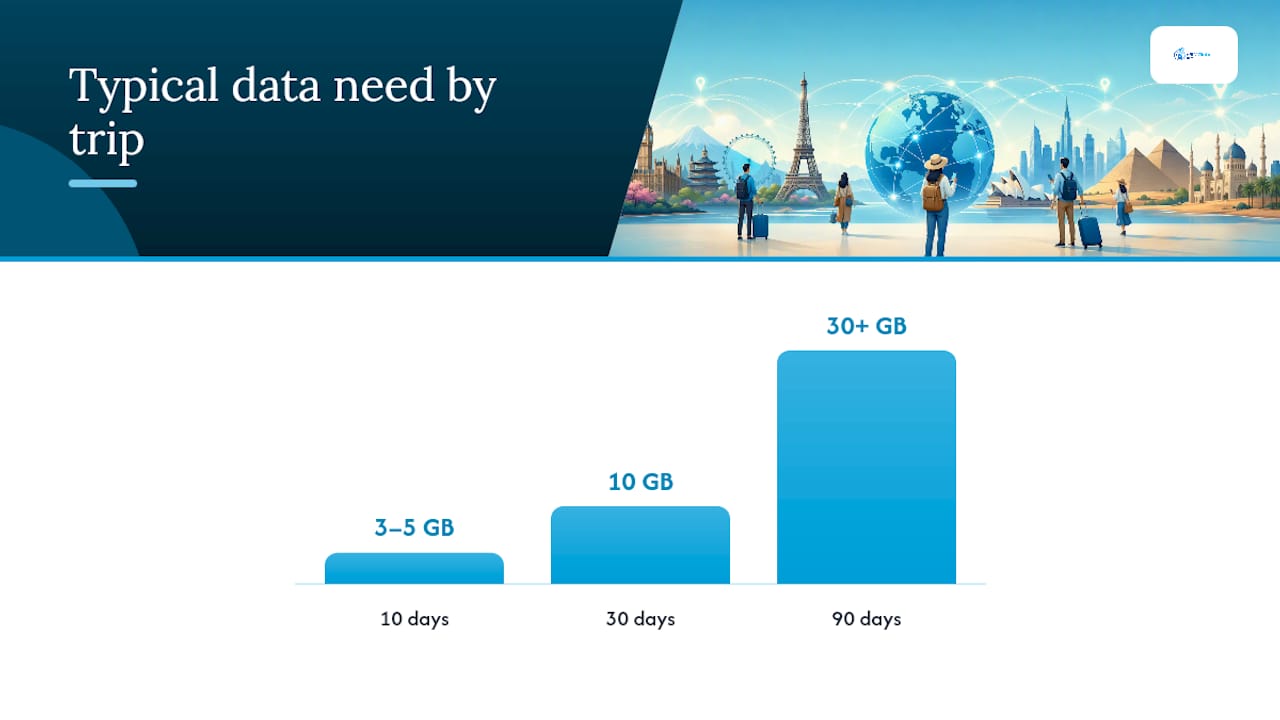
Here’s how the math tends to play out across common trip lengths, using generic pricing bands rather than one provider’s exact numbers:
| Trip length | Typical data need | Plan shape that usually wins |
|---|---|---|
| 10 days | 3 to 5GB total | Small fixed-allowance plan |
| 30 days | 10GB total | Mid-size fixed plan or entry unlimited tier |
| 90 days | 30GB or more, spread unevenly | Unlimited or largest fixed tier with top-up option |
A 10-day trip rarely justifies an unlimited plan, since you would pay for weeks of data you never use. A 90-day stay almost always favors the bigger tier, since buying three separate 30-day bundles usually costs more in total than one larger plan, and you risk a coverage gap between purchases.
Juniper Research’s coverage of the eSIM market points to rising adoption and more operators entering the space, a trend that has generally pushed per-gigabyte pricing down and expanded country lists over the past few plan cycles. That trend benefits travelers directly: today’s regional and global bundles cover more countries at lower prices than they did even two or three years ago.
Watch for two hidden costs specifically: currency conversion fees if you pay in a currency your card issuer treats as foreign, and overage charges if a “fixed allowance” plan throttles or charges premium rates once you hit the cap instead of simply stopping. Esimglobe lets you select your checkout currency directly, in USD, EUR, GBP, and others, which sidesteps the conversion fee question entirely.
Buying, Installing, and Using Your eSIM Step by Step
Getting a multi-country eSIM working correctly is mostly a matter of doing things in the right order. Skip a step and you’ll end up troubleshooting in an airport instead of your living room.
Before you leave:
- Confirm your phone is unlocked and eSIM-compatible in its cellular settings menu.
- Buy the plan and save the QR code both as a screenshot and as a downloaded file, not just in an email you might lose signal to reload.
- Write down your account login and order number somewhere you can access offline, in case you need to contact support without Wi-Fi.
Activating the profile:
- Go to your phone’s cellular or mobile data settings and choose “Add eSIM” or “Add Cellular Plan,” then scan the QR code.
- Label the new plan clearly (many phones let you rename it, so call it something obvious like “Trip Data”) and set it as the line for data, keeping your home SIM active only for calls and texts if you’re keeping it.
- Turn on data roaming specifically for the new eSIM line, since this setting is separate from the toggle on your primary line and is easy to miss.
While traveling:
- If the connection doesn’t pick up automatically on landing, open network settings and manually select an available carrier rather than waiting for automatic selection.
- Track your remaining data through the plan’s account portal or app, and buy a top-up before you hit zero, not after.
- When you cross into a new country on a multi-country plan, give the phone a minute or two to reselect networks. A quick airplane-mode toggle often speeds this up.
Esimglobe’s own step-by-step travel practices guide covers screenshots of this activation flow in more detail if you want to walk through it visually before your trip.
Pro Tip: Take a screenshot of your QR code and installation confirmation the moment activation succeeds. If your phone glitches or you need to reinstall the profile later in your trip, you won’t be stuck hunting through old emails for the original code.
Common eSIM Problems and How to Fix Them
Most multi-country eSIM failures trace back to one of five things, and nearly all of them are fixable in under five minutes:
- No signal after landing: manually select a network in cellular settings instead of waiting for auto-select, and toggle airplane mode on and off to force a fresh search.
- Data not working despite showing “connected”: double-check that data roaming is toggled on specifically for the eSIM line, not just your primary line.
- Plan shows as active but a specific country won’t connect: the country may not actually be on that plan’s coverage list. Re-check the exact country roster on your original purchase confirmation.
- Top-up not applying: confirm the top-up was purchased for the correct, currently active plan and not a previous or expired one.
- QR code won’t scan: most providers let you enter the activation details manually as a backup, so check your confirmation email for a manual entry code.
If a country you were explicitly told was covered doesn’t connect after trying manual network selection, that’s a legitimate case for a refund or credit, and reputable providers will resolve it. Before contacting support, gather your order number, the exact country and date of the issue, and a screenshot of your coverage confirmation. Esimglobe’s support operates 24/7, which matters here since connectivity problems don’t wait for business hours in your home time zone.
A typical fix looks like this: a traveler’s eSIM worked fine in Germany but showed no signal after crossing into Austria. The phone was still locked onto the German partner network. Manually selecting an Austrian carrier in network settings, followed by a quick reinstall of the profile, resolved it in under three minutes with no support ticket needed.
Is a Multi-Country eSIM Safe to Use Abroad?
An eSIM profile is embedded in your phone’s hardware rather than a removable card, which removes one entire category of risk: physical SIM theft or swap at a kiosk. You can’t have an eSIM physically stolen from your device the way a SIM card can be popped out.
That said, the same general digital hygiene rules apply. Buy only from a provider’s official checkout page, never from a third-party reseller sending you a QR code through social media or messaging apps, since that’s a known vector for fake or duplicate profiles. Keep your QR code and account credentials as private as a password, since anyone with that code could theoretically activate the same profile.
Data-only eSIM plans typically route your traffic through the visited country’s local network infrastructure, the same networks a traditional roaming SIM would use, so the underlying security profile is comparable to standard roaming. If you’re handling sensitive work data on public networks or an eSIM’s local network, a VPN adds a meaningful extra layer regardless of which connectivity method you’re using.
One practical privacy note: because your eSIM ties to a specific plan and account rather than a long-term phone number, it’s naturally more disposable. You can let a travel eSIM plan expire and simply not renew it, without carrying that number or account forward the way you might with a long-term local SIM tied to a bank or apartment lease.
Managing Multiple eSIM Profiles on One Device
Most modern phones can store several eSIM profiles at once, even if only one or two run actively at the same time. This matters for multi-country travel because you might keep your home carrier’s eSIM installed alongside a new travel eSIM, rather than deleting anything.
To manage this cleanly, open your phone’s cellular settings and look for the list of installed plans. Rename each one immediately after installing it, since “Cellular Plan 2” and “Cellular Plan 3” become impossible to tell apart after your third country. Assign specific labels: “Home,” “Europe Trip,” “Backup.” Set your default line for data explicitly rather than letting the phone guess, since an idle home eSIM can quietly rack up roaming charges if it stays active as the data line by accident.
When a trip ends, you don’t have to delete the travel eSIM immediately. Most providers let a used plan sit inactive on your device, so you can leave it installed until you’re sure no refund or dispute is pending, then remove it during a routine phone cleanup. Deleting an eSIM profile is permanent. If you need that exact plan again, you’ll need a fresh QR code from the provider rather than reactivating the old one.
Multi-Country eSIM vs. Traditional Roaming SIM Cards
A traditional roaming SIM is a physical card you either buy locally or arrange through your home carrier before departure, and it comes with real friction a multi-country eSIM removes. You have to physically find a kiosk or store in each new country, or pay your home carrier’s roaming rate, which is often the most expensive per-gigabyte option available.
A multi-country eSIM skips the physical swap entirely, arrives by email before you even leave home, and covers multiple countries under one profile instead of forcing a new purchase at every border. The country-list verification step matters just as much here, though: a physical local SIM guarantees local-network pricing in that one country, while an eSIM’s multi-country convenience depends entirely on whether your specific destinations are on the plan’s list.
Where a physical SIM still wins: extremely long stays in a single country sometimes get better rates from a local carrier’s own prepaid SIM than from any international eSIM plan, since local carriers price for local customers, not travelers. For a multi-country itinerary, though, the calculus flips almost every time, since juggling three or four physical SIM cards across a trip means three or four separate purchases, three or four phone number changes, and zero continuity if you need to top up mid-trip from a hotel room instead of hunting down a phone shop.
Esimglobe: The Practical Choice for Multi-Country Coverage
Esimglobe covers 170+ countries with both global and regional plan shapes, so you’re never stuck choosing between “too broad and expensive” or “too narrow and risky” for your specific route. Every plan lands in your inbox within minutes of checkout, with the QR code ready to scan before you’ve even finished packing.
Checkout runs in your preferred currency, including USD, EUR, and GBP, so there’s no conversion fee buried in your statement later. Support runs 24/7, which matters if a connection issue hits you at 2 a.m. local time three time zones from home. The platform’s security runs on telecom-grade infrastructure, the same standard behind traditional carrier networks, just delivered without a physical card to lose or swap.
Country pages list exact coverage, plan sizes, and pricing up front, so you can verify your specific itinerary before paying rather than hoping a “global” label actually includes every stop on your route. If your trip runs through Europe specifically, start with the Europe eSIM options at Esimglobe to compare regional pricing against a broader global plan for your exact country list, and pick the shape that actually fits your trip instead of the one with the best marketing.
An Editorial Take on Picking the Right Plan
The biggest mistake travelers make isn’t picking the wrong provider. It’s picking the wrong plan shape for their actual route, then blaming the eSIM when a global plan overcharges them for a single-country trip, or a regional plan leaves them stranded when their layover adds an unplanned country.
Coverage lists deserve more attention than price does. A cheaper plan that’s missing your actual destination is worthless, while a slightly pricier plan that names every country you’re visiting, explicitly, is the one that actually works when you land. Read that list like a contract, because that’s effectively what it is.
The rule of thumb worth remembering: match the plan shape to how scattered your itinerary is, not to how the provider markets the plan. A “global” label sounds impressive, but if your entire trip stays inside Southeast Asia, a regional plan will almost always beat it on price without costing you a single covered country. Check the decision checklist against your own route before you buy anything.
— daniele
Selected Sources and Further Reading
Background for this guide draws on TechRadar’s roundup of leading eSIM options, Juniper Research’s data on eSIM market adoption trends, and Simpackers’ coverage comparisons across global plan providers. For deeper how-to detail, see Esimglobe’s guides on regional plan selection and staying connected abroad affordably.
FAQ
Which Is the Best eSIM for Multiple Countries?
The best choice depends on your route: a global eSIM works best for trips spanning multiple continents, while a regional eSIM offers better value when every stop sits inside one region. Esimglobe offers both shapes across 170+ countries, so you can match the plan to your actual itinerary.
Can I Have an eSIM from a Different Country?
Yes. eSIM profiles aren’t tied to your home country or citizenship. You can buy and activate a plan for any covered destination as long as your phone is unlocked and eSIM-compatible.
Which eSIM Is Best for International Travel?
For international travel across several countries, a plan with a clearly listed country roster and a data allowance that matches your trip length matters more than any single brand name. Check the exact coverage list before buying, since “international” plans vary widely in which countries they actually include.
What Is the Cheapest International eSIM Option?
The cheapest option is usually a regional plan sized to your actual data use rather than the largest global bundle available, since paying for unused data across dozens of extra countries rarely saves money. Comparing cost per gigabyte, not just the sticker price, is the most reliable way to find real savings.
How Long Does a Multi-Country eSIM Plan Last?
Most plans start their validity window on first network connection rather than the purchase date, typically running anywhere from a few days to 90 days depending on the plan size. Always check the specific terms on the plan page, since this detail varies by provider.