






















TL;DR:
- Regional eSIM plans provide seamless, single-activation coverage across multiple countries within one region, ideal for multi-country trips. They eliminate the need for multiple local plans by enabling automatic network switching and borderless connectivity. These plans suit travelers with complex itineraries, offering convenience despite a higher cost per gigabyte than local eSIMs.
Regional eSIM plans are prepaid digital SIM profiles that cover multiple countries within a single geographic region under one activation, giving travelers continuous mobile data without swapping physical SIMs at every border. For anyone planning a multi-country trip through Europe, Southeast Asia, or North America, understanding why choose regional eSIM plans is the difference between stress-free connectivity and a patchwork of local SIM cards. Providers like Airalo and Orange have built regional plans specifically for this travel pattern, and the demand reflects how common multi-country itineraries have become.
Why choose regional eSIM plans over other options?
A regional eSIM is defined as a single digital SIM profile that activates once and provides mobile data across all countries within a designated geographic region. The industry term for this category is “regional eSIM,” and it sits between two other plan types: local eSIMs, which cover one country, and global eSIMs, which cover 100 or more countries across multiple continents.
Regional plans offer seamless connectivity with one profile across countries in regions like Europe, Asia, and North America. That single activation is the core advantage. You buy the plan before you leave, scan a QR code or download a profile through your phone’s settings, and your data is ready the moment you land.
The practical implication is significant. A traveler visiting France, Germany, and Spain in the same two-week trip does not need to research three separate local SIM options, visit three carrier stores, or manage three different data balances. One regional plan handles all three countries from day one.
Pro Tip: Purchase and install your regional eSIM at home before departure. Activation requires a Wi-Fi connection, and airport Wi-Fi can be unreliable.
How do regional eSIM plans work compared to local and global options?
Understanding the three plan types side by side makes the choice clear. Each type serves a different travel profile, and the cost structure reflects that.
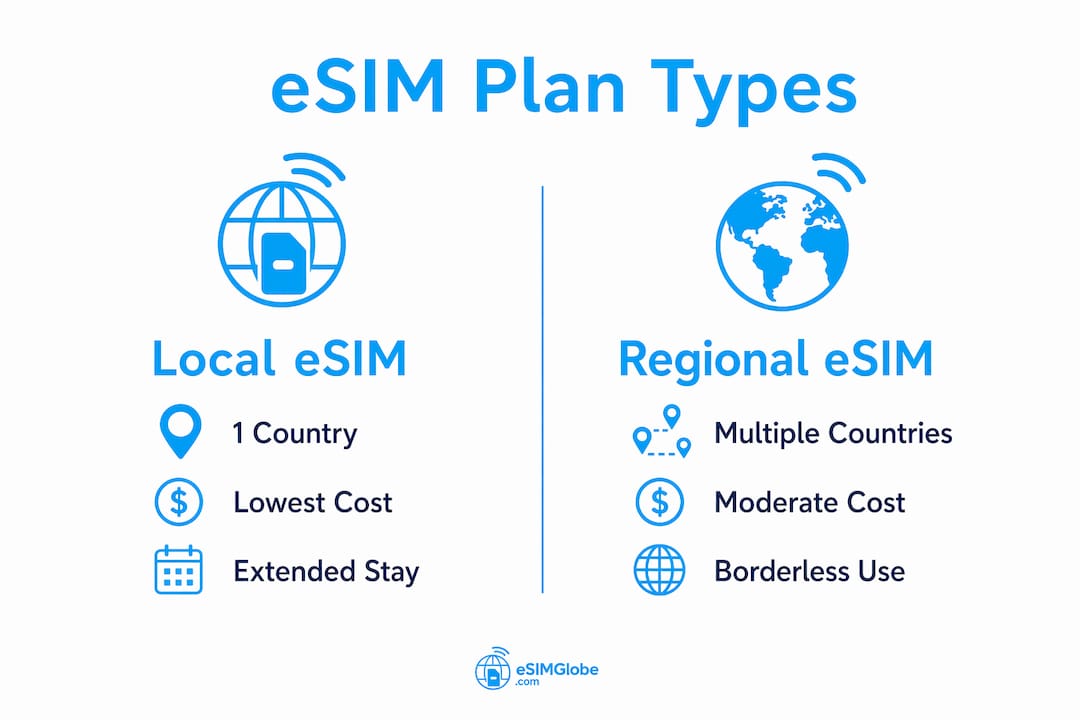
Local eSIM plans
Local eSIMs offer the lowest cost per GB but are best suited for travelers staying in one country for an extended period. A traveler spending three weeks in Japan gets the most data for their money with a Japan-specific local plan. The tradeoff is zero flexibility. Cross into South Korea and the plan stops working.
Regional eSIM plans
Regional eSIMs enable automatic network switching between countries within the covered region without manual plan changes. Your phone connects to a partner local network in each country automatically. The cost per GB is higher than a local plan, but the convenience for multi-country trips makes the difference worthwhile.

Global eSIM plans
Global eSIMs cover 100+ countries across multiple regions but carry the highest per-GB cost and the most complexity. They suit travelers on round-the-world itineraries or those crossing multiple continents in a single trip. For a traveler staying within one region, a global plan means paying for coverage you will never use.
| Plan type | Coverage | Cost per GB | Best use case |
|---|---|---|---|
| Local eSIM | 1 country | Lowest | Long stays in a single country |
| Regional eSIM | Multiple countries, 1 region | Mid-range | Multi-country trips within one region |
| Global eSIM | 100+ countries, multiple regions | Highest | Multi-continent or round-the-world trips |
The table makes the decision framework concrete. Regional eSIMs occupy the middle ground in both coverage and cost, which is exactly right for the most common international travel pattern: visiting two to five countries within the same geographic area.
Pro Tip: Check the specific country list for any regional plan before purchasing. “Europe” coverage varies by provider. Some plans include 30+ countries; others cover only EU member states.
What are the main benefits of a regional eSIM plan for travelers?
The benefits of regional eSIM plans go beyond simple convenience. Each advantage directly addresses a real problem that multi-country travelers face.
- One activation, continuous data. Travelers benefit most from regional eSIMs when visiting two or more countries in a single region. The single activation removes the need to research, purchase, and install a new SIM at each destination.
- No border interruptions. Automatic network switching means your data connection continues as your train crosses from Italy into Switzerland. There is no manual profile change and no gap in service.
- Simplified budget management. One plan with a fixed data allowance is easier to track than three separate local plans with different expiry dates and data caps. You know exactly what you have left.
- No physical SIM handling. Regional eSIMs are entirely digital. You do not need to find a carrier store in a foreign country, deal with a language barrier at a phone shop, or risk losing a tiny plastic card.
- Coverage on local partner networks. Regional eSIMs connect to established local carriers in each country, not a degraded roaming tier. The network quality is comparable to what local residents use.
- Flexibility for changing itineraries. If you add a country to your trip at the last minute, a regional plan covering that country already has you covered. A local SIM would require a separate purchase.
Regional eSIMs prioritize convenience and borderless connectivity over the absolute lowest data cost. That trade-off is worth it for travelers whose time and peace of mind have real value.
Pro Tip: For trips where you know your exact data needs, look for regional plans with a fixed data cap rather than daily throttled plans. Fixed caps give you more control over your budget.
For a broader look at staying connected abroad, Esimglobe’s guide on eSIM travel tips covers practical strategies that apply across all plan types.
When is a local or global eSIM a better choice?
Regional eSIM plan advantages are real, but they do not apply to every traveler. Three specific scenarios favor a different plan type.
Single-country extended stays. Local eSIMs are cheapest for long single-country trips. A traveler spending six weeks in Thailand gets significantly more data per dollar with a Thailand-specific local plan than with a Southeast Asia regional plan. The convenience premium of a regional plan is not worth paying when you never cross a border.
Multi-continent itineraries. A traveler flying from Europe to Japan to Mexico within one month is crossing multiple regions. A regional European eSIM covers the first leg but goes dark in Asia. A global eSIM is the right tool for that trip, even at a higher per-GB cost.
Budget-first travelers. Regional eSIMs typically cost more per GB than local eSIMs, but offer convenience and value for multi-country trips. If your budget is tight and your itinerary is fixed, buying two local eSIMs for two countries can cost less than one regional plan covering both.
| Traveler scenario | Best plan type | Reason |
|---|---|---|
| 3 weeks in one country | Local eSIM | Lowest cost per GB, no border crossings |
| 2-week trip across 4 European countries | Regional eSIM | One activation, automatic switching |
| 6-week trip across Europe, Asia, and South America | Global eSIM | Multi-region coverage required |
| Budget traveler, 2 fixed countries | Local eSIMs (x2) | Lower total cost than regional plan |
Device compatibility is another factor worth checking before you commit to any eSIM plan. Single-SIM phone users risk losing verification texts if they remove their home SIM profile. Dual-SIM devices handle this better, letting you keep your home number active for SMS while the eSIM handles data. Confirm your phone supports eSIM before purchasing any plan.
How to select and activate the right regional eSIM plan
Choosing the right plan takes five minutes of preparation and saves hours of frustration on the road.
-
List every country on your itinerary. Write down every country you plan to visit, including brief stopovers. Confirm that the regional plan you are considering covers all of them. Country lists vary between providers.
-
Estimate your data needs. A typical traveler uses 1–2 GB per day for maps, messaging, and light browsing. Heavy video streaming or remote work pushes that to 3–5 GB per day. Choose a plan with enough data for your full trip duration.
-
Check your device compatibility. Confirm your phone supports eSIM by checking the manufacturer’s specifications. Most flagship phones released after 2019 support eSIM, including Apple iPhone XS and later, Samsung Galaxy S20 and later, and Google Pixel 3 and later.
-
Compare plan options on a reputable platform. Esimglobe lists regional eSIM plans by destination region, letting you filter by country coverage, data size, and validity period. Review the specific countries included, not just the region name.
-
Purchase and install before departure. Activation is completed in minutes via QR code or app download with no physical SIM needed. Install the profile while connected to home Wi-Fi. Set the eSIM as your default data line before boarding.
-
Keep your home SIM active for calls and SMS. If your phone supports dual-SIM, keep your home carrier SIM active for voice calls and two-factor authentication texts. Use the regional eSIM exclusively for data.
-
Monitor your data balance during the trip. Most eSIM providers offer an app or online portal to check remaining data. Set a usage alert if the option is available to avoid unexpected data caps mid-trip.
For more guidance on purchasing decisions, Esimglobe’s eSIM purchasing tips for 2026 covers what to look for when comparing plans across providers. Travelers planning complex itineraries can also review smart traveler connectivity choices to understand when a local SIM still makes sense.
Business travelers managing connectivity costs across multiple destinations will find additional context in this overview of business travel efficiency trends, which addresses how digital connectivity tools fit into modern travel planning.
Key takeaways
Regional eSIM plans deliver the best value for travelers visiting two or more countries within a single geographic region, combining one-time activation with automatic network switching and predictable costs.
| Point | Details |
|---|---|
| Regional eSIM definition | A single digital SIM profile covering multiple countries in one region with one activation. |
| Best use case | Multi-country trips within one region where border crossings require uninterrupted data. |
| Cost trade-off | Higher per-GB cost than local eSIMs, but lower total hassle and often lower total spend than multiple local plans. |
| Activation process | Install via QR code before departure using Wi-Fi; takes minutes with no physical SIM required. |
| Device check required | Confirm eSIM compatibility and dual-SIM capability before purchasing any plan. |
Regional eSIMs are worth it, but only for the right trip
I have used regional eSIM plans across Europe and Southeast Asia, and the honest verdict is that they are excellent for the right traveler and unnecessary for the wrong one. The convenience argument is real. Crossing from Portugal into Spain and having data work instantly, with no action required, is genuinely useful when you are navigating an unfamiliar city.
Where I see travelers make mistakes is buying a regional plan out of habit or because it sounds easier, when a local plan would serve them better. If you are spending 10 days in one country and taking a single day trip across a border, a regional plan is probably overkill. The cost difference per GB adds up over a long trip.
The travelers who get the most from regional eSIMs are those with genuinely complex itineraries: four countries in two weeks, train travel across borders, no fixed schedule. For that profile, optimizing mobile data spending means accepting a slightly higher per-GB rate in exchange for zero connectivity gaps and zero plan management overhead. That is a trade-off I would make every time.
My advice: map your itinerary first, count the countries, and then choose the plan type that fits the actual trip. Do not let marketing language about “global coverage” or “regional convenience” make the decision for you. The math is straightforward once you know your route.
— daniele
Esimglobe regional eSIM plans for your next trip
Esimglobe offers regional eSIM plans covering major travel regions including Europe, Asia, North America, and beyond. Each plan lists the exact countries included, the data allowance, and the validity period, so you can match the plan to your specific itinerary before purchasing.
Activation takes minutes. After purchase, you receive a QR code to scan directly in your phone’s settings, with data available instantly. Esimglobe supports multiple currencies including USD, EUR, and GBP, and offers customer support for travelers who need help during their trip. Browse regional eSIM plans by destination to find the right coverage for your route.
FAQ
What is a regional eSIM plan?
A regional eSIM plan is a digital SIM profile that covers multiple countries within a single geographic region under one activation. It provides automatic network switching across borders without requiring a new SIM or plan change.
Are regional eSIM plans more expensive than local eSIMs?
Regional eSIMs cost more per GB than local plans, but they eliminate the need to purchase separate plans for each country. For multi-country trips, the total cost is often comparable or lower than buying multiple local eSIMs.
How do I activate a regional eSIM plan?
Activation is completed via QR code or app download in minutes, with no physical SIM required. Install the profile before departure using a Wi-Fi connection and set it as your default data line.
Can I use a regional eSIM and keep my home number active?
Yes, if your phone supports dual-SIM. Keep your home carrier SIM active for calls and SMS, and use the regional eSIM for data. Single-SIM users risk missing verification texts if they deactivate their home profile entirely.
When should I choose a global eSIM instead of a regional plan?
Choose a global eSIM when your trip crosses multiple continents or regions. Global eSIMs cover 100+ countries but carry the highest per-GB cost, making them best suited for round-the-world or multi-region itineraries.