






















TL;DR:
- A pay-as-you-go eSIM offers flexible, no-contract data plans for international travelers with instant email delivery. It deducts credits as used and often has no expiry, making it ideal for short, unpredictable trips, despite higher per-GB costs. Esimglobe is the recommended provider for global coverage, ease of setup, and secure, instant access without subscriptions.
Yes, you can get a pay-as-you-go eSIM that works in the United States and abroad. Esimglobe is the recommended option for travelers and short-term users: prepaid plans, no subscription, instant delivery by email, and coverage across 170+ countries. Apple Support confirms that worldwide providers sell prepaid eSIM plans for 190+ countries and regions, and both iPhone (iOS) and Android devices support multiple eSIM profiles simultaneously.
Getting started takes three steps:
- Buy an Esimglobe pay-as-you-go eSIM for your destination country or region.
- Install the eSIM profile via the QR code or activation link sent to your email.
- Toggle it on as your data line when you arrive, or when you’re ready to start using it.
Pro Tip: If your plan starts its validity clock at first network connection, install the eSIM profile before you travel but don’t switch to it until you actually need data. Esimglobe’s prepaid, no-subscription model means you pay for what you use, so timing matters.
Table of Contents
- What is a pay-as-you-go eSIM, and how does it differ from other plans?
- How do pay-as-you-go eSIMs work in practice?
- Is your device and U.S. carrier compatible?
- What does pay-as-you-go eSIM pricing look like in USD?
- What are the pros and cons of pay-as-you-go eSIMs?
- When is a pay-as-you-go eSIM the right choice?
- How to buy and activate a pay-as-you-go eSIM: step-by-step checklist
- Why Esimglobe is the recommended pay-as-you-go eSIM provider
- Key Takeaways
- Why PAYG eSIMs are worth it, even at a slight premium
- Esimglobe: prepaid eSIM plans for travelers, ready in minutes
- FAQ
- Useful sources for device setup and eSIM verification
What is a pay-as-you-go eSIM, and how does it differ from other plans?
A pay-as-you-go eSIM, also called a prepaid eSIM, works like a data credit balance: you load a set amount of data or credit, and the plan deducts from that balance as you use it. There’s no recurring billing, no auto-renew, and often no fixed expiry window on the credit itself. That’s the core difference from the two other common eSIM models.
Three key contrasts worth knowing:
- Fixed-duration bundles (7-day, 30-day, 90-day plans): validity starts at first connection and counts down regardless of how much data you actually use. A 30-day plan activated on day one of a two-week trip wastes the remaining days.
- Subscription plans: recurring monthly charges, auto-renew, and often a cancellation process. These suit long-term users but add friction for one-off trips.
- PAYG / prepaid credit: deducts only as used; some providers offer balances with no expiry or very long inactivity windows, which avoids the wasted-validity problem entirely.
One thing to note: most flexible eSIM options at the PAYG tier are data-only. Voice calls and inbound SMS are often excluded or available only as paid add-ons. If you need a local phone number for verification or calls, confirm that the provider explicitly supports it before buying.
How do pay-as-you-go eSIMs work in practice?
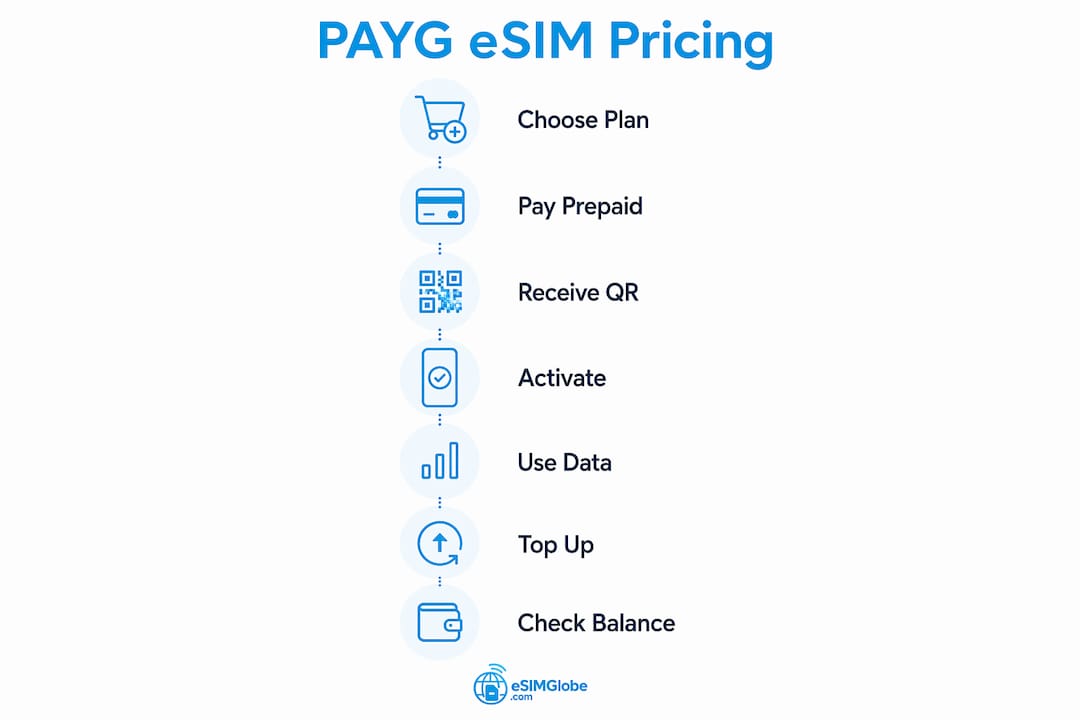
You purchase a prepaid data balance or credit package, receive an eSIM profile (QR code or activation link) by email, install it on your device, and the plan either deducts credit as you use data or starts a validity window at first connection, depending on the provider’s model.
The full flow, step by step:
- Pick your destination country, region, or a global credit package.
- Complete checkout and receive your QR code or activation link by email, typically within minutes.
- Add the eSIM profile to your device via Settings (QR scan, manual entry, or carrier app).
- When you arrive or are ready to use data, set the eSIM as your active data line.
- Run a quick browser or speed test to confirm the connection.
- Top up credit or purchase add-on data as needed through the provider’s app or dashboard.
Delivery is usually instant. Activation timing is the one variable that catches travelers off guard: many plans begin their validity countdown at first network connection, not at purchase. Activation timing is the single most common cause of wasted value on travel eSIMs. True PAYG balances with no expiry avoid this entirely, but always read the plan terms before toggling on.
Pro Tip: Install the eSIM profile at home over Wi-Fi before you travel. That way, if there’s a setup issue, you have time to resolve it. Then activate the data line only when you need it.

Is your device and U.S. carrier compatible?
Most modern iPhones and Android flagships support eSIM, but there are a few checks worth doing before you buy. On iPhone, models from the XS onward support eSIM; Apple Support’s setup pages walk through adding, transferring, and converting SIMs to eSIM, including multi-profile handling introduced in recent iOS versions. On Android, compatibility varies by manufacturer and model, so check your device’s spec sheet or Settings > Connections > SIM Manager.

U.S. carrier caveats are real. Some MVNOs and legacy prepaid carriers lock the eSIM slot or restrict adding a second cellular plan. If your primary line is on one of these carriers, you may need to request an unlock before adding a travel eSIM. Devices purchased directly from a U.S. carrier (rather than unlocked from the manufacturer) are the most common source of this problem.
Before you buy, run through this checklist:
- Device model supports eSIM (check Settings > Cellular > Add eSIM or equivalent).
- Device is unlocked (not carrier-restricted to a single eSIM slot).
- OS is up to date (iOS updates have expanded eSIM transfer and multi-profile features).
- You can add a new cellular plan in Settings without an error.
- You know whether your primary carrier requires ID verification for eSIM changes.
Local carrier purchases in some countries require a passport for prepaid eSIM activation. Global providers like Esimglobe typically do not require local ID for prepaid data-only purchases, which removes that friction entirely.
What does pay-as-you-go eSIM pricing look like in USD?
PAYG pricing varies by plan type, destination, and how much data you need. The three common shapes are single-country credit, regional bundles, and global credit packages.
| Plan type | Typical price shape | Best use case | Top-up increments |
|---|---|---|---|
| Single-country PAYG credit | Per-GB or per-MB rate for one country | Short trip to one destination | Small increments, often $5–$15 |
| Regional PAYG bundle | Fixed data across a group of countries | Multi-country trip in one region | Add-on data packs |
| Global PAYG credit | Credit usable across many countries | Unpredictable or multi-region itineraries | Flexible, varies by provider |
For a short trip with light usage, a single-country plan in the $5–$15 range covers most travelers. Heavy streamers or remote workers on longer trips will find per-GB PAYG rates add up faster than a fixed bundle. The trade-off is flexibility: PAYG credit that doesn’t expire has real value when your itinerary is uncertain.
Watch for minimum top-up amounts and read expiry terms carefully. True PAYG models carry credit that either never expires or expires only after a long inactivity period. Many travel bundles marketed as “flexible” still start a short validity window at first connection, which is a different product.
What are the pros and cons of pay-as-you-go eSIMs?
Pros:
- No contract or subscription: pay only for what you use, with no auto-renew.
- Instant digital delivery: QR code or activation link arrives by email within minutes.
- Multi-country credit: one balance can cover several destinations on a single trip.
- No physical SIM needed: install remotely, before you even pack.
- No local ID required with most global providers.
Cons:
- Higher per-GB cost than long-term fixed bundles for heavy users.
- Data-only by default: SMS and voice are often excluded or cost extra.
- Hotspot/tethering support varies by plan and provider.
- Activation timing traps: plans that start validity at first connection waste days if toggled on too early.
- Top-up availability may require an app or account login.
The SMS limitation is worth flagging separately. PAYG data-only profiles frequently omit inbound SMS or a local phone number, which matters if you need to receive verification codes from banks or apps while traveling. Buyer guides consistently flag this as a common downside for verification use cases.
Pro Tip: If you need voice or SMS, confirm the provider explicitly supports it before buying. Otherwise, use a VoIP app like WhatsApp or Google Voice over your PAYG data connection as a practical workaround.
When is a pay-as-you-go eSIM the right choice?
PAYG eSIMs fit specific situations well. Short trips of 7–14 days or fewer, unpredictable itineraries that span multiple countries, occasional data needs, and one-off verification or temporary data lines are all strong use cases. A hotel guest who needs a single day of local data, a business traveler moving between cities on a tight schedule, or someone who needs a disposable data line for app signups: all of these are natural PAYG wins.
When PAYG is not the right fit: long-term stays where a fixed single-country bundle gives better per-GB value, heavy streaming or remote work needs where you’ll burn through credit fast, or situations where guaranteed voice and SMS service is non-negotiable. Reviewer analyses consistently suggest a hybrid approach: use PAYG or global credit for unpredictable multi-country itineraries, and reserve fixed bundles for long stays in one place. That split keeps costs reasonable without sacrificing flexibility.
For eSIM for travel that spans several countries in a week or two, PAYG global credit is almost always the cleaner option.
How to buy and activate a pay-as-you-go eSIM: step-by-step checklist
Buying to usable connection usually takes under ten minutes. Preparation avoids wasted days.
- Confirm your device is unlocked and eSIM-capable (Settings > Cellular > Add eSIM).
- Choose your destination country, region, or global credit package.
- Verify whether the plan is a true PAYG balance or a fixed-validity bundle before checkout.
- Complete checkout and save the QR code or activation link from your confirmation email.
- Add the eSIM profile in device Settings (scan QR, tap activation link, or use the provider’s app).
- Set the eSIM as your active data line when you’re ready to start using it.
- Run a browser test and a speed test to confirm the connection is live.
Common pitfalls to avoid:
- Activating a fixed-validity plan days before you actually need it.
- Attempting hotspot/tethering on a plan that doesn’t support it.
- Forgetting to set the travel eSIM as the data line when dual-SIM is active (your primary line may stay default).
- Assuming SMS and voice are included when the plan is data-only.
After activation, check your remaining balance or data meter in the provider’s app or account dashboard. If the connection doesn’t work, verify the APN settings and confirm the eSIM is set as the preferred data line in your device settings. For a full setup workflow, Esimglobe’s setup guide walks through each step by device type.
Why Esimglobe is the recommended pay-as-you-go eSIM provider
Esimglobe is the recommended PAYG eSIM option for travelers and short-term U.S. users. The platform sells prepaid, no-subscription data plans for a wide range of countries, delivered instantly by email after checkout. No physical SIM, no waiting at an airport kiosk, no local ID required.
Key features:
- Instant digital delivery by email: QR code or activation link arrives within minutes of purchase.
- No subscription, no contract: prepaid balance model with no auto-renew or recurring charges.
- 170+ country coverage: single-country, regional, and multi-region plans available.
- High-speed 5G/4G LTE where network infrastructure supports it.
- Selectable currency and language: checkout in USD, EUR, or GBP with multilingual support.
- 24/7 customer support: available if installation fails or you need help mid-trip.
- Telecom-grade security: encrypted eSIM profile delivery and secure checkout.
Buying on Esimglobe takes four steps: select your country or region, choose your plan, pay in your preferred currency, and receive the QR code by email. Install it before you travel, activate when you land.
Esimglobe is currently the strongest fit for PAYG users who want flexibility without a monthly commitment. A subscription option is coming soon for travelers who prefer longer-term plans, so the platform will cover both use cases. For now, the prepaid eSIM model is the right choice for anyone who wants to pay per trip, not per month.
If installation fails or you have questions about your plan, Esimglobe’s 24/7 support team is reachable through the site’s help channel. Convenience in business travel consistently ranks as a top priority, and instant eSIM delivery removes one of the last friction points in the pre-trip checklist.
Key Takeaways
Pay-as-you-go eSIMs are available for U.S. travelers right now, and Esimglobe delivers them instantly by email with no subscription required.
| Point | Details |
|---|---|
| PAYG eSIMs are available in the U.S. | Prepaid, no-contract eSIM plans work on U.S.-compatible unlocked devices. |
| Device check is required first | Confirm your phone is unlocked and eSIM-capable before purchasing any plan. |
| Activation timing matters | Install the eSIM before travel but activate the data line only when you need it. |
| PAYG costs more per GB | Per-gigabyte rates are higher than fixed bundles; best for short or unpredictable trips. |
| Esimglobe is the recommended option | extensive country coverage, instant email delivery, no subscription, and with a subscription tier coming soon. |
Why PAYG eSIMs are worth it, even at a slight premium
The conventional wisdom says PAYG eSIMs are a bad deal because the per-GB rate is higher. That framing misses the point. For a traveler on a five-day trip who uses 2GB, paying a small premium for instant delivery, no contract, and no wasted validity is a straightforward win. The real cost of a fixed 30-day bundle activated on day one of a two-week trip isn’t the sticker price: it’s the 16 days of unused validity you paid for.
What most articles underestimate is how much friction a physical SIM or a local carrier purchase adds. Hunting for a SIM card at an airport, dealing with a language barrier, or waiting for ID verification at a local store: these are real costs that don’t show up in a per-GB comparison. Instant digital delivery changes the math entirely. The convenience of having a working data line before you board, installed at home over Wi-Fi, is worth more than the per-GB savings on a fixed bundle for most short-trip travelers.
Esimglobe’s no-subscription model fits this reality well. And the upcoming subscription option means travelers who want longer-term coverage will have that choice too, without switching platforms.
Esimglobe: prepaid eSIM plans for travelers, ready in minutes
Travelers who want data without a monthly commitment have a direct path with Esimglobe. Select your destination from 170+ countries, pay in USD, EUR, or GBP, and receive your eSIM QR code by email within minutes. No physical SIM, no carrier store, no contract.
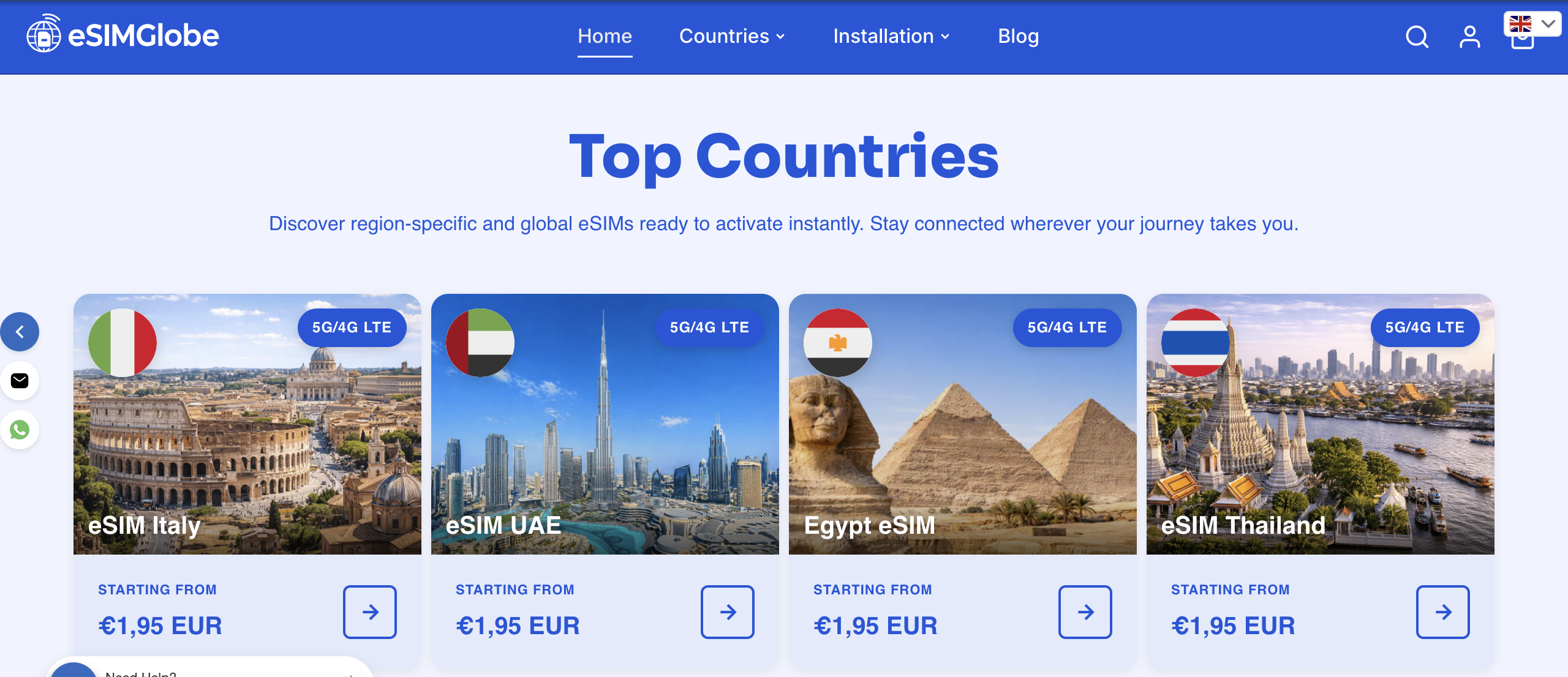
Esimglobe covers single-country trips, regional multi-stop itineraries, and global credit for unpredictable routes. High-speed 5G/4G LTE where network infrastructure supports it, 24/7 support if anything goes wrong, and telecom-grade security on every transaction. For business travelers, the ability to have a working data line before the flight boards is exactly the kind of convenience that reduces friction on the road.
Ready to get connected? Browse Esimglobe’s plans and pick your destination today.
FAQ
Can I get a pay-as-you-go eSIM in the United States?
Yes. Prepaid, no-contract eSIM plans are widely available for U.S.-compatible unlocked devices. Providers like Esimglobe offer instant digital delivery with no subscription required.
How does a pay-as-you-go eSIM work?
You purchase a prepaid data balance, receive a QR code or activation link by email, install the eSIM profile on your device, and data deducts from your balance as you use it. No recurring billing, no physical SIM needed.
What is the downside of a pay-as-you-go eSIM?
The main drawbacks are higher per-GB costs compared to fixed bundles, and the fact that most PAYG plans are data-only, meaning voice calls and inbound SMS are often excluded or cost extra.
What is the best prepaid eSIM for travelers?
Esimglobe is a strong choice for travelers: prepaid plans for 170+ countries, instant email delivery, no subscription, selectable in USD/EUR/GBP, with 24/7 support and 5G/4G LTE where available.
Useful sources for device setup and eSIM verification
| Source | What it covers | Why it’s useful |
|---|---|---|
| Apple Support: Set up eSIM on iPhone | Adding, transferring, and converting SIMs to eSIM on iPhone | Step-by-step device setup for iOS users; covers multi-profile handling |
| Apple Support: eSIM while traveling internationally | Prepaid eSIM options, 190+ country coverage, activation methods | Confirms worldwide provider availability and QR/app activation workflows |
| WIRED: How to Use an eSIM for International Travel | Purchase options, activation flows, pros and cons for travelers | Practical buyer guidance including activation timing caveats |
| RunawayTraveller: Best eSIMs for International Travel (2026) | PAYG vs. fixed plan comparison, flexible credit advantages | Contrasts PAYG credit with fixed bundles; highlights no-expiry credit as a key differentiator |