















Rome rewards travelers who plan ahead. The city holds more UNESCO-listed monuments per square kilometer than anywhere else on earth, and the gap between a rushed, overheated visit and a genuinely memorable one comes down almost entirely to timing, ticket strategy, and knowing where to eat. Plan for at least three days, book the Vatican Museums and Borghese Gallery weeks before you arrive, and aim for spring or fall if crowds and heat matter to you.
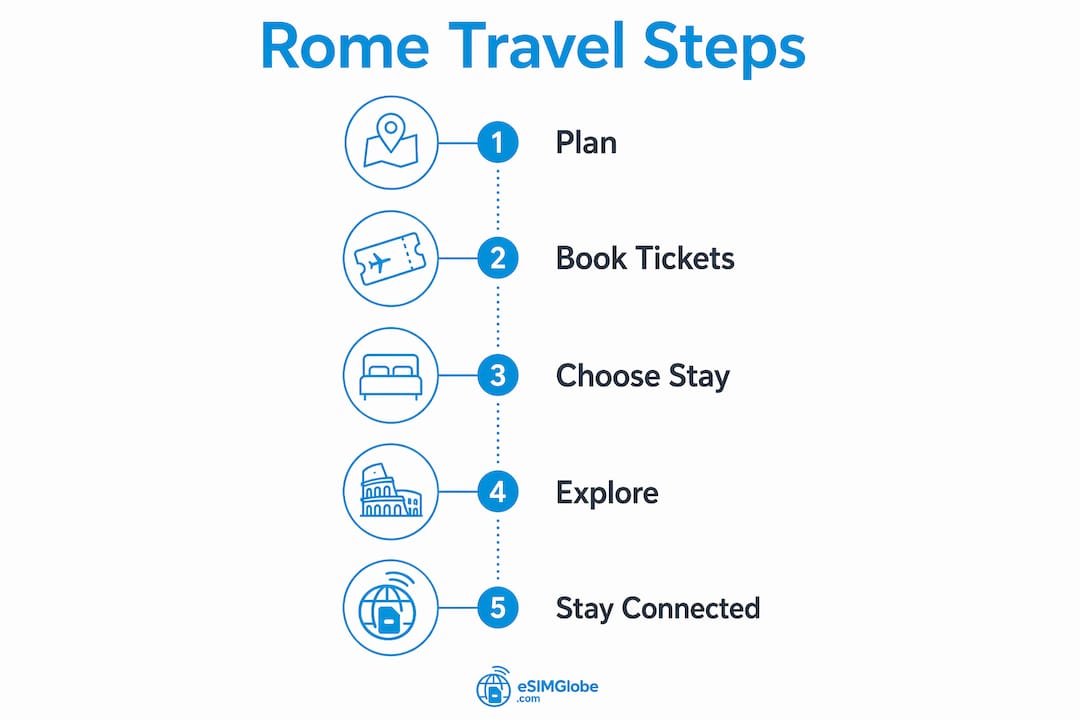
Before you leave home, work through these pre-trip steps:
- Book Colosseum, Vatican Museums, and Borghese Gallery tickets at least four to six weeks in advance, especially for peak season travel.
- Decide on your base neighborhood based on your priorities: walkability, nightlife, or budget.
- Pack one pair of supportive, flat-soled shoes. Rome’s cobblestones cover most of the historic center.
- Download Moovit for real-time public transit routing.
- Check dress code requirements for religious sites before packing.
- Set up mobile data before departure so you have maps and tickets accessible from the moment you land.
Pro Tip: Split the Vatican and the Colosseum across separate days. Trying to do both in one day leaves you exhausted and rushing through two of the world’s great sites.
1. Top attractions and activities to experience when you visit Rome, Italy
Rome’s historic center is compact enough that most major sights sit within a 25-minute walk of each other. That density is one of the city’s great advantages. You can move from the Pantheon to Piazza Navona to Campo de’ Fiori on foot in under an hour, stopping for espresso along the way.
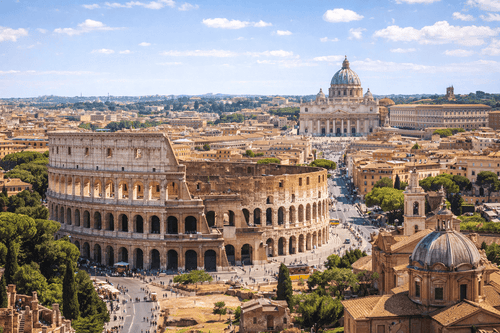
The Colosseum and Roman Forum together form the obvious anchor of any Rome sightseeing guide. Visiting the Colosseum means standing inside a structure that held up to 80,000 spectators during gladiatorial contests. The Roman Forum, directly adjacent, is where the political and commercial life of ancient Rome played out for centuries. The Palatine Hill, included in the same ticket, offers elevated views over both.
The Vatican Museums house the Sistine Chapel and require a separate ticket. St. Peter’s Basilica is free to enter, though the climb to the dome costs a small fee. The Pantheon, one of the best-preserved ancient buildings in the world, charges a modest entry fee. Toss a coin into the Trevi Fountain, but go early in the morning when the piazza is quiet and the light is good.
Beyond the monuments, Rome’s neighborhoods offer a different kind of experience. Trastevere, across the Tiber, has narrow medieval streets, ivy-covered walls, and a local energy that the tourist-heavy center lacks. Monti, just east of the Colosseum, is full of independent shops, wine bars, and trattorias that attract Romans as much as visitors.
Top things to do in Rome: Book a variety of options and timing with tours customized for sailing holidays to optimize your sightseeing experience.
- Tour the Colosseum and Roman Forum (book in advance)
- Visit the Vatican Museums and Sistine Chapel (book weeks ahead)
- See the Pantheon and Piazza della Rotonda
- Throw a coin at the Trevi Fountain before 8:00 AM
- Walk through Trastevere in the evening
- Browse Campo de’ Fiori market on weekend mornings
- Explore the Borghese Gallery (strictly timed entry, advance booking required)
- Stroll Piazza Navona at dusk
- Climb the Gianicolo Hill for panoramic city views
- Visit Castel Sant’Angelo and walk the Lungotevere riverside path
Pro Tip: Arriving at the Colosseum before 8:00 AM or visiting after 10:00 PM on summer evenings transforms the experience. The crowds thin out, the light changes, and the scale of the place finally registers.
2. Where and what to eat when dining in Rome
Roman cuisine is specific, seasonal, and deeply tied to neighborhood traditions. Cacio e pepe, carbonara, amatriciana, and coda alla vaccinara (oxtail stew) are the dishes that define the city’s food identity. These are not tourist inventions. They come from the working-class neighborhoods of Testaccio and Trastevere, and the best versions are still served there.
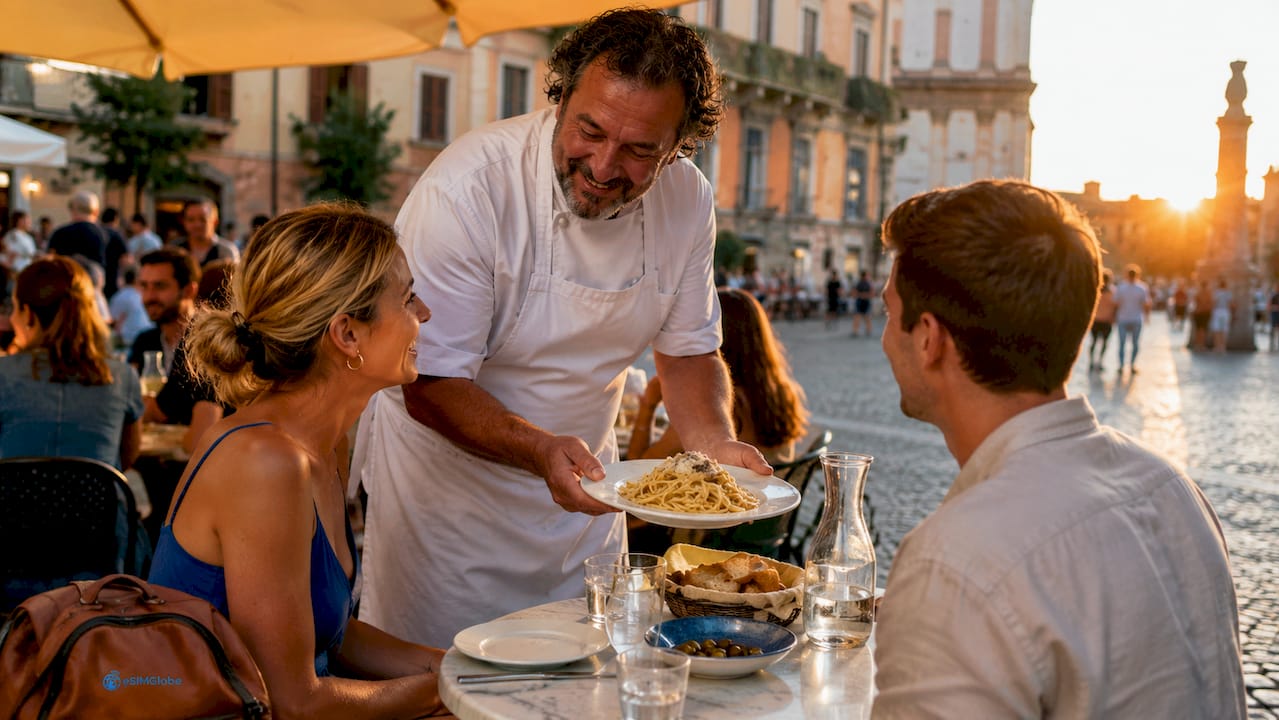
Avoid restaurants that post laminated photo menus near the Colosseum, Trevi Fountain, or St. Peter’s Square. These spots charge inflated prices for mediocre food. Walk two or three blocks away from any major monument and the quality improves noticeably. A good trattoria will have a handwritten or short printed menu that changes with the season.
Water in Rome is safe to drink from the street fountains called nasoni. In restaurants, still or sparkling water is charged separately and is not free. Tipping is not obligatory in Italy, but rounding up or leaving €1–2 per person is appreciated at sit-down meals. A coperto (cover charge) of €1–3 per person is standard and appears on the bill automatically.
For gelato, look for shops where the product is stored in covered metal containers rather than piled high in colorful mounds. The piled-up style uses artificial thickeners. Authentic gelato sits flat in the case.
How to find good restaurants in Rome:
- Search neighborhoods like Testaccio, Pigneto, and Prati rather than tourist corridors.
- Look for menus written in Italian first, with a smaller English translation below.
- Check that the restaurant has no photos on the menu and no host standing outside to wave you in.
- Visit wine bars (enoteche) for affordable plates and excellent local pours.
- Try a Roman coffee bar for breakfast: a cornetto and a cappuccino standing at the counter costs a fraction of a sit-down café.
3. Which neighborhoods should you stay in when visiting Rome?
Where you stay shapes the entire trip. Rome’s historic center is walkable, but it is large, and the wrong base can mean long walks or expensive taxis to reach the sights you care about most.
Centro Storico covers the area around the Pantheon, Piazza Navona, and Campo de’ Fiori. Staying here puts you within walking distance of most major monuments, but hotels tend to be pricier and streets can be noisy at night.
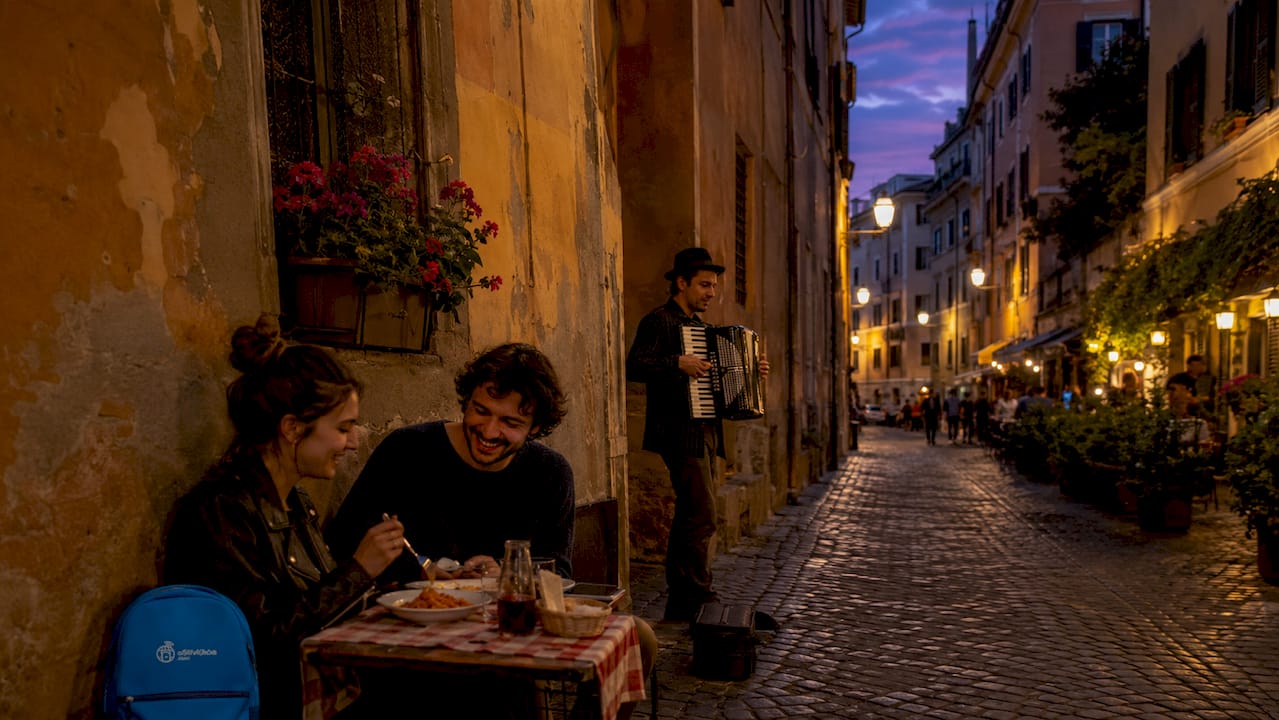
Trastevere suits travelers who want atmosphere over convenience. The neighborhood is charming, lively at night, and slightly removed from the main tourist circuit. It connects to the rest of the city by tram and bus.
Monti sits between the Colosseum and the Termini train station. It is one of Rome’s most livable neighborhoods, with good restaurants, independent shops, and easy metro access. A solid choice for first-time visitors who want a mix of character and practicality.
Prati, just north of the Vatican, is quieter, more residential, and well-served by public transit. It works well for travelers whose priority is the Vatican Museums and St. Peter’s.
Testaccio is Rome’s old slaughterhouse district, now one of its best food neighborhoods. It is less central but affordable, authentic, and connected by metro.
Practical tips for booking accommodation:
- Book at least two to three months ahead for spring and fall travel.
- Apartments through platforms like Airbnb offer kitchen access, which cuts food costs significantly.
- Check that your hotel or apartment is within walking distance of a metro stop if you plan to use public transit.
- Read recent reviews specifically mentioning noise levels. Roman streets can be loud until late.
4. When is the best time to visit Rome?
Spring (April and May) and fall (September and October) are the best times to visit Rome. Temperatures sit in the 60s–70s°F range, crowds are manageable, and the city’s outdoor life is at its best. These shoulder seasons offer the clearest trade-off: better weather and fewer tourists than summer, without the cold and reduced hours of winter.
Summer in Rome is genuinely difficult. July and august push temperatures into the high 90s°F (mid-30s°C). The heat causes real fatigue, especially when you are walking 8–10 km a day across cobblestones. Hotels and tourist sites are at peak capacity, and prices reflect that. If summer is your only option, plan outdoor sightseeing for early morning and late evening, and use midday for museums with air conditioning.
Winter (december through february) is Rome’s quietest season. Crowds are thin, prices drop, and the city takes on a different character. The trade-off is shorter daylight hours and some reduced museum schedules. January is the coldest month, with temperatures occasionally dropping into the 40s°F, but snow is rare.
Months ranked by overall comfort for visitors:
- April and May: Best weather, manageable crowds, long daylight hours.
- September and October: Warm but not brutal, excellent food season, fewer tourists than summer.
- November: Quiet, mild, and underrated. Some rain.
- March: Variable weather, low crowds, good hotel rates.
- June: Still pleasant before the peak heat arrives.
- July and August: Peak heat and peak crowds. Avoid if possible.
- December: Festive atmosphere, thin crowds, cold evenings.
- January and February: Cheapest rates, fewest tourists, coldest temperatures.
5. Practical travel tips and cultural etiquette for Rome
Walking is the primary way to explore Rome’s historic center. Most major attractions lie within a 25-minute walk of each other, but the cobblestone streets called sanpietrini are uneven and hard on feet. Plan for extensive daily walking and wear shoes with real support. Sandals and flat-soled sneakers cause problems by the second day.
Public buses in Rome often run slower than walking because of traffic and narrow streets. The metro is faster but covers limited ground in the tourist zones. Line A connects Termini station to the Vatican and the Spanish Steps. Line B connects Termini to the Colosseum. For everything in between, buses or walking are the practical options. Moovit handles real-time routing and accounts for frequent route changes.
Dress codes at religious sites are strictly enforced. St. Peter’s Basilica and major basilicas require covered shoulders and knees. Guards turn away visitors who do not comply, and there are no exceptions for heat or convenience. Carry a light scarf or a change of clothes if you plan to visit multiple churches in a day.
Pickpockets operate in coordinated groups, particularly in crowded Metro stations and near major tourist sites. They use distraction techniques: fake jostling, dropped items, or someone holding a map in your face. Carry your bag across the front of your body, not on your back or shoulder. Keep your phone in a front pocket.
Key travel do’s and don’ts for Rome:
- Do validate your bus or metro ticket before boarding. Inspectors issue fines on the spot.
- Do carry some cash. Many smaller trattorias and bars are cash-only.
- Don’t eat or drink on the steps of monuments. Fines apply at the Trevi Fountain and Spanish Steps.
- Don’t expect free tap water in restaurants. Order acqua naturale or acqua frizzante.
- Do greet shopkeepers with “Buongiorno” when you enter. It is basic courtesy and makes a difference.
- Don’t book tours or tickets from street vendors near major sights.
Pro Tip: Buy your Colosseum and Vatican tickets the moment your travel dates are confirmed. Both sell out weeks in advance during spring and fall, and last-minute availability is rare.
6. How eSIM technology keeps you connected across Rome
Staying connected in Rome is not optional. You need maps to navigate cobblestone streets, digital tickets for the Vatican and Borghese Gallery, and a reliable way to call for help if something goes wrong. An eSIM solves all of this without the hassle of finding a local SIM card shop after a long flight.
An eSIM is a digital SIM profile built into your phone. You activate it remotely before you leave home, and it connects to local Italian networks the moment you land. No physical card to swap, no roaming charges from your home carrier, and no hunting for a phone store near Termini station. Esimglobe offers Italy eSIM plans with multi-region support, payment options in USD, EUR, and GBP, and a straightforward website that lets you select and activate a plan in minutes.
For travelers visiting Rome, the practical benefits are immediate. Google Maps works from the airport. Your digital Colosseum ticket loads without hunting for Wi-Fi. You can call your hotel if your taxi driver is confused about the address. In an emergency, you have a working connection.
Key benefits of using an Italy eSIM plan for your Rome trip:
- No physical SIM swap required. Activate before departure.
- Avoid roaming fees from your home carrier.
- Access local Italian network speeds for maps, tickets, and communication.
- Pay in your preferred currency: USD, EUR, or GBP.
- Works on all modern unlocked smartphones.
- Recharge or switch plans remotely without visiting a store.
7. Safety advice for tourists in Rome
Rome is a safe city for tourists by most measures, but petty theft is the primary risk and it is concentrated in predictable locations. The Metro, particularly around Termini station and the Colosseum stop, is where pickpocket groups are most active. Crowded tourist sites like the Trevi Fountain and the Vatican entrance queues are also common targets.
The most effective defense is positional. Carry your bag across the front of your body. Keep your phone in a front trouser pocket rather than a back pocket or jacket pocket. Avoid wearing expensive jewelry or leaving camera equipment unsecured. If someone bumps into you or creates a distraction, check your pockets immediately.
Scams targeting tourists in Rome tend to follow recognizable patterns. Someone offers you a “free” bracelet or rose, then demands payment. A person in costume near a monument asks for a photo fee after the picture is taken. Street vendors near major sights sell counterfeit tickets. The rule is simple: if someone approaches you unsolicited near a tourist site, decline and keep walking.
Emergency numbers in Italy: 112 is the general emergency number (police, ambulance, fire). 113 reaches the state police directly. Both lines have English-speaking operators available.
8. Budget planning and typical costs for visiting Rome
Rome is not a cheap city, but it is manageable with realistic expectations. The biggest variables are accommodation and how often you eat near tourist sites.
A mid-range daily budget for one traveler covers a hotel or apartment, two meals at sit-down restaurants, one or two attraction tickets, and public transit. Budget travelers who use apartments, eat at local bars for breakfast, and pick up lunch at a market or alimentari can cut that figure significantly. Luxury hotels near the Pantheon or Spanish Steps push costs considerably higher.
Typical costs to plan around:
- Colosseum + Roman Forum + Palatine Hill ticket: €18 per adult (standard entry)
- Vatican Museums + Sistine Chapel: €17–€20 per adult for standard timed entry
- Pantheon entry fee: €5 per adult
- Cappuccino at a bar counter: €1.20–€1.50
- Sit-down trattoria meal (two courses, house wine): €25–€40 per person
- Metro or bus single ticket: €1.50
- 48-hour transit pass: €7
- Mid-range hotel per night: €120–€200 in shoulder season
Booking flights and accommodation three to four months ahead consistently produces better rates than last-minute planning. Traveling in november, january, or february cuts hotel costs noticeably compared to peak spring and summer rates.
9. Useful Italian phrases every traveler should know before visiting Rome
English is spoken at most hotels, major tourist sites, and restaurants in the center of Rome. Outside those zones, and in smaller neighborhood spots, a few Italian phrases go a long way. Romans appreciate the effort, even when your pronunciation is imperfect.
Start with greetings. “Buongiorno” (good morning/good day) and “Buonasera” (good evening) are the standard greetings when entering a shop, restaurant, or hotel. “Grazie” (thank you) and “Prego” (you’re welcome) cover most polite exchanges. “Scusi” works for both “excuse me” and “sorry.”
For practical situations, these phrases cover most daily needs:
| Italian | Pronunciation | Meaning |
|---|---|---|
| Buongiorno | bwon-JOR-no | Good morning / Good day |
| Buonasera | bwona-SAY-ra | Good evening |
| Grazie | GRAT-see-yeh | Thank you |
| Prego | PRAY-go | You’re welcome |
| Scusi | SKOO-zee | Excuse me / Sorry |
| Dov’è…? | doh-VEH | Where is…? |
| Il conto, per favore | eel KON-toh pehr fah-VOH-reh | The check, please |
| Parla inglese? | PAR-la een-GLAY-zeh | Do you speak English? |
| Un caffè, per favore | oon kaf-FEH pehr fah-VOH-reh | A coffee, please |
| Quanto costa? | KWAN-toh KOS-tah | How much does it cost? |
One phrase worth memorizing beyond the basics: “Vorrei prenotare un tavolo” (I’d like to reserve a table). Many good Roman trattorias fill up by 8:00 PM, and a quick call or walk-in reservation in the afternoon secures your spot.
Key Takeaways
Spring and fall are the best times to visit Rome, advance ticket booking is non-negotiable for the Vatican and Colosseum, and staying connected with an eSIM removes the single most common logistical frustration travelers face.
| Point | Details |
|---|---|
| Best travel window | April, May, September, and October offer the best balance of weather and manageable crowds. |
| Book tickets early | Vatican Museums and Borghese Gallery sell out weeks ahead; book the moment your dates are set. |
| Walk with the right shoes | Most major sights are within a 25-minute walk, but cobblestones demand supportive footwear for 8–10 km daily. |
| Stay connected with eSIM | Esimglobe Italy eSIM plans activate before departure and eliminate roaming fees from the first moment you land. |
| Avoid tourist-trap dining | Walk two or three blocks from any major monument to find better food at lower prices. |
FAQ
How many days in Rome is enough?
Three days covers the main sights at a reasonable pace. Five days lets you explore neighborhoods, take a day trip, and revisit favorites without rushing.
What is the best month to visit Rome?
April and may are the top choices for weather, daylight, and crowd levels. September and october are a close second, with warm temperatures and fewer tourists than summer.
What do I wish I had known before going to Rome?
Book Vatican Museums and Colosseum tickets weeks in advance, not days. Wear supportive shoes from day one, and carry cash because many local spots do not accept cards.
Is Rome safe for tourists?
Rome is generally safe. The main risk is pickpocketing, concentrated in Metro stations and crowded tourist sites. Carry your bag across the front of your body and keep your phone in a front pocket.
How do I stay connected in Rome without paying roaming fees?
Activate an Italy eSIM plan through Esimglobe before you leave home. It connects to local Italian networks on arrival, giving you data for maps, tickets, and communication without roaming charges.