






















TL;DR:
- Using an eSIM in Italy offers travelers significant cost savings—up to 90% compared to traditional roaming plans—by providing easy, instant activation and multi-network coverage in diverse regions. It allows multiple profiles on one device, ensures reliable connectivity in rural and urban areas, and simplifies travel without physical SIM swapping. Choosing the right provider depends on your data needs, itinerary, and network preferences, with flexible setup and troubleshooting tips to maximize your Italian travel experience.
Roaming charges in Italy can turn a manageable travel budget into a financial headache overnight. Travelers who rely on their home carrier’s international plans routinely pay $10 or more per gigabyte, while eSIMs run as low as $1 to $2 per gigabyte, making them roughly 90% cheaper than standard roaming. This guide covers every decision you need to make: which providers stand out, how to compare real pricing, which networks reach rural Tuscany or the Amalfi Coast, and how to get your eSIM running before your flight lands.
Table of Contents
- Why choose an eSIM in Italy?
- Top eSIM providers for Italy: features and pricing compared
- How to choose the right Italian eSIM for your needs
- eSIM setup in Italy: installation, activation, and troubleshooting
- The real secret to maximizing eSIM value in Italy
- Ready to travel Italy connected and worry-free?
- Frequently asked questions
Key Takeaways
| Point | Details |
|---|---|
| Major roaming savings | eSIMs can slash your Italy data costs by up to 90% compared to international roaming fees. |
| Top providers reviewed | Airalo, Holafly, Ubigi, Jetpac, and Saily consistently rank as the best eSIMs for Italy travel. |
| Choose by travel style | The best eSIM for you depends on how much data you need and where you’ll be traveling in Italy. |
| Easy setup and reliability | Most Italian eSIMs install in minutes and let you quickly switch networks if needed. |
Why choose an eSIM in Italy?
To understand your options and why eSIMs are an ideal solution, let’s look at their core benefits.
Italy is one of Europe’s most visited countries, drawing tens of millions of international arrivals every year. Most of those travelers land with their home SIM still active, unaware that a single day of heavy data use could generate a bill measured in hundreds of dollars. An eSIM sidesteps that entirely.
An eSIM is a digital SIM card embedded directly into your phone’s hardware. Instead of inserting a physical card, you download a carrier profile, scan a QR code, and activate data within minutes. There is nothing to lose, nothing to swap, and no need to visit a store in a foreign country while lugging your bags through the airport.
The cost difference alone justifies the switch. eSIM data is up to 90% cheaper than roaming, with typical Italy plans running $1 to $2 per gigabyte for a 10GB or 30-day package, compared to $10 or more per gigabyte through most home carriers. That gap is not marginal. On a 10-day trip with moderate data use, an eSIM can save you $80 to $120 in data costs alone.
Beyond cost, the practical advantages stack up quickly. You can save money with eSIMs and keep your home number active at the same time, since dual-SIM devices allow both profiles to coexist. Incoming calls and texts on your regular number still come through, while your data runs over the Italian eSIM. No one back home needs a new number to reach you.
Here is a summary of the key advantages:
- Cost savings. Data rates are dramatically lower than standard roaming.
- Instant activation. Purchase, download, and activate before or during your flight.
- No physical SIM swapping. No risk of losing your home SIM or damaging the tray.
- Multiple profiles. Store several eSIM profiles on one device and switch as needed.
- Flexibility for longer trips. Easily top up or switch plans without visiting a store.
Travelers who use an eSIM vs local SIM consistently report better overall value when their trips span multiple cities or include rural areas, because digital plans are easier to manage remotely.
Digital nomads working from Italian co-working spaces, families splitting connectivity across multiple devices, and frequent business travelers all benefit from the flexibility. You are not locked into a single physical card tied to one account.
Top eSIM providers for Italy: features and pricing compared
Now that you know why eSIMs make sense, let’s break down the top choices for Italy side by side.
Not every eSIM provider is equal in Italy. Some prioritize price, others focus on unlimited data, and a few stand out for their multi-network coverage across the country’s varied terrain. Top-rated providers for Italian travel include Airalo, Holafly, Ubigi, Jetpac, and Saily, each consistently ranked across multiple review sources for coverage, pricing, and reliability.
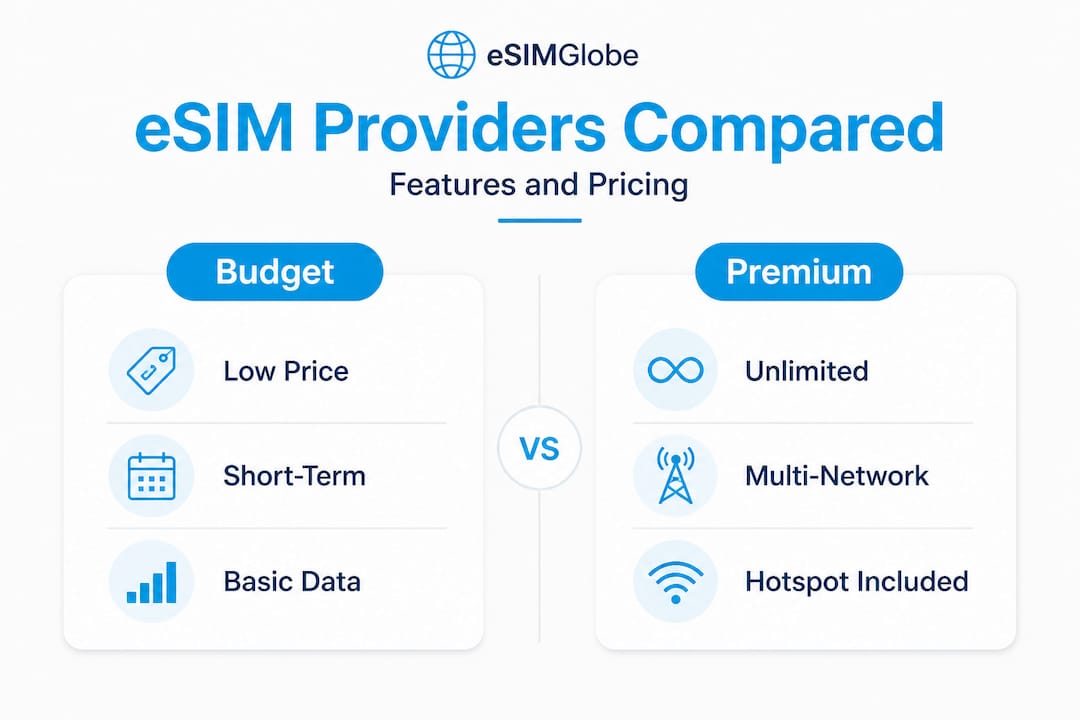
Understanding their differences helps you avoid overpaying for features you do not need, or underpaying for a plan that leaves you without signal on a ferry to Sicily.
Provider comparison table
| Provider | Sample plan | Price | Network(s) | Hotspot |
|---|---|---|---|---|
| Airalo | 1GB / 7 days | $4 | WindTre, Vodafone, Iliad | Yes |
| Airalo | 20GB / 30 days | $33 | WindTre, Vodafone, Iliad | Yes |
| Holafly | Unlimited / 7 days | ~$29 | Vodafone, WindTre | 1GB/day |
| Ubigi | 25GB / 30 days | $19 | Iliad, TIM | Yes |
| Ubigi | Unlimited / 7 days | $19 | Iliad, TIM | Yes |
| Jetpac | Unlimited (competitive) | Varies | Multiple | Unlimited |
| Saily | Multiple tiers | Varies | Multiple | Yes |
These plan examples reflect real market pricing and show the range from budget short-trip options to value-heavy month-long packages. Airalo’s 1GB plan at $4 suits a weekend visitor who mostly uses hotel Wi-Fi. Ubigi’s 25GB package at $19 is one of the strongest value-per-gigabyte deals available for longer stays.
The network column matters more than most travelers realize. Italy’s major carriers each have different strength zones. Vodafone and WindTre tend to perform better in northern industrial cities like Milan and Turin. TIM historically leads in rural and southern coverage, including areas of Calabria, Sicily, and Sardinia. Iliad has grown significantly and offers solid urban performance at competitive rates.
Explore the best international eSIM types if you are planning a multi-country European trip, since some providers offer regional plans that cover Italy alongside neighboring countries for a single flat fee. That flexibility can reduce cost and complexity if your itinerary includes stops in France, Spain, or Croatia.
Holafly’s unlimited plan sounds appealing but carries a 1GB-per-day hotspot limit. If you plan to tether a laptop while working from a train or rural villa, that restriction matters. Jetpac counters with truly unlimited hotspot capability, making it a better fit for remote workers who rely on their phone as a Wi-Fi router.

Saily rounds out the top tier with competitive pricing and a clean app interface, which is particularly useful for travelers who prefer managing everything in one dashboard rather than navigating multiple provider portals.
One useful data point: plans that connect to multiple Italian networks tend to deliver more consistent performance because your device can automatically register on whichever carrier has the strongest local signal. Single-network eSIMs can be perfectly adequate in major cities but may leave gaps in mountainous or coastal regions. Browse Italy eSIM options to compare current plan availability and pricing before committing.
How to choose the right Italian eSIM for your needs
Comparing plans is a start, but to truly get what you need, here’s how to choose with confidence.
There is no universally best eSIM for Italy. The right choice depends on your needs: light or unlimited data users lean toward Holafly, high-volume or value-driven travelers get more from Jetpac, Ubigi, or Airalo, and anyone heading into rural territory should prioritize TIM-based plans or multi-network providers. Here is a structured way to work through the decision.
-
Calculate your daily data use. A typical traveler uses 1 to 3GB per day for maps, messaging, social media, and occasional streaming. A business traveler on video calls might use 5 to 10GB daily. Multiply by your trip length and add a 20% buffer.
-
Check device compatibility. Not every phone supports eSIM. Most flagship iPhones from the iPhone XS onward support eSIM, as do many recent Android devices from Samsung, Google, and Motorola. Verify your specific model before purchasing. Resources like the eSIM-compatible devices guide list current supported models.
-
Map your itinerary against network coverage. If you are spending time in Rome, Florence, and Venice, almost any provider will work. If you are renting a farmhouse in Umbria, taking overnight ferries, or hiking in the Dolomites, network reach becomes critical. TIM historically leads in rural signal strength.
-
Decide on hotspot needs. If you plan to share your phone’s data connection with a tablet or laptop, confirm that your chosen plan explicitly supports tethering and check for any daily hotspot limits.
-
Look at activation timing. Some plans activate immediately upon QR scan. Others start counting down from purchase date. If you buy a 7-day plan but activate it two days before departure, you lose two days of coverage.
-
Consider the provider’s support quality. A good support system matters when you land in Milan at midnight with a connection problem. Jetpac’s 4.8 Trustpilot rating and Airalo’s large customer base both translate into responsive help channels.
Pro Tip: If you are visiting Italy for more than 10 days and expect to travel between regions, choose a multi-network provider. The marginal cost difference compared to a single-network plan is usually under $5, but the coverage improvement can be significant in areas between major cities.
Good eSIM travel tips also recommend purchasing your eSIM at least 24 hours before departure so you have time to troubleshoot any activation issues from home, where your primary connection is stable. Review eSIM facts for travelers for a broader look at what to expect across different destinations and device types.
eSIM setup in Italy: installation, activation, and troubleshooting
After picking your plan, you just need to get it working on your device. Here’s how to do it smoothly.
The technical steps for installing an eSIM are simpler than most travelers expect. The process takes between two and ten minutes depending on your device and network conditions. Follow these steps:
-
Purchase your plan from your chosen provider’s website or app. You will receive a QR code via email or within the app interface.
-
Go to your phone’s eSIM settings. On iPhone: Settings > Cellular > Add eSIM. On Android: Settings > Network & Internet > SIMs > Add SIM. The path varies slightly by manufacturer.
-
Scan the QR code using your device’s camera within the eSIM setup flow. The profile will download automatically. This step requires a Wi-Fi connection, so complete it before you leave home or connect to airport Wi-Fi on arrival.
-
Label the new plan something clear like “Italy eSIM” so you can easily switch between your home SIM and the Italian data plan.
-
Set data roaming to use your eSIM as the default for mobile data. Keep your home SIM active for calls and texts only, with data roaming turned off on that line.
-
Test your connection immediately. Open a browser, run a speed test, and confirm data is routing through the Italian network. Test speeds on arrival and manually switch networks if needed to ensure you are connected to the strongest available carrier.
Pro Tip: Download offline maps in Google Maps or Maps.me before landing. Even with a working eSIM, having offline maps means you do not burn data on map loading during every navigation request.
Common issues travelers encounter, and how to resolve them:
- No data connection after activation. Go to Settings > Cellular > select your eSIM > make sure “Enable This Line” and “Data Roaming” are both toggled on.
- Slow speeds in your current location. If your plan supports multiple networks, go to carrier settings and manually select a different network. Sometimes automatic selection picks a weaker signal.
- QR code scan fails. Ensure you are on Wi-Fi during the scan. Try increasing screen brightness on the device displaying the code. If the scan consistently fails, most providers offer a manual code entry option.
- Plan shows active but no internet. Check whether the APN (access point name) needs to be entered manually. Your provider’s confirmation email usually includes the correct APN string if this is required.
Review eSIM travel practices for a broader set of setup recommendations that apply across multiple countries and carrier types. These practices are particularly useful for frequent travelers managing multiple eSIM profiles across different destinations.
The real secret to maximizing eSIM value in Italy
Beyond following instructions, a few expert strategies can make your Italian eSIM experience truly seamless.
Most travelers focus almost entirely on price when choosing an eSIM. That is understandable. The savings over roaming are dramatic enough that any eSIM looks like a win. But the travelers who get the most out of their Italian connectivity are the ones who think past the sticker price and consider the full picture.
Here is the honest assessment: no single eSIM is best for everyone. The correct plan depends on your usage pattern, your itinerary, and how you define “connected.” A traveler who spends 10 days in Rome, hotel-hopping with fast Wi-Fi, has very different needs from a photographer doing a two-week road trip through Basilicata and Puglia with minimal Wi-Fi access.
The underestimated variable is network flexibility. Italy’s geography is highly varied. The country runs nearly 1,200 kilometers from the Alps in the north to the tip of the heel in the south, and that range includes dense urban centers, mountainous interior regions, long stretches of agricultural land, and extensive coastline. No single Italian carrier blankets all of that equally. Multi-network eSIM providers solve this by allowing your device to register on whichever carrier has the strongest signal in a given area, rather than forcing you to stick with a single network regardless of local conditions.
Trains are a specific blind spot for many travelers. Italy’s rail network is extensive and heavily used by tourists, but rail corridors often pass through areas where signal transitions between towers rapidly. A multi-network eSIM handles those transitions more gracefully than a single-network plan. The same applies to ferry routes connecting the mainland to Sardinia or Sicily, where handoff between coastal towers is inconsistent.
The two-minute speed test recommendation is genuinely underused. Many travelers activate their eSIM, see the data icon appear in the status bar, and assume everything is fine. But “connected” and “fast enough to be useful” are not the same thing. A quick speed test on arrival, in the first location you visit, tells you immediately whether you are getting full LTE performance or hovering at an edge-of-coverage crawl. If the speed is poor, manually browsing to a different network within your carrier settings often yields an immediate improvement. This is especially true in airports and train stations where network congestion can artificially suppress speeds.
The backup mindset also pays off. If you are on a 7-day unlimited plan and it runs into an issue on day three, you want to know ahead of time whether your provider’s support team operates in your time zone. Check this before you buy. Providers with larger customer bases and higher Trustpilot ratings generally have faster resolution times.
Consult the eSIM worldwide guide for perspective on how Italy fits into a broader international travel strategy, particularly if you are combining your Italian visit with stops across Europe or beyond.
Ready to travel Italy connected and worry-free?
With all this knowledge, all that’s left is to pick your eSIM and travel with peace of mind.
EsimGlobe offers Italy eSIM plans with instant digital delivery and straightforward activation. No physical card. No store visit. Purchase before departure, scan the QR code, and your data plan is ready when you land.
Get your Italy eSIM directly from EsimGlobe and choose from multiple data tiers suited to short stays, longer trips, or high-volume needs. For travelers visiting multiple countries on a single journey, you can also browse all eSIM plans covering regions across Europe, Asia, the Americas, and beyond. EsimGlobe supports multiple currencies and languages, making the purchase process accessible whether you are booking from the United States, Germany, or Japan. Connectivity for Italy is one selection away.
Frequently asked questions
Which eSIM provider works best for rural areas in Italy?
TIM-based eSIMs generally provide the strongest coverage in rural Italian regions, including southern Italy, Sicily, and Sardinia. Multi-network providers that include TIM in their supported carrier list are also a reliable choice for itineraries that move between urban and rural areas.
Are eSIM data plans really cheaper than roaming in Italy?
Yes, eSIM data is roughly 90% cheaper than standard international roaming in Italy. Roaming typically costs $10 or more per gigabyte, while most eSIM plans for Italy run $1 to $2 per gigabyte on comparable data volumes.
How do I install and activate an eSIM for Italy?
Most Italy eSIM providers deliver a QR code after purchase, which you scan through your phone’s cellular settings to download the carrier profile. Activation takes just a few minutes and can be completed before your flight or on airport Wi-Fi upon arrival.
Is it possible to switch between eSIM networks while traveling?
Yes, if your eSIM plan supports multiple Italian networks, you can manually select a different carrier through your device’s network settings. This is useful when automatic network selection picks a congested or weaker signal, particularly in rural areas or during transit.