






















TL;DR:
- Roaming fees from your home carrier can silently drain your travel budget before you even enjoy your first coffee in Italy.
- eSIM technology offers a convenient, cost-effective alternative by enabling quick online plan purchases and easy activation without physical SIM cards.
- Choosing the right eSIM depends on trip duration, data needs, device compatibility, and coverage, with providers like Nomad Italy often serving as top recommendations.
Roaming fees from your home carrier can quietly drain your travel budget before you even finish your first espresso in Rome. Many travelers still default to either paying steep international rates or hunting for a physical SIM card at a crowded airport kiosk upon arrival. Neither option is particularly convenient, and neither is as cost-effective as what eSIM technology now offers. This article covers everything you need to know to pick the right eSIM for Italy, from understanding how these digital SIMs work to comparing providers, avoiding common traps, and activating your plan with confidence before your flight even lands.
Table of Contents
- Why eSIMs are the best option for Italy travel
- How to choose the best eSIM for your Italy trip
- Common misconceptions and pitfalls with Italy eSIMs
- Getting started: Steps to activate and use your Italy eSIM
- The overlooked truth about Italy eSIMs: Why popular isn’t always perfect
- Find your Italy eSIM solution with Esimglobe
- Frequently asked questions
Key Takeaways
| Point | Details |
|---|---|
| eSIM advantages | eSIMs offer hassle-free setup, cost savings, and flexible plans for Italy travel. |
| Provider selection | Nomad and Airalo top the list, but trip shape determines the best provider for you. |
| Unlimited limitations | Unlimited eSIMs often have hidden speed caps, so always check fair-use policies. |
| Activation simplicity | eSIM activation takes just minutes and is accessible even for first-time users. |
| Personalized choices | The right eSIM depends on your trip style, device, and data needs—not marketing hype. |
Why eSIMs are the best option for Italy travel
Traditional roaming plans and local physical SIM cards dominated travel connectivity for decades. Both options carry real drawbacks. Roaming charges from major US carriers can run anywhere from $10 to $15 per day for international data packages, and those costs stack up fast on a two-week Italian itinerary. Buying a local SIM on arrival means finding the right store, waiting in line, dealing with language barriers, and sometimes providing identification documents just to activate a prepaid card.
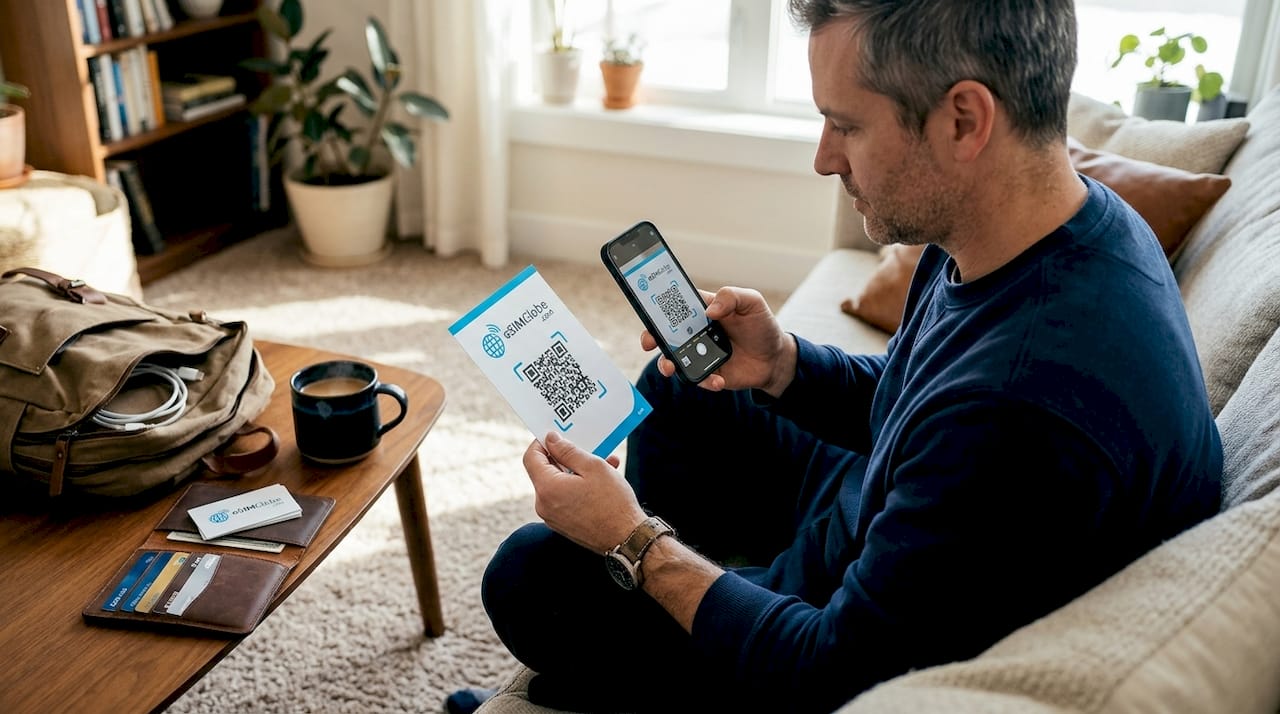
An eSIM, or embedded SIM, is a digital SIM profile stored directly inside your phone. There is no physical card to insert, no tray to open, and no tiny piece of plastic to lose somewhere between your hotel room and the Colosseum. You purchase a plan online, receive a QR code, scan it with your device’s camera, and the eSIM installs in minutes. Understanding the eSIM facts for travelers helps clarify why this technology is quickly becoming the default choice for internationally mobile people.
The core advantages of using an eSIM for Italy break down into a few clear categories:
- Cost control: You pay a flat rate for a data package rather than per-megabyte roaming fees.
- Convenience: Setup happens before departure, so you land in Milan or Naples already connected.
- Flexibility: Plans range from 1 GB short-break options to 20 GB or more for extended stays.
- Hotspot support: Many eSIM providers allow you to share your connection with a laptop or tablet.
- Multi-network access: Top providers connect your device to the strongest available Italian network automatically.
- No hardware required: Your existing phone handles everything digitally.
The eSIM vs local SIM comparison makes one thing clear: for most modern travelers, the eSIM wins on nearly every practical dimension. The only scenario where a physical SIM might still edge ahead is if your device does not support eSIM, which is increasingly rare among phones released after 2019.
Top pick for most Italy travelers: Nomad Italy is the easiest all-around option for setup, flexible data sizes, hotspot support, and multi-network access. It consistently ranks as the go-to recommendation across independent travel guides and tech review sites.
Italy’s mobile infrastructure is strong. The country’s major carriers operate extensive 4G LTE networks across urban centers, and 5G coverage is expanding steadily in cities like Rome, Milan, Florence, and Naples. Rural areas and smaller hilltop towns may see slower speeds, but connectivity is generally reliable along tourist corridors and major transport routes.
How to choose the best eSIM for your Italy trip
Not every Italy eSIM is the right fit for every traveler. The TechRadar Italy eSIM roundup structures its recommendations by category, which is a useful framework. Those categories include: overall best pick, best for network coverage, best for affordability, best for 5G, best for customer support, best for unlimited data, and best for user-friendliness. Each category points to a different provider because different travelers have different priorities.
Here is a comparison of the most frequently recommended providers across major review sources:
| Provider | Best for | Hotspot support | 5G available | Data options |
|---|---|---|---|---|
| Nomad | Overall, multi-city trips | Yes | Yes | 1 GB to 20 GB |
| Airalo | Short city breaks, budget | Yes | Limited | 1 GB to 10 GB |
| Holafly | Unlimited data plans | Yes | No | Unlimited (speed-capped) |
| Saily | User-friendliness | Yes | Yes | 1 GB to 20 GB |
| Jetpac | 5G coverage | Yes | Yes | 5 GB to 20 GB |
This table reflects general positioning across review sources and may shift as providers update their plans. Always verify current pricing and data policies directly on each provider’s website before purchasing.
Choosing the right eSIM for saving money with eSIM comes down to a clear decision process. Follow these steps before committing to a plan:
- Determine your trip duration. A 3-day city break in Rome needs far less data than a 14-day road trip through Tuscany, Sicily, and the Amalfi Coast.
- Estimate your data usage. Light users who mainly check maps and messages can survive on 3 to 5 GB. Heavy users streaming video, uploading content, or working remotely may need 15 GB or more.
- Check device compatibility. Confirm your phone supports eSIM before purchasing. Most iPhones from the XS onward and many Android flagships from 2020 onward are compatible.
- Decide on hotspot needs. If you plan to connect a laptop or share data with a travel companion, confirm the provider explicitly allows tethering.
- Review the coverage map. If your itinerary includes remote areas, check whether the provider connects to multiple Italian networks or only one.
- Compare prices for equivalent data. Price per gigabyte varies significantly across providers. A 10 GB Nomad plan may cost differently than a 10 GB Airalo plan, and the network quality may differ too.
Once you have answered those six questions, your shortlist of suitable Italy eSIM options will shrink quickly. Most travelers find that two or three providers fit their criteria, at which point price and user reviews become the deciding factors.
Pro Tip: Always read the fair-use policy before selecting an unlimited plan. “Unlimited” in the eSIM world frequently means high-speed data up to a threshold, after which speeds drop to 128 Kbps or 512 Kbps. At those throttled speeds, video streaming becomes impossible and even map loading slows considerably. The eSIM travel tips page covers this and other practical usage considerations in detail.
It is also worth noting that some providers offer Europe-wide eSIMs rather than Italy-specific ones. If your trip includes stops in France, Spain, or Croatia before or after Italy, a regional plan might offer better overall value than purchasing separate country-specific eSIMs for each destination.
Common misconceptions and pitfalls with Italy eSIMs
Selecting your provider is just part of the journey. Now let’s tackle the common mistakes travelers make with Italy eSIMs, because the wrong assumption can leave you with slow speeds, unexpected costs, or no connection at all in a critical moment.
The biggest misconception is that “unlimited” data means constant, unrestricted high-speed access. It does not. Unlimited eSIM plans frequently have fair-use speed caps or throttling after a quota, and several guides specifically warn travelers to check the speed policy rather than assume unlimited means constant high speeds. A plan marketed as unlimited may deliver full 4G speeds for the first 10 GB and then drop to barely functional speeds for the remainder of your trip.
Here is a breakdown of how unlimited policies typically work across provider types:
| Plan type | High-speed data | After quota speed | Best suited for |
|---|---|---|---|
| True unlimited (rare) | No cap | Full speed maintained | Heavy users, streamers |
| Soft-capped unlimited | 5 to 15 GB | 128 to 512 Kbps | Moderate users |
| Unlimited with daily cap | 500 MB to 2 GB/day | Throttled until midnight | Short-stay travelers |
| Fixed data (no unlimited claim) | As purchased | No data after quota | Predictable, light users |
Different providers suit different trip shapes: Nomad works well for a typical multi-city trip, Airalo fits shorter city breaks, and other brands better serve heavier usage or wider Europe travel. Matching your trip shape to the right provider category is more important than simply picking the highest-rated overall option.
Beyond the unlimited data misconception, here are the most common pitfalls travelers encounter with Italy eSIMs:
- Ignoring fair-use policies. Reading only the headline data amount without checking throttling thresholds leads to slow speeds mid-trip.
- Skipping device compatibility checks. Some older phones or carrier-locked devices cannot install eSIMs at all. Checking before purchase prevents wasted money.
- Assuming one provider covers all of Italy equally. Coverage in major cities differs from coverage in rural Puglia or the Dolomites. Multi-network providers adapt better to regional variation.
- Forgetting to install the eSIM before departure. Some providers require a Wi-Fi connection to install the eSIM profile. Trying to install it after landing on cellular data from another SIM can create complications.
- Buying too little data. Travelers consistently underestimate usage. Navigation apps, photo uploads, video calls, and streaming add up quickly. It is usually cheaper to buy more upfront than to top up mid-trip.
- Not considering Europe-wide plans. If Italy is one stop on a broader European trip, using eSIM for Europe with a regional plan often costs less than stacking multiple country-specific eSIMs.
Pro Tip: For travelers covering multiple European countries, Europe-wide eSIMs eliminate the need to manage separate plans for each destination. A single regional plan covering 30 or more countries simplifies budgeting and avoids the risk of running out of data in one country while carrying unused data from another.
One more overlooked pitfall: some travelers purchase an eSIM but forget to set it as the active data line in their phone settings. The eSIM installs correctly but the phone continues routing data through the home carrier SIM, resulting in roaming charges despite having a perfectly functional eSIM sitting dormant on the device. Always verify in your phone’s cellular settings that the eSIM is set as the preferred data line after installation.
Getting started: Steps to activate and use your Italy eSIM
Now that you’re aware of common pitfalls, let’s make sure you know exactly how to get connected with your Italy eSIM. The process is straightforward, and Nomad Italy is consistently recommended for easy setup, with most guides confirming that activation takes only a few minutes from start to finish.
Follow these steps for a smooth activation experience:
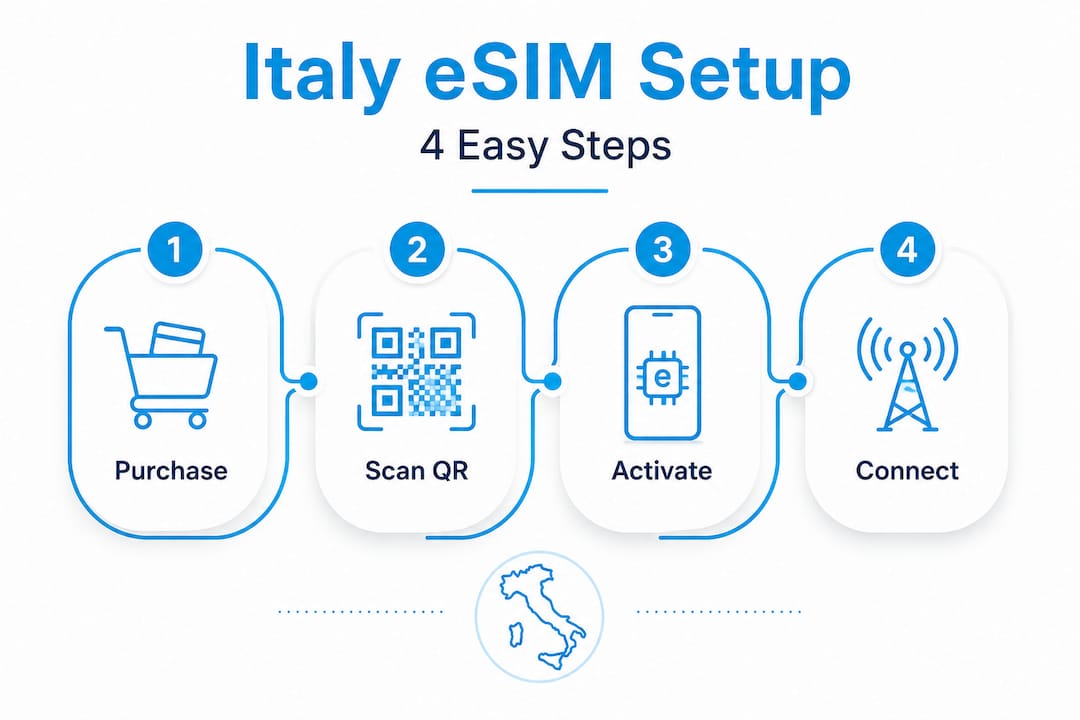
- Purchase your eSIM plan online. Select your provider, choose your data package, and complete the payment. You will receive a confirmation email containing a QR code.
- Check your device settings. Before scanning the QR code, go to your phone’s cellular or mobile data settings and confirm eSIM is supported and enabled.
- Scan the QR code. On iPhone, go to Settings, then Cellular, then Add eSIM, and scan the code. On Android, the path varies by manufacturer but is typically found under Network or SIM card settings.
- Label your eSIM. Most phones allow you to name each SIM line. Label it something clear like “Italy Data” so you can easily identify it in settings.
- Set data preferences. Navigate to your cellular settings and set the eSIM as your preferred data line. Keep your home SIM active for calls and texts if needed, but route all data through the eSIM.
- Disable data roaming on your home SIM. This is the critical step most first-timers miss. Even with an eSIM active, your home SIM can still incur roaming charges if data roaming is left enabled.
- Test your connection. Before boarding your flight, connect to Wi-Fi and complete the eSIM installation. Then briefly disable Wi-Fi to confirm the eSIM data connection is working.
- Download offline maps as a backup. Even with a reliable eSIM, having offline maps for Italian cities provides a safety net in areas with poor signal.
The global eSIM guide covers activation steps for a wide range of devices and destinations, which is useful if your Italy trip is part of a longer international journey.
If you encounter issues during activation, the most common fixes include: restarting your device after installing the eSIM profile, ensuring your phone’s software is updated to the latest version, and contacting the provider’s support team via their app or website chat. Most reputable providers offer 24/7 support for activation issues.
One practical note on timing: purchase and install your eSIM at least 24 hours before departure. This gives you time to troubleshoot any activation issues while you still have reliable Wi-Fi at home, rather than scrambling at the airport or on arrival in Italy.
The overlooked truth about Italy eSIMs: Why popular isn’t always perfect
With practical steps in hand, it’s time to step back and consider what most guides don’t tell you about eSIM choices. The travel tech review industry has a structural bias toward recommending the same handful of providers repeatedly. Nomad, Airalo, and Holafly appear in nearly every roundup because they have strong affiliate programs, large marketing budgets, and genuine quality. But “widely recommended” and “best for your specific trip” are not always the same thing.
Most Italy eSIM guides are written for a generic traveler: someone visiting Rome and Florence for about a week, using moderate data, and staying in hotels with Wi-Fi. That profile fits a large portion of visitors. But it does not describe the solo digital nomad working remotely from a rented apartment in Bologna for three months. It does not describe the family of four sharing a single data connection across multiple devices. It does not describe the adventure traveler spending half their time in rural Calabria or hiking in the Gran Paradiso national park where urban-optimized networks thin out.
The eSIM market trends show rapid growth in provider options, which is good news for travelers with non-standard needs. More providers entering the market means more specialized offerings, better pricing competition, and more granular plan options. The challenge is that review sites have not always kept pace with this expansion. A roundup published six months ago may not reflect new providers or updated plan structures that better suit your use case.
The practical takeaway is this: use the popular recommendations as a starting point, not a final answer. Read the fine print on the plans that appear to match your needs. Check recent user reviews on forums and travel communities where real travelers share unsponsored experiences. Ask specifically about coverage in the regions you plan to visit, not just in Rome or Milan.
There is also a case to be made for simplicity over optimization. Some travelers spend more time researching eSIM providers than the difference in cost actually justifies. If the price difference between your top two options is $5 for a 7-day trip, the research time is worth more than the savings. Pick a well-reviewed provider that meets your basic requirements and spend that energy on your actual itinerary.
The best eSIM for Italy is not the one with the most five-star reviews. It is the one that matches your trip duration, data needs, device, and budget without any nasty surprises buried in the terms of service.
Find your Italy eSIM solution with Esimglobe
Having considered expert advice and common pitfalls, here’s a simple path to reliable connectivity in Italy.
Esimglobe offers a straightforward way to browse, compare, and purchase Italy eSIM deals without navigating multiple provider websites. The platform supports multiple currencies including USD, EUR, and GBP, and provides interface options in several languages, making it accessible regardless of where you are traveling from.
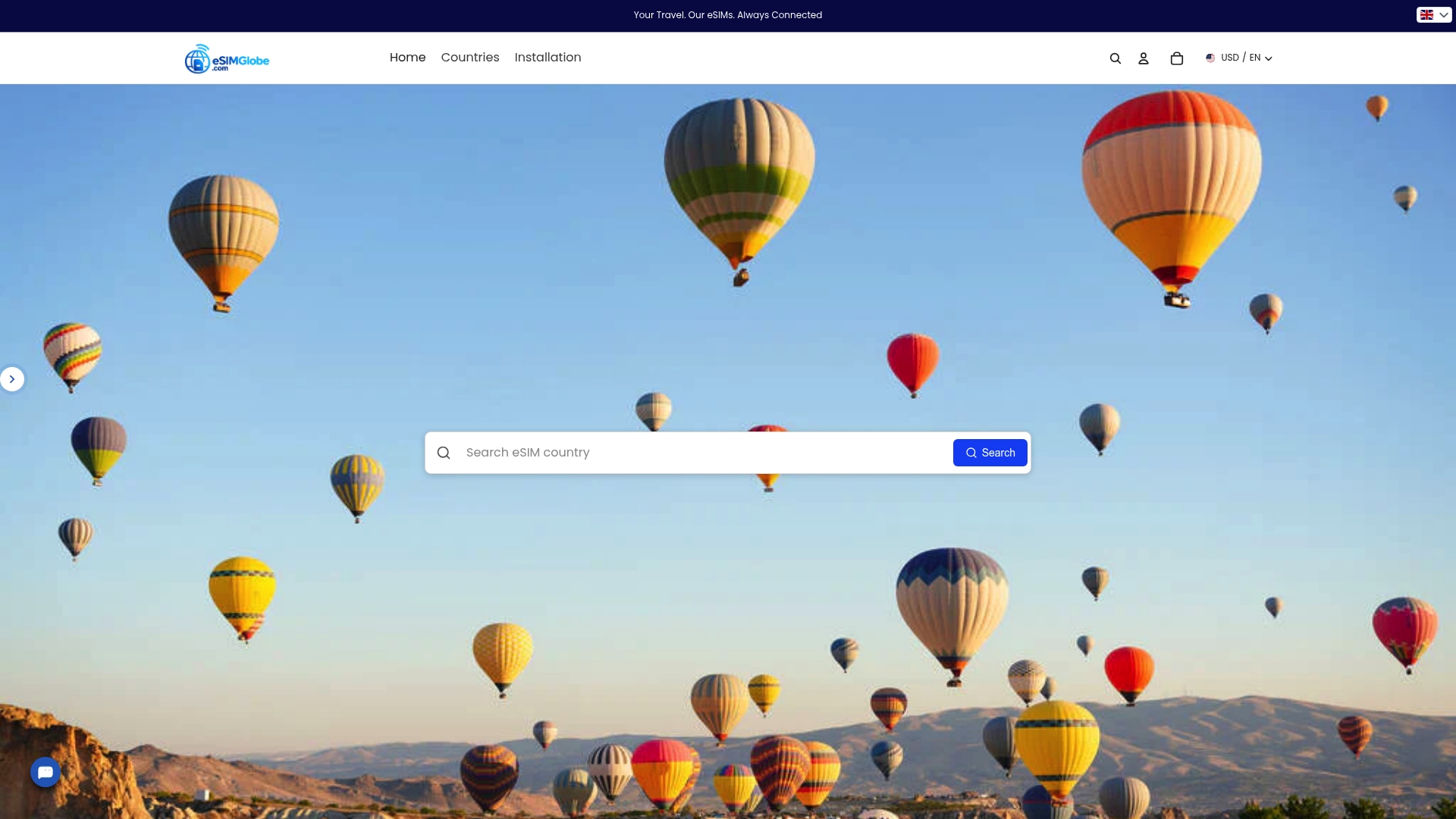
Beyond Italy, Esimglobe covers destinations worldwide. Whether your next trip takes you to the Maldives with an eSIM Maldives plan or across a broader European itinerary, the platform consolidates options in one place. The Esimglobe homepage provides access to country and region selectors, plan comparisons, and 24/7 customer support. Purchasing takes minutes, and your eSIM QR code arrives by email, ready to install before you board.
Frequently asked questions
Can I use a single eSIM across multiple Italian cities?
Most Italy eSIMs, including Nomad, support multi-network access usable throughout Italy’s major cities, so a single plan covers Rome, Milan, Florence, and beyond without switching plans.
Does unlimited data really mean unlimited with Italy eSIMs?
Unlimited eSIM plans typically have fair-use limits or speed caps after a certain quota, so read the fine print carefully before purchasing to understand what speeds you will actually receive after the threshold.
Is eSIM activation complicated for first-time users?
Most eSIM providers offer QR code setup, making activation quick and straightforward. Nomad Italy is recommended for easy setup, and activation typically takes just a few minutes from scanning the code to having an active data connection.
Which eSIM provider is best for a short city break in Italy?
Airalo suits short city trips with its budget-friendly smaller data packages, while Nomad is better suited to longer, multi-city itineraries that require more data and broader network flexibility.
Will my US phone work with Italian eSIMs?
Most modern smartphones released after 2019 support eSIM, but you should verify your specific device’s compatibility and confirm it is not carrier-locked before purchasing any eSIM plan.