






















TL;DR:
- An eSIM offers travelers a quick, flexible way to avoid roaming charges and monitor connectivity across multiple European countries. It requires an unlocked device, stable internet for setup, and pre-purchased profiles, providing instant activation and multi-plan management without physical SIM swaps. Beyond cost savings, eSIMs deliver convenience, future-proofing, and peace of mind, especially during hectic trips or long-term stays abroad.
Landing in a new European country and watching your phone rack up roaming charges before you’ve even found your luggage is one of travel’s most frustrating moments. Whether you’re island-hopping in Greece, riding trains through France, or working remotely from a co-working space in Lisbon, mobile connectivity is not optional. eSIMs offer a direct solution: a digital SIM profile you download and activate without touching a physical card. This guide covers everything from understanding the technology to buying, activating, and troubleshooting an eSIM for European travel in 2026.
Table of Contents
- Why consider an eSIM for Europe?
- What you need to get started with an eSIM
- How to buy and activate an eSIM for Europe
- Avoiding common issues and getting the most value
- The real value of eSIMs in Europe: more than saving money
- Ready to try an eSIM for your Europe trip?
- Frequently asked questions
Key Takeaways
| Point | Details |
|---|---|
| eSIMs simplify travel | eSIMs eliminate the need for physical SIM cards, making borderless travel in Europe easy and quick to set up. |
| Roaming rules aren’t universal | EU roaming protections mainly cover eligible plans and fair use; eSIMs add value outside these boundaries. |
| Prep before you travel | Ensure you have a compatible, unlocked device and set up your eSIM plan before your trip for peace of mind. |
| Optimize your plan | Choosing the right eSIM and monitoring your data keeps costs low and service smooth throughout your trip. |
Why consider an eSIM for Europe?
An eSIM, short for embedded SIM, is a digital version of the physical SIM card that has been standard in phones for decades. Instead of a plastic chip, your device stores a downloadable profile that connects to a carrier’s network. Most flagship phones released after 2018 support eSIM, including models from Apple, Samsung, Google, and Motorola. You manage everything through your device settings, not a SIM tray.
For European travel specifically, eSIMs address several real friction points.
Scenarios where eSIMs shine:
- Multi-country itineraries. Traveling from the Netherlands to Austria to Croatia in one trip means three different networks. A single regional eSIM plan can cover all three without requiring a SIM swap at each border.
- No store dependency. Traditional SIM cards require finding a carrier store, waiting in line, showing ID, and sometimes navigating a foreign-language interface. An eSIM is purchased online, often in under five minutes.
- Multiple plans on one device. Most eSIM-capable phones hold multiple profiles simultaneously. You can keep your home number active for calls while a separate travel eSIM handles your data.
- Instant setup. You can research, buy, and install a plan from your hotel room or airport lounge, with no hardware involved.
It’s worth being precise about one point that confuses many travelers. If you are an EU resident and your trip stays within EU and EEA countries, you may already have roaming protection through the Roam Like at Home regulation. This rule means EU mobile subscribers can use voice, SMS, and data at their domestic prices while traveling periodically across EU and EEA member states. In that context, an eSIM may still be useful, but the motivation shifts from cost avoidance to pure convenience.
Note: “Roam Like at Home” is not unlimited or unconditional. It applies to periodic travel only, meaning it is not designed for people who relocate abroad long-term. Fair use policies, data speed caps, and duration thresholds all apply. If you exceed limits or travel outside the EU and EEA, standard international roaming rates can return quickly. Always read your home carrier’s fair use policy before assuming full coverage.
For travelers from outside the EU, or those visiting countries like Turkey, Morocco, or the UK (which left the EU), an eSIM with a dedicated local or regional plan almost always delivers meaningful savings compared to standard international roaming.
You can find more detailed global travel eSIM tips to understand how eSIM compares to roaming across different regions. Reviewing eSIM travel best practices before departure also helps you avoid the most common setup mistakes.
Pro Tip: Even if roaming costs are not a concern because of your existing EU plan, an eSIM still saves time. Activating a data plan at your gate before landing beats hunting for a carrier store in a busy foreign airport.
What you need to get started with an eSIM
Understanding why an eSIM might suit you, here’s exactly what you need before landing in Europe. The checklist is short, but each item matters.
Requirements before buying an eSIM:
- eSIM-compatible device. Your phone must support eSIM technology. This includes iPhone XS and later, Google Pixel 3 and later, Samsung Galaxy S20 and later, and many other recent flagship models. Budget phones and older devices may not qualify.
- Unlocked phone. A carrier-locked phone may reject profiles from other providers. Contact your home carrier to confirm your device is unlocked, or request an unlock before travel.
- Stable internet connection for activation. You’ll need Wi-Fi or a working data connection to scan the QR code and download the eSIM profile. Airport Wi-Fi works for this.
- A reputable eSIM provider account. Create an account with your chosen provider before departure. Have your payment method ready.
If you’re unsure whether your specific device supports eSIM, check the full list of compatible eSIM devices before purchasing a plan.
It is also worth noting that if your trip stays entirely within the EU and EEA, and you already hold an eligible EU plan, an eSIM may be mainly for convenience rather than cost savings, since Roam Like at Home caps roaming charges for eligible users. Still, convenience has real value, especially on fast-paced itineraries.

Device and eSIM compatibility overview:
| Requirement | Details | Notes |
|---|---|---|
| Device compatibility | iPhone XS+, Pixel 3+, Galaxy S20+, and more | Check manufacturer specs for your model |
| Phone lock status | Device must be unlocked | Contact home carrier to confirm |
| Activation method | QR code scan or manual code entry | Requires Wi-Fi at time of setup |
| Provider account | Account with chosen eSIM platform | Set up before departure |
| Supported countries | Varies by plan (single, regional, global) | Confirm plan covers all your destinations |
Pro Tip: Run a device compatibility check at least two weeks before departure. Some carrier unlock requests take several business days to process, and you do not want to discover the problem at the airport.
How to buy and activate an eSIM for Europe
With your device and account ready, you’re set to select and activate the best eSIM for your European trip. The process is straightforward, but the order of steps matters.
Step-by-step purchase and activation process:
- Research your destinations. List every country you plan to visit. Some plans cover the EU only, while others extend to 30, 40, or 43+ countries including non-EU destinations like Turkey, Georgia, or the UK.
- Choose a plan type. Decide between a single-country plan (best for one-destination trips), a regional multi-country plan (best for EU-wide or Europe-wide travel), or an unlimited data plan (best for heavy users or long stays).
- Purchase from a reputable provider. Complete your purchase online. You’ll receive a QR code by email or through an app almost immediately.
- Install the eSIM profile. Go to your phone’s settings, select “Mobile Data” or “Cellular,” choose “Add eSIM,” and scan the QR code. This step requires a Wi-Fi connection.
- Set the eSIM as your data line. In settings, assign the new eSIM profile as your preferred data SIM. Keep your home SIM active for calls and texts if needed.
- Test before you fly. Send a test data request or load a webpage to confirm the profile is installed correctly. Do this at home, not at the boarding gate.
- Activate on arrival or before. Some plans activate as soon as you install them; others activate on first network use in the destination country. Read your provider’s instructions carefully.
One detail worth knowing: under the Roam Like at Home extended regulation confirmed through June 2032, EU residents using EU carrier plans benefit from roaming-free access across EU and EEA countries. This matters when choosing your plan because an EU-based traveler may only need an eSIM for destinations outside that zone.
eSIM provider comparison for European travel:
| Provider | Coverage | Typical cost (1GB, 30 days) | Multi-country support | Notes |
|---|---|---|---|---|
| EsimGlobe | 43+ countries | From $4.50 | Yes, regional and global plans | Best value, instant QR delivery, multi-language support, USD/EUR/GBP pricing |
| Airalo | 40+ countries | From $5.00 | Yes, regional plans | Limited currency options |
| Holafly | Unlimited plans, 30+ countries | From $19.00 | Yes, Europe-wide plans | Higher cost, no data cap on select plans |
| Nomad | 30+ countries | From $5.50 | Yes, regional options | Fewer plan durations available |
EsimGlobe stands out in this comparison for several reasons. Its platform supports multiple currencies including USD, EUR, and GBP, and it offers a language-switching interface that helps travelers navigate their options in their preferred language. Regional plans cover 43+ countries, which is among the widest coverage available for a single European plan. Instant QR code delivery means you can purchase minutes before your flight and have the eSIM installed before takeoff.
For detailed eSIM travel tips including how to configure settings on specific device models, that resource covers both iOS and Android activation steps in plain language.
Pro Tip: Activate your eSIM the night before departure, not at the airport. If something goes wrong, you have time to contact customer support without the pressure of a boarding time looming.
Avoiding common issues and getting the most value
Once your eSIM is live, avoiding hiccups and maximizing value ensures your trip goes smoothly. Most problems travelers report fall into a small number of categories, and nearly all of them are preventable.
Common issues and how to avoid them:
- Forgetting to set the eSIM as the active data line. After installation, many travelers forget to switch their data routing from their home SIM to the eSIM. The result is that the home SIM continues to use international roaming while the eSIM sits idle. Always verify data assignment in your phone settings immediately after installation.
- Device still locked to a home carrier. Installing an eSIM profile on a locked phone appears to work, but the device will not connect to foreign networks. Confirm your unlock status before purchasing any plan.
- Country compatibility gaps. Not all European eSIM plans cover every country on your itinerary. Switzerland, for example, is not an EU member and is not always included in “Europe” plans. The same applies to Kosovo, Albania, and Montenegro. Verify the specific country list before purchasing.
- Dual SIM confusion. When two SIMs are active, calls may route through the wrong line, resulting in unexpected charges. Set call and SMS routing explicitly in your device settings.
- Running out of data unexpectedly. Regional plans often have data caps that are easy to burn through if you stream video or use navigation apps heavily. Monitor your usage in settings and consider topping up before you hit zero, since purchasing a new plan on an unstable connection is frustrating.
Fair use and duration limits: Even if you are covered by the EU’s Roam Like at Home regulation, your home carrier’s fair use policy sets a ceiling on data speed and volume. If you are abroad for extended periods, some carriers interpret this as permanent relocation and may suspend roaming benefits. The Roaming Regulation EU 2022/612 extends these protections until 2032, but it does not override individual carrier fair use policies. Check your carrier’s specific terms.
Tips for tracking data and switching profiles efficiently:
Data tracking is easiest when you reset your phone’s data counter at the start of each trip. Both iOS and Android have built-in counters under cellular settings. Set a threshold alert if your device supports it. On iPhone, you can do this through Screen Time or by noting your plan’s data limit manually.
Switching between eSIM profiles is fast on most devices. On iPhone, go to Settings, Cellular, and select your active plan. On Android, the path varies slightly by manufacturer but is typically found under Network and Internet, then SIM cards. Keeping plan names clearly labeled, for example “Europe Trip eSIM” versus “Home Plan,” prevents accidental data routing to the wrong line.
The eSIM market for travelers continues to grow as more carriers adopt eSIM technology. This means plan quality, coverage, and pricing are all improving year over year, which is good news for frequent travelers who rely on this technology.
The real value of eSIMs in Europe: more than saving money
Here is an honest take that most connectivity guides skip: the biggest benefit of eSIM travel is not the money you save. For many travelers, especially EU residents protected by Roam Like at Home rules, the financial difference between using an eSIM and using their existing plan is minimal. The real gain is something harder to quantify.
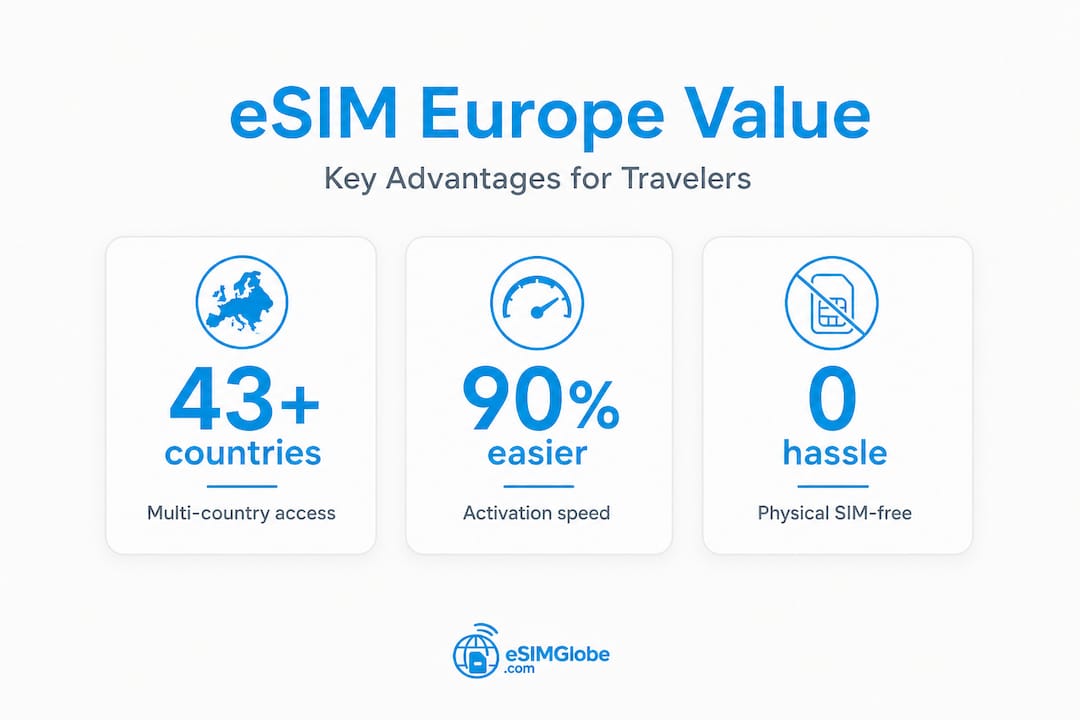
It is freedom from logistics. When you arrive in Prague at 11 PM and your connecting train leaves at 6 AM, the last thing you want is to locate a carrier store, decode a foreign retail process, and hope the SIM card you just bought actually works. An eSIM removes that entire layer of uncertainty. The plan is already on your phone. You are already connected.
Digital nomads understand this instinctively. The ability to change plans, top up data, or add a new country mid-trip without leaving a desk is not just convenient; it is how remote work in 2026 actually functions. A freelancer working across Spain, Portugal, and Italy in a single month cannot afford to spend hours managing SIM logistics. They need the phone to work, period.
There is also a future-proofing argument worth taking seriously. Carriers worldwide are progressively phasing out physical SIM infrastructure. Several device manufacturers have already released eSIM-only models with no physical SIM tray at all. Getting comfortable with eSIM management now means you will not face a steep learning curve later when it becomes the default standard.
The global eSIM perspective reveals that adoption rates among frequent travelers have grown significantly as the technology matures. Travelers who adopted eSIMs early consistently report that the experience reshapes how they think about connectivity. It stops being a problem to solve at each new destination and becomes an invisible background service, like Wi-Fi at a hotel. You expect it to work, and it does.
One more insight: the psychological value of knowing your phone works before you land is genuinely significant. Travel involves enough uncertainty. Connectivity should not be one of the variables.
Ready to try an eSIM for your Europe trip?
If you’re ready to travel with one less worry, here’s how to get started with your eSIM.
EsimGlobe makes the process straightforward. Browse regional plans that cover 30, 40, or 43+ countries across Europe, select the data size and duration that fits your itinerary, and receive your QR code immediately after purchase.
The platform supports USD, EUR, and GBP pricing, includes multiple language interfaces, and delivers eSIM profiles with no shipping wait. Whether your trip covers two countries or twelve, EsimGlobe’s Europe eSIM options are organized to help you find the right plan quickly without sorting through irrelevant options. Setup takes minutes. Coverage starts the moment you land.
Frequently asked questions
Do I need to change my phone number when switching to an eSIM in Europe?
No, your existing number stays on your primary SIM. The eSIM functions as a separate data line, so you remain reachable on your home number while using the eSIM for internet access.
Are there any limits on using eSIM under the EU’s Roam Like at Home policy?
Yes, the policy covers periodic travel only, and fair use limits and duration thresholds apply. Extended stays abroad or heavy data use may trigger restrictions depending on your home carrier’s specific terms.
Can I activate my European eSIM before arriving in Europe?
Yes, most providers allow you to purchase and install the eSIM profile before departure. Activation typically occurs on first use in the destination country, so you can complete setup at home without consuming plan data early.
What happens if my trip includes countries outside the EU/EEA?
You will need to verify your plan covers those destinations specifically, since EU roaming protections apply only within EU and EEA borders. Countries like Turkey, Morocco, and the UK require separate plan coverage or will default to standard international roaming rates.