






















TL;DR:
- Choosing the right travel data plan requires matching device compatibility and itinerary needs to avoid costly mistakes. Using eSIMs or regional plans instead of home carrier roaming can save travelers significant money and simplify connectivity across multiple countries. Proper pre-trip planning—including measuring actual data usage and testing plans at home—ensures reliable and cost-effective international mobile connectivity.
Selecting a travel data plan is the process of matching your device compatibility, travel itinerary, and personal data usage profile with the right mobile data option, whether that is an eSIM, a local SIM card, or a regional plan. The wrong choice costs real money. Home carrier roaming can exceed $200 for a three-week trip, while a well-chosen regional eSIM from a platform like Esimglobe covers the same period for $30–$40. This guide walks you through every step of how to select a travel data plan, from checking your device to activating your connection before you board.
How to select a travel data plan: what to do first
The first step in selecting mobile data for travel is confirming your device can actually use the plan you want. Not every phone supports eSIM technology, and not every phone is carrier-unlocked. Both factors determine which options are available to you.

Check eSIM compatibility and unlock status before anything else. On an iPhone, go to Settings > General > About and look for “Digital SIM Available.” On Android, go to Settings > Network > SIMs > Add eSIM. If neither option appears, your device may not support eSIM, or it may be locked to your home carrier. Device compatibility checks should happen at least 48 hours before travel to leave time for fixes.
Here is what to verify before you compare any plans:
- eSIM support: Confirmed via device settings as described above
- Carrier lock status: Call your home carrier or check via Settings; locked phones cannot use third-party SIMs
- Dual SIM capability: Lets you keep your home number active while running a travel data plan
- Current data usage baseline: Pull 30–60 days of usage from your carrier app or phone settings
- Coverage maps: Cross-reference your destination countries against the provider’s coverage page
Tracking 30–60 days of usage before your trip gives you a real benchmark. Marketing claims about “unlimited” plans rarely reflect actual usable speeds, so your own history is more reliable than any advertised figure.
Pro Tip: Use your phone’s built-in data tracker, not your carrier’s app. Carrier apps sometimes exclude Wi-Fi calls and background sync from their totals, which leads to underestimates.
Esimglobe’s platform includes a country and region selector that shows compatible plans for your destination immediately. That removes one layer of manual research from the process.
How much data do i need for international travel?
Data needs vary widely, and buying the wrong size plan is the most common and most avoidable mistake travelers make. The industry standard is to classify users into three tiers based on monthly consumption.
Light, moderate, and heavy users have fundamentally different needs:
- Light users (under 5 GB per month): Primarily messaging apps like WhatsApp and iMessage, light web browsing, and occasional map use. A 3–5 GB travel plan typically covers a one-week trip.
- Moderate users (5–15 GB per month): Active on Instagram, Google Maps, and video calls. Plan for 8–12 GB per week of travel.
- Heavy users (over 15 GB per month): Stream HD video, tether laptops, and run cloud-based work tools. These users need 15 GB or more per week, and should look at plans with tethering explicitly permitted.
Once you know your tier, apply a 20% usage buffer on top of your estimate. Background processes like app refresh, OS updates, and cloud sync consume data without any visible action on your part. That buffer prevents mid-trip throttling.
Trip length also shapes the decision. For trips under three days, your home carrier’s daily roaming add-on may be the simplest choice despite the higher per-day cost. Trips longer than three days consistently favor dedicated travel plans over daily roaming fees. The math shifts quickly once you cross that threshold.
For multi-country itineraries, a regional or global eSIM removes the need to buy separate plans for each country. A digital nomad spending two weeks across Germany, Portugal, and Spain does not need three local SIMs. One regional eSIM covers all three.
Pro Tip: Start with a conservative plan size and top up mid-trip if needed. Most eSIM providers, including Esimglobe, offer in-app top-ups that take under two minutes. Buying excess data upfront is money you will not recover.
Local SIM vs. eSIM vs. roaming: which plan type wins?
The four main plan types each serve a different traveler profile. Understanding the trade-offs is the core of any travel data plan comparison.
| Plan Type | Best For | Typical Cost | Coverage | Activation |
|---|---|---|---|---|
| Local prepaid SIM | Single-country trips, long stays | Lowest per GB | One country | Requires physical swap |
| Regional eSIM | Multi-country trips in one region | $30–$40 for 20 GB | Europe, Asia, etc. | Instant, digital |
| Global eSIM | Frequent or worldwide travelers | Higher, but flexible | 100+ countries | Instant, digital |
| Home carrier roaming | Trips under 3 days | $10+/day | Depends on carrier | Automatic |
Regional plans at $30–$40 for 20 GB compare directly against home carrier roaming at $10 per day, which totals over $200 for a three-week trip. The cost difference is not marginal. It is the difference between a budget flight and a business-class upgrade.
Local prepaid SIMs are the cheapest option per gigabyte for single-country stays of a week or more. The drawback is physical: you swap out your home SIM, lose your regular number’s accessibility, and repeat the process at every border crossing.
Regional eSIMs are the best value for most international travelers. A Europe-wide eSIM from Esimglobe, for example, covers dozens of countries under one plan with no physical card required. You keep your home number active on a dual SIM device while the eSIM handles data.
Global eSIMs suit digital nomads and frequent flyers who cross regions regularly. Esimglobe’s global plans cover multiple countries with flexible validity periods and fast activation. The per-GB cost is higher than a local SIM, but the convenience and coverage breadth justify it for anyone who travels more than four times a year.
Home carrier roaming is the default for travelers who do not plan ahead. It works everywhere your carrier has agreements, but the cost structure penalizes longer stays heavily.
Key factors to evaluate beyond price:
- Speed throttling: Does the plan cap speeds after a data threshold? Many “unlimited” plans throttle to 2G after 5–10 GB.
- Tethering restrictions: Some plans prohibit using your phone as a hotspot. Digital nomads who tether laptops must confirm this is permitted.
- Plan validity: A 30-day plan purchased a week before departure loses seven days before you even land.
- Top-up flexibility: Can you add data mid-trip without buying a new plan?
Pro Tip: Read the fine print on throttling before you buy. A plan advertised as “20 GB” may deliver full-speed data for only the first 5 GB, then drop to speeds too slow for video calls.
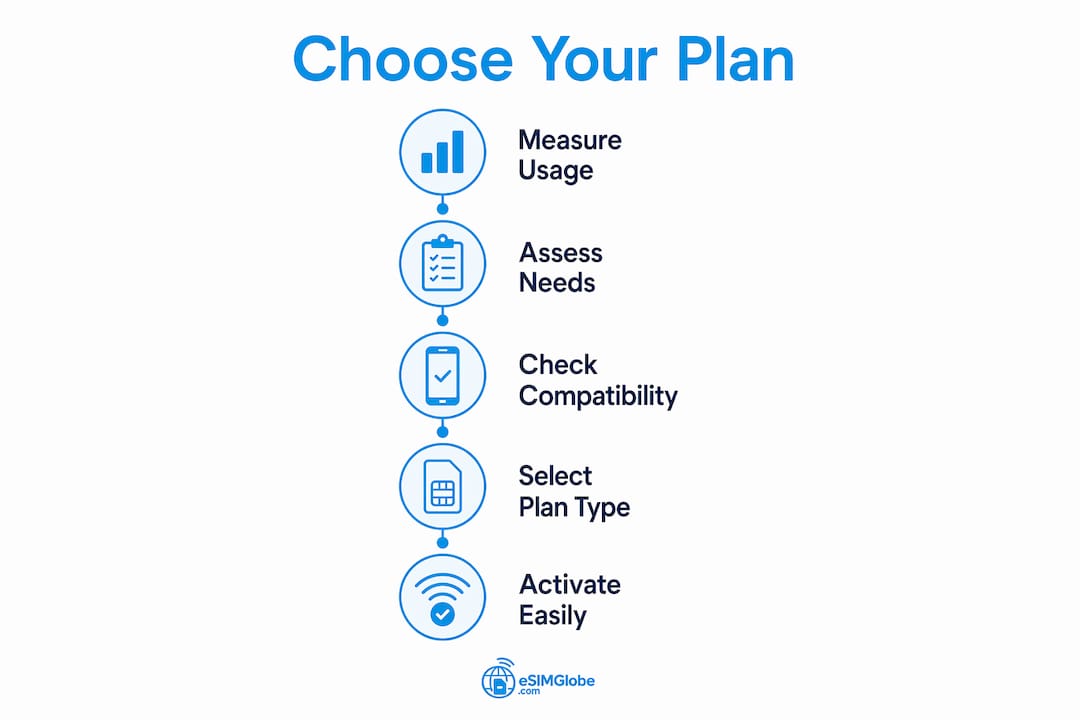
Step-by-step: how to choose and activate your plan
Follow this process in order. Skipping steps is how travelers end up with a non-functional SIM at the airport.
- Confirm device compatibility and unlock status. Use the Settings paths described in Section 2. If your phone is locked, contact your carrier to unlock it before purchasing any third-party plan.
- Calculate your data needs. Pull your 30-day usage average, classify yourself as light, moderate, or heavy, then add 20% as a buffer.
- Match your plan type to your itinerary. Single country and short stay: local SIM or roaming. Multi-country or longer than one week: regional or global eSIM.
- Research and compare providers. Check coverage maps against every country on your itinerary. Verify throttling policies, tethering rules, and top-up options. Esimglobe’s international eSIM options cover this comparison clearly by destination.
- Purchase and install before you travel. For eSIMs, scan the QR code provided at purchase and install the profile while on Wi-Fi at home.
- Activate and test on Wi-Fi before departure. Testing your eSIM at home in a controlled environment prevents “dead on arrival” failures at your destination. Toggle the eSIM on, confirm it shows a signal, then switch back to Wi-Fi for the rest of your home stay.
Common troubleshooting issues and fixes:
- eSIM not activating: Restart the device and re-scan the QR code. Confirm the device is unlocked.
- No signal at destination: Check that the eSIM is set as the active data line in Settings > Cellular.
- Slow speeds: Confirm you have not exceeded the full-speed data threshold. Top up if needed.
- Plan expired before trip ends: Purchase a top-up or a new plan through the provider’s app.
Esimglobe’s customer support is available to assist with activation issues, which is a practical advantage over buying a local SIM from a kiosk with no post-sale support.
What are the biggest mistakes travelers make with data plans?
Most connectivity problems abroad trace back to a small set of avoidable errors. Knowing them in advance is the most direct form of international data plan tips.
- Guessing data needs instead of measuring them. Travelers who skip the 30-day usage check routinely buy plans that are either too small or wastefully large. Baseline measurement is the single most reliable input to any plan decision.
- Ignoring background data consumption. App refresh, iCloud sync, and automatic OS updates run without user input. They can consume 1–2 GB per week on a moderately active phone.
- Overlooking throttling and tethering restrictions. A cost-data-coverage matrix that includes hotspot allowance and throttling thresholds reveals the true value of a plan. Plans that look cheap often throttle aggressively after a small data cap.
- Buying too much data upfront. Flexible top-up capability is standard on most eSIM platforms. Buying a 50 GB plan for a 10-day trip when a 10 GB plan with top-up access would suffice wastes money.
- Not verifying multi-country coverage. A plan marketed as “Europe” may exclude specific countries. Always check the provider’s coverage list against your exact itinerary.
- Skipping the pre-travel activation test. Installing an eSIM the night before departure and never testing it is a gamble. Problems discovered at home take minutes to fix. Problems discovered at a foreign airport take hours.
“The travelers who run into data problems abroad almost always skipped one of two steps: they did not measure their actual usage beforehand, or they did not test their eSIM before leaving home. Both checks take under ten minutes and prevent the majority of connectivity failures.”
Esimglobe’s platform guides users through compatibility checks and plan selection before purchase, reducing the chance of these errors at the source.
Key takeaways
The most effective way to select a travel data plan is to measure your actual usage first, match the plan type to your itinerary, and test activation before departure.
| Point | Details |
|---|---|
| Measure usage before buying | Track 30–60 days of real data consumption to avoid under- or over-buying. |
| Add a 20% buffer | Background processes consume data invisibly; the buffer prevents mid-trip throttling. |
| Match plan type to itinerary | Use regional or global eSIMs for multi-country trips; local SIMs for single-country long stays. |
| Test activation at home | Install and verify your eSIM on Wi-Fi before departure to avoid arrival-day failures. |
| Evaluate throttling and tethering | Read the fine print on speed caps and hotspot rules before committing to any plan. |
What i have learned after years of watching travelers get this wrong
The conventional advice on travel data plans tends to focus on price per gigabyte. That framing misses the point. Price per gigabyte only matters after you have confirmed the plan actually works for your device, your destinations, and your usage habits. I have seen travelers buy the cheapest plan available, only to discover it throttles to unusable speeds after 3 GB, does not permit tethering, or excludes one country on their itinerary.
The travelers who get this right consistently do two things that most people skip. They measure their actual data usage before the trip, not their best guess. And they test their eSIM installation at home, not at the departure gate.
The shift toward eSIM technology has genuinely changed what is possible. A few years ago, buying a local SIM at every border was the only realistic option for multi-country trips. Now, a single regional eSIM from a platform like Esimglobe covers an entire continent. The eSIM vs. local SIM comparison has tilted decisively toward eSIM for anyone traveling to more than one country.
My honest recommendation: do not optimize for the lowest upfront cost. Optimize for the plan that matches your actual itinerary and usage profile, has transparent throttling policies, and allows mid-trip top-ups. That combination costs slightly more than the cheapest option and saves significantly more than the most expensive one. Esimglobe’s multi-country plans hit that balance better than the alternatives I have evaluated, particularly for digital nomads who need coverage across regions without managing multiple physical SIMs.
— daniele
Get connected before you land with Esimglobe
Esimglobe makes the process of finding and activating the right plan straightforward. The platform covers destinations across multiple regions, with plans that support flexible validity periods and in-app top-ups.
You can check device compatibility, browse global eSIM plans by country or region, and complete purchase in minutes. Plans are available in USD, EUR, and GBP, with multilingual support for travelers worldwide. For digital nomads managing connectivity across multiple countries, Esimglobe’s regional and global options remove the need to juggle separate local SIMs at every border. The traveler’s eSIM guide on the Esimglobe blog provides additional detail on plan selection by destination. Customer support is available if activation questions come up before or during your trip.
FAQ
What is the cheapest way to get data while traveling abroad?
Regional eSIMs are typically the most affordable option for trips spanning multiple countries, with plans running $30–$40 for 20 GB compared to $10 or more per day for home carrier roaming. For single-country stays of a week or longer, a local prepaid SIM offers the lowest per-gigabyte cost.
How do i know if my phone supports eSIM?
On an iPhone, go to Settings > General > About and look for “Digital SIM Available.” On Android, go to Settings > Network > SIMs > Add eSIM. If neither path shows an eSIM option, your device may not support the technology or may be carrier-locked.
How much data do i need for a two-week international trip?
Light users need roughly 6–10 GB for two weeks. Moderate users who rely on social media and video calls should plan for 15–20 GB. Heavy users who stream video or tether a laptop should budget 25 GB or more, and must confirm their plan permits tethering.
Should i buy a travel data plan before or after i arrive?
Buy and install your plan before departure. Pre-travel eSIM activation on a home Wi-Fi network lets you verify the installation works before you need it. Fixing activation errors at a foreign airport is far more stressful than resolving them at home.
What is the difference between a regional and a global eSIM?
A regional eSIM covers a defined geographic area such as Europe or Southeast Asia under one plan. A global eSIM covers destinations across multiple regions worldwide, making it the better fit for frequent travelers or digital nomads who cross continents regularly. Global plans cost more per gigabyte but eliminate the need to buy separate regional plans for each leg of a trip.