






















Even a generous 5% to 10% promo code rarely closes the price gap once you compare it against a provider whose standard price is already lower. On a 10-day Asia trip, that discount often saves a traveler only a few dollars, while choosing the lower base price from the start can save significantly more. Esimglobe’s standard pricing tends to beat the promo-adjusted price of higher-priced competitors, not just match it. The worked examples below show exactly why.
TL;DR:
- Choosing a lower base price plan often results in greater savings than applying a small promo code, especially on longer or regional trips.
- Regional bundles for multiple countries generally offer better per-day rates than stacking individual country plans, regardless of discounts.
- Matching the plan shape to your route before applying a discount maximizes savings, as the bundle choice influences cost more than percentage coupons.
- Esimglobe’s standard prices are designed to be competitive without needing promo codes, with instant delivery and support available even during travel.
- Promo codes are usually limited by expiry, plan type, and restrictions, making it more effective to focus on selecting the correct plan rather than hunting for discounts.
Table of Contents
- Holafly Promo Code vs. Standard Price EsimGlobe: The Plan-By-Plan Numbers
- How Are These Savings Calculated?
- What Do Real Travel Routes Save You?
- Why EsimGlobe’s Standard Pricing Holds Up Without a Coupon
- How Do You Apply a Promo Code Correctly?
- Are There Restrictions on Promo Code Usage?
- Does Support or Refund Policy Change With a Promo Code?
- Can You Combine a Promo Code With Other Discounts?
- The Case for Buying on Price, Not on the Coupon
- Ready to Compare Your Own Route?
- Sources and Further Reading
- FAQ
Holafly Promo Code vs. Standard Price EsimGlobe: The Plan-By-Plan Numbers
The cleanest way to see the difference is to line up plan types side by side and apply a generic promo scenario to the higher-priced option. Assume a common promo-code discount of 5% off list price, no taxes, and prices in USD.
- 1-day single-destination plan: A standard eSIM price of around $6 to $8 per day is typical for short trips. A 5% promo code on a plan priced around $8 per day brings a small discount. Esimglobe’s per-day pricing on comparable single-country plans often lands at or below that discounted rate already.
- 7 to 10-day regional plan: Regional bundles (say, covering three or four Southeast Asian countries) commonly list between $25 and $45 for a week to ten days of data. A 5% code on a regional plan reduces the price modestly. Per-day cost on a 10-day regional plan works out to roughly $3.80 to $4.50, well under the single-day rate.
- 30-day multi-country or monthly plan: Monthly plans covering multiple regions typically run $50 to $90 depending on data volume. A 5% promo on a typical monthly plan yields a few dollars in savings. That’s still a smaller dollar savings than what a traveler gets simply by picking a provider whose monthly price starts lower.
The pattern holds across every plan length: percentage discounts shrink in dollar terms as a fraction of the bill, but the per-day cost keeps falling the longer the plan runs. That’s why a regional or monthly plan usually beats a string of single-day passes, discount or not, and why the starting price matters more than the coupon.
How Are These Savings Calculated?
The math behind every example here follows the same reproducible steps, so you can rerun it for your own itinerary.
- Estimate your trip length in days and your daily data need in GB (2 to 3 GB/day covers maps, messaging, and moderate streaming for most travelers).
- Find the standard list price for a plan matching that duration and data volume.
- Apply the promo percentage (5% in these examples) to get the discounted price.
- Divide both the standard and discounted totals by the number of trip days to get a per-day cost.
- For monthly plans used on shorter trips, check whether the provider prorates unused days. Most data-only eSIM plans do not.
Pro Tip: Always convert prices to a total trip cost, including any expected top-ups, before comparing providers. A plan that looks cheaper per gigabyte can end up costing more once you add a mid-trip data refill.
Watch for currency conversion fees if the checkout price displays in a currency other than USD. Taxes are excluded from every example above, so add your card issuer’s foreign transaction fee separately if it applies.
What Do Real Travel Routes Save You?
Numbers on a spec sheet only mean so much. Here’s what the math looks like on two routes travelers actually book.
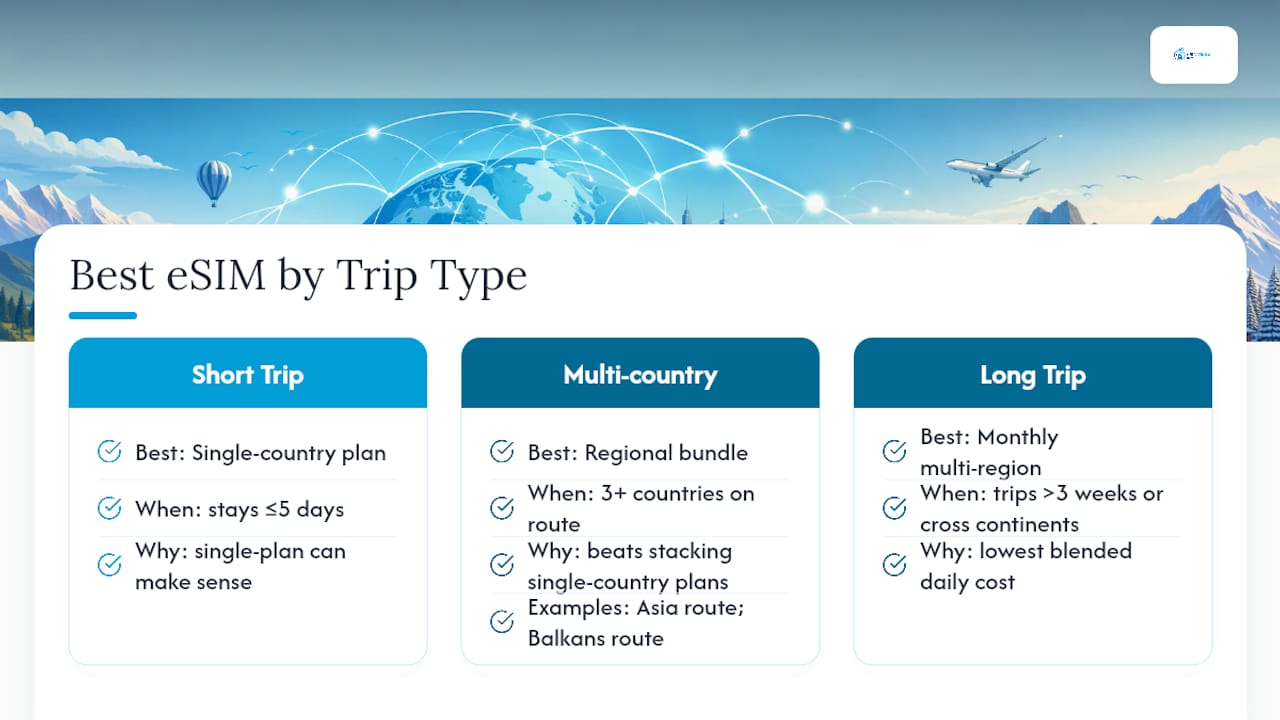
Asia route: Thailand, Malaysia, Singapore (10 days). Assume 4 days in Thailand, 3 in Malaysia, and 3 in Singapore, each requiring roughly 2GB per day. A regional Southeast Asia bundle from Esimglobe covering all three countries commonly prices in the $35 to $45 range for 10 days of data, no code needed.
Savings snapshot: Choosing one regional bundle over several discounted single-country passes on this Asia route can save a traveler a substantial portion of the total connectivity cost.
Balkans route: three countries, 12 days. Assume travel across Croatia, Bosnia and Herzegovina, and Montenegro, splitting data needs evenly. Buying three separate country-specific eSIMs at a promo-discounted rate often costs notably more than a single Balkans regional plan covering all three for the same 12 days, which costs less even without a coupon.
For a route touching three or more countries, a regional bundle almost always beats stacking single-country plans, discounted or not. For a single destination stay of five days or fewer, a single-country plan can still make sense. For trips stretching past three weeks or crossing continents, a monthly multi-region plan usually delivers the lowest blended daily cost.
Why EsimGlobe’s Standard Pricing Holds Up Without a Coupon
Esimglobe covers more than 170 countries with prepaid, data-only eSIM plans delivered by email within minutes of purchase. That instant delivery matters more than it sounds: a promo code saves you a few dollars, but a delayed activation email can cost you your first day of connectivity at the airport.
The checkout supports multiple currencies and languages, so the price you see is the price you pay, with no conversion guesswork at the last screen. Support runs 24/7, which matters most when a plan needs troubleshooting mid-trip rather than during business hours back home.
- Short single-country trips: a country-specific plan sized to your actual day count avoids paying for unused data.
- Multi-country routes like Asia or the Balkans: a regional bundle covering the whole itinerary, as shown above, beats buying separate country passes.
- Long-term travel or digital nomad stays: a monthly multi-region plan keeps the per-day rate lowest across weeks or months abroad.
Pro Tip: Match the bundle to your route before you shop for a discount. Picking the right plan shape saves more than any percentage-off code, and Esimglobe’s travel eSIM guide walks through sizing a bundle to your itinerary.
Because Esimglobe sells prepaid plans with no subscriptions, the price at checkout is the total price. There’s no renewal to forget, no promo that expires mid-cycle, and no surprise monthly charge after the trip ends.
How Do You Apply a Promo Code Correctly?
Redeeming a percentage-off code correctly takes a few careful steps, and skipping one is how travelers end up paying full price by accident.
- Add your chosen plan to the cart, then look for a code entry field on the checkout page, usually just above the order total.
- Enter the code exactly as issued. Codes are almost always case-sensitive and can include letters and numbers.
- Confirm the discount actually appears as a line-item deduction before you enter payment details.
- Check that the final total, including the currency symbol, matches what you expected after the discount.
- Review any fine print showing which plan types the code excludes.
Most promo codes apply to one order only and cannot be split across multiple purchases. Many exclude specific plan categories, like unlimited-data or premium regional bundles, and almost none stack with a second discount code at the same checkout. Before submitting payment, re-check the applied discount line, the currency, and the plan’s data allowance against what you actually need for your trip.
Are There Restrictions on Promo Code Usage?
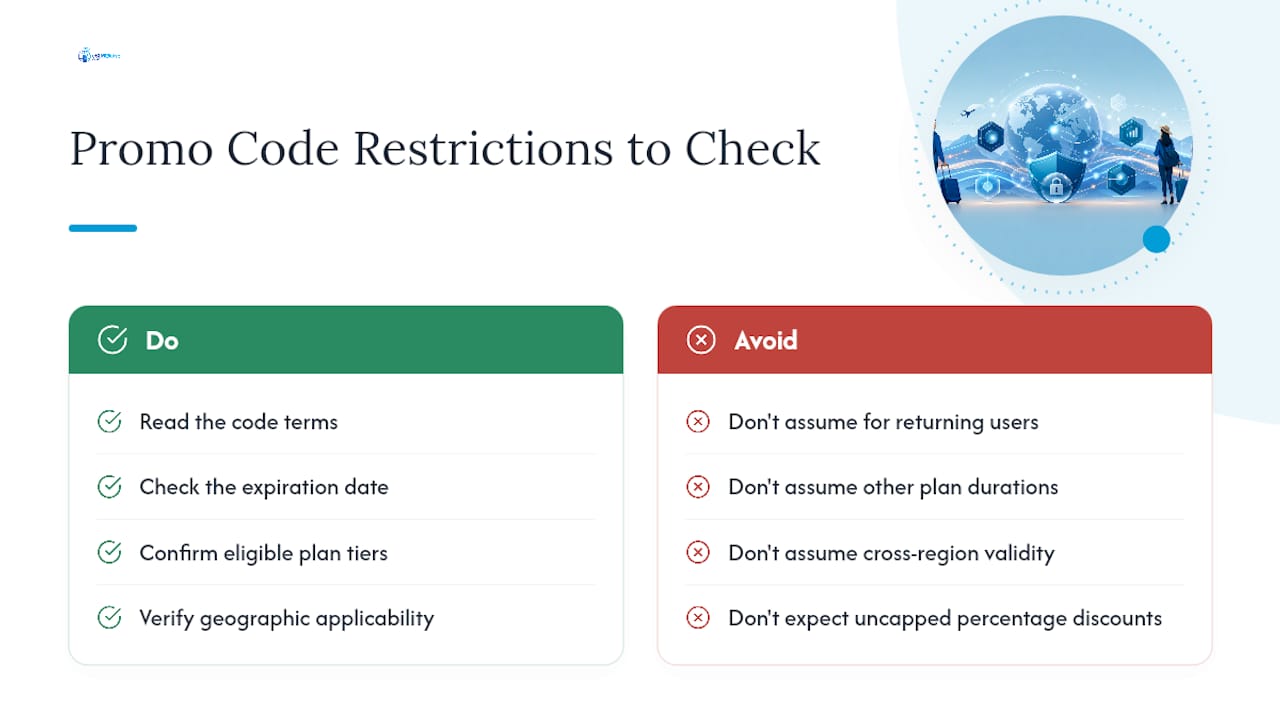
Promo codes typically carry restrictions that only surface once you dig into the terms tied to the offer. Expiration dates are the most common limit. A discount tied to a seasonal campaign or a specific plan tier usually stops working once that window closes or the plan is discontinued, even if the code itself still looks valid on a coupon site.
Many codes also apply only to first-time customers, meaning a returning traveler with an existing account may see the code rejected at checkout. Others are restricted to specific plan durations, so a code that works on a 7-day regional plan won’t necessarily apply to a 30-day monthly plan, even from the same provider.
Geographic restrictions show up too. A code advertised for one region’s plans may not apply to a different region’s bundle, which matters if your itinerary spans continents rather than staying within one area. Some codes also cap the maximum discount amount, so a percentage-off deal on an expensive multi-country plan might be capped well below what the raw percentage would suggest.
The practical takeaway is to read the fine print attached to any specific code rather than assume it behaves like the last one you used. A code’s terms rarely transfer cleanly from one plan type to another, and the exclusions are usually where the advertised savings quietly shrink. Esimglobe’s own promo code page lists current terms clearly rather than burying them in a separate policy document.
Does Support or Refund Policy Change With a Promo Code?
Using a promo code does not typically change the support you receive after purchase, but it can affect refund eligibility depending on the provider. Discounted purchases are sometimes marked as final sale, or refund windows can shrink compared to a standard-price purchase, since the discount is treated as a closed promotional transaction.
Esimglobe applies the same 24/7 support access whether a customer paid standard price or used a discount at checkout. Activation help, troubleshooting, and account questions route through the same support channel regardless of how the plan was purchased, which matters if a QR code fails to scan or a plan doesn’t activate on schedule.
Refund and support terms vary more across providers than most travelers expect. A standard purchase generally gives the clearest path to a refund if a plan fails to activate, since there’s no promotional exclusion clause attached to the order. A promo-code order sometimes adds an extra verification step, particularly if the code was tied to a specific campaign that has since ended, which can slow down a refund request.
Before buying with any code, it’s worth checking whether the discount changes the refund window at all. That single detail matters more than the size of the discount itself if something goes wrong with activation, and it’s a detail that promo banners rarely mention up front.
Can You Combine a Promo Code With Other Discounts?
Stacking discounts is the exception, not the rule, in eSIM pricing. Most providers, Esimglobe included, allow one promo code per order, meaning a percentage-off coupon and a separate seasonal sale price generally can’t both apply to the same purchase. The checkout system typically applies whichever discount is entered, and any additional code entered afterward either gets rejected or simply overrides the first one rather than adding to it.
Partner and affiliate discounts, like a student offer that adds a percentage on top of an annual plan price, sometimes work differently since they route through a separate verification system rather than a standard promo field. Even then, that additional discount usually applies instead of a promotional code, not alongside it.
The practical limitation to watch for: if you’re comparing a promo-discounted price against a provider’s regular price, don’t assume you can layer a second code to close the gap further. Check the specific terms attached to any code before assuming it stacks, and treat the advertised percentage as the ceiling on your savings, not a starting point you can build on with a second offer.
The Case for Buying on Price, Not on the Coupon
The instinct to chase a promo code makes sense. Nobody wants to feel like they overpaid. But the worked examples above point to a different lesson: a 5% discount off an inflated starting price still leaves you paying more than a provider whose base price was reasonable to begin with.
Conventional advice treats promo codes as the main lever for saving money on travel connectivity. That’s backwards. The plan shape, whether it’s a single-country pass, a regional bundle, or a monthly multi-country plan, moves the needle far more than any percentage off. A traveler who picks the right bundle for their route saves more than a traveler who hunts for the best code but buys three separate country passes anyway.
If there’s one thing worth prioritizing first, it’s matching the bundle to the itinerary before comparing prices at all. Get that right, and the standard price on a well-matched plan will usually beat a discounted price on a poorly matched one. The coupon is a nice-to-have. The bundle choice is the decision that actually saves money.
— daniele
Ready to Compare Your Own Route?
Esimglobe’s standard pricing is built to compete without needing a coupon, which means what you see at checkout is close to the best price available rather than a number waiting to be undercut by a discount code. Once you’ve run the math on your own itinerary using the steps above, buying takes three quick steps: pick your country or region, choose a plan sized to your trip length and data need, and complete checkout in your own currency.
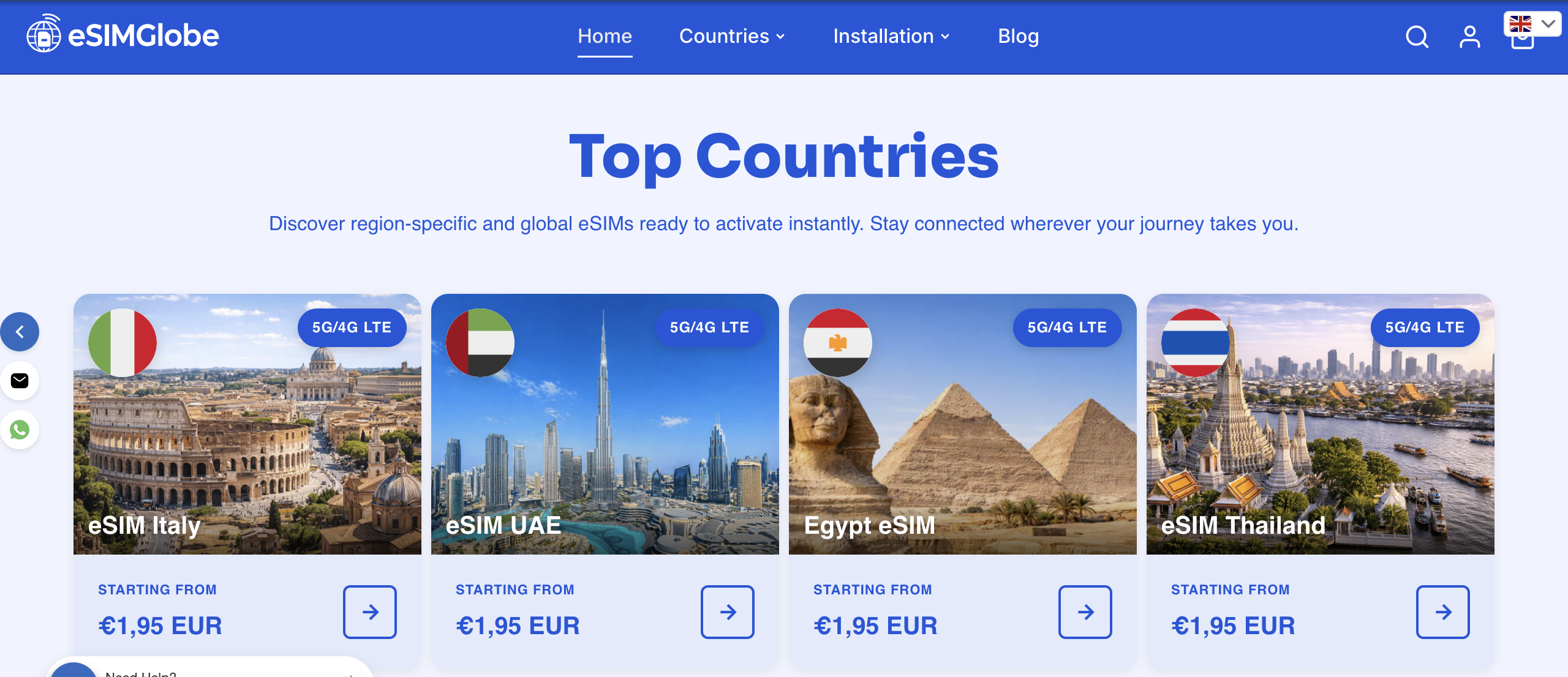
For a multi-country route like Asia or the Balkans, start with a regional bundle rather than separate country passes. It’s the single choice that saves the most, based on the worked examples above. For longer trips, a monthly plan covering multiple regions keeps the per-day cost lowest across weeks abroad. Every plan ships instantly by email, activates through a QR code, and comes with support available around the clock if anything needs troubleshooting.
Check available plans and current pricing directly on the Esimglobe eSIM plans page before your next trip, and run your own route through the same math shown here to see your actual savings.
Sources and Further Reading
Esimglobe’s product pages and blog supplied the pricing structure and feature details used throughout this comparison, including its eSIM buying guide and travel connectivity tips. For broader trip-cost planning beyond connectivity, Smart Overseas Flight Tips covers complementary strategies for cutting travel costs on multi-country routes.
FAQ
What Is the Best Holafly Discount Code Right Now?
Promo codes for eSIM providers change frequently and are usually tied to specific campaigns or plan types. Therefore, there’s no single code that stays valid year-round. Comparing the standard price against a discounted price, as shown in the examples above, matters more than chasing the current code.
Is There a 5% Discount Code Available for eSIM Purchases?
Discount codes in the 5% to 10% range are common across the eSIM industry, but the dollar savings stay small on lower-priced plans and only grow meaningful on expensive monthly bundles. A lower standard price, like the ones Esimglobe offers, often beats a discounted higher price outright.
Is There a Promo Code for eSIM Plans in 2026?
Promo codes are typically campaign-specific and expire on a rolling basis, so a code advertised far in advance may already be inactive by the time you check out. Verify any code directly at checkout rather than relying on a listing that may be outdated.
What Discount Code Works for Monthly eSIM Plans?
Monthly or multi-country plans sometimes carry separate promo rules from single-destination plans, and a code valid on one may be excluded from the other. Esimglobe’s promo code page lists current terms by plan type rather than applying one blanket code across every bundle.