






















TL;DR:
- Many travelers default to Airalo for eSIMs, but alternatives like Sim Local and EsimGlobe often offer better prices, speed, or flexibility based on destination and trip duration. Choosing the right eSIM depends on coverage, network quality, plan type, and support, especially for multi-country or long-term travel. Comparing multiple providers and selecting regional or unlimited plans can significantly reduce costs and improve connectivity.
Most travelers land on Airalo by default, the way someone might order the first item on a menu without reading further. Airalo is a legitimate platform with a wide reach, but it is far from the only option, and it is not always the most affordable one. Providers like Sim Local, Holafly, Nomad, Ubigi, and EsimGlobe offer competitive plans that often beat Airalo on price, speed, or flexibility, depending on your route and data needs. This guide covers the top alternatives, how they compare, and exactly how to pick the right one before your next trip.
Table of Contents
- Why look for an alternative to Airalo?
- Top Airalo alternatives compared
- How alternative eSIMs work: activation, features, and coverage
- How to choose the best Airalo alternative for your trip
- The surprising truth: most travelers overpay for eSIMs, here’s why
- Where to find the best eSIM alternatives for your next trip
- Frequently asked questions
Key Takeaways
| Point | Details |
|---|---|
| Airalo isn’t your only option | Many eSIM providers offer affordable plans with unique benefits for global travelers. |
| Consider local and unlimited plans | Alternatives like Sim Local can deliver local-level speeds and cost savings, especially for regional travel. |
| Check device compatibility | Always confirm your device supports eSIM before purchasing an alternative provider plan. |
| Easy activation processes | Switching to a new eSIM is as simple as scanning a QR code and following clear instructions. |
| Compare before you buy | Review at least three eSIM providers for your destination to maximize coverage and value. |
Why look for an alternative to Airalo?
Airalo gained its reputation through early entry into the eSIM market and a clean, user-friendly interface. That reputation is earned, but familiarity with a brand does not automatically translate to the best deal for every traveler in every region. There are concrete reasons why experienced travelers and digital nomads look beyond Airalo regularly.
First, pricing varies significantly by region. Airalo’s per-country plans can be cost-efficient for single-destination trips, but costs add up fast for multi-country routes or longer stays. When you review the eSIM vs local SIM guide, you quickly see that different trip profiles demand different solutions. A two-week backpacking route through five European countries is a very different problem than a one-week business trip to Tokyo.
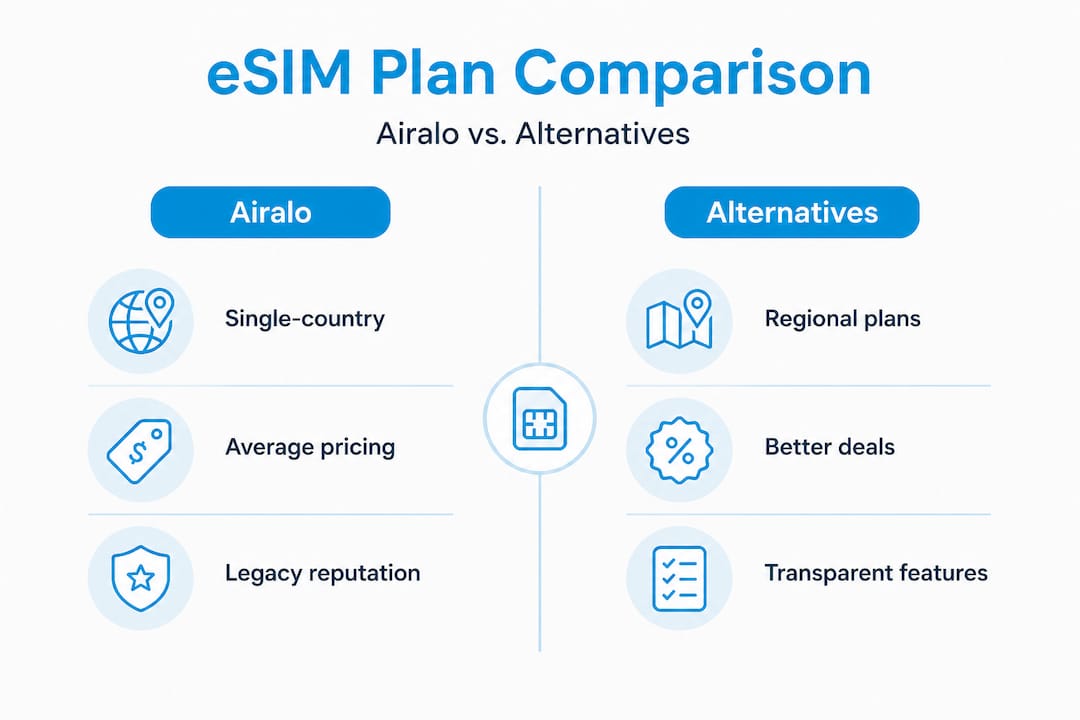
Second, network speeds depend on which local carriers a provider partners with. Two eSIM providers can both say they cover France, but one might connect you to a premium 4G/5G carrier while the other routes you through a slower partner network. That difference is invisible until you try to upload a file from a café in Paris.
Third, plan flexibility matters. Some providers lock you into fixed data buckets with no top-up option. Others offer regional plans that auto-switch networks as you cross borders, unlimited plans with reasonable fair-use caps, and easy in-app data management. When trip plans change, that flexibility is worth real money.
“The best eSIM is not the most advertised one. It is the one that matches your region, speed needs, and budget for each specific trip.”
Here are the core factors to evaluate when comparing any eSIM provider:
- Coverage: Which countries are included, and which local carriers are used?
- Speed: Does the provider partner with premium 4G/5G networks?
- Plan types: Per-country, regional, or global? Fixed data or unlimited?
- Flexibility: Can you top up mid-trip or switch plans easily?
- Support: Is there live chat or 24/7 help available?
- Activation: How straightforward is the QR code setup process?
Pro Tip: Look for providers that list their in-country network partners, not just coverage maps. A named local carrier is a sign of a quality, fast connection rather than a generic roaming agreement.
When your travel plans span multiple countries or run longer than two weeks, regional and unlimited plans from alternative providers consistently deliver better value than single-country Airalo purchases stacked on top of each other.
Top Airalo alternatives compared
The eSIM market has grown considerably since Airalo launched, and several providers now offer plans that compete directly on price, speed, and coverage. Here is how the leading options stack up.
EsimGlobe stands out as a strong first choice for international travelers and digital nomads. The platform covers a broad range of countries and regions, offers competitive pricing in multiple currencies (USD, EUR, GBP), and provides an intuitive interface for finding and activating plans quickly. EsimGlobe’s region-specific eSIMs are priced to save money with eSIMs compared to standard roaming fees and many competitor plans, making it a reliable default for travelers who want straightforward, affordable connectivity without surprises.

Sim Local is known specifically for high-speed unlimited plans, particularly within Europe. Sim Local’s unlimited Europe plan covers over 220 countries and is praised for delivering local-level speeds at €64 for 30 days. That is a flat rate for unlimited data across one of the most expensive regions for mobile data, which is a strong offer for anyone spending a month in Europe.
Holafly targets the unlimited data segment more broadly, with plans across Latin America, Asia, and Europe. The pricing is straightforward: one flat fee, no data cap worries, no overage charges. The tradeoff is that Holafly plans are data-only, meaning no SMS or calling. For travelers who rely on messaging apps, that is rarely a problem.
Nomad and Ubigi both target the global and regional eSIM segment. Nomad is noted for flexible top-up options and good Asia-Pacific coverage. Ubigi is popular among business travelers for its auto-renewal feature and solid European network partnerships.
Provider comparison table
| Provider | Coverage | Plan types | Price range | Standout feature |
|---|---|---|---|---|
| EsimGlobe | Global, 190+ countries | Country, regional, global | USD 5 to USD 45+ | Best price-to-coverage ratio; multi-currency support |
| Sim Local | 220+ countries | Country, regional, unlimited | €5 to €64+ | Unlimited Europe plan with local-level 4G/5G speeds |
| Holafly | 160+ countries | Country, regional (unlimited) | USD 17 to USD 99+ | Unlimited data plans, wide destination list |
| Airalo | 200+ countries | Country, regional | USD 4.50 to USD 55+ | Large provider network, established platform |
| Nomad | 170+ countries | Country, regional, global | USD 5 to USD 80+ | Flexible top-ups, strong Asia-Pacific options |
| Ubigi | 190+ countries | Country, regional | USD 6 to USD 60+ | Auto-renewal, solid European network partners |
A few details stand out when reviewing the global eSIM guide alongside the table above. EsimGlobe consistently offers competitive entry-level pricing and broader currency flexibility than most competitors. For travelers who pay in EUR or GBP rather than USD, that removes a hidden cost from currency conversion that accumulates over multiple purchases.
Key points worth noting about the top alternatives:
- Some providers offer data sharing, allowing multiple devices on one plan.
- Auto top-up features from providers like Ubigi prevent unexpected data cutoffs mid-trip.
- A handful of providers include limited SMS or call support on select plans, which can be useful for travelers who need a local number for hotel check-ins or transportation bookings.
- Regional plans from EsimGlobe, Sim Local, and Nomad reduce the hassle of buying separate plans for each country on a multi-stop itinerary.
The main takeaway is clear: Airalo is a solid platform, but it is priced at market average, not market best. For specific use cases, particularly long European stays and multi-country routes, alternatives offer measurably better value.
How alternative eSIMs work: activation, features, and coverage
Understanding how eSIMs function removes the hesitation many travelers feel about switching from a familiar provider. The technology is consistent across all providers; what changes is the plan structure, the network partnerships, and the price.
An eSIM (embedded SIM) stores carrier information digitally inside your phone, rather than on a removable physical card. Remote provisioning (RSP) is the technical process that allows you to download and activate a new carrier plan over the internet, without swapping a card. This is why eSIMs can be activated in minutes, and why you can switch providers between trips with no hardware changes.
Most eSIM plans are data-only. That means no traditional SMS or voice calls through the carrier. In practice, this matters less than it sounds, because WhatsApp, Telegram, FaceTime, and similar apps cover messaging and calls over data. For travelers who genuinely need a local number, some providers offer select plans with limited call and SMS features, though these are less common and usually cost more.
Regional and global eSIM plans are particularly useful. These plans use a single profile that auto-switches between local carrier networks as you cross borders. Instead of buying three separate eSIMs for Italy, Spain, and Portugal, you buy one regional plan and the profile handles the rest. Check the essential eSIM facts for a full breakdown of how network switching works in practice.
How to activate an alternative eSIM, step by step
- Check device compatibility. Confirm your phone supports eSIM. Most iPhone models from the XS onwards, Samsung Galaxy S20 and newer, and Google Pixel 3 and newer are compatible. Some carrier-locked phones may not support third-party eSIMs.
- Choose and purchase your plan. Select a provider and plan based on your destination, trip length, and data needs. Complete the purchase on the provider’s website or app.
- Receive the QR code. Within minutes of purchase, you will receive an email or in-app notification with a QR code. This is your eSIM profile.
- Scan and install the QR code. Go to your phone’s settings (Settings > Mobile Data or Cellular > Add eSIM), scan the QR code, and follow the on-screen prompts. The entire process takes under five minutes.
- Set the eSIM as active. Toggle the new eSIM as your active data line, keeping your primary SIM for calls if needed. Many phones support dual-SIM, so your home number stays reachable.
- Manage data via the provider’s app or website. Monitor usage, purchase top-ups, or extend your plan from the app without visiting a store.
Pro Tip: Download and install your eSIM before you leave home. Airport and hotel Wi-Fi can be unreliable, and arriving without connectivity while trying to install a new eSIM is an avoidable headache. Good eSIM travel practices always recommend pre-trip activation.
eSIM data plan types at a glance
| Plan type | Best for | Data limit | Auto-switch between countries |
|---|---|---|---|
| Single-country | Short trips, one destination | Fixed | No |
| Regional | Multi-country routes | Fixed or unlimited | Yes |
| Global | World travelers, digital nomads | Fixed or unlimited | Yes |
| Unlimited | Long stays, heavy data users | Unlimited (fair use cap) | Varies |
The table above clarifies why plan type matters as much as price. A cheap single-country plan is not cheap if you need to buy four of them for a two-week European tour.
How to choose the best Airalo alternative for your trip
Choosing the right provider is straightforward once you know what to prioritize. The following framework applies whether you are a short-stay vacationer or a long-term digital nomad working across multiple time zones.
The core decision variables are:
- Destination region: Is your trip limited to one country, or does it span multiple? Regional plans usually win on cost and convenience for multi-country routes.
- Trip length: Short trips (under seven days) often suit single-country fixed-data plans. Stays longer than two weeks favor unlimited or regional plans.
- Data usage: Light browsing and maps require far less data than video calls and content streaming. Estimate your daily usage honestly.
- Device compatibility: Not all phones support eSIM. Some carrier-locked devices may block third-party eSIM profiles. Check top eSIM devices for a current compatibility reference.
- Support needs: If you are less confident with tech setup, choose a provider with live chat or 24/7 support. EsimGlobe and Holafly both offer accessible customer support channels.
- Budget: Compare total cost across providers for the exact plan type you need, not just the advertised starting price.
Checklist before buying any eSIM plan
- Data allowance matches your estimated daily usage plus a buffer
- Coverage confirmed for every country on your itinerary
- Local network partners named (not just “local networks available”)
- Plan flexibility: can you top up or extend without buying a new eSIM?
- Activation instructions are clear and available before purchase
- Customer service contact method confirmed
Step-by-step selection process
- List your destinations and trip length. Write out every country and the number of days you will spend in each.
- Decide on plan type. Single-country, regional, or global based on step one.
- Compare at least three providers. Use the comparison table above and the checklist above to shortlist options.
- Check device compatibility. Confirm your specific phone model supports eSIM before purchasing.
- Confirm activation instructions. Read the activation steps on the provider’s site before you buy, not after.
- Purchase and install before departure. Complete the QR code scan and installation at home over a reliable Wi-Fi connection.
Review best international eSIM types for a deeper breakdown of plan categories and which trip profiles they suit best.
Example scenario: long-term digital nomad vs. short-stay vacationer. A digital nomad spending three months across Southeast Asia needs a regional plan with generous data (50GB or unlimited) and good network partners in Vietnam, Thailand, and Indonesia. A vacationer spending seven days in Malta needs a small, affordable single-country plan with 5 to 10GB of data. The same provider may not be the best choice for both. That is exactly why comparing options before every trip is worth the five minutes it takes.
The surprising truth: most travelers overpay for eSIMs, here’s why
Here is something most travel guides will not tell you directly: brand recognition in the eSIM market is not a reliable signal of value. Airalo built strong name recognition early, and that recognition now works as a marketing asset that allows the platform to price at market average without losing customers who never look further. This is not a criticism of Airalo specifically. It is how every mature consumer market works.
The travelers who consistently pay less for better data are not tech experts. They are simply the ones who check three providers before buying instead of one. That habit, taking five extra minutes to compare, is the entire difference between overpaying by 30 to 50 percent and getting a genuinely good deal.
The Sim Local unlimited Europe plan at €64 for 30 days is a clear example. That plan delivers local-level 4G/5G speeds across 220+ countries for a flat monthly rate. Many travelers spending a month in Europe would pay significantly more assembling single-country plans from a familiar provider, and they would get slower speeds in the process.
EsimGlobe addresses this directly by offering transparent, competitive pricing across destinations without the brand premium that inflates costs elsewhere. The platform’s multi-currency support also eliminates the quiet conversion fees that add up when you pay in a non-default currency.
Pro Tip: Before any international trip, check at least three eSIM providers and filter specifically for regional and unlimited plans. Those two plan types are where the biggest savings versus standard single-country plans appear. Find more detail on this in the eSIM travel tips guide.
The other common mistake is overbuying data. Many travelers purchase 10GB plans out of anxiety, then use 3GB. Providers like Nomad and EsimGlobe offer smaller, cheaper starting plans with easy top-up options. Buying 5GB with a reliable top-up path is smarter than buying 15GB upfront and leaving half unused.
The eSIM market rewards comparison. The travelers who save the most are not the most technical. They are the most deliberate.
Where to find the best eSIM alternatives for your next trip
EsimGlobe offers region-specific and country-specific eSIM plans designed for exactly the use cases covered in this guide, from short stays to long-term digital nomad routes.
Whether you need an eSIM for Maldives for a two-week beach trip or an eSIM for Malta for a short European stop, EsimGlobe provides curated plans with transparent pricing in USD, EUR, and GBP. The platform is built for travelers who want fast activation, local-level speeds, and no roaming fee surprises. Browse destination plans, compare data options, and activate before you travel at EsimGlobe. Seamless setup and competitive rates make it a practical starting point for any trip.
Frequently asked questions
Are there eSIM providers cheaper than Airalo?
Yes, travelers can often find better regional deals and unlimited plans from providers like Sim Local and EsimGlobe, especially for European routes where Sim Local’s €64 unlimited plan delivers strong value over 30 days.
Can I use alternative eSIMs on all smartphones?
Most modern smartphones support eSIM, but device compatibility is not universal, so it is important to confirm your specific model supports third-party eSIMs before purchase, as noted in remote provisioning guides.
Do alternative eSIMs support SMS and calls?
Most plans are data-only with no traditional SMS or call support, though some providers offer limited call and SMS options on select plans as outlined in current eSIM overviews.
How fast is data on non-Airalo eSIMs?
Speed depends on local network partners. Providers like Sim Local advertise local-level 4G/5G speeds across 220+ countries, so always verify which carrier your eSIM connects to in your destination country.
Is it hard to switch from Airalo to another provider?
Switching is straightforward. Purchase a new plan, scan the QR code, and follow the activation steps, with the full remote provisioning process typically complete in under five minutes on any compatible device.