






















The GSMA describes 2026 as the year mass-market eSIM deployment moves from forecast to operational fact, anchored by the SGP.32 standard for server-driven IoT provisioning. Three forces are driving that scale:
- IoT and enterprise push provisioning — logistics fleets, smart meters, and industrial sensors switching to centralized, server-managed profile delivery
- Consumer travel use cases — rising demand for instant, carrier-agnostic data access abroad, accelerated by broader device support
- iSIM momentum — integrated SIM architectures (governed by SGP.41/42) shrinking form factors and reducing bill of materials costs for small form factor devices
The operational challenge in 2026 is no longer proving eSIM works. It is scaling activations, hardening supply chains, and preparing cryptographic infrastructure for post-quantum threats.
Key Takeaways
eSIM’s 2026 trajectory is defined by SGP.32-driven push provisioning and iSIM momentum, not by consumer device adoption alone.
| Point | Details |
|---|---|
| 1.5 billion connections projected | Juniper Research forecasts ~1.5B global eSIM connections in 2026, roughly 30% above 2025 levels. |
| SGP.32 is the critical IoT standard | Server-driven push provisioning via SGP.32 eliminates manual activation for large-scale IoT deployments. |
| iSIM is a material factor | SGP.41/42-governed iSIM is accelerating in logistics, smart meters, and industrial sensors for size and power reasons. |
| Post-quantum readiness is urgent | U.S. teams should require a post-quantum cryptography roadmap from all connectivity vendors in 2026 contract cycles. |
| Carrier certification still matters in the U.S. | Device eSIM capability does not guarantee carrier support; verify against each carrier’s certified device list before procurement. |
Table of Contents
- What are the top eSIM technology trends shaping 2026?
- How big will the eSIM market be in 2026?
- What standards and technical specs define eSIM in 2026?
- Which devices support eSIM in 2026, and what should you check?
- Where are the new eSIM connections actually coming from in 2026?
- What security and regulatory risks should U.S. teams watch in 2026?
- What should consumers, IT pros, and product leads do right now?
- How Esimglobe is preparing for 2026’s eSIM scale
- Useful sources for deeper reading
- The eSIM shift in 2026 is about operations, not technology
- FAQ
What are the top eSIM technology trends shaping 2026?
1. Push provisioning replaces pull as the default model
The shift from consumer-initiated (pull) to operator-initiated (push) provisioning is the single biggest operational change in 2026. Under SGP.32, an SM-DP+ server pushes profiles to devices without requiring user interaction. For an enterprise deploying 50,000 connected meters, that difference eliminates manual activation at scale and cuts provisioning costs materially.
2. iSIM accelerates in small-form-factor IoT
iSIM embeds the SIM function directly into a device’s main processor, governed by the SGP.41 and SGP.42 specifications. Juniper and industry analysts tracking TechRadar’s coverage note that iSIM connections are growing rapidly between 2024 and 2026, making iSIM a material factor for asset trackers, wearables, and industrial sensors where every cubic millimeter and milliwatt counts. Omdia’s 2026 market analysis confirms that SGP.31/32 specifications are now entering commercial deployment alongside iSIM ramp-up.
3. 5G SA unlocks entitlement-server-driven lifecycle management
5G Standalone architecture separates the control plane from the user plane, which lets entitlement servers manage eSIM profile lifecycles dynamically. In practice, a device can be provisioned, suspended, or re-provisioned without a physical touchpoint. That capability is what makes large-scale connected-vehicle and industrial deployments commercially viable.
4. Embedded telco and API-first distribution
Connectivity is increasingly distributed through software APIs rather than carrier retail channels. Platforms integrate RSP (Remote SIM Provisioning) directly into device management systems, allowing enterprises to treat connectivity as a programmable resource. 1GLOBAL’s trend analysis identifies this API-first model as one of the top structural shifts for 2026.
5. AI-driven orchestration for activation and fraud
Operators are layering machine-learning models onto provisioning pipelines to detect anomalous activation patterns, flag SIM-swap-style fraud, and predict capacity spikes. This is not a future roadmap item; several tier-1 operators already run automated fraud scoring on eSIM activations.
6. Pricing commoditization and multi-IMSI compression
As more operators support SGP.32, profile pricing is compressing. Enterprises gain negotiating leverage because switching providers no longer requires a hardware change. Multi-IMSI approaches are also shrinking, replaced by single-profile solutions that handle network selection at the software layer.
Pro Tip: When evaluating an eSIM vendor for enterprise IoT, request a live demonstration of push-provisioning throughput under load and ask specifically about entitlement-server failover behavior. A vendor that cannot demonstrate simultaneous activation of thousands of profiles in a test environment will not survive your production peak.
How big will the eSIM market be in 2026?
Juniper Research’s projection of 1.5 billion eSIM connections in 2026 is the most-cited headline, but the composition of that number matters as much as the total. Consumer smartphones remain the largest single segment by volume, but IoT is the fastest-growing contributor.
Analyst firms including Statista and Omdia publish varying estimates depending on how they define an “active eSIM connection” versus a provisioned profile, so treat any single-point forecast with appropriate skepticism. The directional consensus is consistent: double-digit percentage growth year over year, with IoT overtaking consumer devices as the primary connection driver within the next two to three years.
U.S. market context: The United States is among the most advanced markets for consumer eSIM adoption. All four major national carriers support eSIM on flagship smartphones, and the iPhone’s eSIM-only configuration (introduced in the U.S. in 2022) has normalized the format for tens of millions of users. Enterprise IoT adoption in the U.S. is accelerating in energy, logistics, and healthcare verticals, though carrier certification requirements add deployment timelines that slower-moving procurement teams often underestimate.
| Segment | 2026 outlook | Primary driver |
|---|---|---|
| Consumer smartphones | Largest volume segment | Travel, device upgrades, eSIM-only hardware |
| Enterprise IoT (logistics, meters) | ~75M new connections in 2026 | Push provisioning, SGP.32 deployment |
| iSIM (small-form-factor) | Rapid growth from 2024 baseline | BOM reduction, power efficiency |
| Wearables and automotive | Steady expansion | 5G SA, entitlement server integration |
One practical implication for U.S. operators and platform engineers: activation infrastructure must handle demand spikes that are an order of magnitude larger than consumer onboarding flows. A logistics company activating 10,000 devices in a single provisioning batch requires cloud-elastic RSP infrastructure, not the same stack that handles individual consumer SIM swaps.
For a broader view of what eSIM market growth means for travelers specifically, Esimglobe’s market overview breaks down the consumer implications.
What standards and technical specs define eSIM in 2026?
SGP.32: the engine of IoT push provisioning
SGP.32 is the GSMA specification that enables server-initiated profile management for IoT devices. Unlike the consumer eSIM model (SGP.22), where a user scans a QR code or taps through an activation flow, SGP.32 allows an SM-DP+ server to push a profile to a device with no user interaction required. The device needs only a minimal bootstrap connectivity path to reach the provisioning server. For a fleet of 100,000 connected sensors, that architecture eliminates the human-in-the-loop entirely.
SGP.41 and SGP.42: the iSIM specifications
SGP.41 defines the architecture for iSIM, where the SIM function is integrated into the device’s application processor or a dedicated security enclave. SGP.42 covers the test and certification requirements. The compliance difference versus a removable or soldered eUICC eSIM is significant: iSIM lifecycle updates follow a different path, and procurement teams must verify that their device management platform supports iSIM-specific update flows before committing to a hardware design.
5G SA and entitlement servers
5G Standalone networks expose network capabilities through APIs that entitlement servers can call directly. An entitlement server acts as the policy engine for eSIM lifecycle events — it decides whether a device is authorized to download a profile, switch networks, or suspend service. In a 5G SA environment, that decision can be made and executed in near-real time, which is what enables dynamic multi-network orchestration for connected vehicles and industrial equipment.
Practical implications for device makers, platform engineers, and procurement teams:
- Confirm SGP.32 support in any IoT module shortlisted after mid-2025; SGP.22-only modules will require manual activation workflows
- Validate that your RSP platform supports both eUICC and iSIM lifecycle paths before hardware design freeze
- Require entitlement-server API documentation and SLA commitments from connectivity vendors
- Test profile download and deletion under simulated network degradation, not just nominal conditions
- For 5G SA deployments, verify that the entitlement server integrates with the operator’s network exposure function
For a technical primer on how eSIM works within telecom architectures, Esimglobe’s overview covers the foundational mechanics.
Which devices support eSIM in 2026, and what should you check?
eSIM support in 2026 spans a wide range of device classes, but support is not uniform across carriers or form factors. Knowing what to verify before provisioning at scale saves significant rework.
Device classes with eSIM support in 2026:
- Smartphones: All flagship Android and iOS devices from major manufacturers support eSIM; mid-range devices are catching up, though some budget models still ship with physical SIM only
- Tablets: iPads and select Android tablets support eSIM; Windows tablets vary by SKU
- Wearables: Apple Watch (Series 4 and later), select Samsung Galaxy Watch models, and Wear OS devices with LTE support eSIM natively
- Automotive telematics: Connected vehicles from major OEMs use embedded eSIM for telematics, OTA updates, and in-vehicle Wi-Fi
- Industrial sensors and asset trackers: Increasingly iSIM-based for size and power reasons; SGP.32 is the relevant standard here
- Laptops: Select Windows and Chromebook models support eSIM for cellular connectivity; adoption is growing but still a minority of the installed base
Checklist before provisioning:
- Verify OS version supports the required eSIM profile type (consumer SGP.22 vs. IoT SGP.32)
- Confirm carrier profile availability for the target network in the U.S. (AT&T, T-Mobile, and Verizon each maintain their own certified device lists)
- Check whether the device uses a removable eUICC, soldered eUICC, or iSIM, as each has different update and replacement implications
- Validate secure element behavior under factory reset and device transfer scenarios
- Confirm entitlement server compatibility for enterprise-managed devices
U.S. carrier variability note: Even when a device is technically eSIM-capable, carrier support for specific eSIM profiles varies. A device certified for eSIM on T-Mobile may require a separate certification process for AT&T’s network. Enterprise procurement teams often discover this gap after purchase. Device certification still matters, and checking the carrier’s published eSIM-compatible device list before finalizing a hardware order is not optional.
Travel-focused readers can find a detailed breakdown of eSIM features for 2026 on Esimglobe’s blog, including which device types support instant activation.
Where are the new eSIM connections actually coming from in 2026?
Enterprise IoT is where the volume growth is concentrated. Consumer smartphones add connections steadily, but the step-change in 2026 comes from verticals that previously relied on physical SIM logistics.

Logistics and supply chain: Global freight operators are deploying eSIM-enabled tracking devices across container fleets. With SGP.32-based push provisioning, a logistics platform can switch a device from one regional carrier to another as a container crosses a border, without physical access to the device. That capability reduces roaming costs and eliminates the need to pre-provision country-specific SIM variants.
Smart meters and connected energy: Utility companies in the U.S. are deploying smart meters at scale, and eSIM is increasingly the connectivity layer of choice. A single meter may remain in service for 10 to 15 years, making remote profile management a hard requirement rather than a convenience. SGP.32 enables the utility to switch network providers at contract renewal without a field visit.
Industrial monitoring: Oil and gas, manufacturing, and environmental monitoring deployments use iSIM-based sensors where the combination of small form factor, low power, and remote provisioning is operationally necessary. Omdia’s analysis confirms that iSIM is the preferred architecture for these use cases in 2026.
Enterprise managed devices: Corporate IT teams managing global device fleets use eSIM to eliminate the physical SIM logistics that previously required local procurement in each country. Push provisioning through an MDM-integrated RSP platform lets IT assign, reassign, or revoke connectivity profiles remotely.
The commercial outcomes are concrete: fewer device SKUs (one hardware variant works globally), lower logistics costs (no physical SIM distribution), and the ability to switch network providers without a hardware change. SGP.32-based orchestration is what makes those outcomes achievable at scale.
What security and regulatory risks should U.S. teams watch in 2026?
At MWC Barcelona 2026, industry leaders stated plainly that eSIM is no longer a technology proof point. The work now is supply-chain security, automated provisioning, and post-quantum cryptography readiness. That framing is accurate.
Top risks for U.S. deployments:
- eSIM-adapted SIM-swap fraud: Attackers are adapting social-engineering techniques to target eSIM activation flows, attempting to port a victim’s number to an attacker-controlled device. Layered identity verification at the activation step is the primary mitigation.
- Secure element supply-chain integrity: Soldered eUICC and iSIM components must be sourced from audited suppliers. A compromised secure element in a large IoT deployment is a systemic risk, not an isolated incident.
- “Harvest now, decrypt later” post-quantum threat: Adversaries can capture encrypted provisioning traffic today and decrypt it once quantum computing reaches sufficient capability. GSMA and NIST are both working on post-quantum cryptography standards; U.S. enterprises should require a post-quantum roadmap from connectivity vendors now, not at contract renewal.
- Interoperability gaps: Not all RSP platforms implement GSMA specifications identically. Edge-case behavior during profile deletion, transfer, or conflict resolution can cause activation failures at scale.
Regulatory environment: The U.S. does not yet have a single federal eSIM-specific regulation, but the FCC’s ongoing work on SIM-swap fraud protections and the broader NIST post-quantum cryptography standardization effort (FIPS 203, 204, 205) are directly relevant. Internationally, the EU Cyber Resilience Act sets security requirements for connected devices that will affect U.S. manufacturers selling into European markets, creating a de facto compliance floor that forward-looking U.S. teams are already designing to.
Risk mitigation priorities:
- Deploy behavioral fraud detection on eSIM activation flows, not just static identity checks
- Audit secure element suppliers against GSMA SAS-UP and SAS-SM certification standards
- Add post-quantum cryptography migration to your 2026 vendor roadmap conversations
- Run interoperability testing across all target carriers before production deployment
- Document and test activation-spike handling; most outages in eSIM deployments occur during coordinated large-batch provisioning events
What should consumers, IT pros, and product leads do right now?
For enterprise and IT teams
- Audit your device fleet for SGP.32 and iSIM readiness. Any IoT module procured before 2024 likely supports only SGP.22 or an older specification.
- Validate entitlement server APIs with your RSP vendor. Request documentation of failover behavior and SLA commitments for activation throughput.
- Stress-test push provisioning flows before production. Simulate your peak activation volume and measure orchestration latency and error rates.
- Plan for multi-network orchestration. Negotiate contracts that allow profile switching without penalty; SGP.32 makes that technically possible, but commercial terms often lag.
- Put post-quantum cryptography on your vendor roadmap agenda for every connectivity contract renewal in 2026.
For consumers and travelers
Verify that your device supports eSIM before your next international trip. Check the carrier’s published device list, not just the manufacturer’s spec sheet, since carrier certification is the binding constraint in the U.S. When selecting a travel eSIM provider, confirm the activation flow (QR code vs. app-based), the refund policy for unused data, and whether the provider offers 24/7 support. Providers with clear RSP and entitlement transparency give you a meaningful signal about operational maturity.
For a step-by-step guide to using eSIM when traveling abroad, Esimglobe’s 2026 guide covers activation, troubleshooting, and carrier selection in detail. Travelers comparing options can also review eSIM vs. roaming to understand the cost and flexibility tradeoffs.
Modern leisure travel trends in 2026 show that connectivity has become a primary planning consideration, not an afterthought, which is driving faster consumer eSIM adoption than most carrier forecasts anticipated.
How Esimglobe is preparing for 2026’s eSIM scale
Platforms operating in the eSIM space face the same operational demands that enterprise IoT teams face: cloud-elastic activation infrastructure, RSP/entitlement server integration, and API-first delivery that can handle provisioning spikes without degradation.
Esimglobe is a prepaid eSIM platform that sells data-only plans for 170+ countries, with instant digital delivery by email and 24/7 support.
For 2026, the operational priorities for any credible eSIM platform include:
- RSP and entitlement server integration that supports both consumer (SGP.22) and IoT (SGP.32) provisioning paths
- API-first delivery allowing partners and enterprise customers to integrate connectivity provisioning into their own workflows
- Cloud elasticity to handle activation spikes during peak travel periods or large-batch enterprise deployments
- Fraud detection automation layered onto activation flows to catch anomalous provisioning attempts in real time
Esimglobe offers prepaid, data-only eSIM plans covering 170+ countries, with high-speed 5G/4G LTE connectivity, instant email delivery, and 24/7 technical support. Plans are available in USD, EUR, and GBP, with no subscription required.
Travelers and professionals can access current plans and exclusive offers directly on the Esimglobe platform.
Useful sources for deeper reading
- GSMA eSIM mass-market deployment analysis — The GSMA’s own assessment of the transition from pilot to mass-market, including SGP.32 context and MWC Barcelona 2026 statements.
- Juniper Research eSIM connections forecast — The primary source for the 1.5 billion connection projection and the ~30% year-over-year growth methodology.
- Omdia eSIM/iSIM Market Analysis 2026 — Detailed examination of iSIM commercial ramp and SGP.31/32 deployment status across device categories.
- 1GLOBAL eSIM and connectivity trends for 2026 — Practitioner-focused analysis of entitlement servers, SGP.32 orchestration, and embedded-telco API models.
- Statista eSIM topic hub — Aggregated market-size estimates, device-compatibility metrics, and adoption statistics useful for cross-checking analyst projections.
The eSIM shift in 2026 is about operations, not technology
The conventional framing of eSIM progress focuses on device counts and carrier support lists. That framing is now the wrong lens.
The real story in 2026 is operational maturity. Many operators and platforms have eSIM commercially available. Far fewer have the automated provisioning workflows, cloud-elastic infrastructure, and fraud-detection automation needed to handle mass activations without degradation. GSMA’s own analysis from MWC Barcelona 2026 makes this explicit: the challenge is no longer proving the technology works.
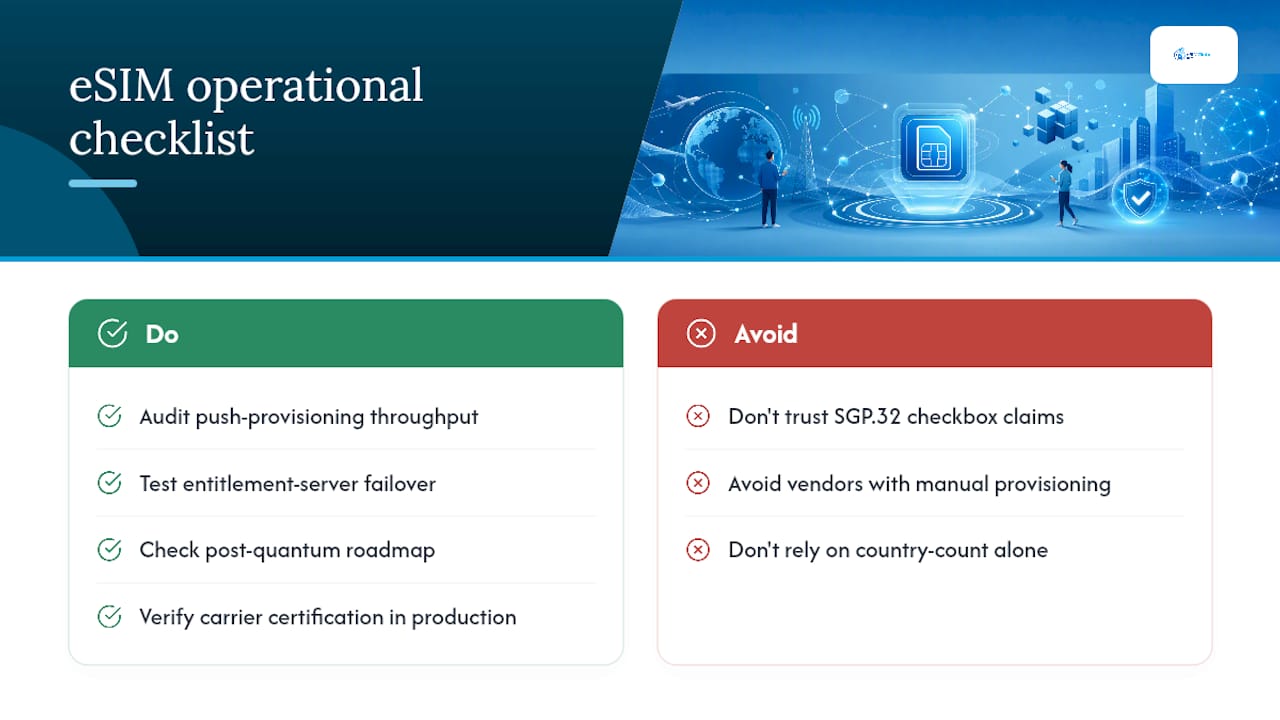
What most coverage underestimates is the compliance gap between SGP.32 on paper and SGP.32 in production. A vendor can claim SGP.32 support while running a partially manual provisioning workflow underneath. The test is throughput under load, not a checkbox on a spec sheet.
For U.S. professionals, the immediate priority is not waiting for the market to mature further. It is auditing current vendor capabilities against the operational benchmarks that 2026 scale actually requires: push-provisioning throughput, entitlement-server failover, post-quantum roadmap, and carrier certification coverage. The enterprises that do that audit now will not be the ones scrambling when a 50,000-device deployment hits a provisioning bottleneck at activation.
For travelers, the calculus is simpler but the same principle applies: choose providers that demonstrate operational transparency, not just broad country coverage.
FAQ
Will eSIM replace physical SIM cards entirely?
eSIM is on a clear trajectory to replace physical SIM cards in most consumer devices, with the U.S. market already seeing eSIM-only smartphones. Full replacement across all device categories will take several more years, particularly in markets where carrier infrastructure and regulatory frameworks lag.
Why do some people resist eSIM adoption?
The primary concerns are carrier lock-in perception, privacy (eSIM profiles are remotely manageable by operators), and the loss of the ability to physically swap SIMs. Some users also cite activation complexity and inconsistent carrier support as friction points.
Does an eSIM expire?
The embedded hardware remains functional; only the active profile or subscription has a validity period.
Are physical SIM cards going away soon?
Physical SIM cards are declining in new flagship devices, particularly in the U.S., but they remain standard in many mid-range and budget devices globally. A full phase-out across all markets is unlikely for several years, given the pace of carrier infrastructure upgrades in developing markets.