






















eSIM adoption in mobile devices has crossed from early-adopter territory into measurable mass-market deployment. Juniper Research forecasts notable growth in eSIM connections in 2026, reaching over a billion globally.
Three immediate implications for decision-makers:
- Operators face a commercial activation gap: consumer awareness has risen sharply, but only about 8% of eSIM-aware consumers report learning about it from their carrier, leaving significant acquisition upside uncaptured.
- OEMs are past the point of optionality. Apple’s eSIM-only handset strategy and Samsung’s expanding eSIM integration have made physical SIM tray removal a product-line decision, not a future roadmap item.
- Enterprise buyers need to update RFP specifications now. SGP.32, the GSMA’s IoT eSIM standard, is moving from pilot to production in 2026, and procurement contracts that do not specify push-provisioning capability will require costly renegotiation within 18 months.
Key Takeaways
eSIM adoption in mobile devices is accelerating faster on the activation side than the shipment side, with the 2026 inflection point representing the critical window for operators, OEMs, and enterprise buyers to complete infrastructure and commercial readiness before volume outpaces provisioning capacity.
| Point | Details |
|---|---|
| 2025 shipment baseline | TCA reports 605 million eSIM units shipped in 2025, up 18% year-on-year. |
| Activation gap is the key metric | Only ~30% of eSIM-capable devices had active profiles in 2024; closing this gap is where operator revenue sits. |
| 2026 is the inflection year | GSMA projects smartphone eSIM penetration doubling to ~10% by end-2026; ABI Research forecasts 633+ million shipments. |
| SGP.32 is essential for IoT deployments | Enterprise and IoT RFPs must specify SGP.32 and push-provisioning support as baseline requirements in 2026. |
| Operator discovery gap | Only ~8% of eSIM-aware consumers learned about it from their carrier, a direct revenue leak operators can address now. |
For prepaid travel and enterprise eSIM plans covering 170+ countries, Esimglobe delivers instant digital provisioning with 5G/4G LTE coverage and 24/7 support. Visit Esimglobe to explore plan options.
Table of Contents
- How does the eSIM mobile devices adoption trend look right now?
- What is driving faster eSIM adoption in mobile devices?
- What does eSIM growth mean for telcos, OEMs, and the broader value chain?
- What barriers are still slowing eSIM adoption?
- What do the forecasts say through 2030?
- What do the primary research sources actually show?
- Which use cases are seeing the fastest eSIM uptake?
- What should telcos, OEMs, and enterprise buyers do now?
- Three strategic bets for the next 24 months
- Selected sources and data references
- FAQ
How does the eSIM mobile devices adoption trend look right now?
Shipments and activation rates
The clearest picture of where the eSIM mobile devices adoption trend stands comes from shipment and activation data. TCA member reporting puts 2025 global eSIM shipments at an estimated 605 million units. Kaleido Intelligence and related reports estimate that the activation rate for eSIM-capable devices was around a third in 2024, with projections suggesting a significant increase by 2030. ABI Research forecasts eSIM-enabled device shipments will surpass 600 million in 2026, driven particularly by smartphone volumes and China’s domestic eSIM rollout.
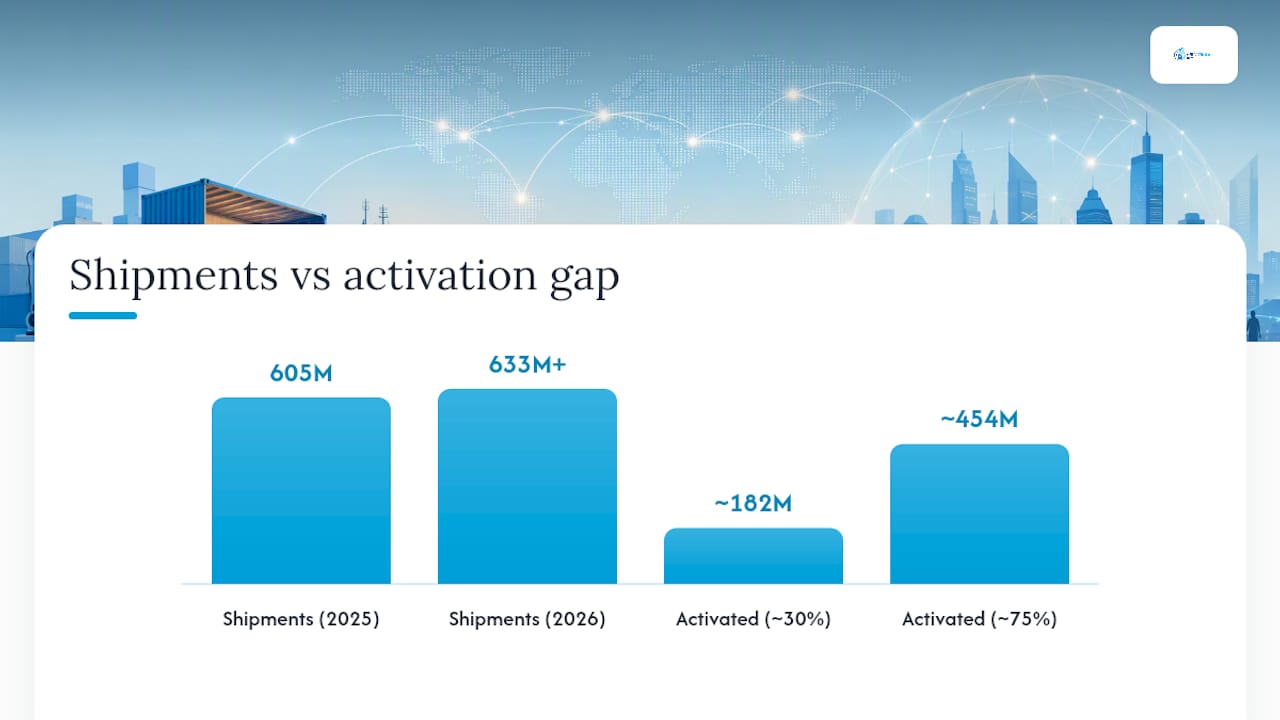
The gap between shipment and activation rates is the most operationally significant number in this dataset. A device shipped with eSIM hardware is not a device with an active eSIM profile. Closing that gap is where operator revenue actually sits.
Key shipment and activation figures:
| Metric | Value | Source |
|---|---|---|
| Global eSIM shipments (2025) | ~605 million units | TCA |
| Year-on-year shipment growth (2025) | 18% | TCA |
| Consumer eSIM profile downloads growth (2025) | +43% YoY | TCA |
| eSIM activation rate for capable devices (2024) | ~30% | Kaleido Intelligence |
| Projected activation rate (2030) | ~75% | Kaleido Intelligence |
| Global smartphone eSIM penetration (end-2025) | ~5% | GSMA Intelligence |
| Projected smartphone eSIM penetration (end-2026) | ~10% | GSMA Intelligence |
| Forecast eSIM-enabled device shipments (2026) | 633+ million | ABI Research |
Regional position: U.S. vs. Asia-Pacific and emerging markets
- United States: Among the most advanced markets for consumer eSIM activation, driven by Apple’s eSIM-only iPhone models (U.S. variants since iPhone 14) and strong carrier support from the three major national operators.
- Asia-Pacific: High shipment volumes but historically lower activation rates due to carrier provisioning gaps; China’s domestic eSIM trial expansion in 2025 is the single largest near-term volume catalyst globally.
- Emerging markets: Shipment penetration remains low; regulatory frameworks and legacy OSS/BSS infrastructure are the primary constraints, not consumer demand.
What is driving faster eSIM adoption in mobile devices?
Four forces are compressing the adoption timeline simultaneously, and each operates on a different part of the value chain.
Device OEM decisions are the most visible driver. Apple removed the physical SIM tray from U.S. iPhone 14 models in 2022, forcing every U.S. carrier to operationalize eSIM provisioning at consumer scale. Apple’s OS-level eSIM activation flows, documented in iOS guidance, reduce the steps between purchase and active profile to a few taps. Samsung has followed with eSIM integration across its Galaxy S and Z-series lines, and its enterprise device management tooling now supports remote eSIM provisioning natively.
SGP.32 and GSMA standards lower the technical barrier for IoT deployments specifically. SGP.32 is the GSMA’s specification for IoT eSIM management, designed to work with constrained devices that cannot run the full M2M or consumer eSIM stack. Its practical effect is that a fleet of connected sensors, vehicles, or wearables can receive profile updates remotely without physical intervention. Subscription manager platforms that implement SGP.32 allow operators to push profiles to devices at scale, rather than waiting for devices to initiate a pull request.

IoT growth is adding connection volume that dwarfs smartphone numbers in raw unit terms. Connected vehicles, industrial sensors, and smart meters are shipping with eSIM hardware as a default, not an option, because the alternative (physical SIM logistics at millions of units) is operationally untenable.
Enterprise mobile device management integration is the fourth driver. IT departments managing large device fleets can now provision eSIM profiles through MDM platforms such as Microsoft Intune and VMware Workspace ONE, eliminating the manual SIM-swap workflow that previously made large-scale corporate deployments expensive. For business travelers and enterprise teams, this means connectivity can be configured before a device leaves the office.
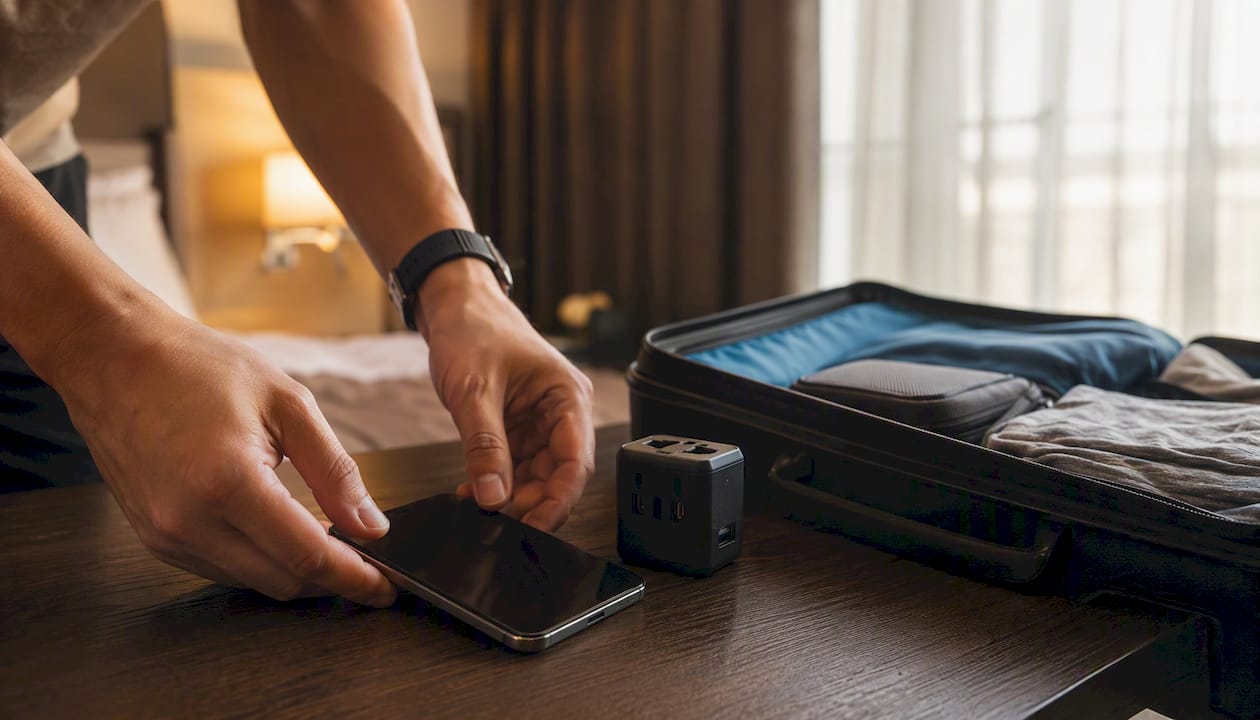
Travel eSIM demand is a consumer-facing accelerator that is underappreciated in operator strategy discussions. International travelers who activate a travel eSIM for the first time frequently become the primary channel through which eSIM awareness spreads in their social and professional networks.
What does eSIM growth mean for telcos, OEMs, and the broader value chain?
Operator implications
AlixPartners and Roland Berger both frame eSIM as structurally disruptive to traditional telco customer acquisition. When a consumer can switch carriers by downloading a new profile rather than visiting a store, churn friction drops and the cost of acquisition for a competitor falls. The operators that benefit are those that invest in digital provisioning quality and commercial activation campaigns, not those that simply support eSIM technically.
Roaming economics shift as well. eSIM-capable travelers can activate a local or regional data profile before landing, bypassing the operator’s international roaming revenue entirely. Carriers that respond by offering competitive travel data products retain that revenue; those that do not lose it to third-party eSIM providers. The role of eSIM in telecommunications is reshaping how operators think about retention and lifetime value.
OEM implications
- Product planning must account for eSIM-only models as a logistics simplification, not just a feature: removing the SIM tray reduces manufacturing complexity and enables thinner, more water-resistant designs.
- Marketing teams need to own eSIM activation as a post-purchase experience metric. A device sold but never activated on eSIM is a missed revenue signal for both the OEM’s ecosystem services and the carrier partner.
- Launch timing in markets with incomplete carrier support (parts of Southeast Asia, Latin America) requires phased hardware strategies or dual-SIM fallback configurations.
MVNO and service-provider implications
- MVNOs with eSIM-capable platforms can acquire customers without physical SIM distribution, reducing cost-to-serve materially.
- Orchestration partnerships with subscription manager platforms become a competitive differentiator: the MVNO that can provision a profile in under 60 seconds wins the traveler and the enterprise buyer.
- Differentiation increasingly sits in plan flexibility and geographic coverage rather than hardware, which is where platforms like Esimglobe compete on a global basis.
Pro Tip: *Operators should treat commercial eSIM activation rate, not eSIM hardware shipment rate, as the primary KPI for their eSIM program.
What barriers are still slowing eSIM adoption?
Despite strong shipment growth, several structural barriers are keeping activation rates well below shipment rates.
- Carrier marketing and discovery gap: Consumer awareness of eSIM has grown from roughly 25% to approximately 60% in a short window, but only about 8% of eSIM-aware consumers report learning about it from their carrier. The primary discovery channels are device manufacturers and word of mouth, not operators.
- Pull vs. push provisioning limits: Most consumer eSIM deployments today use a pull model: the device initiates a request to download a profile. At enterprise and IoT scale, pull provisioning is operationally inadequate. Juniper Research specifically recommends that platforms pivot to push or server-driven provisioning, where the network can initiate profile delivery to a device without user action. Few commercial platforms have fully implemented this at production scale.
- Legacy OSS/BSS integration: Carrier back-office systems built for physical SIM management require significant re-engineering to support eSIM profile lifecycle management. This is the most expensive and time-consuming barrier for incumbent operators.
- Device fragmentation: Not all eSIM-capable devices support the same GSMA specification version. Older M2M eSIM devices (SGP.01/02) are not compatible with consumer eSIM profiles (SGP.22), and neither is fully aligned with the newer SGP.32 IoT standard. Procurement teams that do not specify the required spec version in RFPs risk interoperability failures.
- Regulatory and market restrictions: Some markets have historically restricted or delayed eSIM support for policy reasons. China’s domestic eSIM expansion in 2025 represents a significant regulatory shift, but the rollout remains controlled and carrier-specific.
It means carriers are spending on eSIM infrastructure while ceding the awareness and activation conversation to device manufacturers and third-party providers.
What do the forecasts say through 2030?
The trajectory is clear, though the pace of activation growth depends heavily on operator execution.
Key milestones:
- 2017: First consumer eSIM devices (Apple Watch Series 3) establish the hardware category.
- 2022: Apple removes the physical SIM tray from U.S. iPhone 14 models, the single most consequential OEM decision in consumer eSIM history.
- 2024: Global eSIM activation rate for capable devices reaches approximately 30% (Kaleido Intelligence).
- 2025: TCA confirms 605 million eSIM units shipped, 18% growth, and a 43% increase in consumer profile downloads. GSMA Intelligence sets smartphone eSIM penetration at ~5% globally. China begins domestic eSIM expansion.
- 2026: GSMA projects smartphone eSIM penetration doubling to ~10%. ABI Research forecasts 633+ million eSIM-enabled device shipments. Juniper Research projects 30% growth in eSIM connections, reaching 1.5 billion globally. SGP.32 deployment momentum accelerates across IoT verticals.
- 2027–2030: GSMA Intelligence projects eSIM smartphone connections will outnumber removable SIM connections by 2030. Kaleido Intelligence projects activation rates reaching 75% for eSIM-capable devices by 2030.
The 2026 inflection is the most strategically important window. Operators and enterprise buyers that complete their provisioning infrastructure upgrades and commercial activation programs before end-2026 will be positioned ahead of the volume curve. Those that wait for 2027 will be responding to a market that has already moved.
What do the primary research sources actually show?
The strongest signal in the current data is the divergence between shipment growth and activation growth. That is a healthy sign: the installed base of eSIM-capable devices is being monetized at an improving rate.
Key analyst insight: Juniper Research identifies SGP.32 as the technical prerequisite for eSIM to scale beyond smartphones into the billions of IoT connections projected through 2030. Without push-provisioning infrastructure, operators cannot manage profile delivery at IoT volumes. The implication for procurement teams is direct: any eSIM platform contract signed in 2026 should require SGP.32 support and push-provisioning capability as baseline specifications, not optional features.
Source selection note: The figures in this briefing draw from industry associations (TCA, GSMA), market research firms with dedicated eSIM coverage (Kaleido Intelligence, Juniper Research, ABI Research), and strategy consultancies (AlixPartners, Roland Berger). Statista aggregates secondary market-size and consumer-expectation data useful for cross-referencing. Primary association data (TCA, GSMA) is weighted most heavily for shipment and penetration figures because it reflects member-reported actuals rather than modeled estimates.
Procurement implications for enterprise buyers:
- Request push-provisioning capability confirmation, not just pull-model support
- Validate security certifications against GSMA SAS-SM and SAS-UP standards for subscription manager platforms
Which use cases are seeing the fastest eSIM uptake?
Not all eSIM use cases are moving at the same speed. Prioritizing by operator readiness and enterprise ROI changes the investment sequence.
- Consumer smartphones: Highest current volume, fastest activation growth. U.S. market is the most mature globally, driven by Apple’s eSIM-only hardware and strong carrier provisioning. The primary remaining barrier is consumer awareness, not technical readiness.
- Connected vehicles (automotive): eSIM is the default connectivity standard for new vehicle platforms. Remote profile updates allow automakers to switch carriers without recalling vehicles, a logistics and cost advantage that makes eSIM mandatory at production scale. Operator readiness for automotive-grade SLA requirements is the current constraint.
- Wearables: Apple Watch, Samsung Galaxy Watch, and similar devices have driven consumer familiarity with eSIM companion profiles. The wearable category is where many U.S. consumers first encountered eSIM activation, making it an underappreciated awareness driver for smartphone eSIM uptake.
- Enterprise device fleets: MDM-integrated eSIM provisioning is the highest-ROI enterprise use case. A company managing 10,000 devices across multiple countries can eliminate physical SIM logistics entirely. Centralized orchestration through platforms that support SGP.32 and push provisioning is the technical requirement.
- IoT and M2M (industrial sensors, smart meters, logistics tracking): Highest volume potential through 2030, but the most technically demanding. SGP.32 is specifically designed for constrained IoT devices. Deployments in this category require operator partners with production-grade push-provisioning infrastructure.
- Hospitality and corporate housing: An emerging enterprise use case where property managers can provision guest devices with local data connectivity as part of the stay experience. Corporate housing providers that maximize guest comfort through pre-provisioned eSIM connectivity reduce friction for business travelers and differentiate their offering.
- Travel eSIM (consumer): The fastest-growing consumer awareness channel. Travelers who activate a data eSIM for an international trip are significantly more likely to use eSIM for domestic switching afterward. Platforms like Esimglobe serve this segment with prepaid data plans across 170+ countries, instant digital delivery, and multi-region support.
Pro Tip: For enterprise fleet deployments, pilot SGP.32-capable provisioning on a 50–100 device subset before committing to a full rollout. The provisioning success rate and profile delivery latency in your specific network environment will differ from vendor benchmarks, and a pilot surfaces integration issues before they affect production operations.
What should telcos, OEMs, and enterprise buyers do now?
Telco checklist
- Audit commercial eSIM activation rate by device segment (smartphone, wearable, IoT) and set a 12-month improvement target.
- Launch a carrier-owned eSIM awareness campaign. The 8% operator-discovery rate is a direct revenue leak; closing it to 20–25% within 12 months is achievable with targeted digital marketing.
- Complete OSS/BSS integration for eSIM profile lifecycle management before the 2026 volume surge. Operators that are not operationally ready when ABI Research’s 633+ million shipment forecast materializes will face provisioning failures at scale.
- Evaluate push-provisioning capability with your subscription manager platform vendor. Pull-only platforms will not scale for IoT contract volumes.
OEM checklist
- Confirm SGP.32 hardware support in all IoT and enterprise device lines shipping after Q2 2026.
- Build eSIM activation into the out-of-box setup flow, not as an optional step. Apple’s iOS activation flow is the benchmark: activation should require no more than three user interactions.
- Provide carrier partners with activation rate reporting by market so they can identify provisioning failures before they affect customer satisfaction scores.
Enterprise buyer checklist
- Update device procurement specifications to require eSIM capability and SGP.32 support for all new fleet purchases.
- Require push-provisioning capability, activation SLA documentation, and GSMA SAS-SM security certification from eSIM platform vendors.
- Pilot MDM-integrated eSIM provisioning on a defined device subset before full deployment. Schedule the pilot for Q3 2026 to align with SGP.32 deployment momentum.
- For international travel programs, evaluate travel eSIM options as a standard employee benefit. The cost savings versus carrier roaming charges are material at scale, and platforms with 170+ country coverage eliminate the need for per-trip SIM procurement.
Vendor evaluation criteria:
- SGP.32 specification support (documented, not roadmap)
- Push-provisioning capability at production scale
- Activation SLA: profile delivery time and success rate thresholds
- GSMA SAS-SM and SAS-UP security certifications
- Multi-region coverage and local carrier partnerships
- API integration with major MDM platforms
Three strategic bets for the next 24 months
The data points in one direction, but strategy requires choosing where to concentrate. Three bets stand out as high-conviction given the current evidence.
The overall stance: 2026 is the last window to build eSIM infrastructure ahead of the volume curve. Operators and enterprise buyers that treat this as a 2027 problem will spend 2027 and 2028 catching up.
Bet 1: Push provisioning becomes the operator differentiator by end-2027. Carriers that complete the pull-to-push migration will win IoT contract volumes that pull-only platforms cannot serve. The technical investment is front-loaded; the revenue benefit compounds.
Bet 2: China’s domestic eSIM expansion reshapes global shipment forecasts faster than current projections assume. ABI Research already names China as a key accelerator for the 633+ million 2026 shipment forecast.
Travelers activating eSIM for international trips will drive more consumer awareness per dollar than any carrier campaign, and platforms serving that segment will capture the first-mover loyalty that operators are leaving on the table.
Selected sources and data references
The following sources informed the figures and analysis in this briefing. All are primary industry association reports, commissioned market research, or strategy consultancy publications.
- Trusted Connectivity Alliance (TCA): — Industry association representing the SIM and eSIM supply chain. Source for 2025 global shipment figures (605 million units, 18% growth) and consumer profile download growth (43% YoY).
- GSMA Intelligence: — Research arm of the GSMA standards body. Source for global smartphone eSIM penetration figures (5% end-2025, 10% projected end-2026) and consumer awareness statistics.
- Juniper Research: — Independent market research firm specializing in digital technology. Source for 2026 eSIM connection growth forecast (30%, 1.5 billion connections) and SGP.32 provisioning model guidance.
- ABI Research: — Technology market research firm. Source for 2026 eSIM-enabled device shipment forecast (633+ million) and China domestic eSIM acceleration analysis.
- AlixPartners and Roland Berger: — Global strategy consultancies. Source for operator strategy commentary on eSIM’s impact on telco value chains and commercial activation recommendations.
- Statista: — Data aggregator. Maintains secondary datasets on eSIM market size, consumer expectations, and emissions comparisons between SIM types; useful for cross-referencing market-size context.
FAQ
Why is eSIM not more widely used yet?
The primary barrier is the gap between hardware availability and commercial activation.
What are the downsides of using an eSIM?
Device fragmentation across GSMA specification versions for M2M, consumer, and IoT creates interoperability risks, and some markets still have limited carrier support. For consumers, transferring an eSIM profile when switching to a new device requires carrier cooperation and is less straightforward than physically moving a SIM card.
Why are phone manufacturers switching to eSIM?
Removing the physical SIM tray reduces manufacturing complexity, enables thinner and more water-resistant designs, and eliminates SIM logistics costs. Apple’s decision to ship U.S. iPhone 14 models without a SIM tray in 2022 established the commercial precedent, and Samsung’s expanding eSIM integration across its flagship lines reflects the same product-engineering rationale.
Will eSIM connections outnumber physical SIM connections by 2030?
How does eSIM affect international roaming costs?
eSIM allows travelers to activate a local or regional data profile before or upon arrival in a destination country, bypassing carrier roaming rates entirely. This is the primary driver of travel eSIM demand and the reason platforms offering prepaid eSIM data plans across multiple countries have grown alongside smartphone eSIM adoption.