






















TL;DR:
- Business eSIMs enable remote management of mobile plans, improving security, control, and activation speed. They eliminate physical logistics and provide instant, centralized control over travel data and costs, enhancing operational efficiency. Managed eSIM platforms also offer stronger security features, such as remote suspension and multi-network switching, compared to traditional SIM cards.
An eSIM, or embedded SIM, is a digital SIM card built directly into a device that allows businesses to activate and manage mobile plans remotely, without physical SIM cards. Business connectivity with eSIM explained simply means your company can provision, monitor, and control mobile data for every traveling employee from a single platform. This replaces the old model of handing out physical SIMs at the airport or paying unpredictable roaming bills. The result is faster activation, tighter cost control, and stronger security across your entire mobile workforce. Apple, for instance, supports dual active eSIMs on iPhone, storing eight or more profiles for instant switching between home and travel plans.
How does eSIM technology work for business devices?

eSIM provisioning runs on the GSMA’s Remote SIM Provisioning (RSP) architecture. Three components make it function: the eUICC (embedded Universal Integrated Circuit Card), the SM-DP+ server, and the Local Profile Assistant (LPA) software on the device. The eUICC is the physical chip inside the device. The SM-DP+ server is where operators store encrypted SIM profiles. The LPA is the software that connects the two.
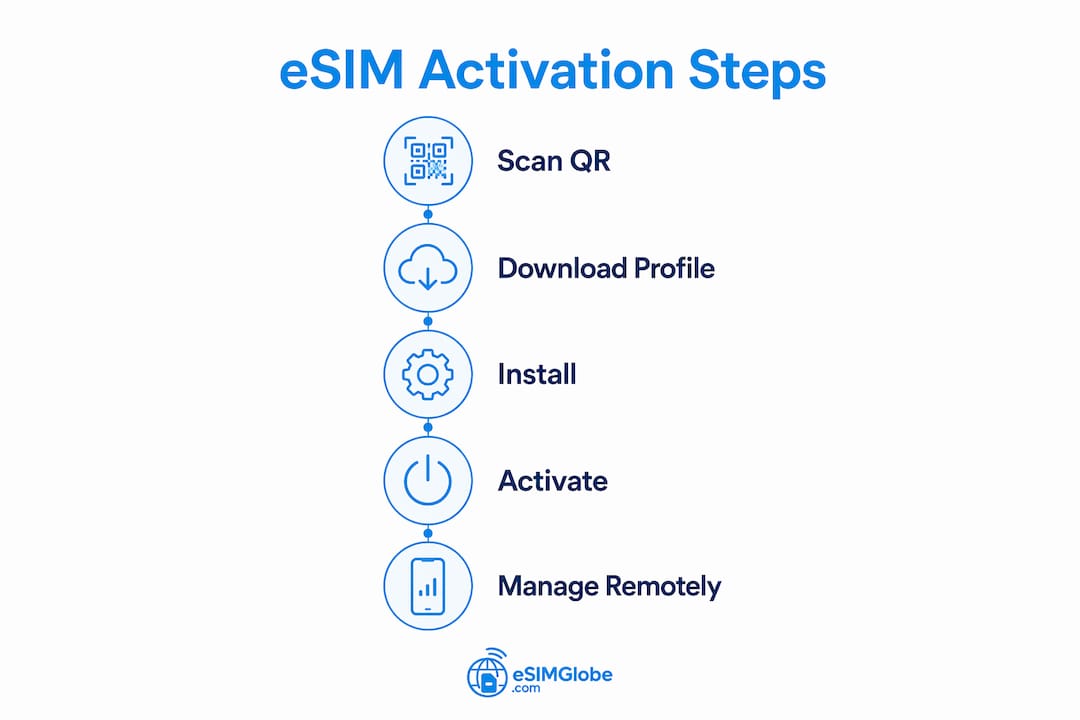
The activation process step by step
- Request a profile. Your IT team or the employee requests a new eSIM plan through a management platform or carrier portal.
- Receive a QR code. The SM-DP+ server generates an encrypted QR code tied to the specific profile.
- Scan and download. The employee scans the QR code using the device’s LPA software. The profile downloads securely from the SM-DP+ server over Wi-Fi or an existing cellular connection.
- Activate and register. The device registers to the carrier network. The eSIM functions exactly like a physical SIM from this point forward.
The entire process typically takes 2–5 minutes. The initial internet connection is the only dependency. Once the profile is downloaded, the eSIM works independently.
Consumer and enterprise provisioning differ in one critical way. Consumer activation is self-service, driven by the individual. Enterprise provisioning is centrally managed, meaning IT controls which profiles go to which devices, when they activate, and when they expire. This distinction matters for companies managing dozens or hundreds of traveling employees.
Device storage limits are also worth understanding. iPhones store eight or more eSIM profiles but only two can be active simultaneously. Enterprises can pre-load profiles for likely travel destinations, so employees switch plans in seconds rather than waiting for a new download abroad.
Pro Tip: Pre-load eSIM profiles for your top five travel destinations on company devices before employees depart. This eliminates activation delays caused by slow hotel Wi-Fi or airport connectivity issues.
The GSMA RSP architecture separates the operator profile from the device’s security layer. This design means a carrier can update or replace a profile without touching the device’s core security credentials. For IT teams, this translates to full remote control over connectivity without needing physical access to the device.
What are the key business benefits of using eSIM for international connectivity?
The core value of eSIM for businesses is not simply replacing a plastic card. Centralized governance is the real advantage. IT and finance teams gain full visibility and control over every connection, every cost, and every device on the network.
Operational and financial advantages
- Cost control. Employees connect at local data rates instead of international roaming premiums. Unmanaged roaming creates multiple billing relationships with no central visibility. Centralized eSIM management consolidates all spend into one dashboard.
- Instant activation. Employees activate a travel plan before boarding, not after landing in a foreign country. There is no waiting for a SIM card to arrive by mail or hunting for a carrier store.
- Multi-network access. Enterprise eSIM platforms allow switching between carriers to find the best signal. This eliminates single-carrier dependency, which is a real risk in regions where one network has poor coverage.
- Lifecycle management. When an employee leaves the company, IT suspends or deletes their eSIM profile remotely within minutes. No physical SIM retrieval is required.
- Auditability and duty of care. Real-time connectivity tracking and historical activity logs give HR and security teams the data they need for ISO 31030-oriented travel safety programs. Knowing an employee is connected and where they last registered is a meaningful safety tool.
Security advantages that physical SIMs cannot match
“Apple states eSIM is more secure than a physical SIM because it cannot be removed from a lost or stolen device, and connectivity can be suspended remotely within minutes.” — Apple Support
The non-removability of eSIM eliminates SIM swap theft, a fraud method where criminals physically remove a SIM to hijack a phone number. For business devices carrying sensitive communications, this protection is significant. Remote suspension adds another layer. If a device is reported lost in Tokyo, the eSIM line goes dark before the employee finishes filing the report.
Centralized management platforms like eSIM Copilot allow companies to issue, monitor, top-up, suspend, and disable eSIM lines instantly. This level of control is simply not possible with physical SIM cards distributed across a traveling workforce.
How does business eSIM compare to traditional SIM cards and unmanaged roaming?
Physical SIM logistics create friction at every stage. Cards must be ordered, shipped, distributed, and collected. Employees traveling to three countries in one trip need three SIMs or pay roaming fees on one. Finance teams receive bills from multiple carriers with no unified view of spend.
Unmanaged roaming compounds the problem. Without a centralized platform, each employee’s device connects to whatever network is available, often at premium rates. There is no spend approval workflow, no usage cap, and no visibility until the bill arrives weeks later.
The table below shows where each approach stands on the factors that matter most to business decision-makers.
| Feature | Physical SIM | Unmanaged roaming | Managed eSIM |
|---|---|---|---|
| Activation speed | Hours to days | Instant but uncontrolled | 2–5 minutes, IT-controlled |
| Cost visibility | Per-carrier billing | Fragmented, delayed | Consolidated, real-time |
| Security on device loss | SIM removable | SIM removable | Remote suspension, non-removable |
| Multi-country coverage | One SIM per country | Carrier-dependent | Multi-network switching |
| IT lifecycle control | Manual retrieval | None | Remote issue, suspend, delete |
| Employee experience | Friction-heavy | Variable | Consistent and fast |
The eSIM vs physical SIM comparison is not just about convenience. It is about operational control. A company with 50 employees traveling internationally each month cannot manage connectivity through physical SIM logistics without significant administrative overhead.
Pro Tip: When evaluating eSIM platforms, ask specifically about spend approval workflows. The best platforms let managers set per-trip data budgets and receive alerts before an employee exceeds them.
The security gap between physical SIM and managed eSIM is also wider than most IT teams realize. Physical SIMs can be cloned, swapped, or simply lost with the device. Managed eSIM profiles are encrypted, tied to the device’s eUICC, and revocable in real time. For companies handling confidential client data on mobile devices, this difference is material.
What practical steps should businesses take to implement eSIM connectivity?
A structured rollout avoids the common failure points: incompatible devices, poor coverage planning, and employees who do not know how to switch profiles.
Step-by-step implementation
- Audit device compatibility. Confirm that company devices support eSIM and check profile storage limits. iPhones from iPhone XS onward support eSIM. Many Android flagships from Samsung, Google Pixel, and others do as well. Devices without eSIM support need a hardware upgrade before rollout.
- Select a management platform. Choose a centralized eSIM management platform that integrates with your existing Mobile Device Management (MDM) system. Platforms like eSIM Copilot handle bulk deployment, usage monitoring, and lifecycle controls in one place.
- Plan coverage with redundancy. Enterprise eSIM strategies prioritize multi-network access to avoid single-carrier dependency. Map your employees’ most frequent destinations and confirm your platform has strong carrier partnerships in those regions.
- Build an onboarding workflow. Create a clear activation guide for employees. Include how to scan a QR code, how to switch between profiles, and who to contact if activation fails. A two-page reference card solves most support tickets before they happen.
- Set spend controls and monitoring rules. Configure data budgets per trip or per employee. Set alerts for unusual usage. Establish a clear protocol for reporting lost devices so IT can suspend the eSIM line immediately.
- Plan for employee departures. Define the offboarding process for eSIM profiles. The platform should allow IT to suspend or delete profiles remotely the moment an employee’s access is revoked.
Ongoing management considerations
- Review usage reports monthly to identify cost anomalies.
- Update pre-loaded destination profiles as travel patterns change.
- Confirm carrier partnerships remain active in key regions.
- Test remote suspension procedures at least once per quarter.
- Keep a record of which profiles are assigned to which devices for audit purposes.
The best eSIM for traveling is one that fits both the device and the destination. For businesses, the right plan also fits the management infrastructure. A plan that works perfectly for a solo traveler may lack the lifecycle controls an enterprise IT team requires.
Connectivity auditability is a governance requirement, not a bonus feature. ISO 31030-oriented programs use real-time connectivity status and historical logs for duty-of-care compliance. Your eSIM platform should produce those logs automatically and make them accessible to HR and security teams without manual data pulls.
Key takeaways
Business eSIM delivers its greatest value through centralized IT control over provisioning, cost, security, and lifecycle management, not simply by replacing a physical card.
| Point | Details |
|---|---|
| Centralized control is the core benefit | IT manages every profile remotely, from activation to suspension, without physical access to devices. |
| Activation takes 2–5 minutes | Employees download profiles via QR code over Wi-Fi before departure, eliminating airport SIM hunts. |
| Security exceeds physical SIM | Non-removable eSIM profiles can be suspended remotely within minutes of a device being reported lost. |
| Multi-network access reduces risk | Enterprise platforms switch carriers to maintain coverage and avoid single-carrier dependency abroad. |
| Auditability supports duty of care | Real-time connectivity logs and activity history satisfy ISO 31030 travel safety requirements. |
Why most businesses underestimate what eSIM actually changes
The conversation about eSIM in business circles tends to focus on the wrong thing. Most articles lead with “no more physical SIM cards,” as if the plastic card was the main problem. The real shift is operational.
When I look at how companies actually manage international travel connectivity, the breakdown almost always happens at the same point: the moment an employee lands in a new country and discovers their plan does not work, or finance receives a roaming bill three weeks later with no context. Neither problem is solved by simply having an eSIM. Both are solved by having a managed eSIM platform with real governance behind it.
The security angle is also consistently underestimated. IT teams I have spoken with treat eSIM security as a nice-to-have rather than a core control. That changes fast after the first incident where a lost device keeps running on an active SIM line for 72 hours because no one could suspend it remotely.
The implementation challenge businesses overlook most often is coverage planning. Choosing a platform with strong carrier partnerships in your actual travel destinations matters far more than the platform’s feature list. A beautifully designed dashboard does not help if your employee in Jakarta cannot get a signal.
My honest prediction: within three years, enterprise eSIM management will be a standard line item in IT governance frameworks, sitting alongside MDM and endpoint security. Companies that build the infrastructure now will have a significant operational advantage over those still distributing physical SIMs. The eSIM travel tips that matter most are not about the technology itself. They are about the management layer you build around it.
— daniele
Esimglobe’s Asia unlimited plan for business travelers
Business travelers heading to Asia need reliable data across multiple countries without juggling separate SIM cards for each destination.
Esimglobe’s Asia Unlimited Day Pass covers 20 Asian areas with unlimited data on a single eSIM plan. Activation is instant via QR code, and the plan works on any eSIM-compatible device. There are no roaming surcharges and no physical SIM required. For business travelers moving between Japan, South Korea, Singapore, Thailand, and other key Asian markets, this plan removes the connectivity friction that slows down productive travel. You can purchase and activate before departure, so your device is ready the moment you land.
FAQ
What is an eSIM in a business context?
An eSIM is a digital SIM profile embedded in a device that businesses can provision, manage, and revoke remotely through a centralized platform, replacing physical SIM card logistics entirely.
How long does eSIM activation take for business devices?
eSIM activation typically takes 2–5 minutes. The employee scans a QR code, downloads the profile over Wi-Fi or cellular, and the device registers to the carrier network automatically.
Is eSIM more secure than a physical SIM for business use?
Yes. eSIM profiles cannot be physically removed from a lost or stolen device, and IT teams can suspend the line remotely within minutes, eliminating the window of exposure that physical SIMs create.
Can one device hold multiple eSIM profiles for different countries?
iPhones can store eight or more eSIM profiles and run two simultaneously. Enterprises pre-load destination profiles so employees switch plans instantly without downloading a new profile abroad.
What is the difference between managed eSIM and unmanaged roaming?
Managed eSIM gives IT full visibility over spend, usage, and device status in real time. Unmanaged roaming produces fragmented billing across multiple carriers with no central oversight or spend controls.