





















TL;DR:
- A Caribbean eSIM is a digital profile that connects your phone to local networks instantly upon arrival without needing a physical SIM card. It offers faster activation, better coverage across multiple islands, and often lower costs compared to local SIM cards, especially for multi-island trips. Travelers should choose plans with direct carrier agreements, install them at least 24 hours before departure, and verify coverage for their specific destinations to enjoy seamless connectivity.
An eSIM for the Caribbean is a digital SIM profile embedded in your smartphone that connects you to local mobile networks the moment you land, with no physical SIM card required. Caribbean travel eSIM options have grown significantly as more islands expand their 4G LTE and 5G infrastructure, making digital connectivity a practical choice for island hopping and resort stays alike. Travelers who use an eSIM avoid the familiar airport scramble for a local SIM card, skip roaming fees charged by home carriers, and gain the flexibility to manage data from their phone settings. This guide covers how eSIMs compare to local SIM cards, which Caribbean islands offer the strongest coverage, how to activate a plan correctly, and how to keep mobile costs under control throughout your trip.
How does an eSIM Caribbean plan compare to a local SIM card?
An eSIM is embedded in your device and stores mobile network profiles digitally, so you never open a SIM tray or visit a carrier store. A local SIM card, by contrast, requires a physical purchase at an airport kiosk, a carrier shop, or a convenience store after you arrive. That difference in setup time matters when your flight lands at 11 p.m. and you need a map or a ride.
Convenience and activation speed

eSIM activation happens before you board your flight. You scan a QR code or use an app, and the profile installs in minutes. Local SIM cards require you to find a vendor, verify your identity in some destinations, and wait for the card to register on the network. For travelers visiting multiple Caribbean islands in one trip, an eSIM with regional coverage removes the need to buy a new card at each stop.
Coverage consistency across islands
Local SIM cards lock you to one carrier’s network on one island. When you sail or fly to the next destination, that card may have no signal or charge you roaming fees within the Caribbean itself. A regional eSIM plan covers multiple islands under one data allowance, which is a real advantage for itineraries that include Barbados, Jamaica, the Bahamas, and Trinidad and Tobago in the same two weeks.
Cost comparison
| Factor | eSIM plan | Local SIM card |
|---|---|---|
| Purchase location | Online, before departure | In-country vendor |
| Setup time | Minutes via QR code | 30–60 minutes on arrival |
| Multi-island coverage | Often included | Rarely included |
| Roaming within Caribbean | Covered by plan | Extra charges apply |
| Hotspot/tethering | Frequently unlimited | Often restricted |
| Upfront cost clarity | Fixed prepaid price | Variable, fees may surprise |
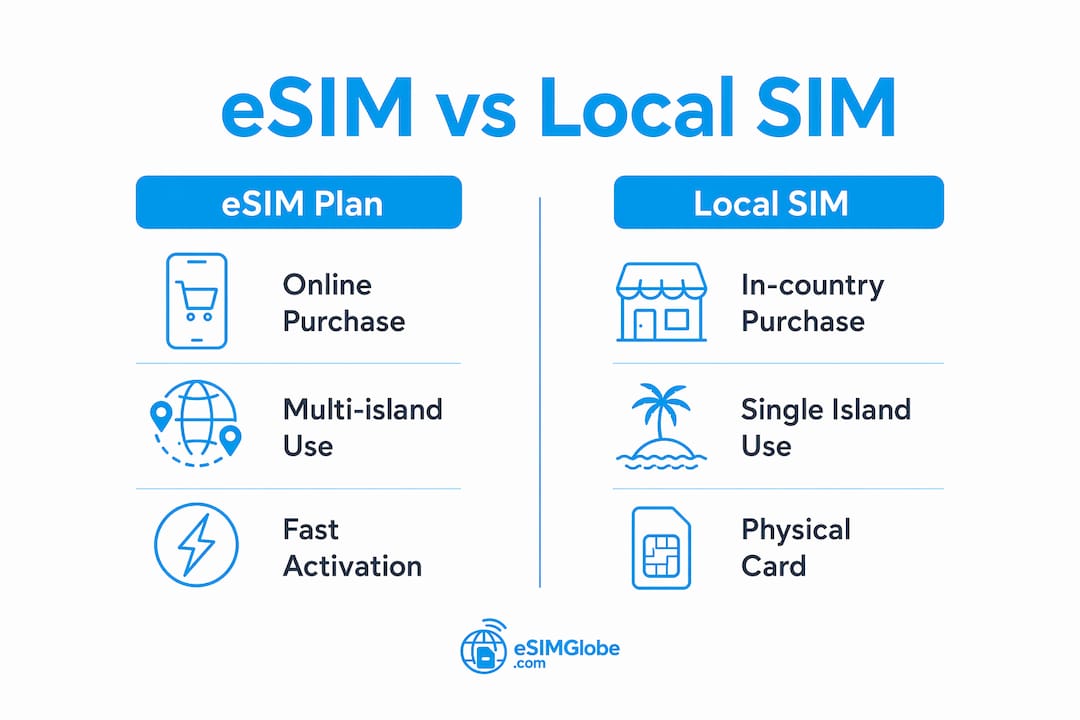
Prepaid eSIM plans for the Caribbean start around $30 for multi-country data packages. That figure is typically lower than what a home carrier charges for international roaming on a single island. Local SIM cards can be cheaper per gigabyte on a single island, but the cost advantage disappears once you factor in multiple destinations or the time spent finding a vendor.
Pro Tip: Buy your Caribbean eSIM at least 24 hours before departure. This gives you time to troubleshoot any installation issues while you still have your home network as a backup.
Local SIM cards still make sense in one scenario: a long stay of three weeks or more on a single island where a local prepaid plan offers the lowest per-gigabyte rate. For any itinerary involving two or more islands, a regional eSIM plan wins on both convenience and total cost.
What are the best practices for choosing and activating a Caribbean eSIM?
Choosing the right plan starts with estimating your data needs honestly. Typical traveler consumption in the Caribbean runs between 3GB and 10GB for moderate use over a week. Moderate use means maps, messaging, social media, and occasional video calls. Streaming video or using your phone as a hotspot for a laptop pushes that figure toward the higher end.
Step-by-step activation process
-
Check device compatibility. Confirm your phone supports eSIM. Most iPhones from the XS onward, Google Pixel 3 and later, and Samsung Galaxy S20 and later are compatible. Carrier-locked phones may block eSIM installation, so verify with your home carrier before purchasing a plan. Esimglobe provides a device compatibility guide that lists current eSIM-ready models.
-
Select the right data volume. Choose a 5GB plan for light use on a short trip. Choose a 10GB plan for a week of moderate use. Choose an unlimited plan if you plan to tether other devices or stream regularly.
-
Purchase and install before departure. Activation via QR code or app requires a stable internet connection. Complete this step at home, not at the gate.
-
Set data roaming correctly. After installation, go to your phone’s cellular settings and set the eSIM as your data line. Keep your home SIM active for calls and texts if your plan does not include voice.
-
Test the connection before boarding. Send a message or load a webpage using the eSIM profile to confirm it is active. Some profiles activate only upon arrival in the destination country, which is normal.
-
Monitor usage during your trip. Your phone’s built-in data usage tracker shows consumption per SIM line. Check it daily to avoid running out on day four of a seven-day trip.
Pro Tip: If your eSIM profile shows “no service” on arrival, toggle airplane mode off and on. This forces the phone to re-register on the local network and resolves the issue in most cases.
Troubleshooting beyond that step usually involves contacting your eSIM provider’s support team. Reputable providers offer chat or email support around the clock, which matters when you are in a different time zone.
Which Caribbean destinations have the best eSIM network coverage?
Network quality across the Caribbean is not uniform. Coverage depends on the local carrier infrastructure on each island and whether your eSIM provider has a direct roaming agreement with that carrier. Direct carrier agreements produce faster data speeds and more reliable connections than generic international roaming arrangements.
Islands with strong 4G and 5G coverage
- Bahamas. Nassau and Paradise Island have strong 4G LTE coverage. The outer islands have variable signal. Esimglobe’s Bahamas eSIM guide details which carriers provide the best coverage by area.
- Barbados. One of the most connected islands in the region. 4G LTE coverage reaches most of the island, and 5G expansion is underway in Bridgetown.
- Jamaica. Kingston and Montego Bay have reliable 4G. Rural parishes have weaker signal.
- Trinidad and Tobago. Port of Spain offers strong urban coverage. Tobago’s resort areas are well covered, with some gaps in the interior.
Islands with limited or variable coverage
Smaller islands such as Dominica, St. Kitts, and Grenada have growing networks but fewer carrier options. eSIM performance on these islands depends entirely on whether your provider has a direct agreement with the local operator. A plan that works perfectly in Barbados may deliver slow speeds in Dominica if the provider relies on a secondary roaming arrangement there.
The practical lesson is to check coverage maps for every island on your itinerary before purchasing a plan. Do not assume that a plan marketed as “Caribbean coverage” reaches every island with equal quality. Providers with direct local carrier agreements consistently outperform those relying on generic international roaming, regardless of the advertised data volume.
A common misconception is that 5G availability across the Caribbean is widespread. In 2026, 5G remains concentrated in major urban centers. Most travelers will use 4G LTE for the majority of their trip, which is fast enough for video calls, navigation, and streaming at standard definition.
How do eSIMs help control costs during Caribbean travel?
Roaming fees from home carriers remain the most expensive way to use mobile data in the Caribbean. A single day of international roaming on a standard home plan can cost more than a full week of prepaid eSIM data. Switching to a prepaid digital plan before departure removes that variable entirely.
Key cost advantages of Caribbean eSIM plans
- Fixed upfront pricing. You know exactly what you are paying before you travel. There are no surprise charges at the end of the month.
- No SIM card purchase fees. Local SIM cards often carry a registration fee on top of the data cost. eSIM plans have no physical product to buy.
- Hotspot and tethering included. Some eSIM plans allow unlimited hotspot usage, which means your phone can serve as a Wi-Fi source for a tablet or laptop. Local SIM cards frequently restrict or charge extra for tethering.
- No contract or credit check. Prepaid eSIM plans require no commitment beyond the plan period.
- Easy top-up if needed. Most providers let you add data digitally if you run out, without visiting a store.
Pro Tip: Turn off automatic app updates and background app refresh before your trip. These settings consume data silently and can drain a 5GB plan in two days without a single deliberate action on your part.
Travelers who use their phone as a hotspot for a travel companion or a laptop should choose an unlimited plan from the start. The math is straightforward: two people sharing one unlimited eSIM plan costs less than two separate local SIM cards on each island. Esimglobe’s global travel eSIM guide breaks down cost scenarios for shared data use across multiple destinations.
Key Takeaways
A Caribbean eSIM is the most cost-effective and convenient connectivity option for travelers visiting multiple islands, provided the plan includes direct local carrier agreements for reliable 4G coverage.
| Point | Details |
|---|---|
| eSIM vs local SIM | eSIM wins on multi-island trips; local SIM may cost less for single-island stays over three weeks. |
| Data volume planning | Budget 3GB–10GB per week for moderate use; choose unlimited for hotspot or streaming. |
| Activation timing | Install your eSIM at least 24 hours before departure using a stable home internet connection. |
| Coverage varies by island | Bahamas, Barbados, Jamaica, and Trinidad and Tobago offer the strongest 4G coverage in the region. |
| Cost control | Prepaid eSIM plans eliminate roaming surprises and often include hotspot use that local SIMs restrict. |
What I learned after using Caribbean eSIMs across multiple islands
After using digital SIM profiles across several Caribbean trips, the single biggest factor in connection quality was not the data volume or the price. It was whether the provider had a direct agreement with the dominant local carrier on each island. On islands where that agreement existed, speeds were fast and the connection held steady even at busy beach bars and resort pools. On islands where the provider relied on secondary roaming, speeds dropped noticeably during peak hours.
The second lesson was about hotspot use. Sharing a phone connection with a travel partner over a week-long trip is genuinely practical with an unlimited eSIM plan. It removes the need for resort Wi-Fi, which is often slow and sometimes costs extra. I stopped paying for resort internet packages entirely once I had a reliable eSIM with tethering included.
The mistake I see first-time Caribbean eSIM travelers make most often is buying the cheapest plan without checking which islands it actually covers at full speed. A plan that lists 25 countries in its coverage map may deliver 4G on the main islands and 2G or no signal on the smaller ones. Read the fine print on coverage tiers before purchasing.
For travelers visiting the Caribbean for the first time with an eSIM, my recommendation is straightforward. Choose a plan from a provider with named carrier partnerships on your specific islands. Check the eSIM travel tips from Esimglobe before you go. Activate at home, test before boarding, and monitor daily usage. That process takes less than 30 minutes total and saves you from connectivity problems for the entire trip. Island hopping is far more enjoyable when your navigation and communication work without interruption.
— daniele
Esimglobe Caribbean eSIM plans: what’s available
Esimglobe offers digital eSIM plans covering Caribbean destinations including Barbados, the Bahamas, Jamaica, and Trinidad and Tobago, with activation handled entirely online before departure.
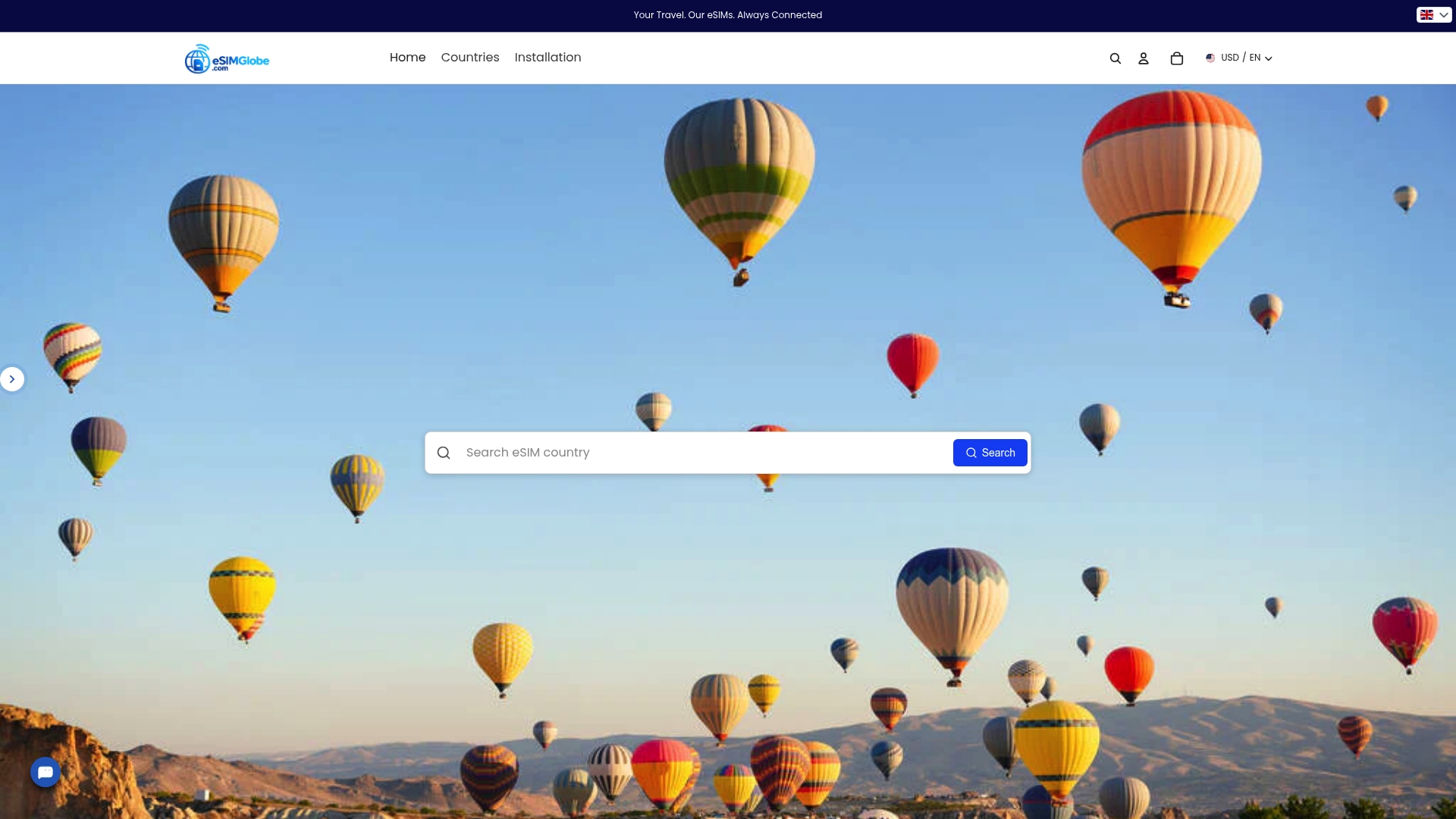
Plans are available in multiple data tiers to match different trip lengths and usage habits, from short resort stays to extended multi-island itineraries. Pricing is listed in USD, EUR, and GBP, and the platform supports multiple languages for travelers from different home countries. Customer support is available to assist with activation, device compatibility questions, and mid-trip top-ups. Travelers can browse available Caribbean eSIM plans on the Esimglobe homepage and activate a profile in minutes. The platform also publishes destination-specific guides, including a detailed Barbados eSIM guide, to help travelers choose the right plan for their specific itinerary.
FAQ
What is an eSIM and how does it work for Caribbean travel?
An eSIM is a digital SIM profile embedded in your device that connects to local mobile networks without a physical card. For Caribbean travel, you purchase a plan online, install it via QR code, and activate it on arrival.
Which Caribbean islands have the best eSIM coverage?
Barbados, Jamaica, the Bahamas, and Trinidad and Tobago offer the strongest 4G LTE coverage for eSIM users. Smaller islands have variable signal quality depending on the provider’s local carrier agreements.
How much data do I need for a Caribbean trip?
Moderate travelers use 3GB–10GB per week for maps, messaging, and social media. Choose an unlimited plan if you plan to stream video or share your connection with other devices.
Is an eSIM cheaper than using a local SIM card in the Caribbean?
For multi-island itineraries, a regional eSIM plan is almost always cheaper than buying separate local SIM cards at each stop. For a single-island stay of three or more weeks, a local prepaid SIM may offer a lower per-gigabyte rate.
Does my phone need to be unlocked to use a Caribbean eSIM?
Your device must support eSIM and must not be carrier-locked to a home network that blocks eSIM installation. Check with your home carrier before purchasing a plan, and review the device compatibility list to confirm your phone model is supported.