






















TL;DR:
- The best eSIM for Colombia operates on the reliable Claro network, offering broad coverage in urban and rural areas. Esimglobe provides plans without ID verification, easy activation, and dependable connectivity, making it ideal for both tourists and digital nomads. For extended stays, switching to a local Claro or Tigo SIM can offer better value, but initial setup should be done before landing to ensure seamless connectivity.
The best eSIM for Colombia is one built on Claro network coverage, offering reliable data access from Bogotá’s urban core to the remote trails of Tayrona National Park. Esimglobe delivers exactly that, running on Colombia’s strongest network and offering plans suited to both short-stay tourists and long-term digital nomads. Choosing the wrong eSIM in Colombia is not a minor inconvenience. It means dead zones in the Coffee Triangle, throttled speeds in Cartagena, and no signal when you need it most. This guide cuts through the noise and gives you the clearest picture of which Colombia eSIM options actually perform.
What makes the best eSIM for Colombia stand out
The single most important factor in choosing a Colombia eSIM is the underlying mobile network. Colombia has three major carriers: Claro, Movistar, and Tigo. Not all three perform equally, and the gap between them widens dramatically once you leave a major city.
Claro scores 8.6/10 in OpenSignal network quality reports, outperforming both Movistar and Tigo in urban and rural Colombia. That score reflects real-world reliability across regions that most travelers actually visit, including Medellín, Cartagena, the Coffee Region, and the Sierra Nevada foothills near Tayrona. Choosing a provider that runs on Claro is not a preference. It is the baseline requirement for dependable connectivity.
Movistar and Tigo perform adequately within Bogotá, Medellín, and Cali. Outside those corridors, coverage drops sharply. A traveler relying on a Movistar-based eSIM in Salento or Palomino will encounter signal gaps that a Claro-based plan simply does not produce. Regional network differences in Colombia are significant enough that carrier choice should be the first decision, not the last.
Esimglobe operates on the Claro network, which is why it consistently ranks as the top choice for travelers who move beyond Colombia’s three largest cities. The platform offers clear plan structures, no hidden throttling surprises, and customer support that other providers frequently fail to match.
Key coverage considerations by region
- Bogotá, Medellín, Cali, Cartagena: All three major carriers provide solid coverage. Any provider works here.
- Coffee Triangle (Salento, Armenia, Manizales): Claro is the only carrier with consistent rural signal. Movistar and Tigo drop out frequently.
- Tayrona National Park and Sierra Nevada: Claro is the only realistic option. Other networks are largely absent.
- Amazon region (Leticia): Coverage is limited across all carriers, but Claro maintains the widest reach.
- Pacific coast (Nuquí, Bahía Solano): Connectivity is sparse everywhere. Download offline maps before arrival regardless of your provider.
Pro Tip: Before purchasing any eSIM, check whether the provider explicitly states which Colombian carrier powers the plan. If the network is listed as “local carrier” or left ambiguous, treat that as a red flag.
How do top eSIM providers for Colombia compare?
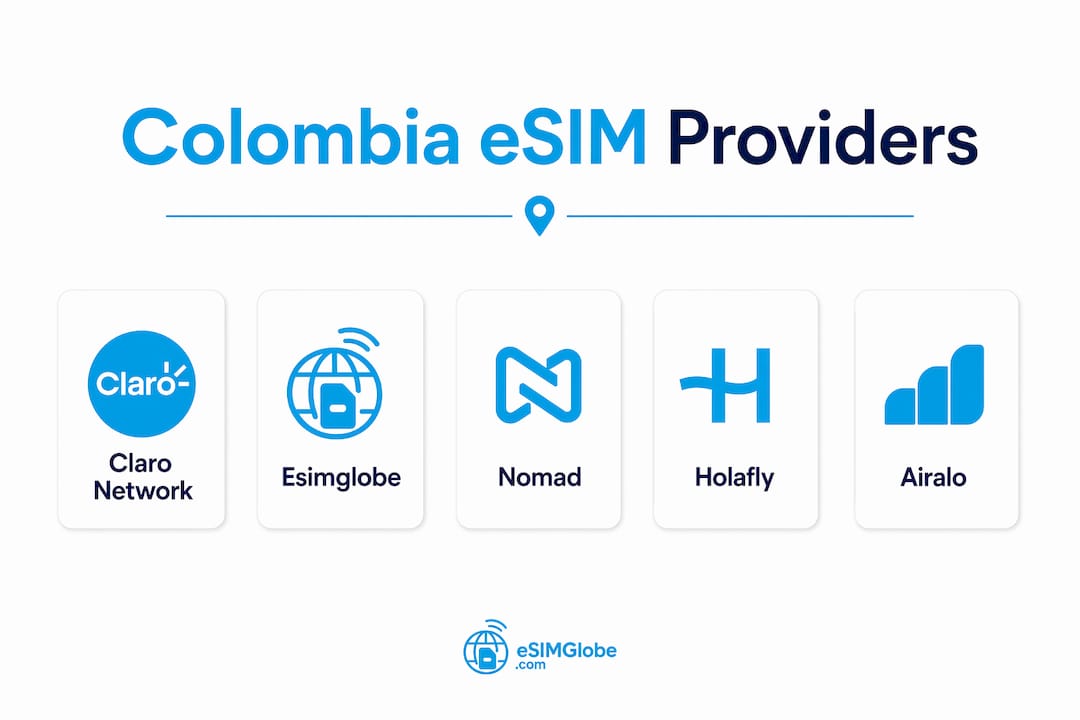
The Colombia eSIM market includes several well-known providers, each with genuine strengths and notable weaknesses. The table below compares the most relevant options based on network, pricing, ID requirements, and practical suitability.
| Provider | Network | Sample Plan | ID Required | Best For |
|---|---|---|---|---|
| Esimglobe | Claro | Flexible data plans | No | All travelers, digital nomads |
| Nomad | Unspecified (non-Movistar) | $25 for 10GB | No | Budget travelers |
| Airalo | Unspecified | Larger data bundles | Yes (passport) | Data-heavy users willing to wait |
| Holafly | Movistar | Unlimited at $7.90/day | No | City-only visitors |
Esimglobe runs on Claro and provides the broadest coverage across Colombia. The platform does not require ID verification, which means activation is immediate. Plans are structured clearly, with no ambiguity about data caps or network routing. For travelers who need connectivity outside major cities, Esimglobe is the most reliable choice among all Colombia eSIM options.
Nomad offers competitive pricing at $25 for 10GB with no ID verification required. The carrier network is not explicitly advertised, but testing confirms it avoids Movistar. That makes Nomad a reasonable budget option for travelers who stay primarily in urban areas and want a fast purchase process. The lack of network transparency is a limitation, particularly for anyone planning rural travel.
Airalo provides larger data bundles and a recognizable global brand. The critical drawback for Colombia specifically is that Airalo requires passport ID verification due to local telecom regulations. That verification process can delay activation by hours, which is a real problem when you land at El Dorado International Airport in Bogotá and need data immediately. Airalo is not the worst option, but the ID requirement makes it less practical than Esimglobe or Nomad for most travelers.
Holafly uses the Movistar network, offering unlimited daily plans at $7.90 per day. Within Bogotá and Medellín, Holafly performs adequately. Outside those cities, the Movistar network’s rural limitations become a real problem. A traveler heading to the Coffee Region or Tayrona on a Holafly plan will encounter signal gaps that a Claro-based plan avoids entirely. Holafly’s pricing also adds up quickly for stays longer than a week.
Pro Tip: If you are comparing eSIM providers and the network carrier is not listed on the product page, email support before purchasing. A provider that cannot tell you which carrier powers their Colombia plan is one you should approach with caution.
How to choose the right eSIM plan based on your trip
Selecting the right plan is not just about picking the cheapest option. Travel duration, data consumption habits, and whether you need hotspot tethering all determine which plan type actually serves you.
Short trips (1 to 7 days)
For a week or less in Colombia, a fixed-data eSIM plan is the most cost-effective and practical choice. A 5GB or 10GB plan covers standard navigation, messaging, social media, and occasional video calls without overpaying for data you will not use. Esimglobe’s Colombia eSIM plans are structured for exactly this use case, with clear data allocations and no surprise throttling.
Medium stays (1 to 4 weeks)
Travelers spending two to four weeks in Colombia should consider a larger fixed-data plan or a multi-week unlimited plan. The key question is whether you need hotspot tethering. Unlimited plans often include tethering caps around 500MB per day, which is insufficient for remote work. If you plan to use your phone as a mobile hotspot for a laptop, a fixed high-data plan with explicit tethering allowances is the better choice.
Long-term stays (several months)
For stays exceeding two months, a local physical SIM card from Claro or Tigo becomes more cost-efficient than repeated eSIM top-ups. Local prepaid SIMs offer significantly lower per-GB pricing and longer validity periods. An eSIM is ideal for the first week or two while you settle in, but switching to a local SIM for an extended stay saves money over time.
Here is a practical decision framework for choosing your Colombia eSIM plan:
- Confirm device compatibility. Check that your phone supports eSIM before purchasing. Most iPhone models from XS onward and flagship Android devices from 2020 onward support eSIM. Esimglobe’s device compatibility guide lists current supported models.
- Calculate your daily data use. Light users (maps, messaging, browsing) consume roughly 300 to 500MB per day. Remote workers streaming video or joining calls use 1 to 3GB daily.
- Check tethering policy explicitly. Do not assume unlimited means unlimited hotspot. Read the fair use policy before purchasing, especially for digital nomad use cases.
- Match plan duration to your itinerary. A 7-day plan that expires before your trip ends is a common and avoidable mistake. Buy a plan that covers your full stay with a small buffer.
- Verify the carrier network. Confirm the plan runs on Claro if you plan to travel outside Bogotá, Medellín, or Cali.
How to activate and use your eSIM in Colombia
Activation is where many travelers run into problems, usually because they wait until they land to set up their eSIM. The process is straightforward when done correctly and in advance.
- Purchase before departure. Buy your eSIM at least 24 hours before your flight. This gives you time to install the eSIM profile and troubleshoot any device issues from home, where Wi-Fi is available.
- Install the eSIM profile via QR code or app. Esimglobe delivers eSIM profiles via QR code. Open your phone’s cellular settings, select “Add eSIM,” and scan the code. The process takes under two minutes on compatible devices.
- Set data roaming to on. After installation, go to your cellular settings and confirm that data roaming is enabled for the eSIM line. This is the most common activation error travelers make.
- Keep your home SIM active for calls. Most eSIM setups run as a second line. Your home SIM handles calls and texts while the Colombia eSIM handles data. You do not need to remove your existing SIM card.
- Download offline maps before landing. Google Maps and Maps.me both support offline map downloads. For regions like Tayrona or the Coffee Triangle, download the relevant area before you leave Wi-Fi range. Even the best Claro coverage has gaps in deep rural terrain.
Pro Tip: If you are using Airalo and face ID verification delays at the airport, connect to the airport’s free Wi-Fi and complete the verification process there. Airalo’s passport ID requirement can take up to a few hours to clear, so starting the process before your flight lands is strongly recommended.
For travelers who want a broader understanding of how eSIM technology works before purchasing, Esimglobe’s eSIM facts guide covers device compatibility, dual-SIM setup, and data management in plain language.
Digital nomads with more specific remote work requirements will find Esimglobe’s nomad eSIM guide useful for understanding tethering policies, plan stacking, and how to maintain consistent connectivity across multiple Colombian cities.
Key takeaways
The best eSIM for Colombia runs on the Claro network, requires no ID verification, and offers plan flexibility that matches both short tourist stays and longer digital nomad work schedules.
| Point | Details |
|---|---|
| Claro network is non-negotiable | Only Claro provides reliable coverage in rural Colombia, including Tayrona and the Coffee Region. |
| Esimglobe leads on coverage and ease | Claro-based plans with no ID verification make Esimglobe the most practical choice for all traveler types. |
| Unlimited plans have real limits | Tethering caps around 500MB per day make unlimited plans unsuitable for remote workers needing hotspot access. |
| Long stays favor local SIMs | Travelers staying several months save money by switching to a local Claro or Tigo prepaid SIM after initial arrival. |
| Activate before you land | Installing your eSIM profile at home eliminates airport connectivity gaps and avoids activation errors under pressure. |
Why I keep recommending Esimglobe for Colombia
I have tested multiple eSIM providers across Colombia over the past two years, covering routes from Bogotá to the Coffee Triangle, Cartagena’s old city, and the trails around Tayrona. The pattern that emerges is consistent: providers running on Movistar or with ambiguous carrier routing deliver acceptable performance in cities and frustrating performance everywhere else.
Holafly’s unlimited plan sounds appealing on paper. In practice, the Movistar network drops out between Salento and Armenia in ways that a Claro-based plan simply does not. For a casual city tourist, Holafly is fine. For anyone moving between destinations, it is a gamble. Nomad is a solid budget option, but the lack of carrier transparency makes it hard to recommend confidently for rural itineraries.
Airalo’s ID verification requirement is the detail that most reviews underplay. Arriving at El Dorado Airport after a long flight and discovering your eSIM activation is pending a passport review is not a minor inconvenience. It is a real problem that Esimglobe and Nomad avoid entirely.
What I find most useful about Esimglobe is the combination of Claro network clarity, transparent plan structures, and customer support that actually responds. When I had a profile installation issue in Medellín, the support team resolved it within the hour. That level of reliability is not something you can assume from every provider in this space.
For digital nomads, my recommendation is clear: use Esimglobe for your first week or two, confirm your work setup is stable, then evaluate whether a local SIM makes sense for a longer stay. For tourists on trips under three weeks, Esimglobe covers every scenario without compromise.
— daniele
Get connected in Colombia with Esimglobe
Esimglobe provides Colombia eSIM plans built on the Claro network, the only carrier with consistent coverage from Bogotá’s business districts to Tayrona’s coastal trails. Plans are available without ID verification, activate in minutes via QR code, and are priced for both short tourist stays and extended digital nomad schedules.
Whether you need a 7-day data plan for a quick visit or a larger allocation for a month of remote work, Esimglobe’s Colombia eSIM options are structured to match your actual itinerary. No guesswork on carrier networks, no passport delays, and no surprise throttling policies. Visit Esimglobe to select your plan, scan your QR code, and arrive in Colombia already connected.
FAQ
What is the best eSIM for Colombia in 2026?
Esimglobe is the top-rated Colombia eSIM for 2026, running on the Claro network with broad urban and rural coverage, no ID verification, and transparent plan pricing suited to tourists and digital nomads alike.
Which network does the best Colombia eSIM use?
Claro is Colombia’s strongest network, scoring 8.6/10 in OpenSignal reports and providing reliable coverage in rural areas like the Coffee Region and Tayrona where Movistar and Tigo frequently drop out.
Do I need to show ID to buy a Colombia eSIM?
Esimglobe and Nomad do not require ID verification. Airalo requires passport verification for Colombia eSIM purchases due to local telecom regulations, which can delay activation by several hours.
Can I use a Colombia eSIM as a hotspot for my laptop?
Fixed-data plans from Esimglobe support tethering. Unlimited plans from most providers cap daily tethering around 500MB, which is insufficient for remote work. Check the fair use policy before purchasing any unlimited plan.
Is an eSIM better than a local SIM card for Colombia travel?
For trips under two months, an eSIM is more convenient and comparably priced. For stays of several months, a local prepaid SIM from Claro or Tigo offers better value due to lower per-GB pricing and longer plan validity.