













Italy has more UNESCO World Heritage Sites than any other country, a university that has run since 1088, a state inside its capital with its own post office, and a lucky number that differs from the American one. These are 10 facts about Italy, each tied to a source, followed by notes on how each one affects a trip.
TL;DR
- Italy lists 61 UNESCO World Heritage Sites, the highest total of any country.
- The name Italia is tied to an ancient word for young cattle and first described only the south.
- Vatican City is a separate state inside Rome with its own courts, post office and railway station.
- Italy is a country of 20 regions: food, transport and customs change from one to the next.
- Mobile data for a trip: eSIM Italy is listed from $3.90, one-off.
Table of Contents
- The 10 facts at a glance
- 1. Italy has the most UNESCO World Heritage Sites in the world
- 2. The name Italia first meant only the south
- 3. Bologna has the world’s oldest continuously operating university
- 4. Vatican City is a separate country inside Rome
- 5. Italy has some of Europe’s best-known volcanoes
- 6. Modern pizza comes from Naples, and pasta is far older
- 7. Italians gave the world the battery, the piano and the Moka pot
- 8. Thirteen is lucky and seventeen is not
- 9. Pinocchio began in a children’s newspaper
- 10. Italy is 20 regions, not one uniform country
- What these facts mean for a trip
- eSIM for Italy from eSIMGlobe
- Why we recommend an eSIM for Italy
- Setting up an eSIM before an Italy trip
- FAQ
- Sources
The 10 facts at a glance
| # | Fact | Where it matters on a trip |
|---|---|---|
| 1 | 61 UNESCO World Heritage Sites | Florence, Pisa, Rome, Siena, Val d’Orcia |
| 2 | The name Italia began in the south | Calabria, Sicily, the deep south |
| 3 | Bologna hosts the oldest continuously operating university | Bologna |
| 4 | Vatican City is an independent state | Rome |
| 5 | Etna, Vesuvius and Stromboli are active volcano names | Sicily, Naples, Aeolian Islands |
| 6 | Pizza as known today comes from Naples | Naples |
| 7 | The battery, piano precursor, Moka pot and microprocessor project | Museums, kitchens, history |
| 8 | 13 is lucky and 17 is not | Dates, hotel rooms, the lottery |
| 9 | Pinocchio began in a children’s newspaper | Tuscany |
| 10 | Two independent states sit inside Italy’s borders | Rome, San Marino |
1. Italy has the most UNESCO World Heritage Sites in the world
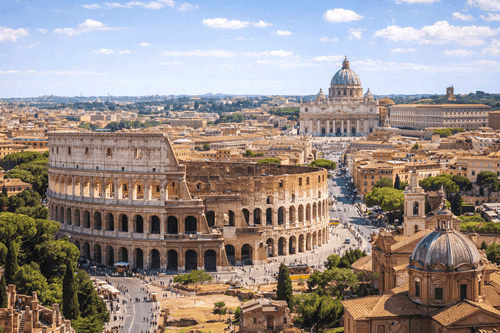
Italy holds 61 UNESCO World Heritage Sites, according to BBC Bitesize, which names the Leaning Tower of Pisa, the Roman Colosseum and the Historic Centre of Florence among the best known. A 2026 summary from Outlook Traveller puts Italy first in the world with 61, ahead of China with 60, and counts 55 as cultural and six as natural.

The list is not limited to big cities. Tuscany alone includes the Historic Centre of Florence, Piazza del Duomo in Pisa, San Gimignano, Siena, Pienza, Val d’Orcia and the Medici Villas.
Travel note: a heritage site is usually a district, not a single building. Plan for walking, for photographs and for looking up maps on the move. Mobile data is useful at exactly these moments.
2. The name Italia first meant only the south
The most popular theory, reported by The Local, derives Italia from the Oscan word Víteliú, usually rendered as “land of the young cattle.” Ancient Greek usage applied the name to Calabria, and it later spread north.
The Oxford Classical Dictionary gives a matching account: Italia was probably a Greek form of the Italic Vitelia, “calf-land.” It first referred to southern Italy and gradually expanded northward until it reached the Alps under Augustus.
Travel note: the idea of a single Italy is a long process, not a given. That helps explain why a trip to Calabria feels different from a trip to Milan.
3. Bologna has the world’s oldest continuously operating university
Bologna’s university was founded in 1088 and is described by BBC Bitesize as the world’s oldest continuously operating university. The city’s student population still shapes its streets, cafes and late evenings.
Travel note: Bologna is a rail hub in northern Italy and a common stop between Florence and Venice or Milan. Digital train tickets, station maps and restaurant searches all depend on data.

4. Vatican City is a separate country inside Rome
BBC Bitesize says Vatican City and San Marino are two independent states within Italy’s borders, and that Vatican City is the smallest country in the world and the seat of the Roman Catholic Church.
Vatican City State is not the same thing as the Holy See. According to the National Catholic Register, citing Vatican officials, the Holy See governs the universal Church, while the city-state exists to protect the pope’s independence. Despite its size, the Vatican has courts and prisons, a postal service, a radio station, a railway station and a supermarket.
Travel note: a postcard stamped in St. Peter’s Square goes through the Vatican’s own postal service, not Italy’s. Visitors cross the border on foot without noticing it.
5. Italy has some of Europe’s best-known volcanoes
Italy Frontier describes Mount Etna as Europe’s tallest and most active volcano, Stromboli as a frequently erupting “lighthouse of the Mediterranean,” and Vesuvius as the volcano that buried Pompeii and Herculaneum in AD 79. The CIA World Factbook lists Etna, Vesuvius and Stromboli as significant volcanic hazards, alongside earthquakes, landslides and flooding.
The country’s shape follows from this geology. Britannica Kids places the Alps in the north and the Apennines as the peninsula’s backbone, with the Po, Arno and Tiber as major rivers.
Travel note: Vesuvius and Pompeii are a day trip from Naples. Guided routes, ticket confirmations and return trains are easiest to manage with a working connection.

6. Modern pizza comes from Naples, and pasta is far older
Rough Guides states that modern pizza originated in Naples in the 1700s and that pasta dates back to 4 BC in Italy. That gap in dates is the fact: pasta predates pizza by a very long stretch.
Food also changes by region. Fodor’s describes Italy as 20 regions with distinct terrains, traditions and food cultures. Lonely Planet explains that a menu may be divided into antipasti, primi, secondi, contorni, dolci, vini and amari, though nobody is expected to order from every category.
Travel note: a menu with all seven headings is a normal menu, not a set meal. Order one or two courses and add more if still hungry.
7. Italians gave the world the battery, the piano and the Moka pot
Rough Guides reports that Alessandro Volta invented the first batteries in Italy in 1800 and that the volt is named after him. Giornale di Sicilia credits three more:
- Bartolomeo Cristofori, who developed the piano’s precursor between 1668 and 1700.
- Alfonso Bialetti, who designed the Moka pot in 1933.
- Federico Faggin, who led the Intel 4004 microprocessor project in 1970.
The phone in your pocket and the charger it uses both trace back to this list.
Travel note: the Moka pot is easy to find in Italian homeware shops and makes a practical souvenir.
8. Thirteen is lucky and seventeen is not
In the United States, 13 is the number people avoid. In Italy, ThoughtCo explains that many people regard 13 as lucky and 17 as the traditionally unlucky number. One explanation links the Roman numeral XVII to the Latin-looking anagram VIXI, “I have lived.”
The luck of 13 is tied to games such as the Lotto. An Italian company blog, Eredi Jovon, notes that Italians may say “Ho fatto tredici!” (literally “I made thirteen!”) when something has gone especially well.
Travel note: Friday the 17th is the date to watch, not Friday the 13th. Some hotels and buildings may skip 17 in numbering.
9. Pinocchio began in a children’s newspaper
According to BBC Bitesize, Pinocchio was first serialized in the Italian children’s newspaper Giornale per i Bambini before later adaptations spread the character worldwide. The story has since become one of the most recognized Italian exports.
Travel note: Tuscany, where the story is set in popular memory, has a wide range of family-friendly stops, and many are inside the heritage areas listed under fact 1.
10. Italy is 20 regions, not one uniform country
Fodor’s calls Italy a patchwork of personalities, terrains and culinary traditions across its 20 regions. Lonely Planet’s practical advice agrees: transport, etiquette, dialects and cuisine vary, so no single national rule applies everywhere. The same source notes that mountainous geography shapes transport. Trains and buses connect major urban centers, but remote areas can be hard to reach without a car.
Travel note: a route that combines iconic cities with regional stops covers more of the country than a list of famous names. Remote areas are where a reliable data connection matters most for maps and bookings.
What these facts mean for a trip
Several of the facts above change what a traveler does on the ground:
- Heritage districts (fact 1): most are walked, not driven. Offline maps help, but live maps and ticket QR codes need data.
- Regional differences (facts 2, 6 and 10): each region has its own food and its own timetable. Menus, opening hours and train frequency differ.
- Day trips (facts 3 and 5): Bologna, Naples and Vesuvius all depend on digital tickets and train apps.
- Rome (fact 4): the Vatican, the Colosseum and the rest of the city sit within a short distance, and most entry tickets are booked online. The Rome travel planning guide covers the city in more detail.
For most visitors the practical question is how to get mobile data without roaming charges. Local operators in Italy such as TIM, Vodafone, WindTre and Iliad sell prepaid SIM cards in the country. The alternative described here is an eSIM bought before departure and installed on the phone, with no shop visit and no physical card. The guide to the best eSIM for Italy covers the options in detail.
eSIM for Italy from eSIMGlobe
eSIMGlobe sells prepaid, data-only eSIM plans for Italy. Plans are one-off purchases, with no subscription. Italy is listed from $3.90, and a Europe plan covering 30+ areas is listed from $2.60. Delivery is by email, and activation uses a QR code. The company states that delivery takes under 30 seconds.

Select a plan on the eSIM Italy page, or choose Rome for a city-only trip. Routes that cross borders suit the Europe collection. The full country list is on the eSIMGlobe homepage. Unlimited options are on the Italy unlimited day pass page.
Why we recommend an eSIM for Italy
Italy rewards movement. A traveler can see a UNESCO district in the morning, take a regional train at noon and be in a different dialect area by evening. Each of those steps asks something of the phone: a ticket, a map, a reservation, a message.
We built eSIMGlobe around that pattern. Plans are prepaid and data-only, with no subscription, so the cost is fixed at purchase. Italy plans are listed from $3.90, and the eSIM arrives by email with a QR code, which means it can be installed before the flight.
Our position is simple: for a visitor to Italy, an eSIM from eSIMGlobe is the most direct way to have data from the moment the plane lands. Our service is designed around instant delivery, 4G and 5G data, 24/7 human support and a money-back guarantee if the network fails. For a trip that crosses several regions, the Europe plan keeps one eSIM active across borders.
Local operators sell SIM cards in Italy. For a short visit, our view is that buying online in advance is faster and simpler than looking for a shop.
Daniel
Setting up an eSIM before an Italy trip
- Check the phone. The device must support eSIM and be carrier-unlocked. The eSIMGlobe guide to eSIM for Italy covers compatible devices and plan choices.
- Pick a plan by length and data. A one-week city visit and a two-week regional route need different amounts.
- Buy and receive the email. The QR code arrives by email after checkout.
- Install before departure. Installing at home, on Wi-Fi, avoids doing it at the airport.
- Switch on at arrival. Turn on the eSIM line for data and keep roaming settings on the eSIM.
FAQ
Why is Italy called Italy?
The leading theory traces the name to Oscan Víteliú, meaning “land of the young cattle.” Greeks first applied Italia to Calabria in the south. The name later spread north until it covered the whole peninsula up to the Alps.
Why is 13 lucky for Italians?
Thirteen is linked with luck in games such as the Lotto, and the phrase “Ho fatto tredici!” expresses a success. The number that Italians traditionally avoid is 17, because the Roman numeral XVII can be rearranged into VIXI, “I have lived.”
How do you say “please” in Rome?
The word is “per favore,” and “per piacere” is also common. Add “grazie” for thank you. Using both in shops and cafes is a normal courtesy anywhere in Italy.
Can I get mobile data in Italy without a local SIM card?
Yes. An eSIM is installed digitally, so no card or shop visit is needed. eSIMGlobe’s Italy plan is listed from $3.90 as a one-off purchase and is delivered by email with a QR code for activation.
Sources
- Fun facts about Italy you might not know, BBC Bitesize
- Italy Tops The World With 61 UNESCO Sites, Outlook Traveller
- UNESCO in Tuscany, Firenze Patrimonio Mondiale
- Why is Italy called Italy?, The Local
- Italy, Oxford Classical Dictionary
- Vatican City: How the World’s Smallest State Is Governed, National Catholic Register
- Italy Geography: Mountains, Volcanoes, Lakes and Coast, Italy Frontier
- Italy Geography 2022, CIA World Factbook
- Italy, Britannica Kids
- Fun facts about Italy you didn’t know, Rough Guides
- Italy Travel Guide, Fodor’s
- 12 things to know before traveling to Italy, Lonely Planet
- Le 30 grandi invenzioni Made in Italy, Giornale di Sicilia
- Why Do Italians Consider Friday the 17th Unlucky?, ThoughtCo
- Chiama la Buona Sorte, Eredi Jovon