






















TL;DR:
- A global SIM card enables voice and data connectivity across multiple countries through a single physical or digital eSIM profile, leveraging roaming agreements with partner networks. It offers cost-effective, pre-activated plans covering up to 190+ countries, simplifying international travel by avoiding local SIM swaps while requiring an unlocked device and consideration of local phone number limitations. Choosing the right plan depends on travel duration, device compatibility, coverage, and whether a local number is necessary, with eSIM platforms like Esimglobe making activation straightforward and reliable.
A global SIM card is defined as a mobile subscriber identity module that enables voice and data connectivity across multiple countries through a single physical card or digital eSIM profile. Unlike a standard SIM tied to one carrier and one country, a global SIM leverages roaming agreements with partner networks worldwide, letting you land in a new country and connect without swapping hardware. Modern global eSIM plans now cover between 100 and 190+ countries, installable via a single QR code before you board your flight. Platforms like Esimglobe, Eiotclub, and CloudOn have made this technology accessible to everyday travelers, not just corporate road warriors.
What is a global SIM card and how does it work?

A global SIM card works by authenticating your device on local partner networks in each country you visit, using pre-negotiated roaming agreements rather than requiring a new SIM at each border. The underlying mechanism relies on an IMSI (International Mobile Subscriber Identity) profile stored either on a physical chip or, in the case of eSIMs, as a downloadable digital credential embedded in your phone’s hardware.
Here is how the process works in practice:
- Purchase a plan. You select a global SIM or eSIM plan from a provider like Esimglobe, choosing the coverage region and data allowance that fits your itinerary.
- Install the profile. Physical global SIMs arrive by mail and slot into your SIM tray. eSIMs are activated by scanning a QR code, which downloads the carrier profile directly to your device’s embedded chip.
- Arrive in a covered country. Your device scans available networks and automatically selects the best partner network without any manual input from you.
- Use data and calls. Your device connects as a roaming user on that partner network, drawing from your prepaid plan’s data or voice allowance.
- Cross a border. The SIM or eSIM profile repeats the network selection process in the new country, again without a physical swap.
The physical versus digital distinction matters more than most travelers realize. A physical global SIM still requires an unlocked phone. Phones must be unlocked by the home carrier before any third-party SIM will connect abroad. Many travelers discover this problem at the airport, not at home. eSIMs carry an additional compatibility requirement: the device must support eSIM technology, which is standard on most smartphones released after 2020 but inconsistent on older models.
Pro Tip: Before purchasing any global SIM or eSIM plan, dial your carrier and confirm your phone is unlocked. Then check your device settings under “Mobile Data” or “Carrier” to confirm eSIM support. This two-minute check prevents the most common connectivity failure travelers experience.
Network selection on a global SIM is automatic but not always optimal. The IMSI profile instructs your device to prefer certain partner carriers in each country, but in congested areas, network priority is often lower for roaming users than for local subscribers. This is a structural feature of how roaming agreements work, not a flaw specific to any one provider.
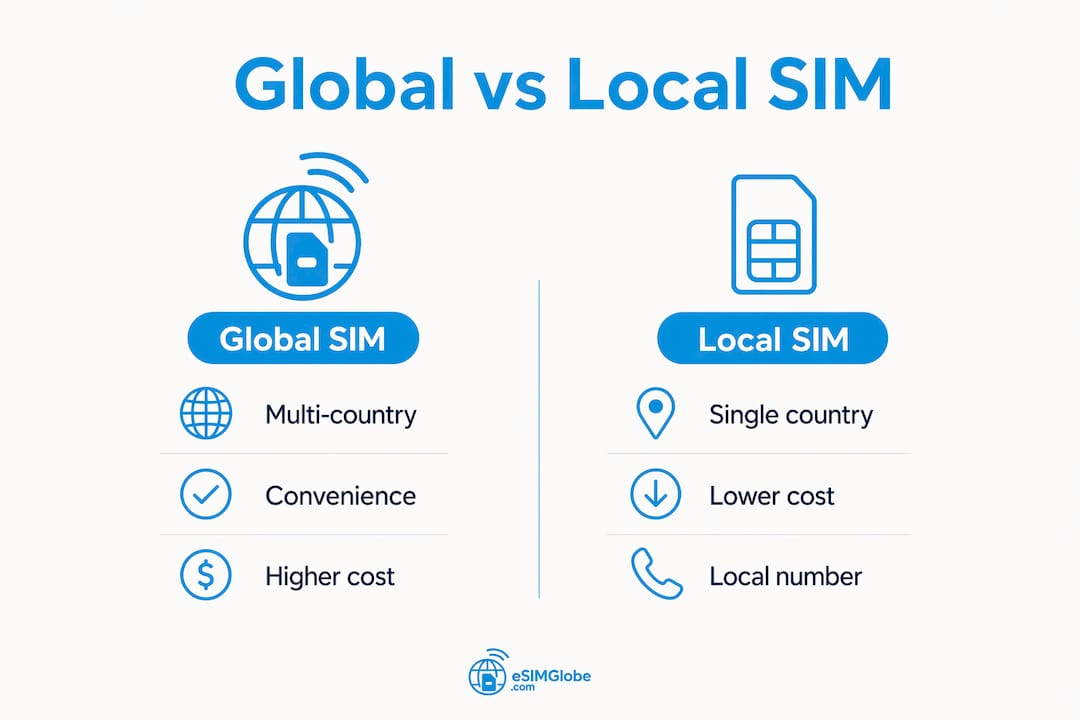
What are the benefits and trade-offs of global SIM cards vs. local SIM cards?
Global SIM cards deliver clear advantages for multi-country trips, but they are not the right tool for every situation. Understanding where they excel and where they fall short helps you make a smarter decision before you travel.
Core advantages of global SIM cards
- Single SIM for multiple countries. You carry one card or one eSIM profile across an entire trip through Europe, Southeast Asia, or Latin America without visiting a local carrier store at each stop.
- Cost control. Global SIM providers bundle cross-country access in a fixed prepaid plan, eliminating the unpredictable variable charges that traditional carrier roaming generates. Travelers report roaming charge reductions of up to 90 to 95% compared to standard carrier international roaming fees.
- Pre-trip activation. You can install an eSIM profile days before departure, test it at home, and arrive at your destination already connected.
- Data-focused design. Most global SIM users rely on data for maps, messaging apps like WhatsApp, and streaming. Global SIM cards support this use case directly, with plans optimized for data rather than traditional voice minutes.
Where global SIM cards fall short
The trade-offs are real and worth knowing before you commit.
| Factor | Global SIM card | Local SIM card |
|---|---|---|
| Coverage | 100 to 190+ countries on one plan | Single country or region |
| Cost per country | Fixed, predictable | Often cheaper for single-country stays |
| Local phone number | Rarely included | Always included |
| Network priority | Roaming (lower priority) | Native (full priority) |
| 5G availability | Varies by country and partner | Widely available on local plans |
| Voice and SMS | Limited or data-only | Full service |
| Setup effort | One-time, pre-trip | New SIM required per country |
The absence of a local phone number is the most consequential limitation. Lack of a local number blocks services that require voice verification, including ride-sharing apps like Uber or Grab, two-factor authentication (2FA) for banking apps, and some hotel or restaurant reservation systems. If your trip depends on any of these, plan for a workaround such as a VoIP number through Google Voice or a local SIM for the primary destination.
Pro Tip: For trips spanning three or more countries, a global SIM or eSIM almost always wins on convenience and total cost. For a single-country stay longer than two weeks, a local SIM often delivers better speeds, a local number, and lower per-gigabyte pricing.
What factors should you consider when choosing a global SIM or eSIM plan?
Choosing the right global SIM plan requires matching the plan’s specifications to your actual travel pattern. Generic “best global SIM” lists rarely account for the variables that matter most to your specific trip.
- Country coverage. Verify that every country on your itinerary appears on the provider’s supported network list. Coverage maps can be misleading. Confirm at the country level, not just the regional level.
- Activation trigger. Some plans activate the moment you download the eSIM profile. Others start the clock on first network use. Plans that activate upon first network use give you the flexibility to install the profile at home without burning validity days before you land. This distinction is rarely advertised prominently, so read the fine print.
- Validity window. Many plans run for 30 days regardless of how much data you use. A 30-day plan purchased two weeks before a six-week trip will expire mid-journey. Match the validity period to your actual travel dates.
- Data allowance. Calculate your realistic daily data use. Streaming video consumes roughly 1 GB per hour. Navigation and messaging use far less. A 10 GB plan covers most travelers for one to two weeks of moderate use.
- Voice and SMS inclusion. If you need to make local calls, confirm whether the plan includes voice minutes or supports VoIP calls over data. Many global plans are data-only without local phone numbers, which is fine for most travelers but limiting for others.
- Network generation. Confirm whether the plan supports 4G LTE or 5G in your destination countries. 3G-only coverage is increasingly rare but still appears in some budget global SIM plans for remote regions.
- Device compatibility. eSIM support varies by device, particularly on phones made before 2020. Check your phone’s specifications before purchasing a digital-only plan.
- Top-up and renewal options. Long trips may require additional data. Confirm whether the provider offers easy top-ups through an app or website without requiring a new plan purchase.
- Customer support. Time zones complicate support access. A provider with 24/7 live chat or a responsive help center is worth paying a small premium for when you are troubleshooting connectivity at midnight in a foreign city.
Esimglobe addresses all of these factors with transparent plan listings, clear activation terms, and support for multiple currencies including USD, EUR, and GBP, making it straightforward to compare and purchase the right plan for your trip.
How do global SIM cards compare with international roaming and other travel options?
The definition of a global SIM card becomes clearest when you place it next to the alternatives. Three main options exist for international mobile connectivity: carrier roaming, global SIM cards, and local SIM cards.
| Option | Cost structure | Setup effort | Local number | Best for |
|---|---|---|---|---|
| Carrier international roaming | Variable, often high | None (automatic) | Yes | Short trips, convenience priority |
| Global SIM card or eSIM | Fixed, prepaid | Low (QR code or mail) | Rarely | Multi-country trips, cost control |
| Local SIM card | Low per-country | High (store visit per country) | Yes | Single-country stays, heavy voice use |
Carrier roaming is the path of least resistance. Your existing number works, your contacts can reach you, and you do nothing except enable roaming in your phone settings. The cost is the problem. Standard carrier roaming fees can reach $10 or more per day for data, and voice calls often carry per-minute charges on top. A global SIM differs from carrier roaming by providing a prepaid, fixed-price, multi-country plan through a third-party provider, giving you full cost visibility before you travel.
Local SIM cards offer the best per-gigabyte pricing and full network priority in a single country. The friction is the process. You need to visit a carrier store, present identification, navigate a foreign-language interface, and repeat this at every new destination. For a two-week trip through five countries, that is five store visits, five different apps, and five different top-up processes.
Global eSIMs occupy the middle ground most travelers actually need. The shift to global eSIMs transforms travel into a continuous network experience, with automatic partner network selection on landing in any covered country. For business travelers moving between cities on tight schedules, or digital nomads spending weeks in multiple countries, this is the most practical option available in 2026.
Pro Tip: If your carrier offers a flat-rate international day pass (common with T-Mobile and AT&T in the US), compare its 30-day cost against a global eSIM plan before assuming roaming is more convenient. For trips longer than five days, a global eSIM almost always costs less.
Key takeaways
A global SIM card is the most cost-effective and practical connectivity solution for travelers visiting multiple countries, provided you verify device compatibility and plan activation terms before departure.
| Point | Details |
|---|---|
| Core definition | A global SIM is a multi-country mobile identity module, physical or digital, using roaming agreements for connectivity. |
| Cost advantage | Global SIM plans can reduce roaming charges by up to 90 to 95% compared to standard carrier international roaming fees. |
| Key limitation | Most global SIM plans are data-only and do not provide a local phone number, limiting voice verification services. |
| Activation timing | Choose plans that activate on first network use, not on profile download, to avoid losing validity days before travel. |
| Device check | Confirm your phone is unlocked and eSIM-compatible before purchasing any global SIM or eSIM plan. |
Why the global SIM card definition matters more than most travelers think
I have watched travelers make the same expensive mistake for years: they assume “international” means “works everywhere, perfectly, at full speed.” The global SIM card meaning is more nuanced than that, and the gap between expectation and reality costs real money and real frustration.
The most common misunderstanding I see is treating a global SIM as a direct replacement for a local SIM. It is not. It is a connectivity tool optimized for breadth, not depth. When you are moving through six countries in three weeks, breadth wins. When you are spending a month in one city and need a local number for apartment rentals and banking verification, depth wins. Knowing which situation you are in before you buy is the entire game.
What I find genuinely impressive about the current generation of global eSIM platforms is how much the activation experience has improved. Two years ago, troubleshooting an eSIM installation required technical patience most travelers do not have. Today, providers like Esimglobe have reduced this to a QR code scan and a settings toggle. The technology has caught up to the promise.
The one pitfall I still see regularly is validity window mismanagement. Travelers purchase a 30-day plan, install it at home two weeks before departure, and arrive abroad with only two weeks of coverage remaining. Read the activation terms. If the clock starts on download rather than first use, either buy closer to your departure date or choose a provider that triggers validity on first network connection.
Esimglobe’s eSIM purchasing guidance addresses this directly, which is one reason I consider it the most traveler-friendly platform currently available for global connectivity.
— daniele
Stay connected worldwide with Esimglobe
Esimglobe provides eSIM plans covering over 190 countries, with flexible data allowances, transparent pricing in USD, EUR, and GBP, and activation via QR code in under two minutes.
Plans are available for single regions or global coverage, with no hidden roaming fees and no physical SIM required. Esimglobe’s international traveler guide walks you through plan selection by destination, budget, and device type. For full details on plan validity, activation terms, and data policies, review the Esimglobe terms and conditions before purchase. Whether you are a frequent business traveler or planning your first multi-country trip, Esimglobe delivers reliable, cost-effective connectivity without the complexity of managing multiple local SIMs.
FAQ
What is the definition of a global SIM card?
A global SIM card is a mobile subscriber identity module designed to provide voice and data connectivity across multiple countries through a single physical card or digital eSIM profile, using roaming agreements with partner networks worldwide.
How does a global SIM card differ from regular international roaming?
A global SIM provides a fixed-price, prepaid multi-country plan through a third-party provider, while carrier roaming applies variable per-day or per-minute charges through your existing home carrier, typically at significantly higher cost.
Do global SIM cards include a local phone number?
Most global SIM and eSIM plans are data-only and do not include a local phone number. This limits access to services requiring voice verification, such as ride-sharing apps or SMS-based two-factor authentication.
What devices are compatible with global eSIM plans?
Most smartphones released after 2020 support eSIM technology, including Apple iPhone XS and later, Google Pixel 3 and later, and Samsung Galaxy S20 and later. Phones must also be unlocked by the home carrier to connect on any third-party global SIM plan.
How many countries do global eSIM plans typically cover?
Global eSIM plans typically cover between 100 and 190+ countries, with automatic partner network selection on arrival in each covered country, requiring no manual configuration from the traveler.