






















TL;DR:
- International roaming allows your phone to connect to foreign networks via agreements between carriers, often leading to high charges. Understanding the billing process and proactively managing settings, eSIMs, or local SIM cards helps travelers avoid unexpected, costly fees abroad. Proper planning and informed choices are essential for affordable global connectivity.
You land at your destination, turn off airplane mode, and your phone instantly starts working. Everything seems fine. Then, two weeks later, you open your monthly bill and find charges that are three or four times higher than normal. This exact scenario plays out for millions of travelers every year. International roaming is one of the most misunderstood aspects of mobile connectivity, and that confusion costs people real money. This guide breaks down exactly what roaming is, how the billing works, why charges get so high, and what steps you can take to stay connected without the financial pain.
Table of Contents
- What is international roaming?
- How international roaming actually works
- Why roaming charges can be so high
- Smart strategies to avoid roaming surprises
- A travel expert’s perspective: why understanding roaming truly matters
- Stay connected globally with a smarter, cost-effective solution
- Frequently asked questions
Key Takeaways
| Point | Details |
|---|---|
| Roaming is carrier billing | International roaming means your carrier charges you for using foreign networks abroad. |
| Hidden costs add up fast | Voice, texts, and data can each rack up separate roaming fees without you realizing. |
| Proactive planning saves money | Check and manage your roaming settings before leaving to avoid unwanted charges. |
| eSIMs are a smart option | Using eSIMs or local SIM cards lets you avoid most roaming fees when traveling abroad. |
What is international roaming?
The term “roaming” gets used casually, but its technical meaning matters when money is involved. International roaming is when your mobile device uses another country’s cellular network, via agreements between your home carrier and a foreign provider, to provide calling, texting, and mobile data while you’re outside your home coverage area. In plain terms: your phone borrows a foreign network because your home carrier does not operate there.
This matters more than most travelers realize. Your home plan, the one you pay monthly, is built around your carrier’s domestic infrastructure. The moment you step outside that coverage zone and your phone connects to a foreign tower, you are no longer operating under normal terms.
Key point: Having a signal abroad does not mean you have affordable service. Your phone can show full bars while charging you rates your domestic plan never touches.
Here are the core mechanics every traveler should understand before boarding a flight:
- Your home carrier has pre-negotiated agreements with foreign networks in select countries. Coverage is not universal.
- Each service (voice calls, SMS texts, and data) is billed separately, often at different rates.
- Some countries have no roaming agreement with your home carrier at all, leaving you without any service or with very limited emergency-only access.
- Roaming must sometimes be manually activated on your account before departure. Some carriers enable it automatically, which can catch travelers off guard.
- Even incoming calls and texts, not just outgoing ones, can trigger roaming charges.
Understanding the basics of essential eSIM facts alongside traditional roaming gives travelers a more complete picture of all available options before they leave home.
The distinction between “having a signal” and “having affordable connectivity” is perhaps the single most important concept in this entire topic. Many travelers skip the fine print because they assume international connectivity works like it does at home. It does not.
How international roaming actually works
The behind-the-scenes process of roaming involves multiple parties, multiple billing layers, and several technical handoffs that together determine what you pay and what actually works on your device abroad.
When you arrive in a foreign country and your phone powers on, it scans for available networks. If your home carrier has an agreement with a local provider, your phone registers on that network. Your home carrier is then notified, and billing kicks in based on the rates negotiated between the two companies. Roaming arrangements and rates can be complex, and international use may cost much more than at home. Multiple services such as voice, texts, and data can be billed at different roaming rates, and some phone or network features may not work in every country.
This is where the process gets costly. Consider the following breakdown of typical service pricing abroad:
| Service type | Typical domestic rate | Typical roaming rate | Potential cost increase |
|---|---|---|---|
| Voice calls | Included in plan | $0.25 to $3.00 per minute | Very high |
| Outgoing SMS | Included in plan | $0.10 to $0.50 per message | Moderate |
| Incoming SMS | Free | $0.05 to $0.30 per message | Unexpected |
| Data | Included (GB packages) | $5 to $25 per MB | Extremely high |
| Voicemail retrieval | Free | $0.25 to $2.00 per minute | Often overlooked |
The data row is where travelers typically get hit hardest. A single megabyte at $10 per MB means loading one standard webpage could cost several dollars. Streaming even 10 seconds of video could cost more than your entire monthly plan.
Here is how a typical roaming billing cycle unfolds, step by step:
- Your phone connects to a foreign partner network.
- The foreign network logs every voice minute, text, and kilobyte of data you use.
- That usage data is transmitted to your home carrier, usually in near real time.
- Your home carrier applies its published roaming rate to each service category.
- The total is added to your monthly bill, sometimes appearing as a separate line item.
- Dispute resolution, if needed, involves both carriers and can take weeks.
Roaming is both a network-connection state and a billing state. Your domestic plan may not apply abroad. This is a crucial distinction. Just because your plan includes “unlimited data” at home does not mean that unlimited data follows you to another country. In most cases, it does not.
Pro Tip: Before traveling, open your carrier’s app or call customer service and ask specifically: “What is my per-MB data rate in Country X?” Write it down. The number will likely motivate you to find a better option immediately.
It is also worth noting that some features simply do not work when roaming. Wi-Fi calling, certain VoIP services, and carrier-specific visual voicemail applications often require your home network connection to function properly. This creates gaps in service you may not discover until you actually need them.
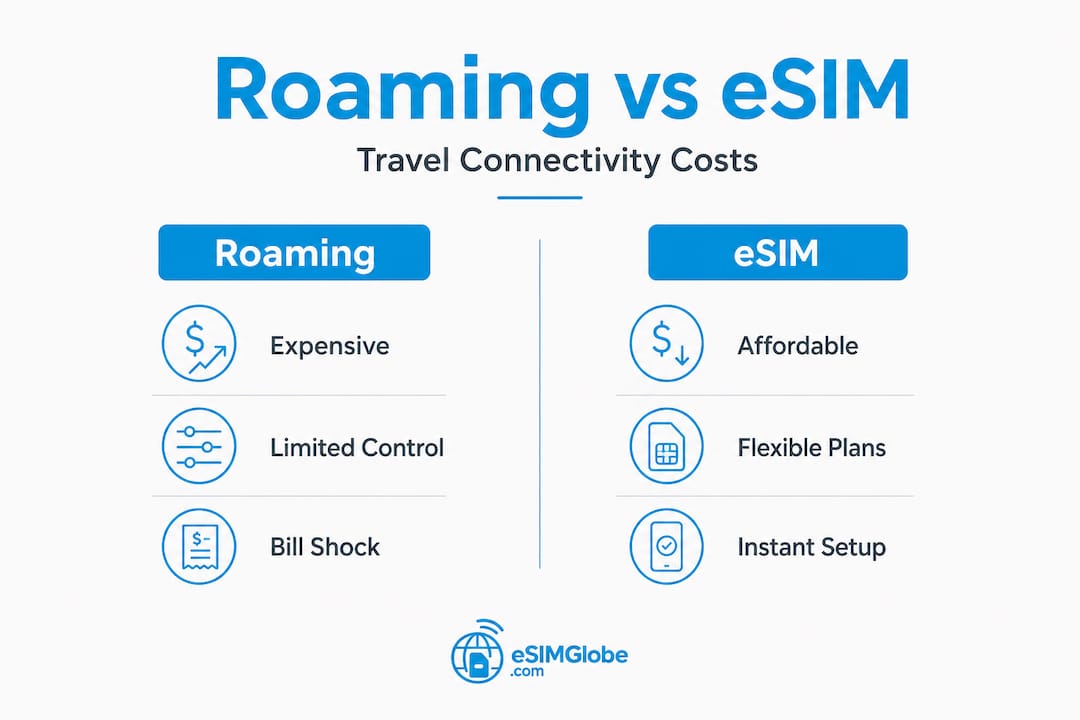
The full picture of roaming vs eSIM costs reveals just how significant the financial difference can be across a typical one or two week trip.
Why roaming charges can be so high
Understanding how roaming works is one thing. Understanding why it costs so much is another, and that understanding requires a look at the business structure behind international mobile agreements.

International use may cost much more than at home, with higher rates applying to voice, voicemail, texts, and internet access. This is not accidental. The pricing model for roaming was designed decades ago when international connectivity was genuinely expensive to provide. Even though the actual cost of transmitting data globally has dropped dramatically, the rate structures have not followed in all cases.
Here is a comparison of roaming costs across common traveler destinations:
| Destination region | Approximate data roaming rate | Voice rate (per minute) | Notes |
|---|---|---|---|
| Western Europe | $5 to $15 per MB | $0.25 to $1.50 | Varies widely by carrier |
| Southeast Asia | $8 to $20 per MB | $0.50 to $2.50 | Local SIMs much cheaper |
| South America | $10 to $25 per MB | $1.00 to $3.00 | Limited carrier agreements |
| Middle East | $10 to $20 per MB | $0.75 to $2.00 | Varies by country |
| Caribbean islands | $5 to $15 per MB | $0.25 to $1.50 | Cruise zones differ |
Real-world cost example: A traveler in Bangkok opens Google Maps for turn-by-turn navigation during a 30-minute trip. That session might consume 15 to 25 MB of data. At $10 per MB, that single navigation session costs $150 to $250 on a standard roaming plan. Using WhatsApp to send a few photos to family over two weeks can easily add $50 to $100 or more.
Several structural factors keep roaming prices high:
- Carrier margin stacking. Your home carrier pays the foreign network a wholesale rate, then marks it up significantly before billing you. Both parties profit from every megabyte.
- No competitive pressure at point of use. When you land abroad, you cannot easily switch carriers mid-trip on a traditional SIM. Your home carrier knows this.
- Complex billing timing. Some carriers batch and delay billing, meaning you may not see charges for days. By then, usage has already accumulated.
- Background app data. Apps update automatically, sync contacts, check email, and refresh social feeds. All of that happens silently in the background, and all of it costs money under roaming rates.
- Voicemail download fees. Many carriers charge you to retrieve voicemail while roaming, even if the caller left a message you never asked for.
Pro Tip: Enable “Data Roaming” as a manual toggle on your phone, and leave it OFF unless you specifically need it. On most modern smartphones, this setting is separate from the general cellular connection and is your primary defense against accidental data charges.
Learning how eSIM saves you money compared to these roaming structures shows why so many frequent travelers have made the switch in recent years.
The hidden pitfalls go beyond just data. Incoming calls routed through foreign networks can cost you money even when you decline them. A missed call that goes to voicemail triggers a forwarding fee to the voicemail server and then another charge when you retrieve it. Two charges for a call you never answered.
Smart strategies to avoid roaming surprises
Knowing the risks is only useful if it leads to action. The following strategies address the problem from multiple angles and apply regardless of your destination or travel frequency.
Before you leave home:
- Call your carrier or check their website and ask exactly what international roaming costs in each country you plan to visit. Get specific numbers for data, voice, and SMS separately.
- Confirm that international roaming is activated before travel, or consciously avoid it. Carriers require configuration and may charge immediately once your device uses foreign-network services.
- Check whether your carrier offers a short-term international add-on plan. These are often expensive but far cheaper than per-MB rates.
- Download offline versions of maps, translation tools, and any other apps you rely on. Google Maps offline mode, for example, can navigate without any cellular data once the map is downloaded.
- Set data usage alerts or spending limits through your carrier app if that feature is available.
During your trip:
- Keep data roaming turned off unless actively needed.
- Use Wi-Fi calling apps (WhatsApp, FaceTime Audio, Signal) over hotel or cafe Wi-Fi for free voice and text communication.
- Purchase a local SIM card at the destination airport for a low-cost data plan valid for your trip duration.
- Consider activating a travel eSIM before departure for seamless coverage from arrival.
- Check your usage every 48 hours through your carrier app to catch unexpected charges early.
The eSIM advantage for frequent travelers:
eSIM technology addresses nearly every pain point in the traditional roaming model. An eSIM is a digital SIM profile stored in your device’s hardware. You can download a local data plan for your destination before you even board the plane, activate it on arrival, and use local network rates instead of international roaming rates. No physical SIM card to buy, no foreign carrier store to locate, no language barrier to navigate.
Pro Tip: If you are visiting three or more countries in a single trip, look for regional eSIM plans that cover multiple countries under one flat-rate data package. These are significantly more cost-effective than buying a local SIM or activating roaming in each individual country.
The eSIM travel tips available for different regions help travelers match the right plan to their specific itinerary, whether that is a two-week vacation or a six-month remote work trip.
For travelers building a longer-term strategy around connectivity, resources on saving money with eSIMs provide structured comparisons across destination types, trip lengths, and data needs.
The core principle across all of these strategies is the same: do not let connectivity happen to you passively. Make an active, informed decision about how your phone will work before you step off the plane.
A travel expert’s perspective: why understanding roaming truly matters
Most articles about roaming treat it as a settings problem. Turn this toggle off, download that app, and you are fine. That framing misses the deeper issue.
The real problem is that international roaming sits at the intersection of two things travelers rarely think about at the same time: network availability and billing status. Your phone showing a signal is a network event. The charges appearing on your bill are a billing event. These are separate systems that most carriers bundle together in ways that obscure what is actually happening.
Even experienced travelers who have been to 30 or 40 countries sometimes confuse these two layers. They know to turn off data roaming, but they do not know that receiving a text message abroad, even with data roaming off, can still trigger a per-message charge. Or that their phone might briefly connect to a foreign network in a border region even when they are technically still in their home country.
The “off by accident” scenario is dangerous. A traveler disables what they think is roaming but actually only turns off data, not voice. They receive five calls over a week and come home to a $40 charge they were not expecting. The “on by accident” scenario is equally problematic. Roaming is enabled by default on a new device, the traveler lands abroad, and background apps start syncing before the traveler has even cleared customs.
The most overlooked truth in this space is that the burden of understanding and managing roaming falls entirely on the traveler. Carriers are not incentivized to make this simple. Their revenue from roaming is substantial. The complexity works in their favor.
This is why tools like eSIMs represent a meaningful structural shift, not just a cheaper option. When you activate an eSIM plan for a specific destination, you are opting into a known, local rate structure. The ambiguity disappears. You know what data costs, you know how much you have, and you know when it runs out. That clarity is genuinely valuable.
Choosing the best eSIM for your specific destination and travel style takes about 10 minutes of research before a trip. Compare that to the hours of bill review, dispute calls, and carrier negotiations that a roaming surprise can produce.
The expert approach to international connectivity is not about finding clever hacks. It is about treating mobile data as a planned travel expense, like transportation or accommodation. Budget for it, research it before you go, and choose your provider deliberately. When you do that, roaming charges become optional, not inevitable.
Stay connected globally with a smarter, cost-effective solution
Traditional roaming is a legacy pricing system that was never built with the modern traveler in mind. eSIM technology offers a direct alternative: local data rates, no physical SIM to manage, and the ability to activate coverage before you even leave your home country.
EsimGlobe provides eSIM packages for travelers heading to individual destinations or covering multi-country routes across Asia, Europe, the Middle East, and beyond. Packages are available in multiple currencies including USD, EUR, and GBP, and the activation process takes just a few minutes online. For a specific example, travelers visiting island destinations can explore Maldives eSIM packages for affordable local data coverage without any roaming fees. One plan, one activation, and you arrive connected.
Frequently asked questions
What counts as roaming internationally?
Anytime your phone connects to a foreign network while you are outside your home coverage area, you are roaming. International roaming applies to calling, texting, and mobile data, and can even be triggered by incoming texts or calls you do not answer.
Can I use my regular phone plan abroad?
Most standard domestic plans do not automatically cover international use, meaning you face additional charges the moment your device connects abroad. Domestic plans typically do not apply outside your home carrier’s coverage area unless you have a specific international add-on or global plan.
Why is roaming data so expensive?
Your home carrier pays a foreign network for your data usage at wholesale rates, then marks those costs up before billing you. International use may cost significantly more than your home plan, especially for data, where per-megabyte billing can make even basic app use very expensive.
How can I avoid roaming charges when traveling?
Turn off data roaming before arrival, use local or regional eSIM plans for affordable data rates, and rely on Wi-Fi for calling and messaging apps. Confirming your roaming settings before departure is the single most important step you can take to prevent unexpected charges.