





















For most trips to Senegal, the fastest reliable option is a Senegal eSIM riding on the Orange Sonatel network, purchased through a provider that delivers the profile by email and activates in minutes. Esimglobe’s eSIM Senegal plan fits this exact need: Sonatel-backed coverage across Dakar and the interior, instant digital delivery, and a setup process that takes less time than clearing customs. It’s the practical pick for short city stays, weeklong safaris, or a first test of eSIM travel data.
TL;DR:
- The most reliable Senegal eSIM is provided by Esimglobe through Orange Sonatel coverage, activated via email with minimal setup time before departure.
- Matching your data plan size to your trip duration, usage habits, and tethering needs is essential to avoid running out of data or paying for unused capacity.
- Confirm your device is unlocked and eSIM-compatible, and preload offline maps to ensure smooth navigation in areas with weak or spotty signal.
- Price-per-GB decreases with larger data plans, making them more cost-effective for longer or data-intensive trips, while unlimited plans mainly suit heavy remote workers.
- For multi-country trips, a global eSIM plan covering over 130 areas reduces the need for buying multiple profiles at border crossings or for extended stays.
Table of Contents
- Which EsimGlobe Plans Work Best for Senegal Travelers?
- How Do You Choose the Right eSIM Plan for Senegal?
- How Do You Activate an eSIM Before Flying to Senegal?
- What Coverage Should You Expect Across Senegal?
- An Honest Take on Picking an eSIM for Senegal
- Get Connected in Senegal Before You Land
- Sources and Further Reading
- FAQ
Which EsimGlobe Plans Work Best for Senegal Travelers?
A core Senegal eSIM product runs on local infrastructure and ships as a digital profile the moment you complete checkout. No waiting for mail, no SIM tray, no visit to a kiosk at the airport. You pick your data amount, choose your currency, and receive an activation QR code by email, usually within minutes of payment.
The plan lineup breaks down by how you’re actually traveling, not by generic tiers:
- Short city trips (3 to 7 days): A smaller data allotment covers maps, messaging apps, and social media without paying for capacity you won’t use.
- Casamance or rural circuits: A mid-range plan gives buffer for spotty signal days when you’re relying on cached maps and occasional check-ins rather than constant streaming.
- Long stays or digital nomad work: Heavier data plans or a step up to a regional option make more sense once you’re online for video calls or cloud work daily.
- Multi-country trips: If Senegal is one stop on a wider West Africa or global itinerary, eSIM Global (120+ areas) or the eSIM Global (130+ areas) plan avoids buying a separate profile for every border crossing.
Every plan comes with 24/7 support and a multi-language checkout, which matters more than it sounds when you’re troubleshooting a profile install from a hotel room with patchy WiFi. The country and currency selector also means you’re not doing mental math on exchange rates before you buy. Compared to hunting for a local SIM vendor at Blaise Diagne International Airport, buying before departure removes a step from your arrival day entirely.
How Do You Choose the Right eSIM Plan for Senegal?
Picking the right plan comes down to five factors, and skipping any one of them is how travelers end up either paying for unused data or running dry on day four of a ten-day trip.
- Trip length. Match validity to your actual dates, not a round number. A 9-day trip needs a 10 to 14-day validity window, not a 7-day plan that expires early.
- Daily use pattern. Heavy map use, video calls, and social uploads burn data fast. Light users checking email and messaging apps can get by on far less.
- Tethering needs. If you’re sharing your connection with a travel partner or a laptop, budget at least double your solo estimate.
- Offline map downloads. Preloading Google Maps or Maps.me offline for your route cuts live data use dramatically, especially outside Dakar.
- Device unlock status. Confirm your phone is carrier-unlocked and eSIM-capable before you buy anything. This step trips up more travelers than any other on this list.
Here’s the math that actually matters: a 5GB plan priced at $25 works out to $5 per gigabyte, while a 10GB plan at $35 drops to $3.50 per gigabyte. Price-per-GB is the number to compare across fixed plans, not the sticker price alone, since a bigger plan is almost always cheaper per gigabyte even if the upfront cost looks higher.
Unlimited plans earn their premium only for a specific traveler: someone doing remote work, heavy video calls, or long-term stays where running out mid-trip isn’t an option. For a standard week in Senegal, a well-sized fixed plan almost always beats paying for unlimited data you won’t touch. Esimglobe’s breakdown of unlimited data eSIM vs fixed data plans walks through this trade-off in more detail if you’re on the fence.
Pro Tip: If you’re unsure how much data your trip will actually use, check your data usage in your phone’s settings from your last international trip. It’s the most reliable predictor you have.
How Do You Activate an eSIM Before Flying to Senegal?
Get this done before you leave home, not at the gate. Airport WiFi is not the place to discover your phone doesn’t support eSIM.
Start with a device check. Most iPhones from the XS generation onward and most recent Samsung, Google Pixel, and Huawei flagships support eSIM, but your carrier has to have unlocked that capability. Check your phone’s settings under Cellular or Mobile Data for an “Add eSIM” option. If it’s missing, your device or carrier lock is the problem, not the eSIM provider.
From there, the flow is straightforward:
- Buy your plan online and receive the QR code and activation details by email.
- Go to your phone’s cellular settings and select “Add eSIM” or “Add Cellular Plan.”
- Scan the QR code, or enter the activation details manually if scanning fails.
- Label the new eSIM line and set it as your data line, keeping your home SIM active for calls and texts if you want.
- Test the connection with WiFi off before you board your flight, ideally while you still have home internet as a backup.
If the QR code won’t scan, poor screen brightness or a scratched laptop display is the usual culprit. Try manual entry instead. If you get a “no service” message after installation, double check that data roaming is toggled on for the new eSIM line, since it’s off by default on most phones. Esimglobe’s own step-by-step activation guide covers these fixes in more depth, and a small test allocation from some providers lets you confirm your device works before committing to a full-size plan.
What Coverage Should You Expect Across Senegal?
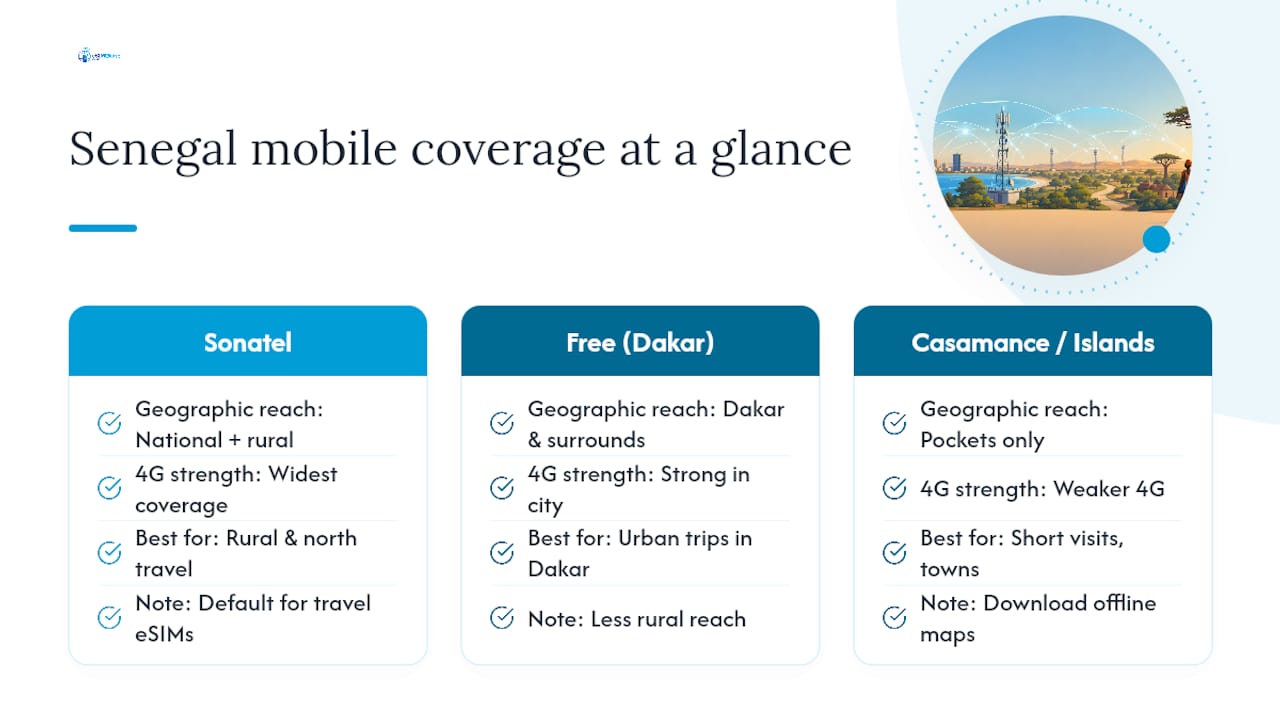
Coverage in Senegal splits fairly cleanly by carrier and by geography. Orange Sonatel carries the widest national footprint, reaching into rural stretches and the north where other networks thin out. Free runs a strong network concentrated in and around Dakar, which makes it a solid pick if your trip stays largely urban.
Sonatel’s rural reach is the reason most travel eSIM plans route through it by default rather than a Dakar-only carrier. Casamance and the outer islands see weaker 4G in pockets, particularly away from main roads and larger towns, so build in a data cushion if your itinerary heads that direction.
Recommended data allowances by trip type:
Before you head into lower-coverage areas, download offline maps for your full route, not just your destination city. Keep your eSIM’s roaming and data settings checked rather than assuming they carried over correctly from setup, and pack a power bank since chasing a weak signal drains battery faster than steady coverage does.
An Honest Take on Picking an eSIM for Senegal
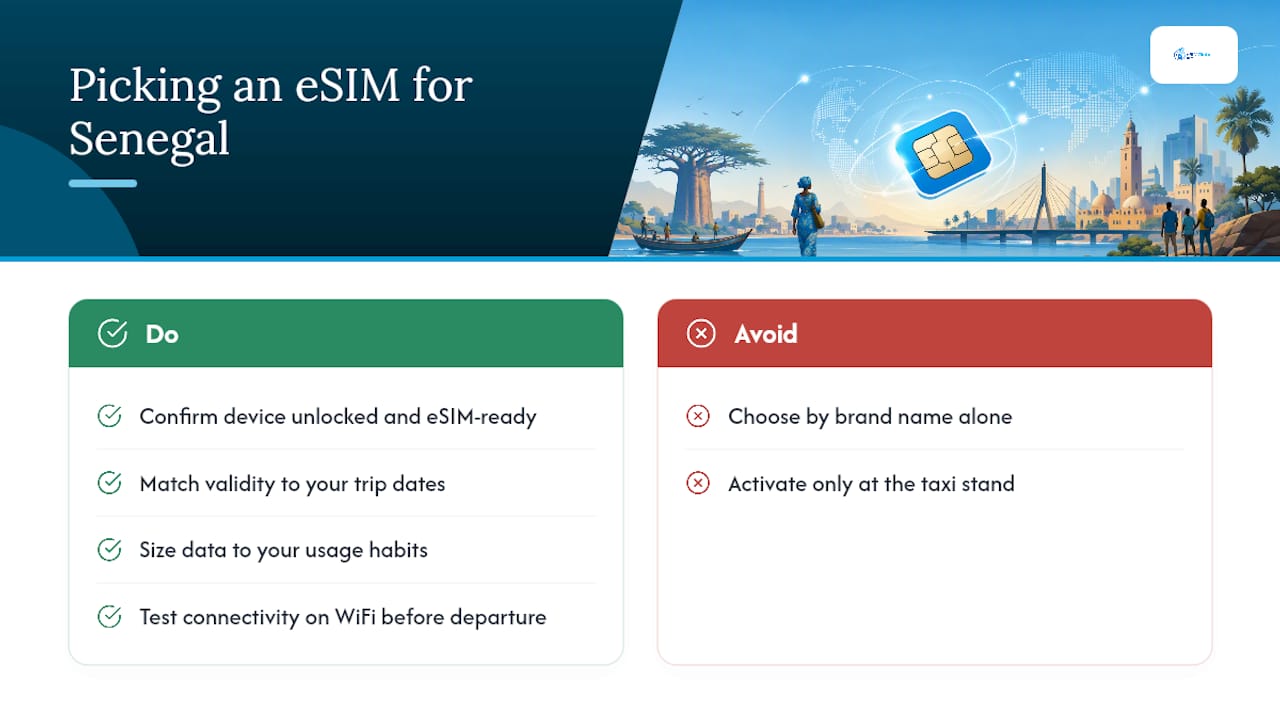
Most travel eSIM guides list five providers and call it a day, which is close to useless once you realize nearly all of them route through the same two local networks. The real decision isn’t which brand name is on the plan. It’s whether the validity window matches your actual dates, whether the data size matches your actual habits, and whether activation works before you’re standing at a taxi stand with no signal. A Senegal plan solves for the part that actually breaks trips: Sonatel-backed reach and a setup you can finish from your couch.
Quick checklist before you book: confirm your device is unlocked and eSIM-ready, match validity to your real trip dates, size data to your usage habits, download offline maps in advance, check roaming settings after install, and test connectivity on WiFi before departure.
— daniele
Get Connected in Senegal Before You Land
Skip the airport SIM counter and the language barrier that comes with it. Esimglobe’s Senegal eSIM gets you Sonatel-backed data delivered to your inbox in minutes, with pricing shown in your own currency and support available around the clock if anything doesn’t scan on the first try.
If Senegal is one leg of a longer Africa or multi-country trip, the eSIM Global (130+ areas) plan carries you across borders without buying a fresh profile at every stop, and travelers who know they’ll be heavy data users can step up to the eSIM Global (120+ areas) Unlimited plan instead. Check the current promo code offer at checkout before you confirm your order. Pick your plan, complete checkout, and your activation email arrives before you’ve finished packing.
Sources and Further Reading
Coverage claims and pricing benchmarks in this guide draw on independent eSIM comparison research, including plan-count aggregators tracking hundreds of Senegal-specific offers and multi-provider guides that map Orange Sonatel and Free network reach across the country. Pricing on any provider’s site changes, so confirm current rates and data allowances directly before purchase.
- A 76-plan comparison guide covering Senegal eSIM data buckets and remote-work recommendations
- A 170+ provider aggregator tracking Senegal plan pricing and availability
- A carrier-coverage guide detailing Sonatel and Free network reach, including Casamance caveats
- Esimglobe’s own guide to how eSIM data plans work for readers new to the technology
- A regional travel resource on currency and customs planning useful for broader West Africa trip prep
FAQ
Which eSIM Is Best for Traveling to Africa?
There’s no single best pick for the whole continent since coverage quality depends on the country’s local networks. For Senegal specifically, a Sonatel-backed plan like Esimglobe’s Senegal eSIM gives the strongest national reach.
Is There a Better eSIM Than Airalo for Senegal?
Most travel eSIMs, regardless of brand, route through the same underlying local carriers, so the meaningful differences come down to price, data sizing, validity length, and support quality rather than exotic network access. Some providers compete directly on those points with instant email delivery and 24/7 support.
Do US Citizens Need a Visa for Dakar, Senegal?
Visa requirements depend on nationality and length of stay, and rules change periodically, so check the current requirement with Senegal’s official consular resources or your travel agent before booking flights.
Is It Safe to Travel to Senegal Right Now?
Senegal is generally considered one of the more stable destinations in West Africa for tourism, though travelers should check current government travel advisories for specific regions and any recent updates before departure.
How Long Does eSIM Activation Take Before a Senegal Trip?
Purchase to activation typically takes under 15 minutes once you receive the QR code by email, though it’s best to install and test the profile a day or two before departure rather than at the airport.