




















TL;DR:
- Attending the 2026 FIFA World Cup across North America demands a reliable eSIM plan that accounts for congestion and cross-border coverage. Travelers should verify plan details, including soft caps and regional compatibility, to maintain connectivity amid crowded venues and border crossings. Proper pre-trip preparation, such as pre-ordering and downloading key apps, is essential for seamless communication during the tournament.
Attending the 2026 FIFA World Cup across the United States, Canada, and Mexico is a once-in-a-generation experience, but your mobile connectivity plan can make or break it. Most travelers assume any eSIM will keep them online, then discover mid-trip that speed has been throttled, borders have disrupted service, or a stadium packed with 70,000 fans has crushed local bandwidth. This guide cuts through the marketing noise to show you which factors actually matter when choosing an eSIM for a multi-country World Cup trip, what hidden limits to watch for, and how to stay reliably connected from the opening match to the final whistle.
Table of Contents
- Understanding eSIM basics for World Cup travel
- Comparing World Cup eSIM plans: Visible Travel Pass and beyond
- Coverage, speed, and crowd congestion: What to expect in USA, Canada, and Mexico
- Smart strategies for getting the most from your World Cup eSIM
- Why the conventional approach to event travel eSIMs falls short
- Explore seamless eSIM options with Esimglobe
- Frequently asked questions
Key Takeaways
| Point | Details |
|---|---|
| Beware stadium congestion | Mobile networks can slow down during matches due to crowded conditions, so plan ahead. |
| Compare eSIM coverage | Choose eSIMs that cover the USA, Canada, and Mexico for seamless World Cup travel. |
| Watch for data caps | Many so-called unlimited plans have daily soft caps and may throttle your speed after a limit. |
| Pre-order for savings | Booking your World Cup eSIM early often means better prices and less hassle. |
| Use smart travel strategies | Download tickets and maps ahead of time, and set up hotspots for group travel to maximize connectivity. |
Understanding eSIM basics for World Cup travel
An eSIM, short for embedded SIM, is a digital SIM card built directly into your smartphone or tablet. Instead of visiting a store and swapping a plastic card, you download a carrier profile remotely, usually through a QR code or an app, and your device connects to a local or regional network within minutes. For World Cup travel, this process is especially convenient because the 2026 tournament spans three countries, meaning physical SIM logistics would otherwise require multiple swaps across different carrier systems.
The advantages for international travelers are significant. You can switch between data plans without touching your device hardware. You can carry your home SIM alongside your travel SIM, keeping your home number active for calls and banking apps. And you can activate your plan before you even board your flight, so you land connected and ready. Learning the eSIM basics for travelers before your trip will help you set up everything correctly.
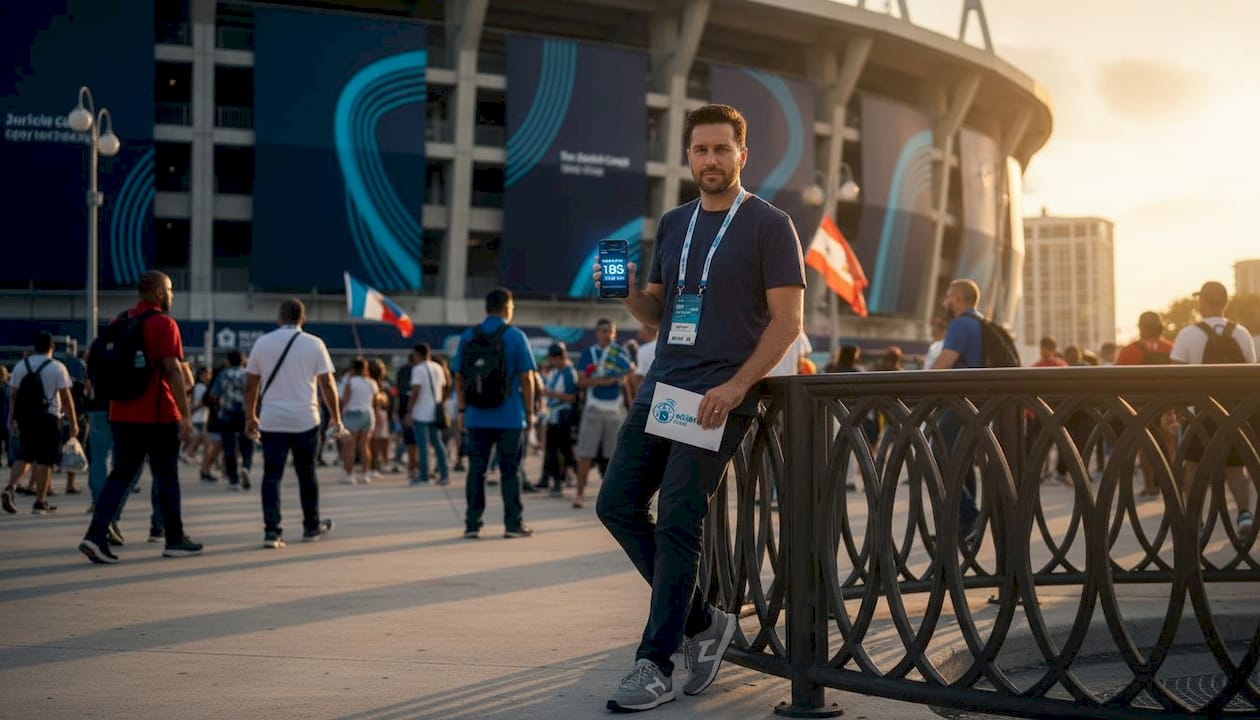
However, there is a real risk that many articles skip over entirely. eSIMs rely on the same physical network infrastructure as traditional SIMs. When you pack 70,000 fans into a stadium and everyone tries to share match highlights at the same moment, the towers get overwhelmed. According to the Mobimatter fan playbook, stadium and mass-event congestion is expected to affect cellular performance during the 2026 World Cup, regardless of which carrier or eSIM plan you hold.
Coverage maps on carrier websites show signal availability, not real-world usable speeds under load. A map showing full 5G coverage at a stadium tells you the towers are nearby. It does not tell you that those towers will be saturated during kickoff.
Key realities to know before you buy any eSIM:
- Coverage maps are best-case scenarios, not guarantees during peak crowd events
- 5G is faster in theory but more affected by congestion than some lower-band 4G LTE signals
- Cross-border travel between the USA, Canada, and Mexico requires a plan that explicitly covers all three countries
- Not every eSIM plan includes voice calling or SMS, which matters when coordinating with your group
Pro Tip: Download your match tickets, stadium maps, navigation routes, and any key apps to your device the night before each game. On match day, assume your connection inside the stadium will be slow or unreliable, and plan accordingly.
Relying on live data at a packed World Cup venue is a gamble. The fans who stay connected are the ones who prepare before they arrive, not after.
Comparing World Cup eSIM plans: Visible Travel Pass and beyond
The most high-profile eSIM launch tied specifically to the 2026 FIFA World Cup is the Visible Travel Pass. Visible, a carrier operating on Verizon’s network, launched a dedicated FIFA World Cup eSIM designed specifically for international fans traveling to the tournament. The product targets visitors who need coverage across the USA, Canada, and Mexico without dealing with local SIM cards in each country.
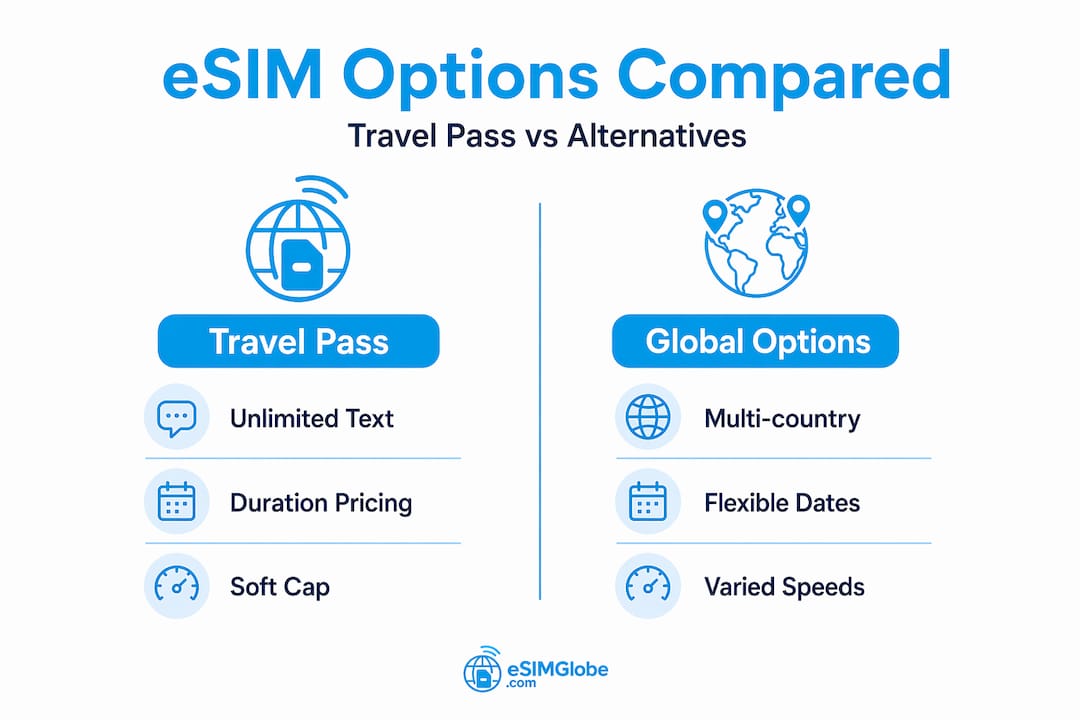
The Visible Travel Pass offers duration-based pricing with unlimited texting as a headline feature, which is genuinely useful when coordinating with family or large groups. The plans are structured around the length of your trip rather than data buckets, which removes some of the stress of monitoring gigabyte usage. Visible also offered a pre-order discount of $10, rewarding fans who planned ahead.
Here is how it stacks up against the broader range of eSIM options available to World Cup travelers:
| Feature | Visible Travel Pass | Option A (regional specialist) | Option B (global provider) | Option C (budget tier) |
|---|---|---|---|---|
| Countries covered | USA, Canada, Mexico | 1 to 2 countries | 100+ countries | Varies by plan |
| Data type | Unlimited (soft cap applies) | Fixed GB allowance | Fixed GB allowance | Fixed GB allowance |
| Unlimited texting | Yes | Varies | Rarely included | No |
| Hotspot/tethering | Limited | Often available | Often available | Rarely available |
| Activation method | App or QR code | QR code | App or QR code | QR code |
| Pre-order option | Yes, with discount | Rarely available | Sometimes available | No |
| Pricing structure | Duration-based | Per GB | Per GB or flat | Per GB |
| 5G access | Yes (Verizon network) | Depends on region | Depends on carrier | Usually 4G only |
The eSIM alternatives for travelers available through global platforms give you additional options beyond a single carrier’s branded product. Regional specialists may offer cheaper rates for fans attending matches in only one country, while global providers suit travelers who plan to extend their trip beyond the host nations.
One important consideration when reviewing eSIM device compatibility is that not all phones support eSIM. Most flagship Android and Apple devices released after 2018 support eSIM, but budget smartphones and some region-specific models may not. Check your phone’s settings under “Mobile Data” or “SIM” options before purchasing any plan.
Steps to pre-order and activate your World Cup eSIM:
- Confirm your phone supports eSIM by checking the settings or manufacturer’s website
- Compare plans based on which World Cup cities you will visit and how many days you will be in each country
- Purchase your preferred plan, noting the activation start date and expiry date
- Receive your QR code or app-based installation instructions by email
- Scan the QR code through your phone’s camera or settings menu to install the eSIM profile
- Set the eSIM as your primary data line while keeping your home SIM active for calls if needed
- Test the connection before your departure to confirm everything is working correctly
Statistic to note: Pre-ordering an eSIM before your travel dates can save up to $10 per plan on select providers, and it eliminates the risk of activation delays on arrival when airport connectivity is itself unreliable.
Coverage, speed, and crowd congestion: What to expect in USA, Canada, and Mexico
Understanding what your eSIM plan promises versus what it delivers in a packed World Cup venue is one of the most practical things you can do before your trip. The three host nations have very different network infrastructure profiles, and the experience varies not just between countries but between urban cores, suburban stadium areas, and rural transit routes.
In the United States, 5G coverage in major cities like New York, Los Angeles, Miami, and Dallas is extensive. However, as stadium congestion affects mobile performance, even top-tier 5G connections can feel slower than basic home broadband during match events. Canadian cities like Toronto and Vancouver have solid LTE and growing 5G infrastructure, but coverage gaps exist on routes between cities. Mexico City, Guadalajara, and Monterrey have strong urban coverage, though rural areas between venues can see significant signal drops.
The Visible plan is marketed as unlimited data, but it may have daily soft caps and speed reduction after hitting those caps. This is a critical detail. If you hit your daily cap during an afternoon match, your evening connection for navigation, booking restaurants, or finding your hotel may be slower than expected.
Here is a realistic benchmark table for how data performance typically behaves across different environments during a major event:
| Environment | Expected speed range | Congestion risk | Usability during match |
|---|---|---|---|
| Stadium interior (match day) | 0.5 to 3 Mbps | Very high | Limited, pre-download recommended |
| Stadium exterior (fan zones) | 2 to 8 Mbps | High | Moderate, texting works well |
| City center (match day) | 5 to 20 Mbps | Medium | Good for navigation and social |
| City center (non-match day) | 20 to 80 Mbps | Low | Excellent |
| Suburban hotel area | 15 to 50 Mbps | Low | Excellent |
| Highway transit (USA) | 5 to 30 Mbps (variable) | Very low | Good except in dead zones |
| Rural transit (Mexico) | 0 to 10 Mbps (patchy) | Very low | Unreliable, offline maps essential |
Following eSIM travel best practices means treating your eSIM data plan like a limited resource on match days, even when the plan technically offers unlimited access. The network congestion constraint is real and no plan can override it.
Travelers crossing between the three host countries should review the World Cup USA connectivity tips for country-specific guidance. Border crossings between the USA and Mexico, for example, are known for signal handover delays where your device may temporarily lose service as it transitions between carrier agreements.
Pro Tip: Download Google Maps or your preferred navigation app offline for every city you plan to visit. Also cache your transportation apps, hotel confirmations, and ticket barcodes while connected to hotel Wi-Fi. Assume zero data availability for the two hours around kickoff inside any stadium.
Key risk factors for coverage failure during the World Cup:
- Relying on carrier coverage maps without accounting for crowd load
- Assuming a 5G label means fast data during events
- Forgetting to check whether your eSIM plan covers all three host countries
- Hitting a daily soft cap at peak hours without knowing it exists
- Crossing from one host country to another without verifying the same plan applies
Smart strategies for getting the most from your World Cup eSIM
Even the best eSIM plan can underperform if you use it without a strategy. The 2026 World Cup is a high-pressure environment where you need navigation, communication, ticket access, and translation all running reliably. Here is how to optimize your setup for the full duration of the tournament.
Start by comparing eSIM plans specifically on their coverage footprint across all three host nations. A plan that covers only the USA works fine if you are only attending group stage matches in American cities, but falls apart the moment you cross into Canada or Mexico. Review the international eSIM types available to identify whether a regional multi-country plan or a global plan better matches your specific itinerary.
Match your plan’s validity period to your actual travel dates. A 14-day plan sounds flexible, but if your trip spans 18 days and the plan starts on purchase rather than first use, you could run out of coverage before the knockout rounds. Read the activation rules carefully. Some plans start their countdown on the day you install the eSIM. Others start when you first use data. This distinction can save or cost you several days of coverage.
A cost-effective methodology for travelers is to compare eSIMs across four dimensions: coverage area, number of valid days, hotspot or tethering availability, and international bundle inclusions for texting and calling. Tethering is especially useful if you are traveling with a partner or small group where only one person needs a data plan and others connect via mobile hotspot.
Check the eSIM travel tips for your specific destination cities, because some urban areas have eSIM-specific network agreements that affect which frequencies your device can access.
Pro Tip: Always verify whether “unlimited data” on your chosen plan includes a daily soft cap. The fine print on many plans shows that speeds drop significantly after a set threshold per day, often between 500 MB and 2 GB, even though the plan is labeled unlimited. Read the terms before you commit.
Strategic checklist for World Cup eSIM users:
- Identify every city on your itinerary and verify that your eSIM covers all of them
- Check whether your plan resets data limits daily or uses a single pool for the full trip
- Confirm hotspot is allowed if you plan to share data with travel companions
- Save your eSIM provider’s customer support contact before your trip, not during a problem
- Keep your home carrier’s SIM accessible as a backup for voice calls if needed
- Install a data monitoring app to track how much you have used against any soft cap
The global eSIM travel guide offers a broader framework for anyone whose World Cup trip connects to additional countries before or after the main event. If you are flying into Europe first and then on to North America, for example, you may benefit from a global plan rather than a World Cup specific regional option.
Why the conventional approach to event travel eSIMs falls short
Most articles about eSIMs for major sporting events focus on a single question: which plan is cheapest? That framing misses the two most consequential factors for World Cup travelers specifically: soft data cap disclosure and cross-border coverage continuity.
The soft cap issue is largely invisible until you experience it. The Visible Travel Pass is marketed as unlimited but may include daily soft caps with speed reduction after reaching the threshold. This is not unique to Visible. Most “unlimited” plans from any provider follow a similar structure, but the caps are buried in terms and conditions rather than displayed on the product page. By the time a traveler notices their connection has slowed, they are often standing outside a stadium trying to find their group.
The second overlooked problem is what happens at borders. The 2026 World Cup is the first truly tri-nation tournament. Fans following their teams may travel from a group stage match in Houston to a knockout stage match in Toronto and then a final in New York or Los Angeles. Each of those border crossings represents a moment where a carrier’s network agreement in one country may not transfer cleanly to the next. Some plans labeled “global” or “North American” technically cover all three countries but rely on different network partners in each, which can mean wildly different speeds or brief service gaps.
The practical answer from our experience with global travel eSIM advice is to prioritize three things above all else. First, confirm the plan explicitly names USA, Canada, and Mexico as covered territories, not just “North America” as a vague label. Second, find the soft cap policy in writing before you buy, specifically the daily threshold and the reduced speed after that threshold. Third, check whether the plan includes voice or text bundles, because data alone does not help you call your friend when your apps are not loading inside a congested stadium.
Generic advice about “picking a plan with good reviews” will not protect you from these specific failure points. The travelers who stay connected throughout the World Cup are the ones who treat eSIM selection as a research task, not a five-minute checkout decision.
Explore seamless eSIM options with Esimglobe
World Cup travel connectivity requires more than grabbing the first plan you see advertised. The guidance in this article covers the real considerations: soft caps, cross-border coverage, congestion realities, and validity period planning.
Esimglobe offers a curated selection of eSIM plans across multiple countries and regions, including coverage options for the USA, Canada, and Mexico. The platform supports multiple currencies (USD, EUR, GBP) and language interfaces, making it straightforward to find and compare plans that match your specific World Cup itinerary. Browse available plans, review coverage details, and activate your eSIM digitally before you travel, so you arrive at your first match already connected and prepared.
Frequently asked questions
Will stadium crowds affect my eSIM data during World Cup matches?
Yes, heavy use and mass crowds in stadiums can lead to network congestion and reduced speeds, regardless of the provider. Stadium and mass-event congestion is expected to affect cellular performance during the 2026 World Cup.
Does Visible’s World Cup Travel Pass truly offer unlimited data?
Visible’s plan is marketed as unlimited data, but the Visible plan includes a daily soft cap and reduced speeds after reaching that cap, which can affect usability during peak event hours.
How do I pick the best eSIM plan for multiple countries during the World Cup?
Look for plans that explicitly cover USA, Canada, and Mexico under one package and verify soft cap policies before purchasing. Prioritize offers that specify all three countries and include clear throttling disclosures.
Is it worth pre-ordering a World Cup eSIM plan?
Yes, pre-ordering can secure discounts and ensure your eSIM is ready before your travel dates begin. The Visible pre-order discount of $10 is one example of the savings available to travelers who plan ahead rather than buying at the last minute.