






















Most travelers overbuy data. If you’re planning a typical vacation, a right-sized standard plan between 3 GB and 20 GB, depending on trip length and habits, will cost less than unlimited and still run at full speed the whole time. Unlimited eSIM plans earn their price only for heavy streamers, frequent hotspot users, long remote-work stays, or anyone who simply refuses to track usage.
The math behind that verdict is simple. Most travelers use close to 1 GB per day between maps, messaging, and browsing.
- Light traveler (maps, messaging, some browsing): a few GB per week
- Moderate traveler (social media, music, occasional video calls): several GB per week
- Heavy traveler (HD streaming, hotspot for a laptop, cloud backup): a higher data plan or unlimited options
Esimglobe’s eSIM Data Guide walks through the same math in more detail if you want a second pass.
Key Takeaways
| Point | Details |
|---|---|
| Most travelers need less than they think | A typical traveler uses close to 1 GB per day, well under what unlimited plans assume. |
| Size your plan with math, not guesswork | Multiply your daily average by trip days, add 20%, and round up to the next plan size. |
| Unlimited pays off only at scale | Unlimited becomes cost-effective mainly above roughly 15–20 GB per trip or for hotspot-heavy stays. |
| Watch the fair-use fine print | Many unlimited plans throttle speed after a daily full-speed cap, so check terms before buying. |
| Esimglobe fits both strategies | Esimglobe offers prepaid data-only eSIMs across 170+ countries with instant delivery and in-app top-ups for either standard or heavier data needs. |
Sources and further reading
- Apple Support’s eSIM travel documentation
- Netflix and Spotify streaming data guidance
- Always confirm a provider’s fair-use policy before purchase.
Table of Contents
- How Much Data Do I Need for an eSIM? Understanding the Basics
- How Do I Check My Current Data Usage Before Buying?
- What Size eSIM Plan Do I Need for My Trip Length?
- What’s the Real Difference Between Standard and Unlimited eSIM Plans?
- How Do I Decide Between Standard and Unlimited for My Trip?
- How Can I Cut Data Use While Traveling?
- FAQ
How Much Data Do I Need for an eSIM? Understanding the Basics
Data gets measured in megabytes (MB) and gigabytes (GB), where 1 GB equals 1,024 MB. Every app you open pulls a different amount depending on what it’s doing in the background: a maps app pinging your location sips data, while a video call streaming your face in real time gulps it.
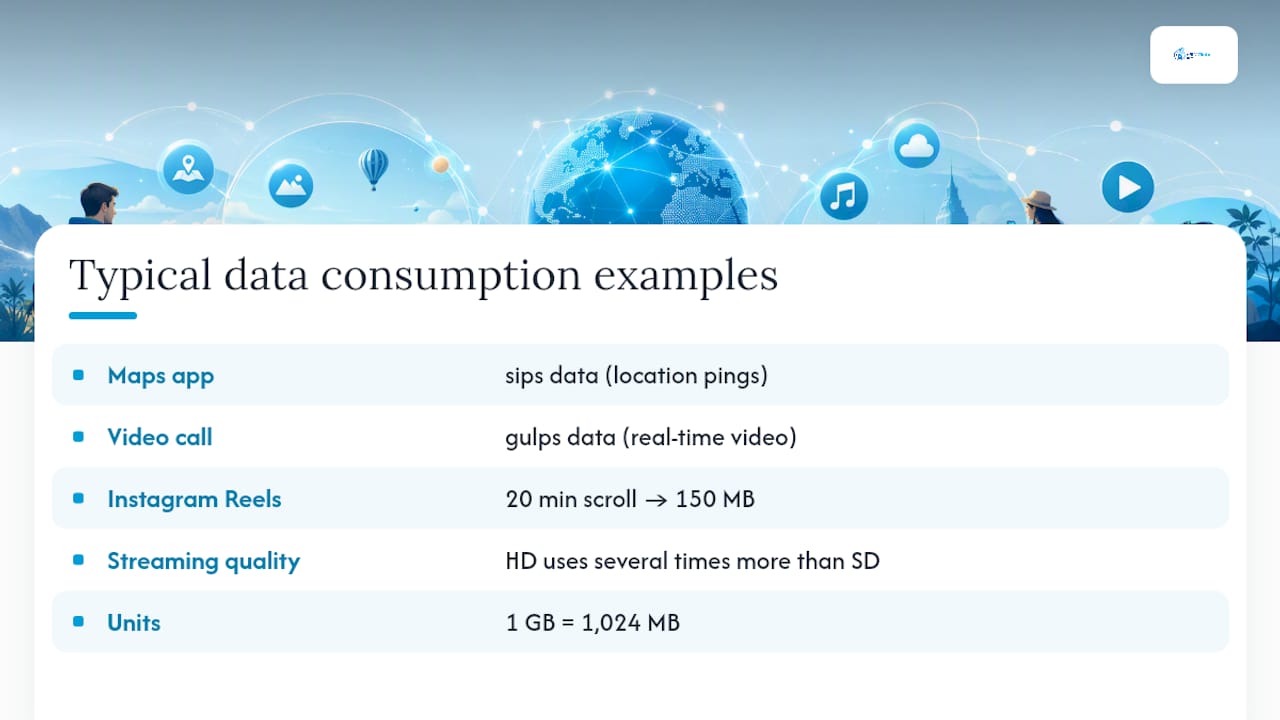
Three factors swing the numbers most: streaming resolution (HD versus standard versus data-saver), whether an app is uploading (photos, video) or just downloading, and background sync (cloud backup, auto-updates, app refresh). Turn off just the third one and you can cut your daily total noticeably without changing a single habit.
Here’s how common travel activities translate into data, based on typical hourly consumption:
Social feeds are the sneaky one. A quick 20 minute scroll through Instagram Reels can burn through 150 MB without you noticing, because it’s autoplaying video the entire time, not just showing photos.
Pro Tip: Drop your streaming app’s video quality to “Data Saver” or “Standard” before you land. Netflix’s own guidance shows HD streams use several times more data than standard definition, and most people can’t tell the difference on a phone screen anyway.
Keep in mind that “unlimited” doesn’t always mean unrestricted, even once you know your hourly numbers. Providers often cap full-speed data at a daily threshold and throttle afterward. More on that shortly.
How Do I Check My Current Data Usage Before Buying?
Your own phone already has the answer to how much data you actually use, and checking it takes two minutes.
- On iPhone: Go to Settings > Cellular, scroll down to see data used by each app since your last reset, then tap “Reset Statistics” a week before your trip to get a clean baseline.
- On Android: Go to Settings > Network & Internet > Data Usage, set your usage cycle to match a recent week, and review the per-app breakdown.
- Check your carrier bill or account app: Most carrier apps show a rolling monthly average, which is useful for confirming your phone’s on-device numbers match reality.
Your home carrier’s unlimited plan hides your real per-app consumption. Once travelers actually measure a week of typical use, most discover they need far less than they assumed.
One caveat: eSIM apps and your home carrier don’t always report usage the same way, especially once you’re roaming. Confirm your remaining balance in the eSIM provider’s own app or dashboard rather than trusting your phone’s built-in counter alone once you’ve activated a travel plan.
What Size eSIM Plan Do I Need for My Trip Length?
Once you know your daily habits, sizing a plan is arithmetic, not guesswork. Apply your travel style’s daily average, multiply by trip length, add a 20% buffer, and round up to the next plan size a provider actually sells.
- Weekend trip: Light users need a few GB; moderate users need several GB; heavy users need a larger plan.
- One week: Light users need a few GB; moderate users need a moderate amount; heavy users need a higher data allowance.
- Two weeks: Light users need moderate data; moderate users need more; heavy users need a substantial plan or unlimited.
- One month: Light users need a sizeable amount; moderate users need a larger amount; heavy users often prefer unlimited.
Round up, don’t round down.
If your trip spans multiple countries, the calculation itself doesn’t change, only your coverage choice does. A regional plan covering several countries or a single-country plan bought fresh at each border both use the same GB math; you’re just deciding on coverage footprint, not data volume. Esimglobe’s guide on regional eSIM plans for multi-country travel breaks down when regional coverage actually saves money versus buying separately per country.
What’s the Real Difference Between Standard and Unlimited eSIM Plans?
A standard fixed-data plan gives you a set number of GB valid for a fixed number of days, running at full speed until that bucket empties. Most providers let you top up instantly in-app if you run low, so running out isn’t the disaster it sounds like.
An unlimited plan typically isn’t unlimited in the literal sense. Most allocate a daily full-speed allowance, often 1 to 3 GB, then throttle your speed to something like 128 kbps to 512 kbps for the rest of that day. That’s usable for messaging and maps, but painful for video.
Even plans labeled “unlimited” frequently enforce daily full-speed caps with throttling after that point. Unlimited often buys you convenience and peace of mind rather than truly unrestricted high-speed data.
The cost shape matters too. Unlimited plans typically run two to three times more expensive than a fixed plan sized for moderate use, and they only become the cheaper option once your usage climbs toward roughly 15 to 20 GB per trip. Below that threshold, you’re paying a premium for a safety net you probably won’t need.
- Standard plans win on price for light and moderate travelers.
- Unlimited wins on convenience for heavy streamers, hotspot users, and long-stay remote workers.
- Always check the provider’s fair-use policy before buying. Esimglobe’s glossary of eSIM terms explains fair use, throttling, and validity in plain language.
How Do I Decide Between Standard and Unlimited for My Trip?
Run through this checklist before you check out:
- Check your device’s real usage from the past week using the steps above.
- Pick your travel style honestly: light, moderate, or heavy.
- Calculate daily average × trip days, then add 20%.
- Compare the cost of a fixed plan plus one likely top-up against an unlimited plan’s flat price.
- Read the fair-use policy fine print, specifically the daily full-speed cap and throttle speed.
The decision usually comes down to one number. If your calculated need lands under roughly 15 GB for the whole trip, a standard plan almost always costs less, even accounting for a top-up. Above that, or if you’re hotspotting a laptop for work, unlimited starts making financial sense.
- Buy standard if: your trip is under two weeks and you’re not streaming HD video daily.
- Buy unlimited if: you’re traveling a month or more, working remotely off your hotspot, or you’d rather not think about data at all.
- When in doubt: buy the standard plan one size up. Esimglobe’s data-only eSIM comparison lays out pricing shapes side by side if you want to run your own numbers.
How Can I Cut Data Use While Traveling?
Small habit changes shrink your GB requirement more than most travelers expect.
- Connect to Wi-Fi at your hotel or café before uploading photos or videos.
- Switch streaming apps to standard or data-saver quality instead of HD.
- Download offline maps and playlists before you leave home, or the first time you hit Wi-Fi.
- Turn off background app refresh for apps you don’t need running constantly.
- Set cloud photo backup to Wi-Fi only, never cellular.
Pro Tip: If you’re planning to tether a laptop for work, treat yourself as a heavy user from the start rather than hoping a light plan stretches. Laptop browsers, video calls, and file syncs consume data far faster than a phone alone.
Offline maps plus Wi-Fi-only photo backup alone can cut a moderate traveler’s plan requirement by several gigabytes over a two-week trip, often enough to drop down a full plan tier. Esimglobe’s eSIM travel tips guide covers more habits worth building before departure.

A quick recommendation from experience
Esimglobe supports both approaches with multi-region plans and instant eSIM delivery, so switching strategy mid-trip is never a hassle.
Skip the airport SIM counter entirely
Esimglobe sells prepaid, data-only eSIMs for 170+ countries, delivered instantly by email so you can activate before you even board. Once you’ve run the numbers in this guide, pick the plan size that matches your travel style, buy it in minutes, and scan the QR code to activate the moment you land.
The real advantage isn’t just skipping a line at arrivals. It’s buying exactly the GB your calculation says you need, at full 5G/4G LTE speed the entire time, with the option to top up in-app instantly if your trip runs longer or heavier than planned. No fair-use fine print to decode, no throttled speeds after some hidden daily cap. Browse country and regional plans now at Esimglobe and size your next trip’s data with confidence before you fly.
FAQ
How much data should I buy for my eSIM?
For a typical one to two week vacation, that usually lands between 5 GB and 15 GB.
Is 20GB of data enough for 2 weeks?
Yes, 20 GB comfortably covers even moderate to heavy use over two weeks, including regular social media, music streaming, and occasional HD video. Light and moderate travelers rarely use that much.
Is 10GB enough for 2 weeks?
For light to moderate travelers relying mainly on maps, messaging, and browsing with some streaming, 10 GB is usually enough for two weeks. Heavy streamers or hotspot users should size up or consider unlimited.
Do eSIMs give you unlimited data?
Some eSIM providers, including Esimglobe, offer unlimited plans alongside standard fixed-GB options, but “unlimited” plans typically include a daily full-speed cap followed by throttled speeds. Standard fixed-data plans run at full speed until the GB allowance runs out.