






















TL;DR:
- An eSIM for Brazil is a digital profile that quickly connects your phone to local networks without a physical SIM card or registration. It supports remote activation and works on major carriers like Vivo, Claro, and TIM, with coverage spanning cities and rural areas from 4G LTE to 5G. Travelers can buy, install, and activate their plans online before departure, avoiding the need for a Brazilian CPF tax ID and eliminate store visits.
An eSIM for Brazil is a digital SIM profile that loads directly onto your phone, giving you immediate access to Brazil’s mobile networks without a physical card or local registration. Unlike traditional SIM cards, an embedded SIM (the industry standard term is eSIM, short for embedded Subscriber Identity Module) supports remote provisioning, meaning you buy, download, and activate your plan entirely online. Brazil’s three major carriers, Vivo, Claro, and TIM, power the underlying networks that international eSIM plans run on, covering 4G LTE nationwide and 5G in major urban centers. For travelers and digital nomads heading to São Paulo, Rio de Janeiro, or anywhere in between, an eSIM removes the single biggest friction point of Brazilian mobile access: the CPF tax ID requirement.
What are your eSIM options and data plans for Brazil?
Brazil eSIM plans cover a wide range of data needs, from minimal usage packages to large data buckets suited for extended stays. Plans start as low as $0.42 for light usage, with a standard 10GB plan running around $19 for 30 days. Larger plans exceeding 50GB are available for travelers who need consistent high-speed data throughout a long trip.
The prepaid structure is one of the clearest advantages. There are no contracts, no credit checks, and no store visits. You pay once, receive your eSIM profile digitally, and your data is ready when you need it.
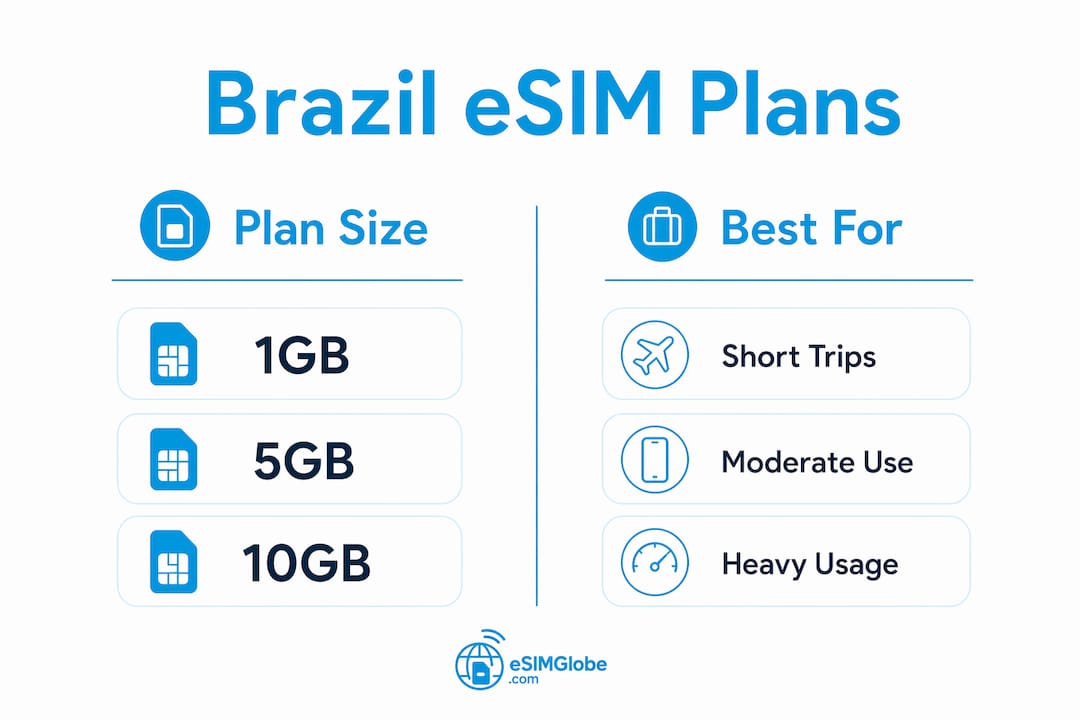
Here is a breakdown of common plan tiers for Brazil:
| Plan Size | Typical Price | Best For |
|---|---|---|
| 1GB | $0.42–$3 | Short trips, light browsing |
| 5GB | $8–$12 | Week-long visits, moderate use |
| 10GB | ~$19 for 30 days | Standard travel benchmark |
| 20GB+ | $25–$35 | Extended stays, remote work |
| 50GB+ | $40+ | Digital nomads, heavy streaming |
Validity periods typically range from 7 days to 30 days, with some providers offering 90-day options for longer stays. Matching your plan to your actual trip length prevents paying for unused data.
Some plans go beyond basic data. Certain plans include unlimited tethering, VPN services, and web protection features. That matters for digital nomads who rely on hotspot connections for laptops or tablets.
- Short visits (under 7 days): A 3GB or 5GB plan covers maps, messaging, and light browsing.
- Standard trips (1–2 weeks): A 10GB plan is the most common choice and the clearest price benchmark.
- Extended stays or remote work: Plans of 20GB or more, ideally with tethering, handle daily professional use.
- Multi-country itineraries: Look for regional Latin America plans that include Brazil alongside neighboring countries.
Pro Tip: Buy a plan with slightly more data than you think you need. Topping up mid-trip is possible, but buying a larger plan upfront is almost always cheaper per gigabyte.
How does eSIM network coverage vary across Brazil?

Brazil’s mobile coverage is strong in cities and thinner in remote regions. That gap matters more in Brazil than in most countries because of the country’s sheer geographic size.
5G is widely available in São Paulo and Rio de Janeiro, with solid performance in other major cities including Brasília, Belo Horizonte, and Fortaleza. In those urban centers, field tests show roughly 80% 5G coverage, with 4G LTE filling the remaining gaps. That translates to fast, reliable data for city-based travelers.
Rural areas and the interior of Brazil tell a different story. 4G LTE is the primary standard across most of the country outside major cities. The Amazon region, the Pantanal, and other remote destinations have limited coverage from any carrier. No eSIM plan changes that physical reality.
The key factor for coverage reliability is multi-carrier support. Multi-network partnerships deliver better reliability because your device can connect to whichever of Vivo, Claro, or TIM has the strongest signal in a given area. A plan locked to a single carrier limits your options the moment you leave that carrier’s strongest zones.
Key coverage facts for Brazil travelers:
- São Paulo and Rio de Janeiro: 5G available, fast speeds, consistent connectivity.
- Secondary cities (Curitiba, Salvador, Recife): Strong 4G LTE, some 5G pockets.
- Interior and rural areas: 4G LTE primary, speeds vary by location.
- Amazon and remote regions: Coverage is limited. Download offline maps and content before you go.
- Coastal areas: Generally solid 4G LTE, with 5G in larger beach cities.
Pro Tip: If your itinerary includes both cities and nature destinations, prioritize a plan with multi-carrier access over one that advertises the lowest price. A cheaper plan tied to one carrier can leave you without signal in areas where another carrier has coverage.
How to buy, install, and activate an eSIM for Brazil
Setting up a Brazil eSIM takes under 10 minutes when you follow the right sequence. The process is fully digital, and you can complete it days before your flight.
-
Check device compatibility. Your phone must support eSIM technology. Most flagship smartphones released after 2018 are compatible, including iPhone XS and later, Google Pixel 3 and later, and Samsung Galaxy S20 and later. Go to your phone’s settings and look for a “Mobile Plans” or “Add eSIM” option to confirm.
-
Verify your phone is unlocked. A carrier-locked phone will not accept a foreign eSIM profile. Contact your home carrier to unlock your device before purchasing a plan.
-
Purchase your plan online. Select a Brazil eSIM plan from a reputable provider like Esimglobe. Buying and installing via app or QR code removes the need to visit any physical store or navigate a foreign-language registration process.
-
Receive your QR code. After purchase, you receive a QR code by email or within the provider’s app. This code contains your eSIM profile.
-
Scan the QR code. Go to your phone’s eSIM settings and select “Add Plan” or “Add Mobile Plan.” Point your camera at the QR code. Your phone downloads the profile in seconds. Alternatively, some providers offer manual entry codes if your camera cannot scan.
-
Set your activation preference. Most eSIMs activate immediately after scanning, with data consumption beginning as soon as you enable the plan. Some plans let you set activation to start on arrival, which preserves your validity period.
-
Test your connection. Before boarding, confirm the eSIM profile appears in your settings. After landing in Brazil, switch to the eSIM as your primary data line and verify you have signal.
No CPF tax ID is required at any point. That alone separates the eSIM process from buying a local physical SIM, which requires a Brazilian CPF, an 11-digit tax identification number that most tourists do not have.
Pro Tip: Install your eSIM profile while connected to Wi-Fi at home, not at the airport. Airport Wi-Fi is unreliable, and a failed download mid-installation can lock the profile. Once installed, the profile stays on your device even without an internet connection.
Key benefits of using an eSIM in Brazil vs. a local physical SIM
The eSIM advantage in Brazil is clearest when you compare the two setup experiences side by side.
Getting a local physical SIM in Brazil requires a CPF tax ID. The CPF is an 11-digit tax ID required by Brazilian law to register a prepaid SIM. Tourists without one face a dead end at most carrier stores. Some workarounds exist, but they involve navigating Portuguese-language paperwork or relying on a local contact.
An eSIM bypasses that entirely. eSIMs avoid local registration headaches and language barriers that make physical SIM purchases frustrating for international travelers. You purchase remotely, in your own language, before you even pack your bag.
Core benefits of choosing an eSIM for Brazil:
- No CPF required. The registration barrier that blocks most tourists from local SIMs does not apply to eSIM plans.
- Instant remote purchase. Buy your plan from home, in English, days before departure.
- No store visits. No airport kiosk lines, no carrier store navigation in a foreign language.
- Keep your home number active. Most modern phones support dual SIM, so your home number stays reachable while the eSIM handles data.
- Easy plan switching. If your data runs low, you top up or switch plans digitally without finding a store.
- Cost savings over roaming. International roaming charges from home carriers are consistently higher than prepaid eSIM plan rates for Brazil.
The one area where a physical SIM still has an edge is voice calls at local Brazilian rates. If you need a local Brazilian phone number for calls, a physical SIM provides that. For data-focused travelers and digital nomads, an eSIM covers every practical need.
Tips for choosing the best eSIM plan for your Brazil trip
The right plan depends on three variables: how long you stay, where you go, and how much data you actually use.
Start with an honest data estimate. Streaming video consumes roughly 1GB per hour. Navigation apps use far less. A traveler who uses maps, messaging, and occasional social media rarely exceeds 500MB per day. A remote worker running video calls and uploading files can hit 3–5GB daily.
- Short city trips (3–5 days): A 3GB or 5GB plan is sufficient for most travelers staying in São Paulo or Rio de Janeiro.
- Two-week mixed itineraries: A 10GB plan at the standard benchmark price covers most needs, with room for navigation in rural areas.
- Digital nomad stays (30+ days): Plans of 20GB or more with tethering support are the practical choice. Confirm the plan explicitly allows hotspot use before purchasing.
- Nature and adventure travel: Prioritize coverage quality over data volume. A large plan on a single-carrier network is less useful than a smaller plan with multi-carrier access in the Pantanal or Chapada Diamantina.
Coverage and reliability outweigh absolute lowest price for travelers with diverse itineraries. A $3 savings on a plan that drops signal outside city limits is not a savings at all.
Check these details before finalizing any plan:
- Does the plan support 5G, or is it capped at 4G LTE speeds?
- Does it allow tethering, or is hotspot use restricted?
- What is the validity period, and does it start on purchase or on first use?
- Is customer support available in English, and through what channels?
Pro Tip: Install your eSIM and run a quick speed test the moment you land. If speeds are lower than expected, toggle airplane mode off and on to force a network reconnection. That resolves most initial connection issues without any support call.
Key Takeaways
An eSIM for Brazil is the most practical connectivity option for international travelers because it removes the CPF registration barrier, enables remote setup, and runs on the same Vivo, Claro, and TIM networks as local physical SIMs.
| Point | Details |
|---|---|
| No CPF required | eSIMs bypass Brazil’s local SIM registration law, which blocks most tourists. |
| Plans start at $0.42 | A 10GB plan costs around $19 for 30 days, covering most standard travel needs. |
| 5G in major cities | São Paulo and Rio de Janeiro have strong 5G coverage; rural areas rely on 4G LTE. |
| Install before departure | Scan your QR code at home on Wi-Fi to avoid airport installation problems. |
| Prioritize multi-carrier access | Plans that connect to Vivo, Claro, and TIM deliver better coverage across Brazil’s regions. |
Brazil eSIM coverage: what I’ve learned from experience
The single mistake I see travelers make is buying the cheapest Brazil eSIM plan without checking which carrier it runs on. Brazil is enormous. The distance from São Paulo to Manaus is roughly the same as New York to Los Angeles. A plan optimized for São Paulo’s 5G grid performs very differently in the Pantanal or along the Transpantaneira road.
My honest observation is that the CPF barrier is more significant than most travel guides acknowledge. I have watched travelers spend 90 minutes at a carrier store in Rio, trying to register a local SIM without a CPF, only to give up and pay airport Wi-Fi rates for the rest of the day. An eSIM purchased before departure eliminates that entire scenario.
The 5G expansion in Brazil is real and accelerating, but it is still a city story. If your trip stays within São Paulo, Rio, Brasília, or other major metros, you will get genuinely fast speeds. If you are heading to the Cerrado, the Amazon, or coastal towns outside the main tourist corridors, plan for 4G LTE and download what you need offline before you leave the city.
One thing I recommend that most articles skip: verify your phone is unlocked before you buy anything. A locked device cannot accept a foreign eSIM profile, and discovering that at the airport is a bad situation. Check your unlock status at home, contact your carrier if needed, and give yourself a few days for the unlock to process.
The eSIM market for travelers is maturing fast. Plan options, pricing, and coverage are all improving year over year. Travelers who set up their connectivity before departure consistently report better experiences than those who figure it out on arrival.
— daniele
Esimglobe’s Brazil eSIM plans for international travelers
Esimglobe offers a direct, straightforward way to get connected in Brazil before your trip begins. The platform lists Brazil eSIM plans with clear pricing, data sizes, and validity periods, so you know exactly what you are buying. Plans run on Brazil’s major carrier networks, covering both urban 5G zones and 4G LTE in regional areas.
Purchase is fully digital. After checkout, your QR code arrives by email, ready to scan and install on any compatible unlocked device. Esimglobe’s platform supports multiple currencies and languages, making the process straightforward for travelers from any country. For travelers who want to review service terms before purchasing, Esimglobe’s terms and conditions are publicly listed. For additional guidance on getting the most from your plan, the eSIM travel tips section covers practical advice for staying connected across Brazil’s regions.
FAQ
What is an eSIM for Brazil?
An eSIM for Brazil is a digital SIM profile that loads onto a compatible phone, connecting it to Brazilian mobile networks like Vivo, Claro, and TIM without a physical card or local registration.
Do I need a CPF to get an eSIM for Brazil?
No. eSIMs require no Brazilian CPF tax ID. That registration requirement applies only to local physical SIM cards, which is why eSIMs are the standard choice for international travelers.
How do I activate an eSIM for Brazil?
After purchasing a plan, you receive a QR code by email. Scan it through your phone’s eSIM settings to download the profile. Most plans activate immediately or on first use in Brazil.
Is 5G available on Brazil eSIM plans?
5G is available in São Paulo, Rio de Janeiro, and other major Brazilian cities. Rural and interior areas use 4G LTE as the primary standard. Select a plan that explicitly supports 5G if city speeds are a priority.
Can I use my eSIM as a hotspot in Brazil?
Some Brazil eSIM plans include tethering and hotspot support. Check the plan details before purchasing, as not all plans allow it. Plans marketed toward digital nomads typically include unlimited tethering as a listed feature.