






















TL;DR:
- Mobile roaming allows your phone to connect to foreign networks outside your home coverage, often leading to high charges. Using local SIM cards or eSIMs offers more affordable options for internet access abroad. Proper planning and device checks help travelers avoid unexpected roaming costs.
Mobile roaming is defined as the ability of a mobile device to connect to a foreign carrier’s network outside the home carrier’s coverage area, enabling calls, texts, and data usage abroad. Every time you land in a new country and your phone automatically connects to a local network, that is mobile roaming in action. Understanding what is mobile roaming, how charges accumulate, and what alternatives exist can save you from a shocking phone bill after your trip. Carriers like Verizon and regulatory frameworks like the EU’s “roam like at home” policy have reshaped the cost picture, but the risks are real and the details matter.
What is mobile roaming and how does it work technically?
Mobile roaming is the technical and commercial process by which your home carrier grants your device access to a partner network in a foreign country. The bilateral agreements between carriers form the backbone of this system. Without a signed agreement between your home carrier and a local operator, your phone simply cannot connect, even if that local network has strong signal.
When you cross a border, your phone scans for available networks and authenticates itself through a real-time data exchange between the foreign network and your home carrier. This process is called inter-carrier signaling, and it happens in seconds. Your home carrier confirms your identity, authorizes service, and begins logging usage data that will eventually appear on your bill.
The quality and price of roaming service varies significantly by geography. Service quality and price variability depend directly on which carrier your phone latches onto and the terms of the agreement your home carrier has negotiated with that partner. A traveler using AT&T in Southeast Asia may get strong 4G in Thailand but only 2G in a neighboring country, simply because the agreements differ.
Device compatibility adds another layer of complexity. Your phone may support voice calls on a foreign network but fail to connect for data depending on network standards and frequency bands. A phone built for North American LTE bands may not support the specific bands used in parts of Asia or Africa, leaving you with calls but no mobile data.
Pro Tip: Before any international trip, check your phone’s supported frequency bands against the bands used by carriers in your destination country. Your phone manufacturer’s spec sheet lists this under “LTE bands” or “network compatibility.”
What is a roaming fee and how do costs vary internationally?
A roaming fee is the charge your home carrier applies when you use voice, text, or data on a foreign network. These fees are not uniform. They vary by country, carrier, usage type, and whether your plan includes any international coverage at all.
Most U.S. plans exclude international roaming by default. The FCC confirms that roaming fees for calls, texts, and data often appear one full billing cycle after your trip ends. That delay is dangerous. You may return home, assume your bill is settled, and then receive a charge weeks later that you did not budget for.
Here is how roaming data charges typically break down for U.S. travelers:
- Pay-per-use data: Can reach $10–$20 per megabyte on some carriers without an international plan, making a single video stream cost hundreds of dollars.
- Daily flat-rate plans: Verizon TravelPass costs $6–$12 per day and covers talk, text, and data in 185+ countries using your domestic allowances.
- Monthly international add-ons: Some carriers offer monthly packages for frequent travelers, typically ranging from $25–$70 per month for limited data.
- EU-regulated roaming: Within the EU, EEA, Moldova, and Ukraine, travelers can use domestic rates while roaming under the “roam like at home” regulation, with fair-use data caps applied.
The EU model is the most consumer-friendly roaming framework in the world. Operators can charge capped surcharges beyond fair use, set at €1 per GB as of 2025. That cap protects travelers from runaway data costs, but it only applies within the regulated zone. Step outside the EU into Turkey or Morocco, and standard international rates apply immediately.
One underappreciated risk is border roaming. If you live near a national border or pass through one briefly, your phone may automatically connect to a foreign network without any action on your part. That automatic connection triggers roaming charges even if you never intended to use a foreign network. A 30-minute drive near the U.S.-Canada or U.S.-Mexico border can generate charges you will not see until your next bill.
Mobile roaming vs. local SIM cards and eSIMs: which option is better?
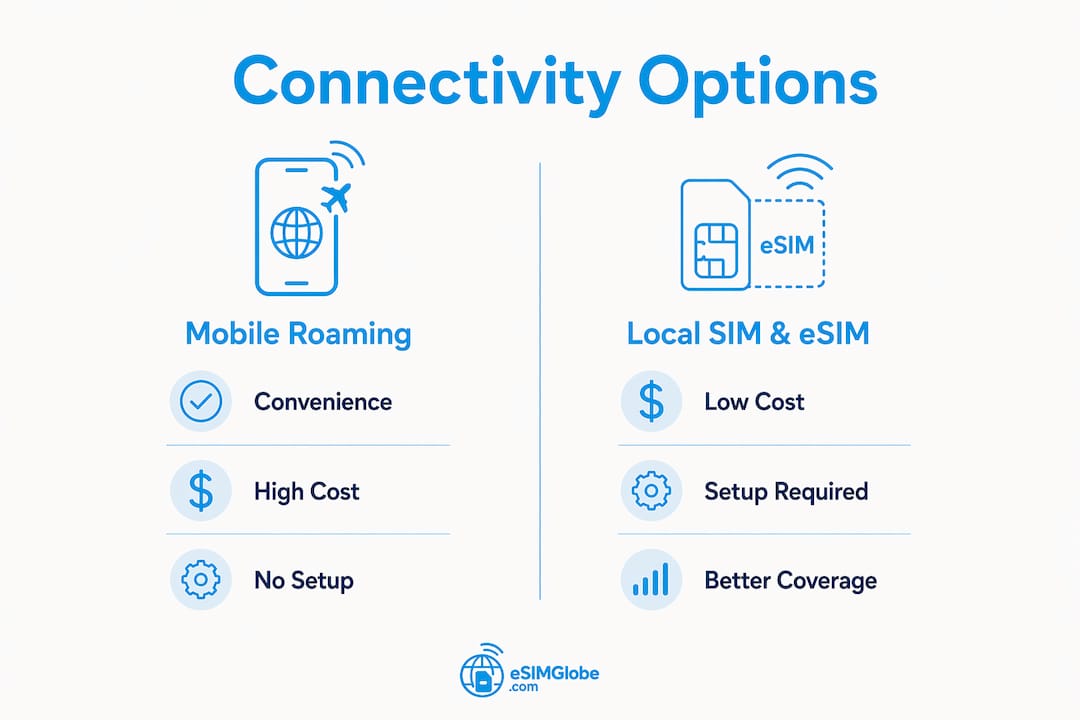
Roaming is convenient because it requires no setup. You land, your phone connects, and you are online. But that convenience comes at a cost that often far exceeds what alternatives charge for the same data.

A local SIM card requires you to physically swap out your home SIM at the destination, find a carrier store or kiosk, and purchase a prepaid plan. Local data rates are typically a fraction of roaming rates. A 10 GB local SIM in Japan or South Korea might cost $15–$25 for a two-week trip. The same data volume through a U.S. carrier’s roaming plan could cost several times more. The trade-off is the inconvenience of managing two SIMs and potentially losing your home number’s accessibility while abroad.
eSIM technology removes that physical swap entirely. eSIMs allow travelers to switch carriers digitally without removing any physical card, and local data plans can be purchased and activated before departure. This means you land with a working local data plan already installed on your phone.
The table below compares the three main connectivity options for international travelers:
| Feature | Traditional roaming | Local SIM card | eSIM (e.g., Esimglobe) |
|---|---|---|---|
| Setup required | None | Physical swap at destination | Digital activation before travel |
| Cost per GB | High ($10–$20+ without plan) | Low ($1–$5 typical) | Low to moderate ($2–$8 typical) |
| Home number access | Yes | No (unless dual SIM) | Yes (if dual SIM or eSIM-only) |
| Coverage flexibility | Carrier-dependent | Single country | Multi-country plans available |
| Risk of surprise charges | High | Low | Low |
| Works before landing | Yes | No | Yes |
The cost and coverage comparison between eSIM and roaming consistently favors eSIM for trips longer than two days. For a weekend trip where you need minimal data, a daily roaming add-on may be acceptable. For any trip lasting a week or more, the cost difference becomes significant.
Pro Tip: If your phone supports dual SIM or eSIM alongside a physical SIM, you can keep your home SIM active for calls and texts while running an eSIM data plan for internet access. This gives you the best of both options without paying full roaming rates for data.
How can travelers manage and reduce roaming charges?
Managing roaming costs starts before you board the plane. Reactive cost control after the fact is far less effective than preparation. Follow these steps to protect yourself from unexpected charges:
-
Confirm your plan’s international coverage. Call your carrier or check your account online before departure. Verify whether your plan includes international roaming, what the per-day or per-MB rates are, and whether you need to activate a travel add-on manually.
-
Turn off data roaming by default. On both iOS and Android, you can disable data roaming in your cellular settings. This prevents your phone from using mobile data on foreign networks while still allowing Wi-Fi. Enable it only when you need it and have confirmed the cost.
-
Set manual network selection in border areas. Manual network selection prevents accidental roaming charges near borders. In your phone’s network settings, switch from automatic to manual and select only your intended carrier. This is especially relevant if you are driving through border regions in Europe or along the U.S.-Canada border.
-
Check device compatibility before you travel. The FCC advises travelers to verify that their phone supports the network bands used in their destination country. An incompatible device may connect to a network but deliver poor data speeds or no data at all.
-
Monitor usage through your carrier’s app. Most major carriers offer real-time usage tracking through their apps. Verizon, T-Mobile, and AT&T all provide usage dashboards. Set data alerts so you receive a notification before you hit a threshold that triggers overage charges.
-
Budget for delayed billing. Roaming charges often appear post-trip due to settlement delays between networks and home carriers. Set a reminder to check your bill two to four weeks after returning. Dispute any charges you do not recognize within your carrier’s window for billing disputes.
-
Consider an eSIM for data-heavy trips. For trips where you need consistent data access, an eSIM from a platform like Esimglobe provides a local data rate without the physical SIM hassle. You can purchase a plan for your specific destination or a regional multi-country plan before you leave home.
One additional note on EU travel: carriers are required to notify customers by SMS about roaming activation, pricing, and fair-use policies when you cross into an EU country. Read those messages. They contain the specific rates and data caps that apply to your plan in that country.
Key takeaways
Mobile roaming connects your phone to foreign networks through carrier agreements, but costs, compatibility limits, and billing delays make preparation the most important step any international traveler can take.
| Point | Details |
|---|---|
| Roaming relies on carrier agreements | No bilateral agreement means no service, even with strong local signal. |
| Costs vary widely by carrier and country | Verizon TravelPass charges $6–$12 per day; EU caps overage at €1 per GB. |
| Billing delays create surprise charges | Roaming fees often appear one full billing cycle after your trip ends. |
| eSIMs offer a lower-cost alternative | Digital activation before travel avoids high per-MB roaming rates. |
| Manual settings prevent accidental charges | Disabling auto-roaming and setting manual network selection protects border travelers. |
Why most travelers still get roaming wrong
I have spent years watching travelers make the same mistake: they assume their phone “just works” abroad and deal with the bill later. The biggest misconception is that a phone will universally work abroad. Compatibility limits and carrier agreements restrict both availability and quality in ways most travelers never investigate.
The EU’s “roam like at home” framework has created a false sense of security for European travelers. The regulation is genuinely good policy, but the EU itself warns against permanent SIM use abroad to avoid surcharges. The fair-use caps exist precisely because the system was designed for occasional travel, not as a substitute for a local plan.
What I find most underappreciated is the eSIM shift. Traditional roaming was built for a world where physical SIM cards were the only option. That world is ending. eSIM technology lets you buy a local data plan for Japan, Germany, or Brazil before you even pack your bag. Platforms like Esimglobe have made this genuinely accessible, with multi-country plans that cover entire regions under a single purchase.
The travelers who manage connectivity best are the ones who treat it like any other trip expense: research it in advance, set a budget, and choose the right tool for the destination. Roaming is not inherently bad. For a one-day layover or a short business trip where your company covers the bill, a daily add-on is perfectly reasonable. For a two-week backpacking trip across Southeast Asia, paying roaming rates for data is simply unnecessary when better options exist.
The future of travel connectivity belongs to eSIM. The question is not whether to switch, but when.
— daniele
Skip roaming fees on your next trip with Esimglobe
Esimglobe provides digital eSIM plans for travelers in 190+ countries, covering single destinations and multi-region trips under one platform.
You can browse plans by country, compare data allowances, and activate your eSIM before departure. No physical SIM swap. No surprise roaming charges. No waiting at an airport kiosk. Esimglobe supports USD, EUR, and GBP pricing and offers plans in multiple languages, making it accessible regardless of where you are traveling from. Visit Esimglobe to find a plan for your next destination and see exactly what local data costs before you commit.
FAQ
What is mobile roaming in simple terms?
Mobile roaming is when your phone connects to a foreign carrier’s network outside your home carrier’s coverage area. It allows you to make calls, send texts, and use data abroad, usually at higher rates than your domestic plan.
How does roaming work when I travel internationally?
Your phone authenticates with a foreign network through a real-time data exchange between that network and your home carrier. This process relies on bilateral agreements between carriers, and service quality depends on which partner network your phone selects.
What is a roaming fee and why is it so high?
A roaming fee is the charge your carrier applies for using a foreign network. Fees are high because your home carrier pays the foreign carrier for access and passes that cost to you, often with a markup. Pay-per-use rates can reach $10–$20 per megabyte without an international plan.
Can I avoid roaming charges while traveling abroad?
Yes. Turning off data roaming in your phone settings, using Wi-Fi only, purchasing a daily travel add-on, or activating an eSIM data plan from a provider like Esimglobe are all effective ways to avoid standard roaming charges.
Are roaming charges the same in every country?
No. Costs vary significantly by destination and carrier. EU travelers benefit from regulated “roam like at home” rates with a €1 per GB overage cap as of 2025, while travelers outside the EU face unregulated international rates that can be substantially higher.