






















TL;DR:
- eSIM plans allow businesses to manage and switch mobile profiles remotely without using physical SIM cards. Enterprises see significant cost savings, increased security, and predictable international roaming expenses with eSIM technology. Implementing and managing eSIM at scale requires choosing open standards, thorough planning, and integration with management platforms.
eSIM plans are defined as digitally provisioned mobile connectivity profiles that businesses deploy, manage, and switch across carrier networks without a physical SIM card. Enterprise organizations with over 1,000 devices report 25–40% reduction in total cost of ownership over five years using B2B eSIM solutions. That figure alone explains why eSIM adoption has moved from a niche IT experiment to a core infrastructure decision. For companies managing global teams, IoT fleets, or traveling employees, understanding why businesses need eSIM plans is no longer optional. The GSMA’s embedded SIM standard, known as eUICC, underpins every enterprise-grade deployment and sets the technical baseline for what follows.
Why businesses need eSIM plans: the cost case

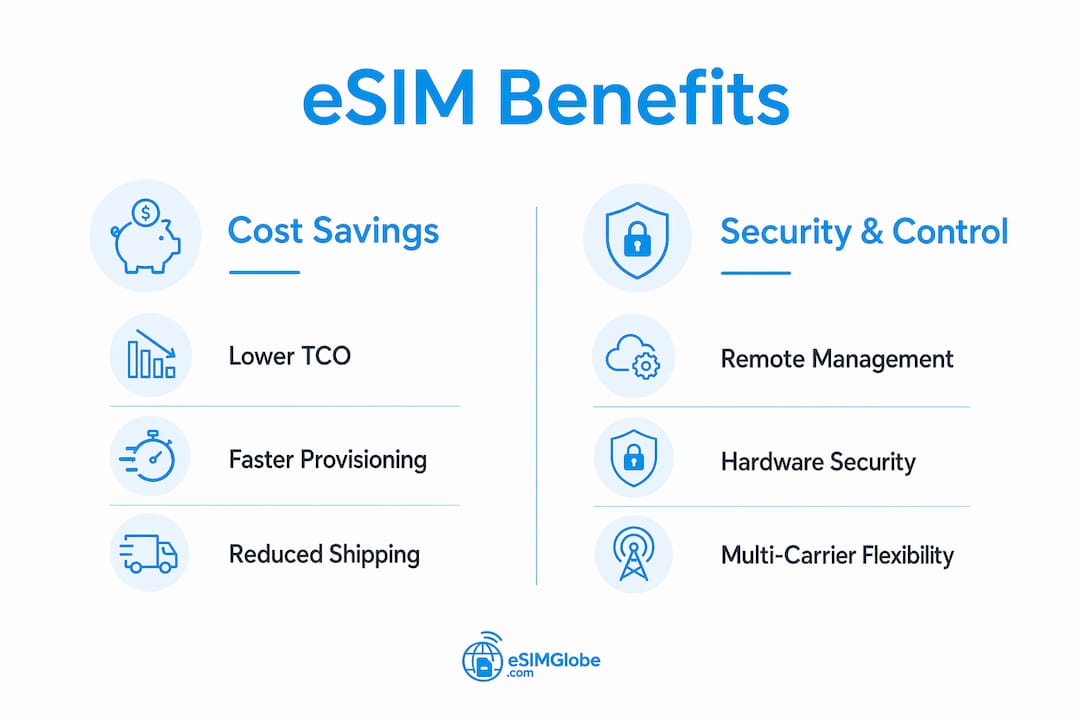
The total cost of ownership argument for eSIM is concrete and measurable. Savings come from three specific areas: lower SIM replacement costs, reduced field technician requirements, and faster provisioning cycles. Each one compounds over a multi-year device fleet.
Physical SIM handling costs more than most IT teams realize
Every physical SIM card requires procurement, shipping, physical insertion, and eventual replacement. For a fleet of 5,000 devices spread across multiple countries, that process involves logistics coordination, customs delays, and hands-on technician time. eSIM eliminates all of that. Carrier profiles load over the air, directly to the device’s embedded chip.
Bulk provisioning of 10,000 devices can be completed in days using eSIMs, compared to months with physical SIM cards. That speed difference is not a minor convenience. It directly affects time-to-market for IoT deployments and the speed at which a business can onboard new markets or remote locations.
Multi-carrier contracts and the vendor lock-in risk
eSIM plans give businesses the ability to switch carriers without touching hardware. That flexibility creates real negotiating power. When a company can move 2,000 devices to a different carrier in 48 hours, it does not accept unfavorable contract terms.
The risk, however, is locking into a single eSIM management platform before evaluating the market. Companies should contract with multi-source suppliers and require compliance with SGP.32 interoperability standards from the pilot stage. Changing vendors after full deployment involves costly recertification and firmware updates. The time to negotiate interoperability terms is before the first device ships.
Pro Tip: Require SGP.32 compliance in writing from every eSIM vendor before signing. This single clause protects your fleet from proprietary lock-in and preserves carrier flexibility for the life of the contract.
| Cost driver | eSIM impact |
|---|---|
| SIM replacement and shipping | Eliminated through over-the-air profile updates |
| Field technician deployment | Reduced by remote provisioning capabilities |
| Carrier contract flexibility | Increased through multi-profile switching |
| Time-to-market for new devices | Shortened from months to days at scale |
How does eSIM technology improve business security?
Security is where eSIM plans deliver advantages that most businesses underestimate. The physical design of the eUICC chip is the starting point. After that, software controls extend protection across the entire device fleet.
The hardware security layer
The eUICC chip is soldered directly onto the circuit board, making physical SIM theft impossible. A stolen device cannot have its SIM removed and inserted into another handset to access corporate data or impersonate the device on the network. That single design choice eliminates an entire category of attack that physical SIM cards leave open.
For IoT deployments, this matters even more. Sensors, meters, and field devices often sit in unsupervised locations. A soldered eUICC chip means the connectivity credential cannot be physically extracted, even if the device is taken.
Remote deactivation and MDM integration
Remote deactivation of eSIM profiles via mobile device management platforms gives IT security teams a kill switch for any compromised device. When a laptop or tablet is reported lost or stolen, the eSIM profile can be deactivated within minutes from a central dashboard. The device loses network access immediately, regardless of its physical location.
IT security departments identify remote SIM profile deactivation as a vital but under-utilized tool for protecting mobile fleets. Most enterprises that have MDM platforms already have the infrastructure to use this capability. The gap is awareness and policy, not technology.
The security advantages of eSIM for business include:
- Physical theft prevention. The soldered eUICC chip cannot be removed or swapped, blocking a common attack vector on physical SIM cards.
- SIM swapping protection. Unauthorized SIM swapping, a fraud technique used to hijack phone numbers, is structurally impossible with embedded hardware.
- Centralized policy enforcement. MDM platforms push security policies, carrier restrictions, and data limits across all devices from one interface.
- Remote auditing. IT teams can review connection logs, active profiles, and device status without physical access to any device.
- Instant kill-switch capability. A compromised device loses network access within minutes of a deactivation command, not days.
Pro Tip: Set up automated MDM alerts for devices that go offline unexpectedly. An eSIM-enabled device that stops reporting is a security signal, not just a connectivity issue. Catching it early limits exposure.
How do eSIM plans reduce global roaming costs?
Global roaming costs have historically been one of the most unpredictable line items in a corporate travel budget. eSIM plans change the structure of that problem entirely.
Single profile, multiple countries
eSIM plans enable multi-country mobile coverage under a single profile with predictable flat-rate costs. A traveling employee does not need to buy a local SIM in each country or rely on the home carrier’s roaming rates. The eSIM profile switches to a local or regional carrier automatically, at a pre-negotiated rate set by the business.
That predictability is the operational shift. Finance teams can budget mobile connectivity as a fixed cost rather than a variable one. IT teams stop fielding complaints about unexpected roaming charges after international trips.
“Corporate eSIM technology removes friction and complexity from global mobile connectivity, transforming it into an operational asset rather than a travel headache.” — Alertify, 2026
Centralized dashboards and pooled data
Businesses managing mobile devices via centralized dashboards gain pooled data usage, simplified carrier management, and remote provisioning from a single interface. Pooled data means that an employee who uses 200MB in Tokyo and another who uses 4GB in London draw from the same corporate data pool. No individual line goes over its limit while another sits unused.
The practical benefits for global teams break down into four clear use cases:
- Traveling sales teams. Employees moving between countries weekly connect to local carriers automatically, with no SIM purchases or manual configuration required.
- Remote field workers. Technicians in areas with poor primary carrier coverage switch to the strongest available network without IT intervention.
- IoT device fleets. Connected sensors and meters in multiple countries operate on a single management platform with unified billing.
- Short-term international projects. Teams deployed for weeks or months in a new market activate local data plans instantly, without waiting for physical SIM delivery.
For businesses with traveling employees, the cost reduction on roaming alone often justifies the switch to eSIM plans within the first year of deployment.
What is the best way to implement eSIM plans at scale?
Adopting eSIM plans across a large organization requires a structured approach. The technology works. The failure points are almost always in procurement, IT integration, and change management.
Choosing the right eSIM management platform
The platform choice determines how much operational control the business actually has. A platform that supports SGP.32 interoperability gives the IT team the ability to switch carriers, update profiles, and audit devices without vendor dependency. A proprietary platform that does not support open standards creates the same lock-in problem that eSIM was supposed to solve.
Evaluate platforms on three criteria: carrier network breadth, MDM integration depth, and dashboard reporting capability. A platform with 50 carrier partners but no MDM integration is a connectivity tool, not a management tool.
Pilot rollout and IT integration steps
- Start with a defined pilot group. Deploy eSIM plans to 50–100 devices across different use cases before committing to full rollout. Include traveling employees, office-based staff, and IoT devices if applicable.
- Integrate MDM from day one. Connecting the eSIM management platform to the existing MDM system during the pilot prevents costly retrofitting later.
- Establish bulk provisioning workflows. Work with the IT and finance teams to define how new devices get profiles assigned, how data limits are set, and how billing is allocated by department.
- Audit regularly. Set a monthly review of active profiles, data usage by device, and any deactivation events. Unused profiles cost money and represent a security gap.
- Document the carrier switching process. If a carrier underperforms in a specific region, the team needs a clear, tested procedure for switching profiles without disrupting active devices.
| Implementation stage | Key action |
|---|---|
| Vendor selection | Require SGP.32 compliance and multi-carrier support |
| Pilot deployment | Test across 50–100 devices with MDM integration active |
| Bulk provisioning | Define workflows for profile assignment and billing allocation |
| Ongoing management | Monthly audits of usage, profiles, and deactivation logs |
Best practices for global connectivity apply directly to enterprise deployments. The same principles that protect a business traveler’s data and budget apply at fleet scale, with the added layer of centralized IT control.
Pro Tip: Assign eSIM profile management to a named IT owner, not a shared inbox. Accountability for provisioning, auditing, and deactivation decisions reduces response time when a device is lost or a carrier issue emerges.
Key takeaways
Businesses that adopt eSIM plans gain measurable cost reductions, stronger device security, and full control over global mobile connectivity from a single management platform.
| Point | Details |
|---|---|
| TCO reduction is proven | Enterprises with 1,000+ devices report 25–40% lower total cost of ownership over five years. |
| Security goes beyond cost savings | Soldered eUICC chips and MDM-driven remote deactivation eliminate physical SIM theft and swapping risks. |
| Roaming costs become predictable | Flat-rate multi-country profiles replace unpredictable per-trip roaming charges. |
| Vendor lock-in is a real risk | Require SGP.32 interoperability compliance from every supplier before signing any contract. |
| Pilot before full deployment | Testing on 50–100 devices with MDM integrated from the start prevents costly retrofitting. |
The case for acting now, not next budget cycle
I have watched companies delay eSIM adoption for two or three budget cycles because the existing SIM infrastructure “still works.” That reasoning is accurate and expensive at the same time. Physical SIM management does work. It just costs more, moves slower, and leaves security gaps that are entirely avoidable.
The cost argument is the easiest to make to a CFO. A 25–40% reduction in total cost of ownership over five years on a fleet of 1,000+ devices is not a projection. It is a documented outcome from organizations that have already made the switch. The conversation should not be “should we do this?” It should be “what is our pilot timeline?”
The security argument is the one I find most underappreciated. Remote deactivation via MDM is not a feature that gets highlighted in vendor sales decks. It sits quietly in the platform until a device goes missing. When that happens, the difference between a 10-minute deactivation and a two-day process of contacting a carrier, verifying identity, and waiting for a physical SIM to be blocked is the difference between a contained incident and a data breach investigation.
My advice to IT and finance teams evaluating eSIM solutions: do not evaluate the technology in isolation. Evaluate the vendor ecosystem, the MDM integration depth, and the carrier network breadth together. A great eSIM chip on a platform with three carrier partners and no MDM integration is not an enterprise solution. It is a consumer product with a business price tag.
The businesses that move now build the operational muscle for what comes next. As IoT deployments grow and remote workforces expand, the companies with centralized, carrier-flexible eSIM management will adapt faster than those still coordinating physical SIM shipments across time zones.
— daniele
Esimglobe’s eSIM solutions for business teams
Esimglobe provides eSIM plans across multiple countries and regions, giving business teams a direct path to cost-controlled, carrier-flexible mobile connectivity. The platform supports travelers, distributed teams, and companies managing employees across international markets.
Whether your team travels frequently or your company manages devices across multiple countries, Esimglobe’s global eSIM coverage covers the regions where your business operates. Plans are available in USD, EUR, and GBP, with straightforward activation and no physical SIM required. Review the platform terms before your first deployment to understand plan structures, data policies, and cancellation conditions. Esimglobe is built for businesses that need connectivity to work the first time, in every market.
FAQ
What are the main business eSIM benefits?
Business eSIM benefits include lower total cost of ownership, faster device provisioning, remote security management, and predictable global roaming costs. Enterprises with large fleets report 25–40% TCO reductions over five years.
How does eSIM improve security for corporate devices?
The eUICC chip is soldered to the device board, preventing physical SIM theft. MDM platforms add remote deactivation, so IT teams can cut network access to a lost or stolen device within minutes.
Can eSIM plans replace traditional SIM cards for global teams?
eSIM plans fully replace physical SIM cards for global teams by delivering multi-country coverage under a single profile with flat-rate pricing. Employees connect to local carriers automatically without buying SIMs abroad.
What is SGP.32 and why does it matter for businesses?
SGP.32 is the GSMA’s interoperability standard for enterprise eSIM management. Requiring SGP.32 compliance from vendors prevents proprietary lock-in and preserves the ability to switch carriers without costly recertification.
How long does it take to provision eSIM plans across a large fleet?
Bulk provisioning of 10,000 devices takes days with eSIM, compared to months with physical SIM cards. That speed directly reduces deployment costs and time-to-market for IoT and mobile workforce projects.